Quick Answer
“That sucks” is an informal expression used to convey disappointment, frustration, or sympathy when something unfortunate occurs. While widely understood in casual settings, it can sound insensitive or unprofessional in formal contexts.The best alternatives include: “That’s unfortunate,” “I’m sorry to hear that,” “That’s disappointing,” “That’s tough,” and “That’s a shame.”
Looking for 50+ Other Ways to Say That Sucks? While it’s a common expression for showing sympathy or disappointment, it isn’t always the best fit for every situation. This guide shares 50+ alternatives to “That Sucks”, ranging from casual and humorous to polite and professional, so you can respond naturally in any conversation.
Why Do People Search For Other Ways to Say That Sucks
When people search for “other ways to say that sucks,” they typically need to express disappointment or sympathy but recognize that the phrase may be too casual for certain situations. Many users are looking to upgrade their vocabulary for professional environments, while others want to sound more empathetic or articulate in personal conversations.
The search intent generally falls into these categories:
Professional communication needs: Users often prepare for work emails, meetings, or client interactions where “that sucks” would be inappropriate. They need alternatives that maintain professionalism while still conveying genuine concern.
Social awareness: Many people recognize that casual expressions can sometimes sound dismissive or insensitive. They want to show more empathy and emotional intelligence in their responses.
Vocabulary expansion: English learners and native speakers alike seek to diversify their language and avoid repetitive phrases.
Tone matching: Users want to match their response to the gravity of a situation what works for a missed bus won’t work for a job loss.
The distinction between spoken and written usage matters significantly. In speech, listeners can interpret tone through voice and body language. In writing, words carry the full emotional weight, making careful phrasing more critical.
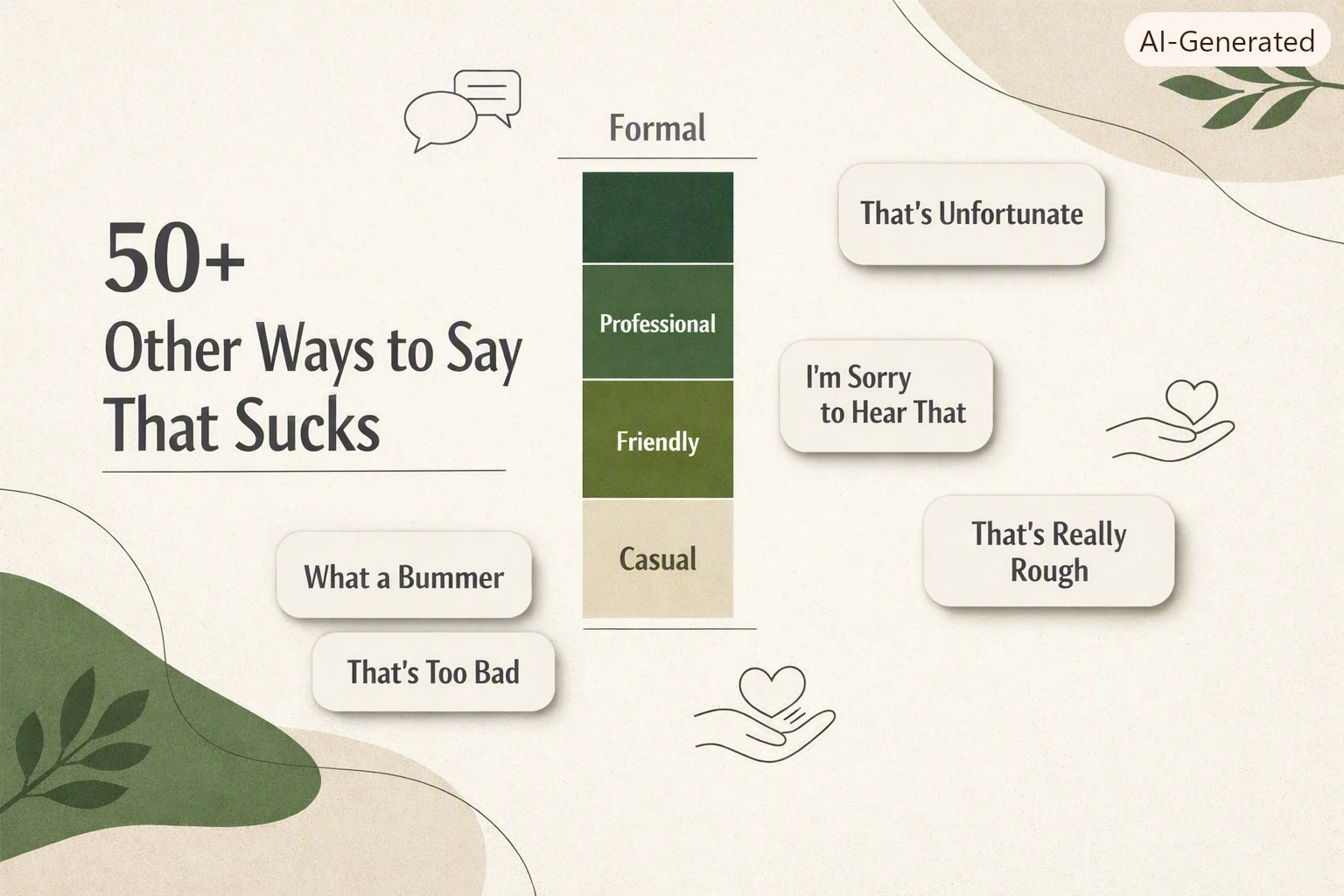
Tone Ladder System
Understanding the tonal spectrum helps you choose the right expression for any situation. Here’s how alternatives to “that sucks” rank across different formality levels:
Very Formal
These expressions are appropriate for official communications, formal letters, business proposals, and situations involving senior leadership or external stakeholders. They maintain distance while expressing appropriate concern.
Examples: “I regret to hear that,” “This is deeply concerning,” “Please accept my sympathies regarding this situation”
Formal
These work well in professional emails, workplace conversations with colleagues or managers, and client communications. They balance professionalism with genuine empathy.
Examples: “That’s unfortunate,” “I’m sorry to hear that,” “That’s disappointing,” “This is not ideal”
Neutral
These phrases fit both professional and personal contexts. They’re safe choices when you’re unsure about the appropriate tone.
Examples: “That’s tough,” “That’s a shame,” “That must be hard,” “I can see why that’s frustrating”
Casual
These are appropriate for conversations with friends, family, or close colleagues in informal settings. They acknowledge disappointment without excessive formality.
Examples: “That’s rough,” “What a bummer,” “That stinks,” “That’s a letdown”
Informal
These are best reserved for very close relationships and extremely casual contexts. They may use slang or more colorful language.
Examples: “That blows,” “That’s the worst,” “Ugh, that’s terrible,” “Man, that’s brutal”
Tone Classification Table
| Phrase | Tone Level | Formality | Best Situation |
|---|---|---|---|
| I regret to hear that | Very Formal | High | Official letters, formal complaints |
| Please accept my sympathies | Very Formal | High | Professional condolences |
| I’m sorry to hear that | Formal | High | Workplace emails, client calls |
| That’s unfortunate | Formal | High | Professional settings, bad news delivery |
| That’s disappointing | Formal | Medium-High | Performance reviews, feedback sessions |
| That’s a shame | Neutral | Medium | General conversations, mild disappointments |
| That must be hard | Neutral | Medium | Supporting someone through difficulty |
| That’s tough | Neutral | Medium | Acknowledging challenges |
| That’s rough | Casual | Medium-Low | Friends, casual workplace conversations |
| What a bummer | Casual | Low | Social situations, minor setbacks |
| That stinks | Casual | Low | Informal conversations with friends |
| That blows | Informal | Very Low | Close friends, extremely casual settings |
Quick Selection Guide
In a job interview: “That’s unfortunate” or “I’m sorry to hear that”
In an email to a client: “I’m sorry to hear that” or “That’s disappointing”
At a networking event: “That’s tough” or “That’s a shame”
In a casual conversation: “That’s rough,” “What a bummer,” or “That stinks”
Real-Life Conversation Transformations
Job Interview Scenario
Before (Too Informal):
Interviewer: “Unfortunately, we had to put the project on hold due to budget cuts.”
You: “That sucks.”
After (Professional and Empathetic):
Interviewer: “Unfortunately, we had to put the project on hold due to budget cuts.”
You: “That’s unfortunate to hear. I understand these decisions aren’t easy. Out of curiosity, is there a timeline for when the project might resume?”
Why it works: You acknowledge the difficulty without sounding dismissive, show understanding of business realities, and demonstrate forward-thinking by asking a constructive question.
Networking Event Scenario
Before (Too Casual):
Contact: “Our company just lost our biggest client.”
You: “That sucks, man.”
After (Professional but Warm):
Contact: “Our company just lost our biggest client.”
You: “I’m sorry to hear that. That must be incredibly challenging for the team right now. How are you all managing through it?”
Why it works: You express genuine sympathy, acknowledge the difficulty, and show interest in their experience without prying too deeply.
Email Scenario
Before (Inappropriate):
Subject: Response to news
Hi Sarah,
That sucks about the project delay. Let me know if you need anything.
Thanks,
John
After (Professional and Considerate):
Subject: Regarding project update
Dear Sarah,
I was disappointed to learn about the project delay. I understand these situations are challenging, and I appreciate your transparency in communicating this.
Please let me know if there’s anything I can do to support the team during this time.
Why it works: The tone is professional yet empathetic, shows understanding of the situation’s impact, and offers constructive support rather than just acknowledging the problem.
Casual Conversation Scenario
Before (Potentially Insensitive):
Friend: “I didn’t get the apartment I applied for.”
You: “That sucks.”
After (More Empathetic):
Friend: “I didn’t get the apartment I applied for.”
You: “Oh no, I’m really sorry to hear that. I know how much you were hoping for that place. That must be really disappointing.”
Why it works: You show specific understanding of their situation, acknowledge their investment in the outcome, and validate their emotions without being overly dramatic.
50+ Other Ways to Say That Sucks
1. That’s unfortunate
Meaning: A polite expression acknowledging that something negative has happened.
Explanation: This phrase maintains professionalism while expressing sympathy. It’s versatile enough for almost any disappointing situation and doesn’t assign blame.
Example: “Your application wasn’t selected this time? That’s unfortunate. I hope you’ll apply again in the future.”
Best use: Professional settings, email correspondence, conversations with acquaintances
Worst use: Very serious personal tragedies where stronger empathy is needed
Context variability: Works in most professional and neutral situations; can sound cold in deeply emotional contexts
2. I’m sorry to hear that
Meaning: A straightforward expression of empathy when someone shares bad news.
Explanation: This is one of the most universally appropriate responses to disappointment. It shows you care about the person’s experience without being overly dramatic.
Example: “I’m sorry to hear that your grandmother passed away. She was such a lovely person.”
Tone: Formal to casual (versatile)
Best use: Almost any situation where someone shares unfortunate news
Worst use: When you need to express your own disappointment (it’s more about empathy for others)
Context variability: One of the most versatile alternatives; works across all formality levels
3. That’s really tough
Meaning: Acknowledges that someone is facing a challenging situation.
Explanation: This phrase expresses understanding of difficulty without being overly emotional. It shows you recognize the weight of what they’re experiencing.
Example: “Your project got rejected after all that work? That’s really tough.”
Tone: Neutral to casual
Best use: Informal workplace conversations, supporting friends through challenges
Worst use: Very formal business communications
Context variability: Primarily spoken; can work in writing but feels more natural in conversation
4. That’s disappointing
Meaning: Directly expresses that an outcome was not satisfying.
Explanation: This straightforward phrase acknowledges disappointment without being dramatic. It’s clear and professional while still conveying genuine feeling.
Example: “The restaurant changed their menu and removed your favorite dish? That’s disappointing.”
Tone: Formal to neutral
Best use: Professional settings, expressing your own disappointment, feedback conversations
Worst use: When you need to show deeper sympathy for serious situations
Context variability: Works well in both speaking and writing; professional enough for emails
5. That’s a shame
Meaning: A mild way to express regret about an unfortunate situation.
Explanation: This polite expression shows sympathy without being overly dramatic. It’s a gentle way to acknowledge disappointment.
Example: “You missed the deadline by just an hour? That’s a shame.”
Tone: Neutral
Best use: General conversations, mild disappointments, polite acknowledgment
Worst use: Serious situations requiring stronger emotional expression
Context variability: Works in both speaking and writing; very British English friendly
6. That must be hard
Meaning: Acknowledges the difficulty of someone’s situation with empathy.
Explanation: This phrase validates the person’s experience without making assumptions about how they feel. It shows you recognize their struggle.
Example: “That must be hard for you, especially with everything else you’re dealing with.”
Tone: Formal to neutral
Best use: Supporting someone through ongoing difficulties, showing deep empathy
Worst use: Minor inconveniences (sounds exaggerated)
Context variability: Excellent for both speaking and writing; shows emotional intelligence
7. That’s rough
Meaning: A casual way to acknowledge a tough situation.
Explanation: This informal expression is widely used in everyday speech. It shows you understand the person is facing difficulty without being too serious.
Example: “You worked all weekend and still missed the deadline? That’s rough.”
Tone: Casual
Best use: Friendly conversations, supportive responses to friends and peers
Worst use: Professional settings or formal correspondence
Context variability: Primarily spoken; feels too casual for most writing
8. What a bummer
Meaning: A casual expression of disappointment or frustration.
Explanation: This lighthearted phrase acknowledges disappointment without being too serious. It’s friendly and approachable.
Example: “Your vacation got canceled due to the weather? What a bummer.”
Tone: Casual to informal
Best use: Social situations, conversations with friends, minor setbacks
Worst use: Professional contexts, serious situations
Context variability: Spoken language; rarely appropriate in formal writing
9. That stinks
Meaning: A casual way to acknowledge a bad situation.
Explanation: This informal expression keeps the conversation friendly without being overly dramatic. It’s a light way to show understanding.
Example: “You have to work on your birthday? That stinks.”
Tone: Casual to informal
Best use: Friendly conversations, mild frustrations
Worst use: Professional communications, serious situations
Context variability: Spoken primarily; can appear in casual texts but not formal writing
10. That’s not ideal
Meaning: A polite way to acknowledge that something is suboptimal.
Explanation: This understated expression is very professional. It acknowledges a problem without negative language or drama.
Example: “The software update caused system crashes? That’s not ideal.”
Tone: Formal to neutral
Best use: Professional settings, diplomatic communication, problem-solving conversations
Worst use: Personal situations where empathy is more appropriate than diplomacy
Context variability: Excellent for professional writing; can feel cold in personal contexts
11. I feel for you
Meaning: Direct and personal expression of sympathy.
Explanation: This phrase shows genuine care and understanding of someone’s difficulties. It reassures them that their struggles are recognized.
Example: “You’ve been through so much lately. I really feel for you.”
Tone: Warm, compassionate (neutral to casual)
Best use: Supporting someone through ongoing hardship, personal relationships
Worst use: Professional settings with people you don’t know well
Context variability: More natural in speaking; can feel intimate in writing
12. That’s a tough break
Meaning: Emphasizes that someone has experienced bad luck.
Explanation: This phrase highlights the element of misfortune in a situation. It’s sympathetic without being overly emotional.
Example: “Your car broke down right before your job interview? That’s a tough break.”
Tone: Casual
Best use: Conversations about unexpected setbacks, bad luck situations
Worst use: Formal settings, situations caused by someone’s own actions
Context variability: Primarily spoken; casual enough for friendly emails
13. That’s a real letdown
Meaning: Expresses deep disappointment about an event or outcome.
Explanation: This phrase conveys a sense of unmet expectations and sadness. It’s used when someone had high hopes that weren’t fulfilled.
Example: “You didn’t get the internship you were hoping for? That’s a real letdown.”
Tone: Neutral to casual
Best use: When discussing expectations that weren’t met, personal disappointments
Worst use: Very formal situations, minor inconveniences
Context variability: Natural in both speaking and writing
14. That’s heartbreaking
Meaning: Expresses deep sympathy for a serious or tragic event.
Explanation: This intense phrase is reserved for truly saddening situations. It conveys strong emotional empathy.
Example: “They had to cancel their wedding due to a family emergency. That’s heartbreaking.”
Tone: Emotional, compassionate (serious)
Best use: Situations involving loss, serious disappointment, deeply upsetting news
Worst use: Minor problems, everyday frustrations
Context variability: Usually spoken; can be used in writing for serious situations
15. That’s frustrating
Meaning: Acknowledges both disappointment and the irritation that comes with it.
Explanation: This phrase validates someone’s emotional response while keeping the response professional. It shows you understand they’re annoyed.
Example: “Your WiFi keeps cutting out during important meetings? That’s frustrating.”
Tone: Neutral to casual
Best use: Situations involving obstacles, technology problems, ongoing issues
Worst use: Major life disappointments or serious problems
Context variability: Works in both speaking and writing; appropriate for professional settings
16. That’s unfortunate timing
Meaning: Highlights that the timing of a bad situation made it worse.
Explanation: This specific phrase acknowledges both the event and the added challenge of bad timing.
Example: “Your car broke down right before your presentation? That’s really unfortunate timing.”
Tone: Formal to neutral
Best use: When timing plays a critical role in the disappointment
Worst use: Situations where timing isn’t a relevant factor
Context variability: Good for both speaking and professional writing
17. What a disappointment
Meaning: Expresses strong disappointment about unmet expectations.
Explanation: This phrase conveys a sense of letdown when an outcome wasn’t as hoped. It’s straightforward and clear.
Example: “The final episode of the show wasn’t what I expected. What a disappointment.”
Tone: Neutral
Best use: Discussing unmet expectations, personal or professional disappointments
Worst use: When you need to show empathy for someone else’s loss
Context variability: Works in both contexts; can be dramatic in casual conversation
18. I can’t believe that happened
Meaning: Expresses both disappointment and surprise.
Explanation: This phrase shows you’re not only disappointed but also shocked by what happened. It conveys stronger emotion.
Example: “Your flight was canceled last minute with no explanation? I can’t believe that happened.”
Tone: Neutral to casual
Best use: Unexpected or shocking disappointments
Worst use: Predictable outcomes, situations where surprise isn’t appropriate
Context variability: Natural in both speaking and writing
19. That’s a hard pill to swallow
Meaning: Acknowledges that a situation is difficult to accept.
Explanation: This metaphorical expression implies that accepting reality is challenging. It shows you understand the situation is genuinely difficult.
Example: “You didn’t get into the program you’ve been working toward for years? That’s a hard pill to swallow.”
Tone: Neutral
Best use: When someone is processing difficult news, situations requiring acceptance
Worst use: Minor inconveniences (sounds over-dramatic)
Context variability: Better in speaking; can work in writing with the right tone
20. Oh no, that’s awful
Meaning: Strong expression of distress or sympathy.
Explanation: This phrase conveys concern and sympathy, often used for unexpected bad news. It’s expressive and direct.
Example: “You lost your wallet while traveling abroad? Oh no, that’s awful!”
Tone: Casual to informal
Best use: Genuinely upsetting situations, surprising bad news
Worst use: Professional settings, mild disappointments
Context variability: Primarily spoken; feels too emotional for most writing
21. That’s painful
Meaning: Describes something particularly difficult or distressing.
Explanation: This phrase conveys emotional discomfort due to an unpleasant experience. It’s expressive but clear.
Example: “Your work got deleted right before the deadline after you spent all night on it? That’s painful.”
Tone: Casual
Best use: Major setbacks, experiences that cause genuine distress
Worst use: Minor frustrations, professional situations
Context variability: More natural in speaking than writing
22. What a blow
Meaning: Acknowledges a significant setback or disappointment.
Explanation: This phrase expresses that something is difficult to handle. It’s strong but not overly emotional.
Example: “You had been preparing for that promotion for months and didn’t get it? What a blow.”
Tone: Neutral to casual
Best use: Professional and personal disappointments, unexpected setbacks
Worst use: Minor inconveniences
Context variability: Works in both speaking and writing
23. That’s a setback
Meaning: Acknowledges that something has delayed or hindered progress.
Explanation: This professional phrase is useful for situations where someone faces a challenge to their goals. It’s objective and constructive.
Example: “The funding fell through for the project? That’s a setback, but let’s look at other options.”
Tone: Formal to neutral
Best use: Professional or goal-oriented discussions, problem-solving contexts
Worst use: Personal situations where emotional support is more appropriate
Context variability: Excellent for professional writing; can sound clinical in personal contexts
24. That’s unfortunate news
Meaning: Formal way to acknowledge bad news.
Explanation: This professional phrase sounds respectful and still conveys empathy. It’s appropriate for work settings.
Example: “The client decided to go in another direction after all our work? That’s unfortunate news.”
Tone: Formal
Best use: Professional environments, email correspondence
Worst use: Casual conversations, personal relationships
Context variability: Primarily written; can sound stiff in speech
25. That’s rough luck
Meaning: Emphasizes that someone has experienced misfortune.
Explanation: This slightly old-fashioned expression highlights the unfortunate nature of a situation without blaming anyone.
Example: “You were in the wrong place at the wrong time? That’s rough luck.”
Tone: Casual
Best use: Situations where bad luck is clearly the cause
Worst use: Situations where someone’s actions contributed to the outcome
Context variability: Natural in spoken English; less common in formal writing
26. What a drag
Meaning: Describes an annoying or inconvenient situation.
Explanation: This informal phrase shows shared frustration without being harsh. It makes the listener feel understood.
Example: “You have to work another weekend? What a drag.”
Tone: Informal
Best use: Annoying situations, inconveniences among friends
Worst use: Serious problems, professional contexts
Context variability: Primarily spoken; appropriate for casual texts
27. That’s not ideal
Meaning: Polite acknowledgment that something is suboptimal.
Explanation: This diplomatic phrase is very useful in professional settings. It avoids negative language while clearly communicating the problem.
Example: “The new system has significant bugs and the team is frustrated? That’s not ideal.”
Tone: Formal to neutral
Best use: Professional conversations, problem-solving, diplomatic communication
Worst use: Personal situations requiring emotional support
Context variability: Excellent for professional writing; can sound detached in personal contexts
28. That’s less than ideal
Meaning: Slightly more formal way to acknowledge a suboptimal situation.
Explanation: This understated expression maintains a professional tone while acknowledging problems. It’s very useful in business settings.
Example: “The quarterly results were significantly below projections? That’s less than ideal.”
Tone: Very formal
Best use: Professional settings, business communications
Worst use: Personal conversations, emotional situations
Context variability: Primarily used in professional writing and speech
29. That’s a challenging situation
Meaning: Recognizes difficulty while implying possibility for solutions.
Explanation: This problem-solving oriented phrase acknowledges difficulty but keeps the focus on finding solutions.
Example: “We’ve lost our key supplier and the project is stalled? That’s a challenging situation.”
Tone: Formal to neutral
Best use: Professional contexts requiring solutions, team discussions
Worst use: Situations where emotional support is the priority
Context variability: Natural in both speaking and writing; business-friendly
30. That’s not the best outcome
Meaning: Diplomatic way to express disappointment with results.
Explanation: This phrase allows for balanced perspective and opens discussion of alternatives. It’s constructive and professional.
Example: “The merger didn’t go through as expected? That’s not the best outcome, but we should review our next steps.”
Tone: Formal
Best use: Discussing results and consequences in professional settings
Worst use: Personal situations requiring empathy
Context variability: Professional writing and meetings
31. I’m disappointed to hear that
Meaning: Expresses personal disappointment about news received.
Explanation: This phrase focuses on your own emotional response while acknowledging the situation. It’s professional but genuine.
Example: “I’m disappointed to hear that the project has been cancelled. We were all very excited about it.”
Tone: Formal to neutral
Best use: Professional contexts, expressing personal disappointment
Worst use: When you need to focus on empathy for someone else
Context variability: Natural in both professional speaking and writing
32. That must be so annoying
Meaning: Acknowledges that someone is dealing with something irritating.
Explanation: This phrase validates frustration about minor but persistent problems. It’s casual and relatable.
Example: “Your email has been down all morning and you can’t reach IT? That must be so annoying.”
Tone: Casual
Best use: Minor frustrations, ongoing inconveniences
Worst use: Serious situations, professional contexts
Context variability: Primarily spoken; appropriate for friendly emails
33. That’s really disheartening
Meaning: Expresses that something is causing loss of hope or confidence.
Explanation: This slightly more formal or emotional word is used when someone feels discouraged after trying hard.
Example: “After all that training, you didn’t qualify? That’s really disheartening.”
Tone: Formal to neutral
Best use: Situations involving effort and disappointment
Worst use: Minor frustrations
Context variability: Works in both speaking and writing; shows emotional intelligence
34. What a letdown
Meaning: Expresses that something didn’t meet expectations.
Explanation: This phrase conveys disappointment when something anticipated turns out poorly.
Example: “The movie had such good reviews but was terrible? What a letdown.”
Tone: Casual to neutral
Best use: Discussing disappointments in entertainment, events, or experiences
Worst use: Serious situations, professional contexts
Context variability: Natural in conversation and casual writing
35. That’s a pity
Meaning: Expression of regret about a situation.
Explanation: This polite phrase shows sympathy without being overly dramatic. It’s particularly common in British English.
Example: “You can’t make it to the conference this year? That’s a pity.”
Tone: Neutral (slightly more formal in American English)
Best use: General disappointments, polite acknowledgment
Worst use: Serious situations requiring stronger language
Context variability: Common in British English; more formal in American English
36. That’s not good news
Meaning: Direct but polite way to acknowledge bad information.
Explanation: This straightforward phrase acknowledges negative information without strong emotional language.
Example: “The board rejected our proposal? That’s not good news.”
Tone: Neutral
Best use: Professional and personal situations, acknowledging bad information
Worst use: When someone needs emotional support
Context variability: Works in both speaking and writing; somewhat detached
37. I sympathize with you
Meaning: Formal expression of understanding and compassion.
Explanation: This direct phrase shows you understand someone’s feelings. It’s appropriate for serious professional situations.
Example: “I sympathize with you regarding this difficult decision. It’s never easy.”
Tone: Very formal
Best use: Serious professional situations, formal correspondence
Worst use: Casual conversations, minor disappointments
Context variability: Primarily written; can feel stiff in casual conversation
38. That’s a real shame
Meaning: Slightly stronger version of “that’s a shame.”
Explanation: This phrase expresses more emotion than the standard version while remaining polite and appropriate.
Example: “You were so looking forward to that holiday and had to cancel? That’s a real shame.”
Tone: Neutral to casual
Best use: Situations where mild regret isn’t enough
Worst use: Very formal contexts
Context variability: Natural in both speaking and writing
39. Well, that’s not exactly winning
Meaning: Playful way to acknowledge a less-than-ideal situation.
Explanation: This humorous phrase borrows from pop culture to describe setbacks lightly. It’s playful without being dismissive.
Tone: Informal
Best use: Lighthearted conversations, minor disappointments among friends
Worst use: Serious situations, professional contexts
Context variability: Primarily spoken; informal writing
40. That’s rubbish
Meaning: British informal expression for something terrible or nonsensical.
Explanation: This colorful expression is common in British English. It conveys strong disapproval in a casual way.
Tone: Informal
Best use: British conversations, very casual settings
Worst use: Professional situations, American audiences
Context variability: Regional; common in British English, less common elsewhere
41. What a disaster
Meaning: Strong expression for a complete failure or very bad situation.
Explanation: This dramatic phrase is used when something goes completely wrong. It’s expressive and immediate.
Example: “Everything that could go wrong did go wrong today. What a disaster.”
Tone: Casual to informal
Best use: Situations where many things have gone wrong
Worst use: Professional contexts, minor problems
Context variability: Spoken primarily; can appear in informal writing
42. I’m gutted
Meaning: British informal expression for feeling very disappointed or upset.
Explanation: This is one of the most common British ways to express strong disappointment. It’s emotional and natural in everyday conversation.
Tone: Informal (UK-specific)
Best use: Strong disappointment among friends or in casual settings
Worst use: Professional settings, American audiences
Context variability: Regional; very common in UK, less common elsewhere
43. That’s not what I hoped to hear
Meaning: Polite way to express that the news is disappointing.
Explanation: This phrase focuses on your expectations rather than the situation itself. It’s diplomatic and professional.
Example: “I was hoping for a different outcome. That’s not what I wanted to hear.”
Tone: Formal to neutral
Best use: Professional conversations, responding to disappointing news
Worst use: Personal situations requiring empathy
Context variability: Natural in both speaking and writing
44. That’s a bit much to handle
Meaning: Acknowledges that a situation is overwhelming or difficult.
Explanation: This phrase shows understanding of someone’s burden without being overly emotional. It’s supportive and practical.
Example: “With all these deadlines and the team being short-staffed? That’s a bit much to handle.”
Tone: Neutral to casual
Best use: Stressful situations, overwhelming workloads
Worst use: Minor inconveniences
Context variability: Natural in both speaking and writing
45. That must be really frustrating
Meaning: Validates someone’s frustration while keeping the response professional.
Explanation: This phrase shows you understand their irritation and empathize with their situation.
Example: “The system keeps crashing when you’re in the middle of important work? That must be really frustrating.”
Tone: Neutral
Best use: Professional and casual situations involving frustration
Worst use: When you need to express your own disappointment
Context variability: Excellent for both speaking and writing
46. That’s a tough one
Meaning: Casual acknowledgment that something is difficult to deal with.
Explanation: This friendly phrase recognizes difficulty without being too serious. It’s supportive but not heavy.
Example: “You have to decide between two great opportunities? That’s a tough one.”
Tone: Casual
Best use: Friendly conversations, difficult decisions
Worst use: Professional settings, serious situations
Context variability: Primarily spoken; appropriate for casual texts
47. That sounds terrible
Meaning: Expresses that what someone described is very bad.
Explanation: This direct phrase shows you recognize the severity of a situation. It’s clear and sympathetic.
Example: “Your car got stolen and they broke into your house too? That sounds terrible.”
Tone: Casual to neutral
Best use: Genuinely bad situations, expressing sympathy
Worst use: Minor problems, professional contexts
Context variability: Natural in speaking and some informal writing
48. That’s a real pickle
Meaning: Playful understatement for a complicated or difficult situation.
Explanation: This quaint expression downplays the severity of a situation, potentially making it feel more manageable. It’s whimsical and light.
Tone: Informal
Best use: Complicated situations among friends, adding humor to difficulty
Worst use: Serious situations, professional contexts
Context variability: Primarily spoken; very informal
49. That’s no good
Meaning: Simple, direct acknowledgment that something is bad.
Explanation: This straightforward phrase is clear and to the point. It’s universally understood and appropriate for casual settings.
Example: “The repair is going to cost more than the car is worth? That’s no good.”
Tone: Casual
Best use: Everyday disappointments, simple acknowledgment
Worst use: Professional settings, requiring more sophisticated language
Context variability: Primarily spoken; common in casual conversation
50. That’s not acceptable
Meaning: Strong expression that something falls below standards.
Explanation: This phrase is more critical than empathetic. It’s used when something should have met expectations.
Example: “They delivered the wrong order and were rude about it? That’s not acceptable.”
Tone: Formal to neutral
Best use: Situations requiring accountability, when standards haven’t been met
Worst use: Supporting someone through personal difficulties
Context variability: Professional contexts; can sound harsh in personal situations
51. I regret that this happened
Meaning: Formal expression of regret about a situation.
Explanation: This phrase takes responsibility or shares regret without emotional drama. It’s appropriate for professional contexts.
Example: “I regret that this happened to your team. Please know we’re taking it seriously.”
Tone: Very formal
Best use: Professional communications, formal apologies
Worst use: Casual conversations
Context variability: Primarily written; professional contexts
Usage Comparison Table
| Phrase | Spoken Use | Written Use | Context |
|---|---|---|---|
| That’s unfortunate | Yes | Yes | Professional, formal |
| I’m sorry to hear that | Yes | Yes | All contexts |
| That’s really tough | Yes | Sometimes | Informal support |
| That’s disappointing | Yes | Yes | Professional and personal |
| That’s a shame | Yes | Yes | Neutral, polite |
| That must be hard | Yes | Sometimes | Emotional support |
| That’s rough | Yes | Rarely | Casual conversation |
| What a bummer | Yes | Rarely | Very casual, social |
| That stinks | Yes | Sometimes | Casual, friendly |
| That’s not ideal | Sometimes | Yes | Professional |
| I feel for you | Yes | Sometimes | Personal support |
| That’s a tough break | Yes | Rarely | Casual, bad luck |
| That’s a real letdown | Yes | Yes | Disappointment |
| That’s heartbreaking | Yes | Sometimes | Serious, emotional |
| That’s frustrating | Yes | Yes | Frustration situations |
| That’s unfortunate timing | Yes | Sometimes | Timing-related |
| What a disappointment | Yes | Yes | Unmet expectations |
| I can’t believe that happened | Yes | Rarely | Surprising news |
| That’s a hard pill to swallow | Yes | Sometimes | Difficult acceptance |
| Oh no, that’s awful | Yes | Rarely | Upsetting news |
| That’s painful | Yes | Rarely | Distressing situations |
| What a blow | Yes | Sometimes | Significant setbacks |
| That’s a setback | Yes | Yes | Professional contexts |
| That’s unfortunate news | Yes | Yes | Formal, professional |
| That’s rough luck | Yes | Rarely | Casual, bad luck |
| What a drag | Yes | Rarely | Very casual |
| That’s less than ideal | Sometimes | Yes | Business contexts |
Email and LinkedIn Ready Expressions
Professional Email Greetings
Formal openings:
- “I was disappointed to learn that…”
- “It is with regret that I acknowledge…”
- “I was sorry to hear about…”
Neutral openings:
- “I wanted to express my concern regarding…”
- “I’m writing to acknowledge the challenges with…”
- “Thank you for sharing the update. I understand this is disappointing.”
Professional Introductions
When introducing bad news in emails:
- “I regret to inform you that…”
- “It appears that we’ve encountered an issue with…”
- “Following a careful review, we have determined that…”
LinkedIn Connection Messages
First contact:
- “I noticed your experience at [Company] and was impressed by your work. I understand the recent changes there must have been challenging.”
- “Your post about [topic] really resonated with me. I can imagine how frustrating that situation must have been.”
Following up:
- “Following up on our previous conversation about [topic], I understand there have been some setbacks. I’m sorry to hear that and hope things improve.”
Follow-up Lines
After a disappointing outcome:
- “While this outcome is disappointing, I’m confident we can find alternatives.”
- “I appreciate your transparency in sharing this news, even though it’s unfortunate.”
- “Given these circumstances, let’s focus on what we can control going forward.”
Native Speaker Insight
Natural Native Usage Patterns
Native English speakers often choose alternatives based on the relationship and situation. In professional contexts, you’ll hear “I’m sorry to hear that” more than any other alternative. It’s safe, professional, and shows empathy without overstepping.
Shortened Spoken Versions
In casual conversation, native speakers often shorten phrases:
- “Sorry to hear that” instead of “I’m sorry to hear that”
- “That’s too bad” becomes “That’s too bad, man”
- “Bummer” alone often replaces “What a bummer”
What Sounds Unnatural
Non-native speakers sometimes use overly formal language in casual situations:
- “I am experiencing disappointment regarding this situation” sounds forced
- Using “That’s unfortunate” for very minor problems sounds overly serious
- Saying “I sympathize with your predicament” in casual conversation sounds stiff
Preferred Professional Alternatives
In most professional settings, native English speakers prefer:
- “I’m sorry to hear that” (most versatile)
- “That’s unfortunate” (for more serious situations)
- “That’s disappointing” (for work-related disappointments)
- “That’s not ideal” (for problems that need solving)
According to workplace communication experts, “I’m sorry to hear that” works in virtually every professional situation, making it the safest choice when you’re unsure . It shows genuine empathy without being too casual or too formal.
Common Mistakes and What Not to Say
Unnatural Phrases
Mistake: Using overly complex language to sound more professional.
❌ “I find this situation to be extremely disheartening and regretful.”
✅ “I’m sorry to hear that. That must be disappointing.”
Mistake: Trying to sound formal by adding unnecessary words.
❌ “I am writing to express my profound disappointment regarding this news.”
✅ “I was disappointed to hear about this.”
Tone Mismatch
Mistake: Using casual language in serious situations.
❌ Friend: “My mother passed away.” Response: “That sucks.”
✅ Friend: “My mother passed away.” Response: “I’m so sorry. That’s heartbreaking.”
Mistake: Being too formal with close friends.
❌ Friend: “I lost my job.” Response: “I regret to hear that unfortunate news.”
✅ Friend: “I lost my job.” Response: “I’m really sorry. That’s tough.”
Grammar Mistakes
Mistake: Using “I’m sorry to hear that” for situations you caused.
❌ “I’m sorry to hear your project is delayed” (when you caused the delay)
✅ “I apologize for the delay to your project”
Mistake: Mixing formality levels awkwardly.
❌ “That’s not ideal, my dude”
✅ “That’s not ideal” (professional) OR “That’s rough, man” (casual)
Over-formal or Awkward Usage
Mistake: Using very formal phrases in casual contexts.
❌ “I sympathize with your disappointment regarding your lost sandwich.”
✅ “That’s too bad about your sandwich.”
Mistake: Showing no emotion when emotion is expected.
❌ “That is an unfortunate development.” (for a friend’s serious illness)
✅ “I’m so sorry to hear that. How are you doing?”
Expansion Phrases
Greeting Variations
- “I was sorry to learn that…” (professional)
- “It’s disappointing to see that…” (neutral)
- “Oh no, that’s terrible!” (casual)
Introduction Phrases
- “When I heard about your situation, I felt…” (empathetic)
- “In light of what’s happened, I want you to know…” (supportive)
- “I understand this is difficult because…” (validating)
Polite Communication Alternatives
- “I recognize this must be challenging for you.”
- “I can only imagine how frustrating this is.”
- “This situation seems to present some difficulties.”
Conversational English Upgrades
- Instead of “That sucks” → “That’s rough” or “That’s a bummer”
- Instead of “That’s bad” → “That’s unfortunate” or “That’s not ideal”
- Instead of “That’s terrible” → “That’s heartbreaking” or “That’s awful” (for serious situations)
Decision-Making Table
Quick Fast List
Here are the top 10 best alternatives to “that sucks” for quick reference:
- I’m sorry to hear that – Most versatile, works everywhere
- That’s unfortunate – Best for professional settings
- That’s disappointing – Clear and professional
- That’s tough – Good for supporting someone
- That’s a shame – Polite and neutral
- That’s rough – Casual but caring
- What a bummer – Light and friendly
- That stinks – Casual and relatable
- That’s not ideal – Professional and diplomatic
- That must be hard – Shows deep empathy
Mini Quiz
Test your understanding with these scenario-based questions:
Question 1: You’re in a job interview, and the interviewer tells you the position has been put on hold. Which response is the most appropriate?
A. “That sucks.”
B. “That’s unfortunate. I understand these decisions aren’t easy.”
C. “What a bummer!”
D. “That’s rough, man.”
Correct Answer: B. “That’s unfortunate. I understand these decisions aren’t easy.” is professional, empathetic, and respectful making it the best choice in a formal interview setting.
Question 2: Your close friend tells you they didn’t get the apartment they wanted. Which response shows the most empathy?
A. “That sucks.”
B. “That’s not ideal.”
C. “Oh no, I’m really sorry. I know how much you wanted that place.”
D. “That’s unfortunate.”
Correct Answer: C. “Oh no, I’m really sorry. I know how much you wanted that place.” acknowledges your friend’s disappointment and expresses genuine emotional support.
Question 3: You’re writing a professional email to a client about a project setback. Which phrase is most appropriate?
A. “That sucks about the project.”
B. “I’m sorry to hear this isn’t working out as planned.”
C. “What a bummer about the project.”
D. “That’s rough luck.”
Correct Answer: B. “I’m sorry to hear this isn’t working out as planned.” maintains a professional tone while expressing empathy in a business setting.
Question 4: A colleague tells you that a team member is leaving unexpectedly. Which response is the most appropriate?
A. “That’s not ideal, but okay.”
B. “I’m sorry to hear that. That’s tough for the team.”
C. “What a disaster!”
D. “That stinks.”
Correct Answer: B. “I’m sorry to hear that. That’s tough for the team.” is thoughtful, supportive, and appropriate for a professional workplace conversation.
Question 5: Your friend is frustrated by a minor inconvenience. Which response is the most natural?
A. “That’s heartbreaking.”
B. “What a tragedy.”
C. “That’s annoying. I hate when that happens.”
D. “I’m deeply sorry to hear this unfortunate news.”
Correct Answer: C. “That’s annoying. I hate when that happens.” matches the situation without sounding overly dramatic or excessively formal.
FAQs
Is it polite to say “that sucks”?
No, “that sucks” is not considered polite in most professional or formal situations. While it’s common in casual conversation with friends, the phrase is informal and can sound dismissive or insensitive in workplace settings. For professional contexts, alternatives like “That’s unfortunate” or “I’m sorry to hear that” are much better choices .
What is more professional than “that sucks”?
More professional alternatives include: “That’s unfortunate,” “I’m sorry to hear that,” “That’s disappointing,” “That’s not ideal,” and “That’s a shame.” These phrases express sympathy and acknowledge disappointment while maintaining a professional tone appropriate for workplace and formal settings .
Can I use “I’m sorry to hear that” in a professional email?
Yes, “I’m sorry to hear that” is widely accepted in professional emails. It’s a versatile, polite expression that shows empathy without being too casual. It works well in response to bad news, project setbacks, or personal situations shared in a professional context .
What do native speakers say instead of “that sucks”?
Native English speakers use a variety of alternatives depending on the context.
- In professional settings, they say “I’m sorry to hear that” or “That’s unfortunate.”
- In casual conversations, they might say “That’s rough,” “What a bummer,” “That stinks,” or “That’s a shame.”
- In very informal settings with close friends, they might use “That blows” or “That’s the worst.” The key is matching the phrase to the situation and relationship .
What is the best alternative to “that sucks” for a formal situation?
The best alternative depends on the exact situation, but “I’m sorry to hear that” is the most versatile choice for formal settings. “That’s unfortunate” is also excellent for professional contexts, especially when you need to sound more formal but still empathetic. “That’s disappointing” works well when you’re addressing unmet expectations in a workplace context .
Conclusion
Expanding your vocabulary beyond “that sucks” isn’t just about sounding more professional; it’s about communicating with greater precision and empathy. The phrase “that sucks” has its place in casual conversation, but in professional settings and emotionally charged situations, the right words can make all the difference. They show you care about the other person’s experience and understand the gravity of their situation.
By mastering the tone ladder and choosing the appropriate expression for each context, you’ll become a more effective communicator. Practice using these alternatives in different situations, and pay attention to how others respond. You’ll likely find that people appreciate hearing thoughtful, appropriate responses that match the situation whether that’s a formal business email, a supportive conversation with a friend, or a networking event where you want to make a positive impression.