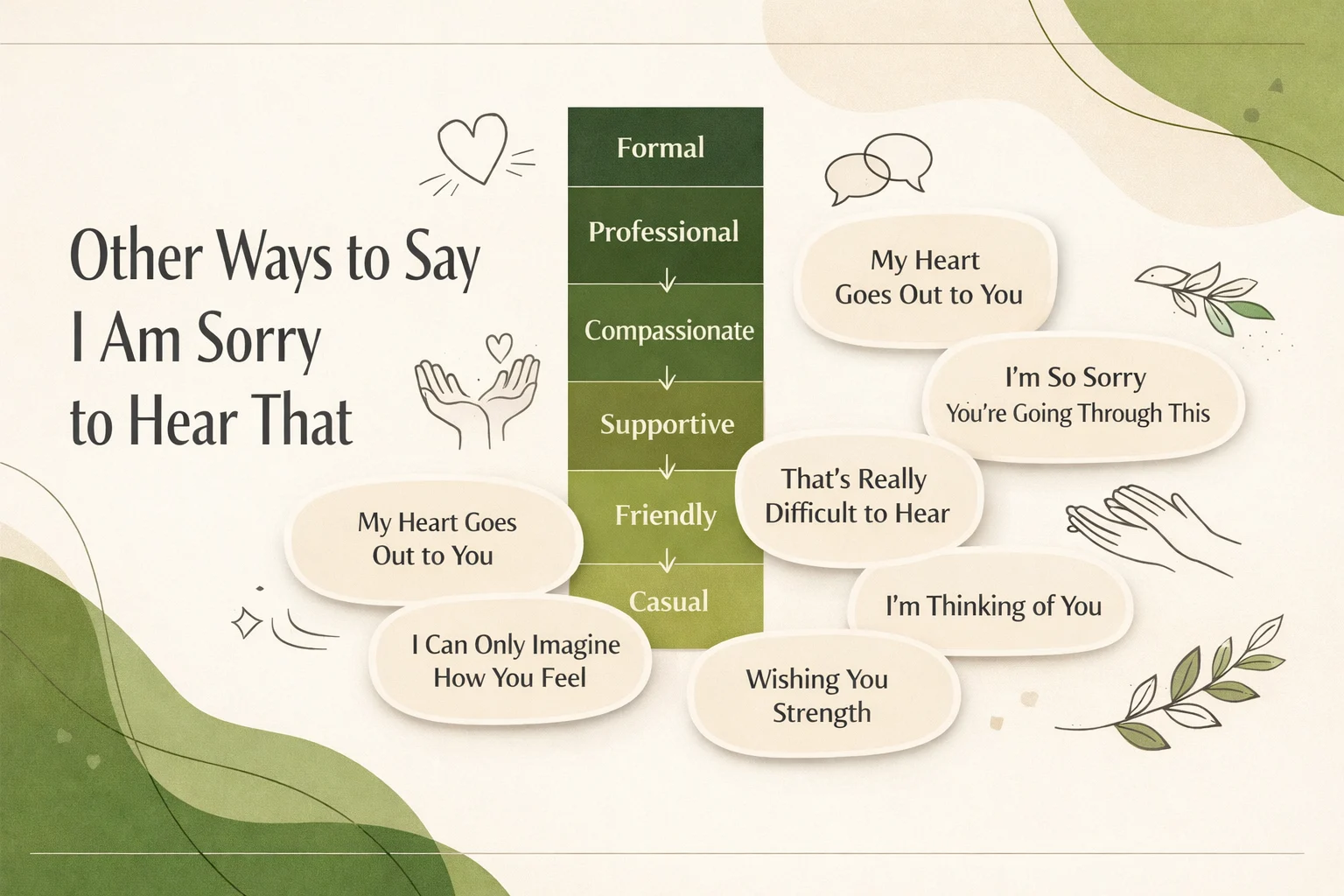
Quick Answer
“I am sorry to hear that” is an expression of sympathy used to acknowledge someone’s bad news, hardship, or unfortunate situation. It conveys empathy and care without implying personal fault or apology. The phrase signals that you recognize the person’s difficulty and feel compassion for what they are experiencing .5 best alternatives:
That must be really difficult for you, I can only imagine how hard that must be, My heart goes out to you, I truly sympathize with your situation, I’m here if you need someone to talk to .
Expressing sympathy and showing genuine care when someone shares bad news is a critical communication skill, yet many people find themselves reaching for the same default phrase over and over again. The words you choose in these moments can strengthen relationships, build trust, and provide real comfort or they can feel hollow and impersonal. Other ways to say I am sorry to hear that exist in abundance, but knowing which alternative fits your specific situation requires understanding tone, context, and relationship dynamics. This comprehensive guide delivers over forty alternatives to I am sorry to hear that, organized by formality, situation, and emotional weight, so you can respond with authenticity every time .
Why Do People Search For Other Ways to Say I Am Sorry to Hear That
Understanding why people search for alternatives to I am sorry to hear that reveals deeper communication needs. Users typically seek this information for several key reasons:
- Professional communication needs: Workplace emails, client correspondence, and professional networking situations demand more polished phrasing .
- Relationship-building: People want to sound more genuine and less formulaic when comforting friends, family, or colleagues.
- Cultural and generational adaptation: Younger generations and different cultural contexts may perceive certain phrases differently.
- Emotional authenticity: Users recognize that “sorry to hear that” can sound robotic or dismissive and want language that conveys deeper care.
Spoken versus written usage patterns differ significantly: In spoken conversations, shorter, more direct phrases work well, often accompanied by tone of voice and body language that convey sincerity. Written communication especially emails, LinkedIn messages, and condolence notes requires more careful phrasing because the reader cannot hear your tone. The phrase other ways to say I am sorry to hear that also reflects awareness that formal writing needs elevated language .
Professional English phrases dominate in workplace contexts, while informal expressions in English serve personal relationships better. The choice between formal and informal communication intent shapes every alternative selection .
Tone Ladder System
Very Formal
Phrases in this category suit condolence letters, formal business correspondence, and communications with senior executives or clients. These expressions convey respect, gravity, and professionalism while maintaining emotional distance appropriate for formal settings.
Formal
These alternatives work in professional emails, workplace conversations, and situations where you need to show empathy without crossing into overly personal territory. They maintain professionalism while acknowledging emotional content.
Neutral
Neutral phrases serve well in semi-professional contexts, interactions with acquaintances, and situations where the relationship hasn’t yet established deeper personal bonds. They balance warmth with appropriateness.
Casual
These expressions fit comfortable workplace relationships, friendly interactions, and social situations where some informality is expected. They sound natural and unforced.
Informal
Use these only with close friends, family members, and intimate relationships. They can sound inappropriate or dismissive in professional contexts.
Professional vs. Casual Preferences
| Preference | Best Tone | Examples |
|---|---|---|
| Professional | Formal or Neutral | I truly empathize with your situation, That must be really challenging |
| Spoken English | Casual or Informal | That’s rough, I’m here for you |
| Written English | Formal or Neutral | Please accept my condolences, I’m keeping you in my thoughts |
Table: Tone Classification
| Phrase | Tone Level | Formality | Best Situation |
|---|---|---|---|
| I offer my sincerest condolences | Very Formal | High | Death, serious loss, formal correspondence |
| I am deeply saddened to hear that | Very Formal | High | Professional condolences, formal sympathy |
| Please accept my heartfelt condolences | Very Formal | High | Condolence letters, formal emails |
| I truly empathize with your situation | Formal | Medium-High | Workplace challenges, professional support |
| That must be really difficult for you | Formal | Medium | Colleague struggles, professional setbacks |
| I can only imagine how hard that must be | Formal | Medium | Serious personal news in professional settings |
| I understand how upsetting that must feel | Formal | Medium | Disappointments, workplace frustrations |
| I’m keeping you in my thoughts | Neutral | Medium | Written support, acquaintance relationships |
| That sounds really tough | Neutral | Medium | Everyday difficulties, semi-professional contexts |
| That must feel overwhelming | Neutral | Medium | Stress, burnout, multiple challenges |
| I’m here for you | Casual | Low-Medium | Close colleagues, friendship support |
| I feel for you | Casual | Low-Medium | Informal empathy, personal connections |
| That really sucks | Informal | Low | Close friends only, very casual settings |
| I’m so sorry you’re dealing with this | Casual | Low-Medium | Personal conversations, supportive contexts |
Quick Selection Guide
Interview Situation
Best phrase: “I understand this must be hard” or “That’s really unfortunate”
Why: Maintains professionalism while showing appropriate empathy without sounding overly familiar .
Professional Email
Best phrase: “I truly empathize with your situation” or “That must be really challenging”
Why: Formal enough for written business communication, demonstrates emotional intelligence .
Networking Event
Best phrase: “That sounds really tough” or “I can imagine how difficult that must be”
Why: Balances professional networking etiquette with genuine human connection .
Casual Conversation
Best phrase: “I’m here for you” or “That’s rough”
Why: Direct, authentic, and matches the informal tone of personal relationships .
Real-Life Conversation Transformations
Job Interview Scenario
Before (Unnatural):
Interviewer: “I was let go from my previous position during company restructuring.”
Candidate: “I am sorry to hear that.” (This sounds robotic and fails to build connection.)
After (Natural English):
Interviewer: “I was let go from my previous position during company restructuring.”
Candidate: “That must have been really challenging to navigate. It sounds like you handled a difficult transition.” (This shows empathy while demonstrating professionalism) .
Networking Event Scenario
Before (Awkward):
Contact: “My startup didn’t survive the economic downturn.”
Professional: “I’m sorry to hear that.” (This ends the conversation rather than building connection.)
After (Improved):
Contact: “My startup didn’t survive the economic downturn.”
Professional: “That sounds really tough. What are you working on now?” (This acknowledges difficulty while continuing the conversation) .
Email Scenario
Before (Generic):
“Dear Mr. Thompson, I am sorry to hear that you are leaving the company. Best regards, [Name]”
After (Professional):
“Dear Mr. Thompson, I was deeply saddened to learn of your departure. Your contributions to our team have been invaluable, and I truly understand this must be a difficult transition. Please know you have my support during this time of change.”
Casual Conversation Scenario
Before (Cold):
Friend: “I failed my driving test again.”
Response: “I’m sorry to hear that.”
After (Supportive):
Friend: “I failed my driving test again.”
Response: “That really sucks I’m so sorry you’re dealing with this. I’m here for you when you’re ready to try again.”
40+ Other Ways to Say I Am Sorry to Hear That
1. That must be really difficult for you
Meaning: Acknowledges the person’s hardship by focusing on their experience rather than the event .
Explanation: This phrase shows you recognize their struggle and care about their emotional experience. It avoids judgment while offering validation.
Example: “That must be really difficult for you to manage with your current workload.”
Tone: Empathetic, supportive
Best Use: Colleagues, acquaintances, professional settings
Worst Use: Informal conversations with close friends
Context Variability: Works in both written and spoken contexts, but feels more natural in spoken conversations where your tone can convey sincerity.
2. I can only imagine how hard that must be
Meaning: Expresses humility by acknowledging you cannot fully understand their experience while still offering empathy .
Explanation: This phrase demonstrates emotional intelligence by recognizing the uniqueness of their situation. It avoids false claims of complete understanding.
Example: “I can only imagine how hard that must be for you and your family right now.”
Tone: Gentle, respectful, humble
Best Use: Serious situations, grief, major life challenges
Worst Use: Minor disappointments or everyday frustrations
Context Variability: Excellent for written sympathy notes; works well in serious conversations.
3. My heart goes out to you
Meaning: A deeply empathetic expression conveying emotional solidarity .
Explanation: This phrase communicates that you share their emotional pain, making it suitable for profound sadness or grief.
Example: “My heart goes out to you during this incredibly difficult time.”
Tone: Warm, heartfelt, compassionate
Best Use: Grief, loss, serious illness
Worst Use: Professional settings with acquaintances
Context Variability: Best in personal, emotional situations; can feel too intimate in formal business contexts.
4. I truly empathize with your situation
Meaning: Expresses genuine understanding and shared feeling about their circumstances .
Explanation: A formal way to show you connect with their experience while maintaining professional boundaries.
Example: “I truly empathize with your situation and hope you find resolution soon.”
Tone: Professional, sincere, respectful
Best Use: Workplace challenges, professional correspondence
Worst Use: Close personal relationships where warmth is expected
Context Variability: Excellent for emails; natural in formal spoken conversations.
5. That sounds really tough
Meaning: Acknowledges difficulty in a conversational and relatable way .
Explanation: This simple phrase validates their struggle without being overly dramatic or formal.
Example: “That sounds really tough how are you holding up?”
Tone: Supportive, conversational
Best Use: Friendly conversations, casual workplace discussions
Worst Use: Death or serious tragedy
Context Variability: Natural in spoken English; casual enough for informal writing.
6. I understand how upsetting that must feel
Meaning: Validates their emotional response and shows you recognize their distress .
Explanation: This phrase acknowledges that their feelings are reasonable and understandable.
Example: “I understand how upsetting that must feel after all your preparation.”
Tone: Validating, compassionate
Best Use: Disappointments, setbacks, frustrations
Worst Use: Situations where you don’t understand the context
Context Variability: Works well in both spoken and written contexts.
7. I’m here for you
Meaning: Offers emotional availability and ongoing support .
Explanation: This phrase goes beyond sympathy by showing willingness to help or listen when needed.
Example: “I’m here for you whenever you need to talk or process this.”
Tone: Warm, supportive, reassuring
Best Use: Personal relationships, close colleagues
Worst Use: Formal professional emails
Context Variability: Natural in spoken English; works in personal messages.
8. That must feel overwhelming
Meaning: Acknowledges the emotional intensity of multiple or severe challenges .
Explanation: Validates feeling overwhelmed while expressing understanding.
Example: “That must feel overwhelming, but please remember you don’t have to face it alone.”
Tone: Compassionate, understanding
Best Use: Stressful situations, burnout, multiple challenges
Worst Use: Simple setbacks or minor frustrations
Context Variability: Good for both contexts; feels empathetic without being overbearing.
9. I truly sympathize with you
Meaning: A formal expression of shared concern and compassion .
Explanation: This phrase communicates respect and care while maintaining professional boundaries.
Example: “I truly sympathize with you during this challenging time.”
Tone: Respectful, professional, kind
Best Use: Professional settings, formal correspondence
Worst Use: Casual personal conversations
Context Variability: Excellent for written formal communication; less natural in speech.
10. That must be really challenging
Meaning: Recognizes difficulty without minimizing the person’s experience .
Explanation: A professional yet human way to acknowledge someone’s struggles.
Example: “That must be really challenging to navigate with your team.”
Tone: Professional, understanding
Best Use: Workplace conversations, professional emails
Worst Use: Deeply emotional personal situations
Context Variability: Natural in business English; appropriate for written and spoken use.
11. I’m keeping you in my thoughts
Meaning: Offers emotional support and mental solidarity from a distance .
Explanation: This phrase conveys care and concern even when you cannot offer practical help.
Example: “I’m keeping you in my thoughts as you go through this difficult period.”
Tone: Warm, thoughtful, kind
Best Use: Written support messages, acquaintances
Worst Use: Close relationships where more personal language is expected
Context Variability: Excellent for emails and cards; slightly formal for speech.
12. That’s really unfortunate
Meaning: A neutral acknowledgment of bad news .
Explanation: This phrase balances empathy with professionalism, suitable for many workplace situations.
Example: “That’s really unfortunate let’s discuss how we might move forward.”
Tone: Neutral, polite, composed
Best Use: Professional setbacks, business disappointments
Worst Use: Personal grief or tragedy
Context Variability: Natural in professional writing and speech.
13. I appreciate you sharing that with me
Meaning: Shows gratitude for their trust and vulnerability .
Explanation: This phrase acknowledges the courage it took to share difficult news.
Example: “I appreciate you sharing that with me it mustn’t have been easy.”
Tone: Warm, supportive, respectful
Best Use: Personal conversations, sensitive disclosures
Worst Use: Casual or superficial conversations
Context Variability: Works well in both contexts but feels more natural in spoken conversations.
14. That must be so frustrating
Meaning: Validates feelings of frustration or anger about a situation .
Explanation: This phrase acknowledges the emotional difficulty of dealing with obstacles.
Example: “That must be so frustrating after all the effort you’ve invested.”
Tone: Empathetic, validating
Best Use: Professional obstacles, project challenges
Worst Use: Situations involving serious illness or death
Context Variability: Natural in both contexts; slightly more conversational.
15. I’m sorry you’re going through this
Meaning: Focuses sympathy on their experience rather than the event itself .
Explanation: This phrase personalizes the sympathy by connecting with their journey.
Example: “I’m sorry you’re going through this it’s completely understandable to feel upset.”
Tone: Kind, caring, supportive
Best Use: Personal difficulties, ongoing challenges
Worst Use: Situations where you don’t know the person well
Context Variability: Excellent for both contexts; feels genuine and warm.
16. I wish I could make things easier for you
Meaning: Expresses a sincere desire to help while acknowledging limitations .
Explanation: This phrase shows care and compassion without making unrealistic promises.
Example: “I wish I could make things easier for you right now.”
Tone: Warm, caring, supportive
Best Use: Close relationships, serious personal situations
Worst Use: Professional formal contexts
Context Variability: Better in spoken conversations; personal messages.
17. That sounds heartbreaking
Meaning: Acknowledges severe emotional pain or sadness .
Explanation: This phrase expresses strong empathy for deeply sad situations.
Example: “That sounds heartbreaking I’m so sorry you’re experiencing this.”
Tone: Deeply empathetic, caring
Best Use: Grief, loss, profound sadness
Worst Use: Minor disappointments or casual conversations
Context Variability: Better in spoken conversations; works in personal written messages.
18. I hope things get better soon
Meaning: Combines sympathy with hope for improvement .
Explanation: This phrase acknowledges difficulty while offering encouragement.
Example: “I hope things get better soon you deserve some peace after this.”
Tone: Hopeful, encouraging, kind
Best Use: Ongoing challenges, illness, difficult transitions
Worst Use: Situations that require immediate action rather than hope
Context Variability: Natural in both contexts; feels warm and supportive.
19. I feel for you
Meaning: A short but powerful expression of emotional solidarity .
Explanation: This phrase communicates shared feeling without elaborate explanation.
Example: “I feel for you in this situation it must be incredibly draining.”
Tone: Warm, genuine, supportive
Best Use: Informal conversations, close relationships
Worst Use: Formal professional contexts
Context Variability: Natural in spoken English; casual for personal messages.
20. That’s really upsetting to hear
Meaning: Acknowledges the emotional impact of the news .
Explanation: This phrase validates their distress while expressing your own emotional response.
Example: “That’s really upsetting to hear about the project cancellation.”
Tone: Empathetic, sincere
Best Use: Disappointments, professional setbacks
Worst Use: Very formal or deeply personal situations
Context Variability: Works in both contexts; conversational yet appropriate.
21. I can see why that would be upsetting
Meaning: Validates their emotional response by showing understanding .
Explanation: This phrase demonstrates active listening and emotional intelligence.
Example: “I can see why that would be upsetting anyone would feel similarly.”
Tone: Validating, understanding, compassionate
Best Use: Emotional conversations, frustrations
Worst Use: Situations where you don’t understand the context
Context Variability: Natural in spoken English; works in written personal messages.
22. You’re not alone in this
Meaning: Offers comfort by reminding them of support systems .
Explanation: This phrase addresses isolation and emphasizes available help.
Example: “You’re not alone in this please reach out anytime you need support.”
Tone: Reassuring, supportive, comforting
Best Use: Personal struggles, feeling isolated
Worst Use: Situations where practical help is needed
Context Variability: Great for personal messages; natural in spoken conversations.
23. That must be really hard to process
Meaning: Acknowledges the emotional difficulty of absorbing bad news .
Explanation: This phrase recognizes that understanding and accepting difficult news takes time.
Example: “That must be really hard to process take all the time you need.”
Tone: Gentle, compassionate
Best Use: Shock, unexpected news, major changes
Worst Use: Everyday frustrations
Context Variability: Works in both contexts; feels thoughtful and caring.
24. I’m deeply sorry you’re dealing with this
Meaning: Expresses serious sympathy for ongoing difficulties .
Explanation: This phrase communicates profound empathy for extended challenges.
Example: “I’m deeply sorry you’re dealing with this it’s more than anyone should handle alone.”
Tone: Deeply empathetic, sincere
Best Use: Serious personal struggles, illness
Worst Use: Casual conversations
Context Variability: Formal enough for professional writing; warm for personal messages.
25. I can’t imagine what you’re going through
Meaning: Expresses humility about understanding their unique experience .
Explanation: This phrase acknowledges the depth of their situation while being honest about not fully comprehending it.
Example: “I can’t imagine what you’re going through, but I’m here to listen.”
Tone: Humble, empathetic, respectful
Best Use: Serious loss, trauma, unique challenges
Worst Use: Everyday difficulties
Context Variability: Best in personal contexts; can work in professional sympathy.
26. That’s truly unfortunate news
Meaning: Formal acknowledgment of bad news .
Explanation: A more formal way to express sympathy that maintains professional distance.
Example: “That’s truly unfortunate news please let me know if I can assist.”
Tone: Professional, composed, respectful
Best Use: Business communications, professional emails
Worst Use: Personal, emotional situations
Context Variability: Excellent for formal writing; less natural in speech.
27. I’m sending you strength
Meaning: Offers encouragement and emotional support .
Explanation: This phrase provides support without dwelling on the negative.
Example: “I’m sending you strength during this difficult time.”
Tone: Encouraging, supportive, uplifting
Best Use: Written support messages, cards, texts
Worst Use: Formal professional contexts
Context Variability: Best in written personal messages.
28. That must weigh heavily on you
Meaning: Acknowledges the emotional burden of their situation .
Explanation: This phrase recognizes the weight of their circumstances without minimizing them.
Example: “That must weigh heavily on you please know I’m available if you need to talk.
Tone: Empathetic, understanding
Best Use: Serious personal situations, responsibilities
Worst Use: Minor frustrations
Context Variability: Works in both contexts but feels more natural in personal conversations.
29. I understand that’s not easy
Meaning: Simple acknowledgment of difficulty .
Explanation: This phrase validates their struggle without elaborate explanation.
Example: “I understand that’s not easy take whatever time you need.”
Tone: Gentle, supportive
Best Use: Everyday challenges, personal struggles
Worst Use: Formal professional contexts
Context Variability: Natural in spoken conversations; simple for personal messages.
30. I hope you find some comfort
Meaning: Expresses hope for peace during difficulty .
Explanation: This phrase combines sympathy with a positive wish for the person.
Example: “I hope you find some comfort during this difficult time.”
Tone: Warm, supportive, hopeful
Best Use: Grief, serious personal challenges
Worst Use: Situations where action is needed
Context Variability: Works in personal messages; slightly formal for speech.
31. That’s so sad to hear
Meaning: Simple expression of sadness about their news .
Explanation: This phrase conveys genuine sadness without complexity.
Example: “That’s so sad to hear I’m truly sorry you’re experiencing this.”
Tone: Genuine, caring
Best Use: Personal disappointments, sad news
Worst Use: Professional formal contexts
Context Variability: Natural in spoken English; works in personal messages.
32. I know this is painful for you
Meaning: Acknowledges emotional pain directly .
Explanation: This phrase shows you recognize and validate their suffering.
Example: “I know this is painful for you, and I wish I could ease that pain.”
Tone: Gentle, compassionate, caring
Best Use: Personal loss, deep emotional situations
Worst Use: Casual or professional contexts
Context Variability: Best in personal, emotional conversations.
33. You have my full support
Meaning: Offers complete backing and assistance .
Explanation: This phrase goes beyond sympathy to offer practical and emotional support.
Example: “You have my full support through this challenging time.”
Tone: Supportive, reassuring
Best Use: Workplace challenges, professional struggles
Worst Use: Casual conversations
Context Variability: Works in both professional and personal contexts.
34. That’s got to be hard
Meaning: Simple, casual acknowledgment of difficulty .
Explanation: This phrase validates struggle in a relaxed, conversational way.
Example: “That’s got to be hard to manage with everything else on your plate.”
Tone: Casual, supportive
Best Use: Everyday conversations, casual workplace discussions
Worst Use: Serious emotional situations
Context Variability: Natural in spoken English; too casual for formal writing.
35. I’m keeping you in my prayers
Meaning: Spiritual expression of support and concern .
Explanation: This phrase offers support through spiritual connection and is meaningful to those who share religious beliefs.
Example: “I’m keeping you in my prayers during this difficult time.”
Tone: Spiritual, supportive
Best Use: Religious contexts, personal support
Worst Use: Professional settings, non-religious relationships
Context Variability: Depends on relationship and beliefs; best used only when appropriate.
36. That must be so challenging
Meaning: Acknowledges significant difficulty .
Explanation: A professional yet empathetic expression for workplace challenges.
Example: “That must be so challenging to manage with limited resources.”
Tone: Professional, understanding
Best Use: Workplace struggles, professional challenges
Worst Use: Personal emotional situations
Context Variability: Excellent for professional settings; neutral enough for many contexts.
37. I really sympathize with what you’re going through
Meaning: Strong expression of shared concern .
Explanation: This phrase conveys deep understanding and emotional connection.
Example: “I really sympathize with what you’re going through and want you to know I care.”
Tone: Warm, professional, caring
Best Use: Mixed personal and professional situations
Worst Use: Very formal or very casual contexts
Context Variability: Works well in both contexts with appropriate tone adjustment.
38. That must be heartbreaking
Meaning: Acknowledges profound emotional pain .
Explanation: This phrase recognizes the deepest level of emotional suffering.
Example: “That must be heartbreaking for you and your family.”
Tone: Deeply empathetic, caring
Best Use: Grief, serious loss, devastating news
Worst Use: Minor disappointments
Context Variability: Best in personal, emotional contexts; can work in professional condolences.
39. Please know I care about what you’re going through
Meaning: Expresses genuine concern and interest .
Explanation: This phrase personalizes empathy and shows emotional investment.
Example: “Please know I care about what you’re going through you’re not alone.”
Tone: Warm, caring, personal
Best Use: Personal relationships, supportive contexts
Worst Use: Formal professional settings
Context Variability: Natural in spoken conversations; works in personal messages.
40. I’m here if you need someone to talk to
Meaning: Offers emotional availability and listening support .
Explanation: This phrase invites conversation and shows willingness to provide emotional support.
Example: “I’m here if you need someone to talk to anytime you’re ready.”
Tone: Supportive, caring, available
Best Use: Personal struggles, emotional support
Worst Use: Situations where professional help is needed
Context Variability: Excellent for both spoken and written contexts.
41. That’s truly unfair
Meaning: Validates feelings about injustice or undeserved hardship .
Explanation: This phrase acknowledges that their situation is unjust and undeserved.
Example: “That’s truly unfair you didn’t deserve this outcome.”
Tone: Supportive, validating
Best Use: Injustice, undeserved hardship, unfair outcomes
Worst Use: Situations where fairness isn’t the issue
Context Variability: Natural in both contexts; feels supportive.
42. I admire your strength through this
Meaning: Acknowledges resilience while showing empathy .
Explanation: This phrase recognizes their courage and handling of difficulty.
Example: “I admire your strength through this difficult time.”
Tone: Encouraging, supportive, respectful
Best Use: Overcoming challenges, serious situations
Worst Use: Minor frustrations
Context Variability: Works in both contexts; feels especially powerful in serious situations.
Table: Usage Comparison
| Phrase | Spoken Use | Written Use | Context |
|---|---|---|---|
| That must be really difficult for you | Excellent | Good | Professional and personal |
| I can only imagine how hard that must be | Very Good | Excellent | Serious situations |
| My heart goes out to you | Good | Very Good | Grief, loss |
| I truly empathize with your situation | Good | Excellent | Professional correspondence |
| That sounds really tough | Excellent | Good | Casual conversations |
| I understand how upsetting that must feel | Very Good | Very Good | Disappointments |
| I’m here for you | Excellent | Good | Personal relationships |
| That must feel overwhelming | Very Good | Good | Stress, burnout |
| I truly sympathize with you | Good | Excellent | Formal situations |
| That must be really challenging | Very Good | Excellent | Workplace contexts |
| I’m keeping you in my thoughts | Good | Very Good | Written support |
| That’s really unfortunate | Very Good | Excellent | Professional setbacks |
| I appreciate you sharing that with me | Excellent | Very Good | Trust-building |
| That must be so frustrating | Excellent | Very Good | Obstacles, challenges |
| I’m sorry you’re going through this | Excellent | Very Good | Personal difficulties |
| That sounds heartbreaking | Very Good | Good | Deep sadness |
| I hope things get better soon | Very Good | Excellent | Encouragement |
| I feel for you | Excellent | Good | Informal empathy |
| You’re not alone in this | Very Good | Very Good | Personal support |
| That’s truly unfortunate news | Good | Excellent | Business correspondence |
| I’m sending you strength | Good | Very Good | Written encouragement |
| That must weigh heavily on you | Very Good | Good | Emotional burden |
Email and LinkedIn Ready Expressions
Email Greetings
“Dear [Name], I was truly saddened to learn about [situation]. Please know that I’m thinking of you during this time.”
I hope this message finds you as well as possible given the circumstances. I wanted to express my sympathy regarding [situation].”
Professional Introductions
“Before we discuss business matters, I want to acknowledge the difficult situation you’re navigating.”
“I understand this is a challenging time, so I appreciate you taking the time to connect.”
LinkedIn Connection Messages
After learning about your recent challenges, I wanted to reach out and offer my support. I truly empathize with your situation and hope you find resolution soon.”
“Your professional journey has been inspiring, and I was sorry to hear about your recent setback. Please know you have my support.”
Follow-up Lines
“I’ve been keeping you in my thoughts since we last spoke. I hope things are moving in a positive direction.”
“I’m still thinking of you and wanted to check in. Please don’t hesitate to reach out if there’s anything I can do.”
Native Speaker Insight Box
Natural Usage Patterns
Native speakers often combine sympathy phrases with action-oriented statements. For example: “That sounds really tough how can I support you?” This demonstrates both empathy and practical help, sounding more genuine than sympathy alone.
Shortened Spoken Versions
In fast-paced conversations, native speakers frequently contract “I am” to “I’m” and use shortened phrases like “That’s rough” or “That’s tough.” These sound more natural than formal, elongated expressions.
What Sounds Unnatural
Overly formal language in personal situations, such as “I am deeply saddened to hear that” in response to a friend’s minor disappointment, sounds awkward. Similarly, using casual phrases like “That sucks” in professional contexts can damage your professional reputation .
Preferred Professional Alternatives
Business professionals prefer phrases like “That must be challenging” or “I understand this is difficult” because these sound supportive without crossing personal boundaries. They demonstrate emotional intelligence while maintaining professionalism .
Common Mistakes and What Not to Say
Unnatural Phrases
Using “I’m sorry” when you aren’t responsible or apologizing: “I’m sorry to hear that” acknowledges sympathy, not fault. Adding unnecessary apologies like “I’m sorry, I’m sorry” sounds anxious and unnatural.
Tone Mismatch
Using overly emotional language in professional settings: “My heart absolutely breaks for you” might be appropriate for close friends but sounds too intimate in workplace contexts .
Using casual language in serious situations: “That sucks” minimizes profound loss or grief .
Grammar Mistakes
Incorrect: “Sorry hear that”
Correct: “I’m sorry to hear that”
Incorrect: “I’m sorry to hear”
Correct: “I’m sorry to hear that”
Overly Formal or Awkward Usage
Saying “I express my deepest sympathies” in everyday conversation sounds unnatural. This phrase belongs in formal written condolences, not casual speech.
What to Avoid
Don’t offer solutions unless asked. Phrases like “You should just…” after expressing sympathy sound dismissive of their feelings. Instead, keep the focus on support: “I’m here for you if you need anything” .
Don’t compare their situation to others’. “I know someone who had it worse” invalidates their feelings .
Expansion Phrases
Greeting Variations
- “I hope you’re doing as well as possible given everything”
- “I’ve been thinking about you lately”
- “How are you holding up?”
Introduction Phrases
- “Before we proceed, I want to acknowledge…”
- “I understand this is a difficult time, so I appreciate you…”
- “As you navigate this challenge, I want you to know…”
Polite Communication Alternatives
Conversational English Upgrades
- Instead of “that’s sad” → “that must be really weighing on you”
- Instead of “I’m sorry” → “I’m keeping you in my thoughts”
- Instead of “that’s too bad” → “that’s really unfortunate”
Table: Decision-Making Table
| Situation | Best Phrase | Why It Works |
|---|---|---|
| Colleague’s project failure | That must be really challenging | Professional yet empathetic; focuses on their experience |
| Friend’s breakup | I’m here for you whenever you need to talk | Warm and supportive; invites further conversation |
| Client’s business loss | I truly empathize with your situation | Professional, respectful, and compassionate |
| Family member’s illness | I’m keeping you in my thoughts and prayers | Personal and spiritually supportive when appropriate |
| Networking contact’s setback | That sounds really tough how are you handling it? | Conversational; invites connection without being intrusive |
| Employee’s personal struggle | I’m sorry you’re going through this please let me know how I can support you | Professional, caring, and action-oriented |
| Acquaintance’s disappointment | That’s really unfortunate | Appropriate for the relationship; not too familiar |
| Close friend’s grief | My heart goes out to you | Deeply emotional; matches relationship intimacy |
| Formal condolence letter | Please accept my heartfelt condolences | Respectful and appropriate for formal sympathy |
| Casual conversation about difficulty | That’s got to be hard | Natural and authentic; doesn’t overstate emotions |
Quick Fast List
Top 10 Best Alternatives
- That must be really difficult for you
- I can only imagine how hard that must be
- My heart goes out to you
- I truly empathize with your situation
- I’m here for you
- That sounds really tough
- I understand how upsetting that must feel
- I’m sorry you’re going through this
- That must be really challenging
- I’m keeping you in my thoughts
Mini Quiz
Test your understanding with these scenarios:
1. Your colleague just lost a major client. What’s the most professional response?
A. “That really sucks”
B. “That must be really challenging”
C. “My heart goes out to you”
D. “I’m so sorry you’re going through this”
2. A close friend shares devastating news about their family. What’s most appropriate?
A. “That’s truly unfortunate”
B. “I truly empathize with your situation”
C. “My heart goes out to you”
D. “That must be really difficult for you”
3. You’re writing a condolence email to a business associate. Which phrase fits best?
A. “I feel for you”
B. “That sounds really tough”
C. “Please accept my heartfelt condolences”
D. “I’m here for you”
4. A networking contact mentions a project setback. What’s the best response?
A. “That sounds really tough what’s next?”
B. “My heart goes out to you”
C. “I’m deeply saddened”
D. “That must be heartbreaking”
5. A friend shares that they failed an exam. What’s most natural in casual conversation?
A. “I truly sympathize with your situation”
B. “That’s really unfortunate news”
C. “I’m sorry you’re dealing with this that’s rough”
D. “Please accept my condolences”
Answers: 1-B, 2-C, 3-C, 4-A, 5-C
FAQs
Is it polite to say “I am sorry to hear that”?
Yes, “I am sorry to hear that” is polite and widely accepted in both personal and professional communication. It shows empathy and acknowledges someone’s difficulty without implying fault or overstepping boundaries . However, it can sound generic if overused, making alternatives valuable.
What is more professional than “I am sorry to hear that”?
More professional alternatives include “I truly empathize with your situation,” “That must be really challenging,” and “I understand this must be difficult.” These phrases demonstrate emotional intelligence while maintaining professional boundaries .
Can I use “I am sorry to hear that” in email?
Absolutely. “I am sorry to hear that” works well in professional emails. However, for more formal emails or sensitive situations, consider “I was deeply saddened to learn” or “Please accept my sincerest condolences” .
What do native speakers say instead of “I am sorry to hear that”?
Native speakers often shorten the phrase to “Sorry to hear that” or use contextual alternatives like “That’s rough,” “That’s tough,” or “I’m sorry you’re going through this.” They also frequently combine sympathy with offers of support, such as “That sounds really difficult how can I help?”
What is the best alternative for “I am sorry to hear that” in a professional setting?
The best professional alternatives depend on the situation. For general workplace challenges, “That must be really challenging” works well. For more serious situations, “I truly empathize with your situation” demonstrates deeper understanding while maintaining professionalism .
Conclusion
Mastering other ways to say I am sorry to hear that transforms how you connect with others during difficult moments. The phrase itself is not wrong or inadequate, but having a diverse vocabulary of empathic expressions allows you to match your response to the situation, relationship, and emotional weight of the news. Whether you choose “That must be really difficult for you” for a professional setback, “My heart goes out to you” for a personal loss, or “I’m here for you” for a friend in need, the key lies in selecting language that feels authentic and appropriate.
Remember that the most powerful responses often combine empathy with genuine offers of support. Native speakers naturally pair sympathy phrases with “How can I help?” or “I’m here if you need anything,” creating responses that feel both caring and action-oriented. As you practice these alternatives, you’ll develop better emotional intelligence and strengthen your professional and personal relationships. The goal isn’t to memorize every phrase but to build an authentic repertoire that lets you respond with sincerity in any situation. Keep practicing, stay aware of tone and context, and your communication will become more natural, supportive, and professional.
Read More Related Articles:
- 35+ Other Ways to Say Happy Thursday | Make Your Greetings More Engaging In 2026
- 35+ Other Ways to Say “Nice to Meet You” | Formal to Casual In 2026
- 35+ Other Ways to Say “Did You Sleep Well” | For Better Communication In 2026

Lucas Mitchell is a content writer at synoseek.com. He writes simple, thoughtful pieces that focus on everyday ideas, observations and general knowledge topics. His work is shaped by a calm, realistic tone that keeps the reader engaged without overstatement.