Quick Answer
Other ways to say agree include expressions that show you share the same opinion, support an idea, or confirm you feel the same way as someone else.The five best alternatives are I couldn’t agree more, absolutely, that’s true, I’m with you on that, and definitely.
Looking for 50+ other ways to say agree in English? Whether you’re having a casual conversation, participating in a meeting, or writing a professional email, using a variety of expressions can make your communication sound more natural and engaging. In this guide, you’ll discover 50+ Other Ways to Say Agree in English, complete with meanings, examples, and the best situations to use each alternative confidently.
Why People Search for 50+ Other Ways to Say Agree in English
Most people look for alternatives to agree because the word starts to feel flat after repeated use. English learners and native speakers alike want their conversations, emails, and presentations to sound fresh and natural instead of mechanical.
There are a few common reasons someone searches for this phrase.
They want professional English phrases that sound polished in meetings, interviews, or written communication. They want informal expressions in English to use with friends or coworkers in relaxed settings. They are comparing spoken versus written usage, since some phrases that sound perfectly natural out loud feel awkward on paper. They are trying to understand alternatives to agree that match a specific tone, whether that is enthusiastic support or a calm, neutral confirmation.
Understanding the difference between formal and informal communication intent is the real skill here. A phrase like sounds good to me works perfectly in a text message but would feel out of place in a formal business proposal. Knowing which register fits which situation is what separates natural English from textbook English.
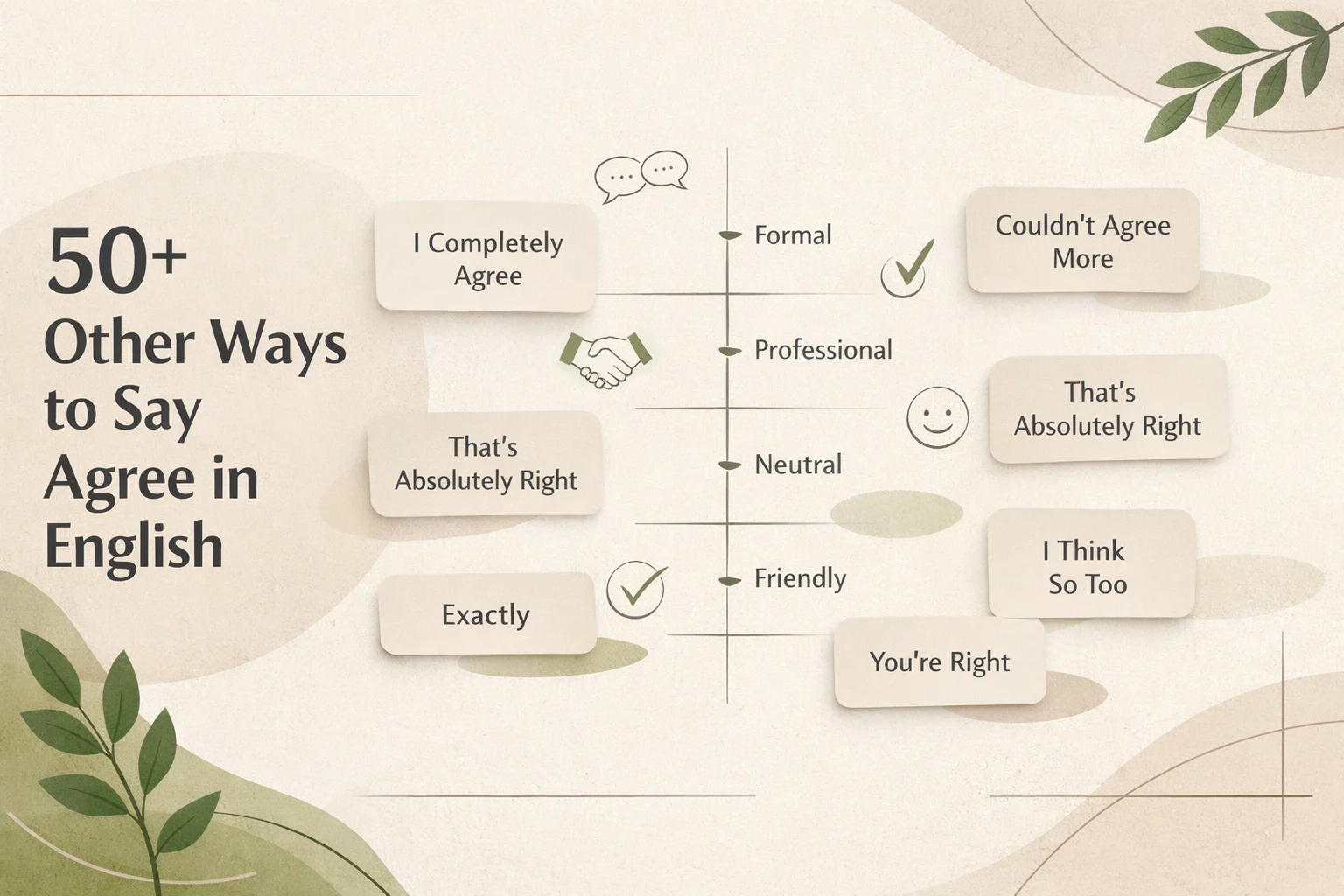
Tone Ladder
Not every way of saying agree carries the same weight. Some phrases are reserved for boardrooms and official documents, while others belong in casual chats with friends. Ranking phrases on a tone ladder helps you choose the right one instantly.
Very Formal
These phrases appear in official writing, legal contexts, academic papers, and high level business communication. Examples include I concur and I am in full agreement with this proposal. They sound polished but can feel stiff in everyday conversation.
Formal
Formal phrases work well in professional emails, interviews, and workplace meetings without sounding overly rigid. Examples include I agree with your assessment and that is a fair point.
Neutral
Neutral expressions are safe in almost any setting, spoken or written. Examples include I agree, that’s true, and you’re right.
Casual
Casual phrases are common among coworkers, classmates, and acquaintances in relaxed but still professional situations. Examples include sounds good to me and I’m with you on that.
Informal
Informal phrases are best kept for close friends, family, or very relaxed group chats. Examples include totally, same here, and for sure.
Very formal and formal phrases tend to sound more professional and are best suited for writing, especially emails, reports, and official documents. Neutral phrases work everywhere. Casual and informal phrases are best for spoken English among people you already know well.
Table: Tone Classification
| Phrase | Tone Level | Formality | Best Situation |
|---|---|---|---|
| I concur | Very Formal | High | Legal or academic writing |
| I am in full agreement | Very Formal | High | Official reports |
| I agree with your assessment | Formal | Medium High | Business emails |
| That is a fair point | Formal | Medium High | Interviews and meetings |
| I agree | Neutral | Medium | Everyday speech and writing |
| That’s true | Neutral | Medium | Conversations and messages |
| You’re right | Neutral | Medium | Discussions and debates |
| Sounds good to me | Casual | Medium Low | Team chats, informal emails |
| I’m with you on that | Casual | Medium Low | Coworker conversations |
| Totally | Informal | Low | Friends and family |
| Same here | Informal | Low | Casual chats and texting |
| For sure | Informal | Low | Spoken conversation |
Quick Selection Guide
Sometimes you just need the fastest possible answer. Use this guide to pick the right phrase without overthinking it.
Interview
Use I agree with that or that’s a fair point. Both sound confident and professional without being overly stiff.
Use I agree with your assessment or I’m in agreement with this plan. These phrases read clearly and maintain a professional tone.
Networking
Use I couldn’t agree more or that resonates with me. These show enthusiasm while staying appropriate for a professional but social setting.
Casual Conversation
Use totally, for sure, or same here. These keep the exchange light and natural among friends.
Real Life Conversation Transformations
Seeing a phrase in context makes it far easier to use naturally. Here are four common situations showing how a simple agree can be transformed into something more natural and specific.
Job Interview Scenario
Before: The interviewer says teamwork is important in this role, and I agree.
After: The interviewer mentioned that teamwork is essential here, and honestly, that’s exactly how I see it too. Collaboration has always been central to how I work.
Networking Event Scenario
Before: You said the industry is changing fast. I agree.
After: You said the industry is changing fast, and I couldn’t agree more. I’ve noticed the same shift in the projects I’ve been working on recently.
Email Scenario
Before: I agree with your proposal.
After: I’ve reviewed the proposal and I’m fully on board with the direction you’ve outlined. It aligns well with our current priorities.
Casual Conversation Scenario
Before: Yeah, I agree, that movie was great.
After: Honestly, same here, that movie was amazing. The ending completely caught me off guard too.
50+ Other Ways to Say Agree in English
Below is a detailed breakdown of the most useful alternatives to agree, organized so you can quickly find the right tone, meaning, and example for any situation.
I Couldn’t Agree More
Meaning: A strong, enthusiastic way of expressing full agreement. Explanation: Used when you feel exactly the same way and want to emphasize it. Example: I couldn’t agree more, that presentation was excellent. Tone: Enthusiastic, warm Best use: Conversations, networking, casual meetings Worst use: Formal legal or academic writing Context variability: Works in both spoken and written English
Absolutely
Meaning: A confident, quick confirmation of agreement. Explanation: Shows strong support without extra explanation. Example: Absolutely, that’s the right approach. Tone: Confident, energetic Best use: Meetings, casual chats, interviews Worst use: Very formal written reports Context variability: More common in speech than in writing
That’s True
Meaning: A neutral acknowledgment that a statement is correct. Explanation: Confirms accuracy without adding strong emotion. Example: That’s true, the deadline was moved up. Tone: Neutral Best use: Everyday conversation and discussion Worst use: Situations needing strong enthusiasm Context variability: Common in both spoken and written English
You’re Right
Meaning: Directly acknowledges that the other person is correct. Explanation: Personalizes the agreement toward the speaker. Example: You’re right, we should reconsider the budget. Tone: Neutral to warm Best use: Discussions, debates, everyday chats Worst use: Highly formal writing Context variability: Works well in both spoken and written form
Exactly
Meaning: Confirms complete alignment with what was said. Explanation: Often used to emphasize precision in agreement. Example: Exactly, that’s what I was trying to explain. Tone: Confident, direct Best use: Conversations, discussions, quick replies Worst use: Formal documents Context variability: Mostly spoken, occasionally used in messaging
I’m With You on That
Meaning: Expresses support and alignment with someone’s opinion. Explanation: Shows solidarity, often used in group discussions. Example: I’m with you on that, we should delay the launch. Tone: Supportive, casual Best use: Team discussions, informal meetings Worst use: Formal legal writing Context variability: Common in both spoken and written casual English
Same Here
Meaning: A short, casual way to say you feel the same way. Explanation: Used between friends or close colleagues. Example: Same here, I was thinking the exact same thing. Tone: Informal Best use: Texting, casual conversation Worst use: Professional emails or interviews Context variability: Almost exclusively spoken or informal writing
Definitely
Meaning: A strong confirmation of agreement. Explanation: Adds certainty and confidence to the statement. Example: Definitely, that’s the best option available. Tone: Confident Best use: Conversations, interviews, casual emails Worst use: Overly formal legal documents Context variability: Works in both spoken and written contexts
For Sure
Meaning: A relaxed, confident way of agreeing. Explanation: Very common in casual American English. Example: For sure, that plan makes the most sense. Tone: Casual, confident Best use: Friends, informal chats Worst use: Formal meetings or written reports Context variability: Mostly spoken English
That Makes Sense
Meaning: Confirms understanding and agreement with reasoning. Explanation: Often used when agreeing with an explanation rather than an opinion. Example: That makes sense, I hadn’t thought of it that way. Tone: Thoughtful, neutral Best use: Discussions, problem solving conversations Worst use: Situations needing enthusiastic support Context variability: Common in spoken and written English
I See Your Point
Meaning: Acknowledges the validity of someone’s argument. Explanation: Shows agreement while sounding thoughtful and reflective. Example: I see your point, we should adjust the strategy. Tone: Reflective, respectful Best use: Debates, meetings, discussions Worst use: Very casual conversations Context variability: Works well in spoken and formal contexts
I’m On Board With That
Meaning: Confirms full support for a plan or idea. Explanation: Common in workplace settings when agreeing to proceed with something. Example: I’m on board with that new schedule. Tone: Supportive, professional Best use: Team meetings, project discussions Worst use: Very formal legal writing Context variability: Common in spoken and written professional English
Sounds Good to Me
Meaning: A relaxed way of agreeing to a plan or suggestion. Explanation: Frequently used in casual professional settings like team chats. Example: Sounds good to me, let’s move forward with that. Tone: Casual, friendly Best use: Team chats, informal emails Worst use: Formal presentations or interviews Context variability: Common in both spoken and written informal English
You Took the Words Right Out of My Mouth
Meaning: Expresses that you were about to say the exact same thing. Explanation: A vivid, conversational way to show strong agreement. Example: You took the words right out of my mouth, that’s exactly my concern too. Tone: Enthusiastic, conversational Best use: Casual conversations, group discussions Worst use: Formal writing Context variability: Mostly spoken English
I Concur
Meaning: A formal way to state agreement. Explanation: Common in legal, academic, or highly professional contexts. Example: I concur with the committee’s decision. Tone: Very formal Best use: Official documents, formal meetings Worst use: Casual conversation, texting Context variability: Almost exclusively written or formal spoken English
That’s a Fair Point
Meaning: Acknowledges that someone’s argument is reasonable. Explanation: Often used before agreeing or partially agreeing. Example: That’s a fair point, we should look into it further. Tone: Thoughtful, professional Best use: Interviews, debates, meetings Worst use: Very casual chats Context variability: Common in spoken and written professional English
I Hear You
Meaning: Shows understanding and agreement with someone’s feelings or opinion. Explanation: Often used to validate emotions along with agreement. Example: I hear you, that situation would frustrate me too. Tone: Empathetic Best use: Personal conversations, supportive discussions Worst use: Formal business writing Context variability: Mostly spoken English
No Doubt About It
Meaning: A confident, emphatic form of agreement. Explanation: Used to remove any uncertainty from the statement. Example: No doubt about it, that was the right decision. Tone: Confident Best use: Conversations, informal presentations Worst use: Very formal written documents Context variability: Mostly spoken, occasionally written casually
I Totally Agree
Meaning: An enthusiastic, strong form of agreement. Explanation: Adds emphasis to a simple statement of agreement. Example: I totally agree, we need more time for testing. Tone: Enthusiastic, casual Best use: Conversations, informal emails Worst use: Very formal writing Context variability: Common in both spoken and written informal English
You’ve Got a Point There
Meaning: Acknowledges validity in someone’s argument, often after some thought. Explanation: Slightly more casual than that’s a fair point. Example: You’ve got a point there, I hadn’t considered that angle. Tone: Thoughtful, casual Best use: Discussions, debates Worst use: Formal documents Context variability: Mostly spoken English
I’m in Agreement
Meaning: A clear, professional statement of agreement. Explanation: Common in written business communication. Example: I’m in agreement with the proposed timeline. Tone: Professional Best use: Emails, reports, meetings Worst use: Very casual conversation Context variability: Common in written professional English
That’s Exactly What I Think
Meaning: Confirms complete alignment in opinion. Explanation: Adds personal emphasis to the agreement. Example: That’s exactly what I think, we should prioritize quality first. Tone: Confident, personal Best use: Discussions, interviews Worst use: Extremely formal writing Context variability: Works in spoken and written English
I Share Your View
Meaning: A formal way of expressing that you hold the same opinion. Explanation: Common in professional or academic discussions. Example: I share your view on the importance of transparency. Tone: Formal Best use: Meetings, professional writing Worst use: Casual chats Context variability: Mostly written and formal spoken English
Well Said
Meaning: A compliment combined with agreement. Explanation: Used to praise how someone expressed their point while agreeing with it. Example: Well said, that summarizes the situation perfectly. Tone: Appreciative, professional Best use: Meetings, presentations, discussions Worst use: Very casual texting Context variability: Works in spoken and written English
I Second That
Meaning: Formally supports a suggestion or opinion, often in group settings. Explanation: Originates from formal meeting language but is now used casually too. Example: I second that, let’s move the meeting to Thursday. Tone: Supportive, semi formal Best use: Meetings, group decisions Worst use: Very casual one on one chats Context variability: Common in spoken English, both formal and informal
Right On
Meaning: A casual, enthusiastic way to show agreement. Explanation: Common in relaxed spoken conversations. Example: Right on, that’s exactly how it should be done. Tone: Casual, energetic Best use: Friends, informal settings Worst use: Professional writing Context variability: Almost exclusively spoken English
Precisely
Meaning: Confirms exact agreement with strong confidence. Explanation: Slightly more formal than exactly. Example: Precisely, that’s the issue we need to address. Tone: Confident, semi formal Best use: Discussions, interviews, presentations Worst use: Very casual texting Context variability: Works in spoken and written English
I Couldn’t Have Said It Better Myself
Meaning: Strong agreement combined with admiration for how the point was expressed. Explanation: Adds warmth and appreciation to the agreement. Example: I couldn’t have said it better myself, that’s the core issue exactly. Tone: Warm, enthusiastic Best use: Conversations, networking Worst use: Very formal writing Context variability: Mostly spoken English
That’s Spot On
Meaning: Confirms that a statement is accurate and well made. Explanation: A British English favorite that has spread globally. Example: That’s spot on, the numbers confirm exactly that. Tone: Confident, casual Best use: Discussions, informal meetings Worst use: Very formal documents Context variability: Common in spoken English
Agreed
Meaning: A short, direct confirmation of agreement. Explanation: Works well as a quick reply in both writing and speech. Example: Agreed, let’s finalize the plan by Friday. Tone: Neutral, efficient Best use: Emails, meetings, quick replies Worst use: None, it fits almost anywhere Context variability: Extremely versatile across spoken and written English
Fair Enough
Meaning: Accepts a point as reasonable, sometimes with slight reservation. Explanation: Shows agreement while allowing room for nuance. Example: Fair enough, I can see why you made that choice. Tone: Casual, balanced Best use: Discussions, everyday conversation Worst use: Formal writing Context variability: Mostly spoken English
I Think So Too
Meaning: A simple, personal way to confirm agreement. Explanation: Slightly softer than a direct I agree. Example: I think so too, the new design looks much cleaner. Tone: Neutral, friendly Best use: Conversations, casual emails Worst use: Very formal reports Context variability: Works in spoken and written English
That Checks Out
Meaning: Confirms that information or reasoning is accurate. Explanation: Often used when agreeing after verifying facts. Example: That checks out, the figures match what I found too. Tone: Analytical, neutral Best use: Work discussions, technical conversations Worst use: Emotional or personal conversations Context variability: Works in spoken and written English
I’m Inclined to Agree
Meaning: A cautious, thoughtful form of agreement. Explanation: Suggests agreement after some consideration. Example: I’m inclined to agree, though I’d like more data first. Tone: Formal, careful Best use: Professional discussions, interviews Worst use: Very casual chats Context variability: Mostly written and formal spoken English
You Read My Mind
Meaning: Expresses that someone said exactly what you were thinking. Explanation: A warm, conversational way to show strong agreement. Example: You read my mind, I was about to suggest the same thing. Tone: Warm, enthusiastic Best use: Casual conversations, friendly discussions Worst use: Formal writing Context variability: Mostly spoken English
We’re on the Same Page
Meaning: Confirms mutual understanding and agreement. Explanation: Common in workplace settings to confirm alignment. Example: We’re on the same page about the project goals. Tone: Professional, friendly Best use: Meetings, team discussions Worst use: Very casual texting Context variability: Common in spoken and written professional English
I’m All For It
Meaning: Expresses enthusiastic support for an idea. Explanation: Shows more excitement than a plain agreement. Example: I’m all for it, let’s start planning right away. Tone: Enthusiastic, casual Best use: Team discussions, informal meetings Worst use: Formal legal documents Context variability: Works in spoken and written casual English
That Resonates With Me
Meaning: Shows a deeper, more personal form of agreement. Explanation: Suggests the idea connects with your own values or experience. Example: That resonates with me, I’ve felt the same way for a while. Tone: Thoughtful, warm Best use: Networking, personal conversations Worst use: Very casual quick replies Context variability: Works in spoken and written English
Without a Doubt
Meaning: A strong, confident confirmation of agreement. Explanation: Removes any hesitation from the statement. Example: Without a doubt, that’s the right strategy. Tone: Confident Best use: Presentations, discussions Worst use: Very formal legal writing Context variability: Works in spoken and written English
I’m Aligned With That
Meaning: A professional way to confirm shared direction or opinion. Explanation: Common in corporate and project management language. Example: I’m aligned with that approach for the next quarter. Tone: Professional Best use: Business meetings, emails Worst use: Casual conversations Context variability: Mostly written and formal spoken English
Table: Usage Comparison Table
| Phrase | Spoken Use | Written Use | Context |
|---|---|---|---|
| I couldn’t agree more | High | Medium | Conversations, networking |
| Absolutely | High | Low | Meetings, casual chats |
| I concur | Low | High | Legal and academic writing |
| Sounds good to me | High | Medium | Team chats, casual emails |
| I’m in agreement | Medium | High | Business emails, reports |
| Same here | High | Low | Texting, casual talk |
| That’s spot on | High | Medium | Discussions, informal writing |
| Fair enough | High | Low | Everyday conversation |
| We’re on the same page | Medium | High | Meetings, project updates |
| I share your view | Low | High | Professional writing |
Email and LinkedIn Ready Expressions
Written communication often needs a slightly more polished phrase than everyday speech. These expressions work well for professional messages.
Email Greetings
Thank you for your email, and I fully agree with the points you raised. I appreciate your perspective and I’m in agreement with the proposed next steps.
Professional Introductions
I wanted to reach out and let you know I agree with your recent article on this topic. Your point about the market shift really resonated with me.
LinkedIn Connection Messages
I came across your post and completely agree with your take on remote work trends. Would love to connect and continue the conversation.
Follow Up Lines
Following up on our earlier conversation, I remain fully aligned with the direction we discussed. Let me know the next steps whenever you’re ready.
Native Speaker Insight
Native English speakers rarely repeat the word agree in the same conversation. Instead, they naturally shift between short confirmations and longer, more expressive phrases depending on the tone of the discussion.
In fast, casual speech, phrases often get shortened. Absolutely becomes just totally or for sure. I couldn’t agree more often becomes couldn’t agree more, dropping the subject pronoun in relaxed speech.
Certain phrases sound unnatural when used incorrectly. Saying I concur in a casual text message to a friend feels stiff and out of place. Similarly, saying totally in a formal business email feels unprofessional. Matching tone to context is more important than the specific words chosen.
Preferred professional alternatives that native speakers reach for often include that’s a fair point, I’m on board with that, and we’re on the same page, since these sound confident without being overly casual or overly formal.
Common Mistakes and What Not to Say
Learners often make small mistakes when trying to vary their agreement phrases. Here are the most common ones to avoid.
Using I concur in casual conversation sounds unnatural and overly stiff among friends or coworkers you know well.
Using totally or for sure in a formal email creates a tone mismatch that can seem unprofessional.
Saying I am agree is a common grammar mistake. The correct form is simply I agree, without the verb to be.
Overusing without a doubt or absolutely in every sentence can sound exaggerated rather than genuine.
Mixing very formal and very informal phrases in the same message, such as combining I concur with for sure, creates an inconsistent tone that confuses the reader.
Expansion Phrases
Beyond direct synonyms for agree, these related expressions help round out your conversational and written English.
Related expressions for confirming agreement include that’s accurate, you make a good point, and I see it the same way.
Polite ways to show partial support include I mostly agree, that’s largely true, and I see where you’re coming from.
Alternatives for softening disagreement while still showing respect include I understand your point, though I see it slightly differently, and that’s one way to look at it.
Conversational upgrades that keep agreement fresh in everyday speech include couldn’t agree more, that’s the truth, and you nailed it.
Table: Decision Making Table
| Situation | Best Phrase | Why It Works |
|---|---|---|
| Job interview | That’s a fair point | Sounds thoughtful and professional |
| Formal email | I’m in agreement with your proposal | Clear and polished for written communication |
| Networking event | I couldn’t agree more | Shows enthusiasm and builds rapport |
| Casual chat with friends | Totally | Natural, relaxed, and easy to say |
| Team meeting | Sounds good to me | Friendly yet appropriate for work settings |
| Legal or academic writing | I concur | Matches the formality of the context |
| LinkedIn message | I completely agree with your take | Professional but still personable |
Quick Reference List
Here are some of the best alternatives to “I agree” that you can use in different situations:
- I couldn’t agree more
- Absolutely
- That’s true
- Sounds good to me
- I’m on board with that
- Fair enough
- I second that
- That’s a fair point
- Agreed
- We’re on the same page
Mini Quiz
Test your understanding with these quick scenarios.
Question 1
Scenario: You are in a job interview and want to agree with the interviewer professionally. Which phrase should you use?
A. Totally
B. That’s a fair point
Correct Answer: B. That’s a fair point
Why? It sounds respectful, thoughtful, and professional, making it appropriate for an interview setting.
Question 2
Scenario: A close friend shares an opinion you completely agree with over text. Which reply sounds more natural?
A. I concur
B. Same here
Correct Answer: B. Same here
Why? “Same here” is casual, friendly, and commonly used in everyday text conversations.
Question 3
Scenario: You are replying to a formal business email and want to confirm your support for the proposed plan. Which response is best?
A. I’m in agreement with the proposed plan
B. For sure
Correct Answer: A. I’m in agreement with the proposed plan
Why? This phrase maintains a professional tone and clearly communicates your support in business correspondence.
Question 4
Scenario: During a team meeting, a colleague suggests moving the deadline, and you support the idea. Which phrase fits best?
A. Sounds good to me
B. I am agree
Correct Answer: A. Sounds good to me
Why? “Sounds good to me” is a natural and professional way to express agreement during workplace discussions. “I am agree” is grammatically incorrect in English.
FAQs
Is it polite to say I couldn’t agree more
Yes, it is considered polite and even complimentary. It shows enthusiasm and genuine support for what someone said, making it a great choice for conversations and networking situations.
What is more professional than saying I agree
Phrases like I’m in agreement with your proposal, that’s a fair point, and I share your view sound more polished and are better suited for professional emails and meetings.
Can I use casual phrases like totally in a work email
It’s best to avoid very casual phrases like totally or for sure in formal written communication. Stick to neutral or formal options such as I agree or I’m on board with that.
What do native speakers say instead of I agree
Native speakers often use phrases such as sounds good to me, I’m with you on that, exactly, and we’re on the same page, depending on how formal the situation is.
What is the best alternative for agree in a job interview
That’s a fair point and I agree with that assessment both work well, since they sound thoughtful and professional without being overly casual.
Conclusion
Learning different ways to say agree makes your English sound more natural, confident, and adaptable across every situation, whether you’re writing a formal email, chatting with friends, or speaking in a job interview. The key is matching the tone of the phrase to the context you’re in, since a word that works perfectly in casual conversation might feel out of place in a professional setting.
Practice moving between formal, neutral, and casual expressions until choosing the right one feels automatic. Over time, this flexibility will make your spoken and written English sound far more natural, helping you communicate agreement in a way that feels genuine rather than repetitive.
Read More Related Articles:
- 35+ Other Ways to Say Happy Thursday | Make Your Greetings More Engaging In 2026
- 35+ Other Ways to Say “Nice to Meet You” | Formal to Casual In 2026
- 35+ Other Ways to Say “Did You Sleep Well” | For Better Communication In 2026

Caleb Dawson is a content writer at synoseek.com, where he works on simple, reader-focused articles across a range of everyday topics. His writing style is practical and grounded, aiming to present information in a clear and relatable way without unnecessary complexity.