Quick Answer
“Just to clarify” is a polite phrase used to confirm understanding, correct a misunderstanding, or ask for more detail before moving forward in a conversation. It signals that the speaker wants accuracy rather than confusion.Five best alternatives: to confirm, let me make sure I understand, for clarity, to double check, just to be clear.
People say “just to clarify” so often that it can start to sound repetitive, especially in emails, meetings, and customer conversations where precision matters. This guide gives you 30+ Other Ways to Say “Just to Clarify” organized by tone and situation, so you always sound clear, confident, and professional, whether you are confirming a detail in a job interview, double checking instructions from a manager, or simply making sure a friend understood you correctly.
Why People Search for Other Ways to Say “Just to Clarify”
When someone searches for other ways to say just to clarify, they usually fall into one of three groups.
Professionals Who Want Variety
People writing emails, reports, or meeting notes often reuse “just to clarify” so frequently that it starts to feel robotic. They want professional English phrases that sound fresh while keeping the same intent.
Non Native English Speakers
Many learners search for alternatives to just to clarify because they want to understand how native speakers naturally rephrase clarification requests in both spoken and written English.
Communicators Avoiding Repetition
Writers, teachers, and customer service professionals want conversational English improvements so their writing or speech does not sound stiff or repetitive across multiple messages.
Spoken versus written usage also matters here. In conversation, people often use shorter forms like “just to check” or “quick clarification.” In written communication such as emails, more structured forms like “to confirm my understanding” or “for clarity” tend to work better because they read clearly without tone of voice to support them.
Formal and informal expressions in English also differ sharply for this phrase. A formal meeting needs phrases like “may I confirm” while a casual chat with a coworker can use something as simple as “wait, just checking.”
The Tone Ladder System
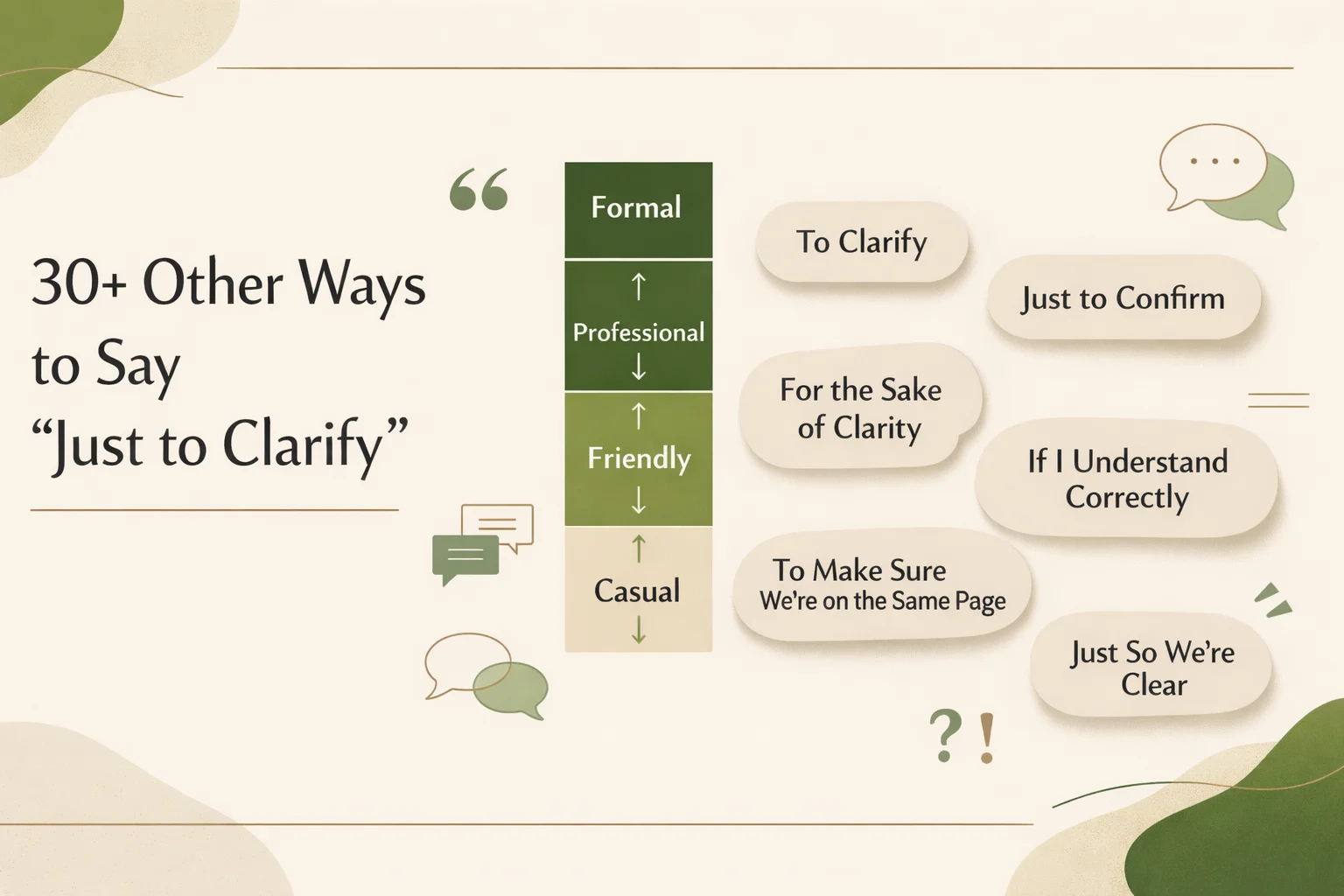
Not every clarification phrase fits every situation. Using an overly casual phrase in a formal email, or an overly formal phrase in a quick chat, can feel out of place. Here is how the tone ladder breaks down from most formal to most casual.
Very Formal
“May I seek clarification on this matter” is used in highly formal writing, legal contexts, or very senior communication.
Formal
“To confirm my understanding” or “For the sake of clarity” are ideal for professional emails, reports, and structured meetings.
Neutral
“Just to confirm” or “To make sure I understand correctly” work well in most everyday professional situations.
Casual
“Just checking” or “Quick clarification” suit relaxed workplace conversations and casual emails between colleagues.
Informal
Wait, so you mean” or “Just so I’m clear” are best for friends, casual chats, or very informal team messages.
Formal and very formal phrases sound more professional and are best suited for writing, while casual and informal phrases feel more natural in spoken English. Neutral phrases are the safest choice when you are unsure which tone fits, since they work in both spoken and written contexts.
Table: Tone Classification
| Phrase | Tone Level | Formality | Best Situation |
|---|---|---|---|
| May I seek clarification on this matter | Very Formal | Very High | Legal documents, senior leadership communication |
| To confirm my understanding | Formal | High | Professional emails, business reports |
| For the sake of clarity | Formal | High | Formal writing, instructions, documentation |
| Just to confirm | Neutral | Medium | Everyday professional conversations |
| To make sure I understand correctly | Neutral | Medium | Meetings, interviews, emails |
| Just checking | Casual | Low Medium | Workplace chats, informal emails |
| Quick clarification | Casual | Low Medium | Team messages, casual meetings |
| Wait, so you mean | Informal | Low | Friends, casual conversations |
| Just so I’m clear | Informal | Low | Informal team chats, texting |
| Correct me if I’m wrong | Informal | Low | Casual discussions, brainstorming sessions |
Quick Selection Guide
This section helps you choose the right phrase instantly based on your situation.
Interview
Best phrase: “To make sure I understand the question correctly.” This sounds thoughtful and professional without feeling repetitive.
Best phrase: “To confirm my understanding before proceeding.” This reads clearly and avoids ambiguity in written communication.
Networking
Best phrase: “Just to clarify what you mentioned earlier.” This keeps the tone polite and conversational while staying professional.
Casual Conversation
Best phrase: “Wait, just to check, did you mean.” This feels natural and unforced in everyday spoken English.
Real Life Conversation Transformations
Seeing the upgrade in context makes the difference clear. Below are four before and after scenarios showing natural English transformation rather than simple synonym swapping.
Job Interview Scenario
Before: “Just to clarify, you want me to explain my weaknesses?”
After: “To make sure I understand the question correctly, are you asking me to describe an area I am actively working to improve?”
The after version sounds more thoughtful and demonstrates stronger communication skills, which interviewers notice.
Networking Event Scenario
Before: “Just to clarify, what company do you work for again?”
After: “Sorry, I want to make sure I have this right, which company are you with?”
The after version feels warmer and more natural in a social professional setting rather than sounding like a formal interrogation.
Email Scenario
Before: “Just to clarify, the deadline is Friday?”
After: “To confirm my understanding, the deadline for this deliverable is Friday at 5pm, is that correct?”
The after version is more specific and reduces the chance of further back and forth emails.
Casual Conversation Scenario
Before: “Just to clarify, are we still meeting at 6?”
After: “Quick check, are we still on for 6?”
The after version sounds more natural and effortless between friends or casual coworkers.
30+ Other Ways to Say “Just to Clarify”
Each entry below includes the phrase, its meaning, an example sentence, tone, best use, worst use, and how much its meaning can shift depending on context.
1. To confirm my understanding
Meaning: Used to verify that you have correctly understood information before acting on it.
Example: “To confirm my understanding, the meeting has been moved to Thursday.”
Tone: Formal. Best use: business emails and meetings. Worst use: casual chats with friends. Context variability: low, since it almost always signals a serious confirmation request.
2. For the sake of clarity
Meaning: Used to introduce a clarification that prevents confusion in writing or speech.
Example: “For the sake of clarity, this policy applies only to new employees.”
Tone: Formal. Best use: documentation, instructions, official communication. Worst use: informal texting. Context variability: low.
3. Just to confirm
Meaning: A shorter, slightly more casual way to check accuracy of information.
Example: “Just to confirm, you will send the invoice by Monday?”
Tone: Neutral. Best use: everyday professional conversations. Worst use: extremely formal legal writing. Context variability: medium.
4. To make sure I understand correctly
meaning: Signals genuine effort to grasp the other person’s meaning before responding.
Example: “To make sure I understand correctly, you want the report finished before the client call?”
Tone: Neutral. Best use: interviews, meetings, training sessions. Worst use: very short casual exchanges. Context variability: medium.
5. May I seek clarification on this matter
Meaning: A highly formal way to request clearer information, often used in official or legal settings.
Example: “May I seek clarification on this matter before we proceed further?”
Tone: Very Formal. Best use: legal documents, senior executive communication. Worst use: casual workplace chats. Context variability: very low.
6. Just checking
Meaning: A relaxed way to confirm something without sounding overly serious.
Example: “Just checking, did you already send that file?”
Tone: Casual. Best use: workplace chats, informal emails. Worst use: formal client communication. Context variability: medium.
7. Quick clarification
Meaning: Signals a brief, low pressure request for more information.
Example: “Quick clarification, are we meeting in person or online?”
Tone: Casual. Best use: team messages, casual meetings. Worst use: formal written reports. Context variability: medium.
8. Wait, so you mean
Meaning: Used in spoken conversation to restate what someone said before confirming it.
Example: “Wait, so you mean we are launching next week instead of next month?”
Tone: Informal. Best use: friends, casual conversations. Worst use: professional emails. Context variability: high.
9. Just so I’m clear
Meaning: A casual phrase used to express a desire for accurate understanding.
Example: “Just so I’m clear, you want this finished today, not tomorrow?”
Tone: Informal. Best use: informal team chats, texting. Worst use: client facing emails. Context variability: medium.
10. Correct me if I’m wrong
Meaning: Politely invites correction while restating your understanding of something.
Example: “Correct me if I’m wrong, but I believe the budget was approved last week.”
Tone: Informal. Best use: casual discussions, brainstorming sessions. Worst use: very formal documentation. Context variability: high.
11. To clarify further
Meaning: Used when adding more detail to a previous explanation.
Example: “To clarify further, the new policy only affects remote employees.”
Tone: Formal. Best use: follow up emails, detailed explanations. Worst use: short casual texts. Context variability: low.
12. Let me make sure I’ve got this right
Meaning: A friendly way to confirm understanding before moving forward.
Example: “Let me make sure I’ve got this right, you need the slides by Wednesday morning?”
Tone: Neutral. Best use: meetings, calls, everyday conversations. Worst use: extremely formal legal contexts. Context variability: medium.
13. In other words
Meaning: Used to restate or simplify something that was just said.
Example: “In other words, the deadline has not actually changed.”
Tone: Neutral. Best use: explanations, teaching, presentations. Worst use: situations needing a direct question. Context variability: medium.
14. To put it another way
Meaning: Used to rephrase an idea for better understanding.
Example: “To put it another way, we need approval before any spending happens.”
Tone: Neutral. Best use: presentations, written explanations. Worst use: very brief casual exchanges. Context variability: medium.
15. Just to be clear
Meaning: Emphasizes the importance of avoiding misunderstanding, often used before stating something firmly.
Example: “Just to be clear, this decision is final.”
Tone: Neutral to Formal depending on context. Best use: meetings, emails, instructions. Worst use: overly casual conversations where it can sound blunt. Context variability: medium.
16. To clarify your question
Meaning: Used when responding to someone’s question by first confirming what they are actually asking.
Example: “To clarify your question, are you asking about pricing or delivery time?”
Tone: Formal. Best use: customer service, presentations, interviews. Worst use: informal chats. Context variability: low.
17. If I understand correctly
Meaning: Politely restates someone’s point before confirming or responding.
Example: “If I understand correctly, you would like the report shortened to two pages.”
Tone: Formal to Neutral. Best use: business meetings, client calls. Worst use: very casual texting. Context variability: medium.
18. To avoid any confusion
Meaning: Signals that the clarification is meant to prevent a misunderstanding before it happens.
Example: “To avoid any confusion, please send all requests to this email address only.”
Tone: Formal. Best use: instructions, official communication. Worst use: casual conversation. Context variability: low.
19. Let’s double check that
Meaning: A practical phrase used to confirm details before finalizing something.
Example: “Let’s double check that before we send the invoice to the client.”
Tone: Neutral. Best use: teamwork, project discussions. Worst use: highly formal written documentation. Context variability: medium.
20. Just one more thing to confirm
Meaning: Introduces an additional clarification after most details have already been discussed.
Example: “Just one more thing to confirm, will the event start at 9am or 10am?”
Tone: Neutral. Best use: meetings, emails, planning conversations. Worst use: very short informal messages. Context variability: medium.
21. To clear up any confusion
Meaning: Used when addressing a misunderstanding that has already occurred.
Example: “To clear up any confusion, the meeting location has changed to room 204.
Tone: Formal. Best use: emails, announcements, corrections. Worst use: light casual chats. Context variability: low.
22. So just to recap
Meaning: Used to summarize and confirm key points before moving forward.
Example: “So just to recap, you’ll send the draft and I’ll review it by Friday.”
Tone: Neutral. Best use: meetings, calls, project wrap ups. Worst use: very formal legal writing. Context variability: medium.
23. Help me understand
Meaning: A softer, more conversational way to ask for clarification, often used to encourage explanation.
Example: “Help me understand why the timeline changed so suddenly.”
Tone: Neutral to Casual. Best use: coaching conversations, feedback discussions. Worst use: extremely formal written reports. Context variability: high.
24. Just want to make sure we’re on the same page
Meaning: Expresses a desire for mutual understanding before proceeding with a task.
Example: “Just want to make sure we’re on the same page before the call starts.”
Tone: Casual to Neutral. Best use: team communication, project coordination. Worst use: formal legal contexts. Context variability: medium.
25. To be precise
Meaning: Used to clarify exact details, often numerical or factual.
Example: “To be precise, the budget increase was 12 percent, not 15.”
Tone: Formal. Best use: reports, data discussions, technical explanations. Worst use: casual social conversations. Context variability: low.
26. Just so we’re clear
Meaning: A firm, slightly assertive way to confirm understanding, often before stating expectations.
Example: “Just so we’re clear, the project deadline cannot be extended.”
Tone: Neutral to Casual. Best use: workplace conversations, setting expectations. Worst use: very formal client communication. Context variability: medium.
27. To clarify my point
Meaning: Used when restating or expanding on something you previously said.
Example: “To clarify my point, I am not against the idea, just the timeline.”
Tone: Formal. Best use: debates, presentations, professional discussions. Worst use: very short casual replies. Context variability: low.
28. Quick question to clarify
Meaning: Introduces a short clarifying question without disrupting the flow of conversation.
Example: “Quick question to clarify, is this report due today or tomorrow?”
Tone: Casual to Neutral. Best use: meetings, chats, emails. Worst use: extremely formal written documents. Context variability: medium.
29. Just to verify
Meaning: Used when confirming factual accuracy, often in technical or transactional contexts.
Example: “Just to verify, your shipping address is still the same one on file?”
Tone: Neutral. Best use: customer service, transactions, technical support. Worst use: emotional or sensitive conversations. Context variability: medium.
30. To make things clearer
Meaning: Used when simplifying or explaining something in more detail for better understanding.
Example: “To make things clearer, here is a breakdown of each step in the process.”
Tone: Neutral. Best use: tutorials, instructions, presentations. Worst use: very brief casual exchanges. Context variability: low.
31. Just to set the record straight
Meaning: Used when correcting a misunderstanding or misinformation directly.
Example: “Just to set the record straight, I never agreed to that deadline.”
Tone: Neutral to Casual. Best use: correcting misunderstandings, clarifying past statements. Worst use: highly formal written reports. Context variability: high.
32. Allow me to clarify
Meaning: A polished, formal way to introduce a clarification, often in professional speech.
Example: “Allow me to clarify, the proposal only covers phase one of the project.”
Tone: Formal. Best use: presentations, formal meetings, public speaking. Worst use: casual texting. Context variability: low.
Table: Spoken vs Written Usage Comparison
| Phrase | Spoken Use | Written Use | Context |
|---|---|---|---|
| To confirm my understanding | Natural | Excellent | Business emails, reports |
| Just checking | Very Natural | Slightly informal | Workplace chats |
| If I understand correctly | Natural | Excellent | Meetings, client calls |
| Wait, so you mean | Very Natural | Too casual | Spoken conversations only |
| For the sake of clarity | Slightly stiff | Excellent | Formal writing, documentation |
| Quick clarification | Very Natural | Works well | Team messages, casual emails |
| Just so we’re clear | Natural | Natural | Workplace conversations |
| May I seek clarification on this matter | Can sound archaic | Works for formal letters | Legal, executive communication |
| Help me understand | Very Natural | Natural | Coaching, feedback conversations |
| Just to verify | Natural | Excellent | Customer service, technical support |
Email and LinkedIn Ready Expressions
This section provides ready to use templates for emails and professional messaging.
Email Greeting and Clarification Request
Subject: Quick Clarification Needed on Project Timeline
Dear Sarah,
I hope you’re doing well. To confirm my understanding, the revised deadline for the project is the 15th of next month, is that correct? I want to make sure our team plans accordingly.
Thank you for confirming.
Best regards, Your Name
LinkedIn Connection Follow Up Message
Hi James,
Thanks for connecting. Just to clarify, are you currently working on the data analytics side of the team or focused more on product strategy? I’d love to learn more about your role.
Best, Your Name
Follow Up Line After a Meeting
To confirm my understanding from our call earlier, you’ll send the contract by end of day and I’ll review it first thing tomorrow morning.
Native Speaker Insight
Native speakers rarely use the full phrase “just to clarify” in casual speech. In everyday conversation, it often gets shortened to “just checking” or “quick question.”
In professional spoken English, “just to confirm” is used far more often than “just to clarify” because it sounds slightly less repetitive and flows more naturally in meetings.
What sounds unnatural is overusing very formal phrases like “may I seek clarification on this matter” in everyday office conversations. It technically works, but it sounds overly stiff and distant in most modern workplaces.
The preferred professional alternative among native speakers is “to confirm my understanding,” since it sounds polished without feeling robotic, and it works equally well in speech and writing.
Common Mistakes and What Not to Say
Using “just to clarify” repeatedly within the same email or conversation makes writing feel repetitive and mechanical. Vary the phrase using alternatives from this guide.
Saying “just to clarify” without actually asking a clear follow up question leaves the listener confused about what exactly needs clarification. Always pair the phrase with a specific question.
Using overly formal phrases like “may I seek clarification on this matter” in a casual team chat creates an unnecessary tone mismatch that can feel cold or distant.
Saying “correct me if I’m wrong” too often in professional settings can sound like you lack confidence, even though the phrase is grammatically correct and useful occasionally.
Expansion Phrases
These related expressions strengthen vocabulary around clarification, confirmation, and polite communication.
Greeting variations include phrases like “quick question before we continue” and “before we move forward.”
Introduction phrases include “I just want to make sure” and “before I respond, let me confirm.”
Polite communication alternatives include “would you mind clarifying” and “could you elaborate on that.
Conversational English upgrades include “just making sure I follow” and “so essentially you’re saying.”
Table: Decision Making Table
| Situation | Best Phrase | Why It Works |
|---|---|---|
| Job interview | To make sure I understand the question correctly | Sounds thoughtful and demonstrates active listening |
| Professional email | To confirm my understanding | Formal, clear, and reduces follow up confusion |
| Networking event | Just to clarify what you mentioned earlier | Polite and conversational without sounding stiff |
| Casual conversation | Quick check, did you mean | Natural and effortless in everyday speech |
| Client meeting | If I understand correctly | Professional and shows careful attention |
| Team chat | Just checking | Casual and quick, fits informal communication |
| Correcting a misunderstanding | Just to set the record straight | Direct and effective for resolving confusion |
| Formal documentation | For the sake of clarity | Polished and appropriate for written instructions |
| Customer service | Just to verify | Standard, professional, and widely understood |
| Public speaking | Allow me to clarify | Polished and confident in front of an audience |
Top 10 Alternatives to “Just to Clarify”
- Let me make sure I’ve got this right
- To confirm my understanding
- Just to confirm
- For the sake of clarity
- To make sure I understand correctly
- If I understand correctly
- Just checking
- Quick clarification
- To avoid any confusion
- Just to verify
Mini Quiz
Test your understanding with these scenario based questions.
Question 1
You are in a job interview and want to confirm what the interviewer is really asking. Which phrase is most appropriate?
A. Wait, so you mean B. To make sure I understand the question correctly C. Just checking D. Correct me if I’m wrong
Correct answer: B. This phrase sounds thoughtful and professional, which is ideal for an interview setting.
Question 2
You are writing a formal email to a client and need to confirm a deadline. Which phrase fits best?
A. Just so I’m clear B. Wait, so you mean C. To confirm my understanding D. Quick clarification
Correct answer: C. This phrase is polished and appropriate for formal written communication with a client.
Question 3
You are chatting casually with a coworker and want to quickly confirm a meeting time. Which phrase works best?
A. May I seek clarification on this matter B. Just checking C. To clarify my point D. Allow me to clarify
Correct answer: B. This phrase is short, casual, and fits naturally into a quick workplace chat.
Question 4
You need to correct a misunderstanding that already happened in a previous conversation. Which phrase fits best?
A. Just to set the record straight B. Quick clarification C. Just so I’m clear D. Help me understand
Correct answer: A. This phrase is specifically designed for correcting misunderstandings clearly and directly.
FAQs
Is it polite to say just to clarify?
Yes, it is generally polite and widely accepted in both professional and casual English. However, overusing it in the same conversation can start to sound repetitive, so varying your phrasing keeps communication feeling natural.
What is more professional than just to clarify?
“To confirm my understanding” and “for the sake of clarity” are both more formal and professional alternatives, especially suited for written communication like emails and reports.
Can I use just to clarify in an email?
Yes, it works well in emails, though pairing it with more specific alternatives like “to confirm my understanding” or “to avoid any confusion” can make written communication sound more polished and precise.
What do native speakers say instead of just to clarify?
Native speakers often shorten it in conversation to phrases like “just checking” or “quick question,” and in professional writing they frequently prefer “to confirm my understanding” for a more polished tone.
What is the best alternative for a formal business setting?
“To confirm my understanding” or “for the sake of clarity” are the strongest choices for formal business settings, since they sound professional in both spoken meetings and written correspondence.
Conclusion
Saying just to clarify is a useful habit, but relying on the same phrase repeatedly can make communication feel flat and repetitive over time. By learning formal, neutral, casual, and informal alternatives, you gain the flexibility to match your tone precisely to each situation, whether that is a job interview, a client email, a networking conversation, or a quick chat with a coworker.
The real skill lies in tone awareness rather than memorizing a long list of phrases. Practice noticing the formality of each situation before choosing your words, and over time these alternatives will start to feel like natural instinct rather than a conscious choice, helping you sound clearer, more confident, and more professional in every conversation.
Read More Related Articles:
- 30+ Other Ways to Say Please Let Me Know | Expert-Approved Phrases for Every Situation In 2026
- 30+ Other Ways to Say Sorry to Hear That | Kind Phrases That Comfort and Connect In 2026
- 40+ Other Ways to Say “I’m Sorry for Your Loss” | Express Your Sympathy Gracefully In 2026

Caleb Dawson is a content writer at synoseek.com, where he works on simple, reader-focused articles across a range of everyday topics. His writing style is practical and grounded, aiming to present information in a clear and relatable way without unnecessary complexity.