Quick Answer:
“Make a difference” means to have a positive, meaningful effect on people, situations, or the world. Native speakers often replace it with phrases like make an impact, create positive change, leave a mark, contribute meaningfully, or drive change, depending on tone and setting.
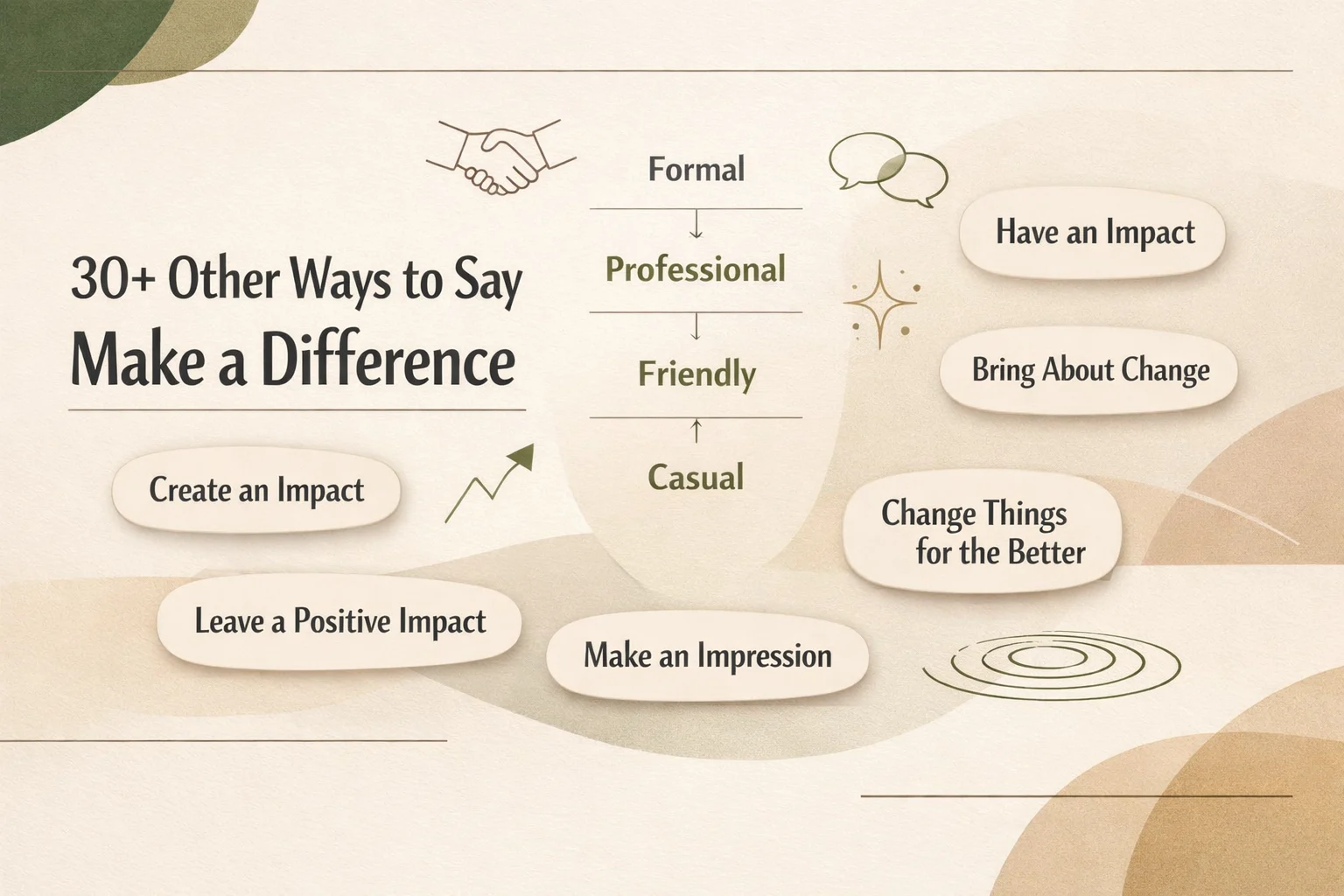
If you have used “make a difference” in every interview, email, and LinkedIn message you have written this year, you are not alone. It is one of the most common phrases in professional and everyday English, which also means it can sound repetitive if overused. This guide gives you 30+ Other Ways to Say Make a Difference, organized by tone, situation, and real conversation examples, so you always know the right phrase to use.
Why People Search for Other Ways to Say Make a Difference
Most people searching this phrase fall into a few categories. Some are preparing for a job interview and want to avoid sounding generic. Others are writing a cover letter, a LinkedIn summary, or a networking message and want to stand out. Some are simply trying to sound more natural in spoken English, since “make a difference” can feel stiff in casual conversation.
There is also a clear split between spoken and written usage. In speech, people lean toward shorter, warmer expressions like help others or do good. In writing, especially formal writing, longer and more polished phrases such as contribute meaningfully or create positive change tend to work better.
Common related searches include alternatives to make a difference, professional English phrases for impact, informal expressions in English for helping others, and conversational English improvements for everyday speech. Understanding search intent matters because the “best” phrase always depends on formality level, audience, and medium, not just meaning.
The Tone Ladder System for Make a Difference Alternatives
Every alternative to “make a difference” sits somewhere on a scale from very formal to very informal. Knowing where a phrase falls helps you choose correctly in seconds.
Very Formal
Phrases like effect meaningful change or contribute significantly to positive outcomes belong here. These suit academic writing, official reports, and executive communication.
Formal
Expressions such as make a meaningful impact or drive positive change work well in job interviews, cover letters, and professional emails.
Neutral
Phrases like make an impact or improve things sit comfortably in almost any professional or semi professional context, including LinkedIn and general workplace conversation.
Casual
Everyday expressions such as help out or do some good fit relaxed workplace chats, team meetings, and informal networking.
Informal
Phrases like give back or pay it forward are common in spoken English among friends, community groups, and social settings.
Formal phrases tend to sound more professional in writing, while shorter, warmer phrases usually sound more natural when spoken aloud. Matching tone to context is the single biggest factor in sounding like a fluent, confident English speaker.
Table: Tone Classification of Make a Difference Alternatives
| Phrase | Tone Level | Formality | Best Situation |
|---|---|---|---|
| Effect meaningful change | Very Formal | High | Academic and official writing |
| Contribute meaningfully | Formal | High | Cover letters, interviews |
| Make a meaningful impact | Formal | High | Job interviews, LinkedIn |
| Drive positive change | Formal | Medium High | Leadership statements |
| Make an impact | Neutral | Medium | Resumes, general emails |
| Improve things | Neutral | Medium | Everyday professional talk |
| Leave a mark | Neutral | Medium | Motivational writing |
| Help out | Casual | Low Medium | Team conversations |
| Do some good | Casual | Low Medium | Volunteering contexts |
| Give back | Informal | Low | Community, spoken English |
| Pay it forward | Informal | Low | Friendly, social settings |
Quick Selection Guide
Use this block when you need an instant answer without reading the full article.
For a Job Interview
Say make a meaningful impact or contribute meaningfully to show professionalism without sounding robotic.
For a Formal Email
Say drive positive change or create lasting impact for a polished, confident tone.
For Networking Events
Say make an impact or help create real change, since it sounds natural when spoken aloud.
For Casual Conversation
Say do some good or give back, both of which feel warm and unforced in everyday speech.
Real Life Conversation Transformations
Seeing phrases in context makes the difference between memorizing synonyms and actually sounding natural.
Job Interview Scenario
Before: I want a job where I can make a difference.
After: I am looking for a role where I can contribute meaningfully to outcomes that matter, both for the team and the people we serve.
Networking Event Scenario
Before: I really want to make a difference in this industry.
After: I am hoping to drive real change in this space, especially around sustainability.
Email Scenario
Before: Our program helps make a difference in local communities.
After: Our program is designed to create lasting impact within the communities we serve.
Casual Conversation Scenario
Before: I just want to make a difference, you know?
After: I just want to help out in some way that actually matters.
Notice how the “after” versions do more than swap words. They adjust rhythm, add specificity, and match the formality of the situation, which is what fluent speakers naturally do.
30+ Other Ways to Say Make a Difference
Below is the full list of alternatives, each explained with meaning, an example sentence, tone, and best and worst use cases so you can choose with confidence.
1. Make an Impact
Meaning: To produce a noticeable, positive effect. Explanation: This is the most common neutral alternative and works almost anywhere. Example: She wanted to make an impact in her first year at the company. Tone: Neutral Best use: Resumes, interviews, general writing Worst use: Very casual chats, where it can feel slightly formal Context variability: Works across almost every professional setting
2. Create Positive Change
Meaning: To actively cause improvement in a situation or system. Explanation: Slightly more formal, often used in leadership and social impact contexts. Example: The nonprofit was founded to create positive change in education. Tone: Formal Best use: Mission statements, cover letters Worst use: Everyday spoken conversation Context variability: Strong in written, weaker in spoken English
3. Leave a Mark
Meaning: To be remembered for a lasting, meaningful contribution. Explanation: More emotional and reflective than direct alternatives. Example: His work in the community left a mark that lasted for years. Tone: Neutral to formal Best use: Motivational speeches, tributes Worst use: Technical or corporate writing Context variability: Best in narrative or reflective writing
4. Bring About Change
Meaning: To cause a shift or transformation to happen. Explanation: Common in activism, policy, and leadership language. Example: Young voters are helping bring about change in local politics. Tone: Formal Best use: Political, social, and organizational contexts Worst use: Casual personal conversation Context variability: Best suited to public or institutional topics
5. Have a Positive Effect
Meaning: To influence something or someone in a good way. Explanation: A safe, clear, and slightly softer alternative. Example: Regular mentorship has a positive effect on student confidence. Tone: Neutral Best use: Academic and workplace writing Worst use: High energy motivational contexts, where it can sound flat Context variability: Reliable across most formal writing
6. Contribute Meaningfully
Meaning: To add real, valuable input toward a goal or cause. Explanation: A strong interview and cover letter phrase that signals purpose. Example: I want to contribute meaningfully to a team that values growth. Tone: Formal Best use: Job interviews, applications Worst use: Text messages, casual talk Context variability: Ideal for career focused communication
7. Change Lives
Meaning: To have a deep, personal impact on individuals. Explanation: Emotionally powerful, often used in healthcare, education, and charity work. Example: Teachers have the power to change lives every single day. Tone: Neutral to emotional Best use: Storytelling, nonprofit messaging Worst use: Corporate business writing, where it may feel exaggerated Context variability: Strongest in people centered fields
8. Improve Things
Meaning: To make a situation or system better in a general sense. Explanation: Simple and understated, useful when the impact is small but real. Example: Even small changes at work can improve things for everyone. Tone: Neutral to casual Best use: Everyday conversation, informal writing Worst use: Formal reports needing specific outcomes Context variability: Flexible but lacks precision
9. Leave a Lasting Impression
Meaning: To be remembered positively over time. Explanation: Focuses on memory and perception rather than measurable results. Example: The volunteer program left a lasting impression on everyone involved. Tone: Formal Best use: Reflective writing, testimonials Worst use: Data driven or technical reports Context variability: Best for people and relationship focused content
10. Drive Change
Meaning: To actively lead or push transformation forward. Explanation: Popular in leadership and corporate strategy language. Example: As a manager, she drives change across every department she leads. Tone: Formal Best use: Leadership bios, executive communication Worst use: Casual spoken English Context variability: Common in business and strategy contexts
11. Shape the Future
Meaning: To influence long term outcomes or direction. Explanation: Aspirational and forward looking, often used in education and innovation. Example: Engineers today are shaping the future of clean energy. Tone: Formal Best use: Vision statements, speeches Worst use: Small scale or short term contexts Context variability: Best for big picture, long term topics
12. Do Good
Meaning: To act in a kind or beneficial way toward others. Explanation: Simple, warm, and widely used in everyday speech. Example: She just wants a job where she can do good in the world. Tone: Casual Best use: Spoken English, informal writing Worst use: Formal reports or academic writing Context variability: Extremely natural when spoken aloud
13. Give Back
Meaning: To contribute to a community after receiving support from it. Explanation: Common in volunteering, charity, and gratitude focused contexts. Example: After his recovery, he wanted to give back to the hospital that helped him. Tone: Informal to neutral Best use: Community and volunteering conversations Worst use: Corporate strategy documents Context variability: Strongest in personal and community stories
14. Move the Needle
Meaning: To create measurable, noticeable progress. Explanation: A business idiom implying real, trackable results. Example: This new strategy is finally starting to move the needle on sales. Tone: Neutral to formal Best use: Business meetings, performance reviews Worst use: Emotional or personal storytelling Context variability: Best in results driven, corporate settings
15. Effect Change
Meaning: To cause a specific and often significant transformation. Explanation: More formal and slightly literary compared to bring about change. Example: The committee was formed to effect change within the organization. Tone: Very formal Best use: Official documents, formal speeches Worst use: Everyday conversation Context variability: Best for institutional or written contexts
16. Add Value
Meaning: To contribute something useful or beneficial to a team or process. Explanation: A business favorite, often used in interviews and performance discussions. Example: I always look for ways to add value to every project I join. Tone: Neutral to formal Best use: Job interviews, workplace communication Worst use: Personal or emotional conversations Context variability: Strongly tied to professional and business English
17. Transform Lives
Meaning: To create deep, lasting positive change in people. Explanation: Powerful and emotional, best reserved for genuinely significant impact. Example: The scholarship program has transformed lives across the region. Tone: Formal to emotional Best use: Nonprofit and education storytelling Worst use: Minor or everyday achievements Context variability: Should be used sparingly for real impact
18. Influence Positively
Meaning: To guide or affect someone or something in a beneficial direction. Explanation: A balanced, professional phrase suitable for many contexts. Example: Good leaders influence positively without needing to control every decision. Tone: Neutral to formal Best use: Leadership and mentorship contexts Worst use: Very casual conversation Context variability: Works well in written professional English
19. Leave a Legacy
Meaning: To create something meaningful that lasts beyond one’s involvement. Explanation: Reflective and often used when discussing long careers or life work. Example: He hoped to leave a legacy that would inspire future generations. Tone: Formal Best use: Tributes, retirement speeches, long term vision Worst use: Short term or minor accomplishments Context variability: Best suited to reflective, long form writing
20. Serve a Purpose
Meaning: To fulfill a meaningful role or function. Explanation: Slightly more abstract, focused on meaning rather than outcome. Example: Volunteers here truly feel they serve a purpose greater than themselves. Tone: Neutral to formal Best use: Reflective and motivational writing Worst use: Technical or data focused reports Context variability: Works best in purpose driven storytelling
21. Make a Lasting Impact
Meaning: To create change that continues to matter over time. Explanation: A stronger, more specific version of make an impact. Example: We want every project to make a lasting impact, not a temporary fix. Tone: Formal Best use: Strategy documents, mission statements Worst use: Small, everyday actions Context variability: Best for long term or high stakes goals
22. Create Real Change
Meaning: To produce genuine, meaningful improvement rather than surface level results. Explanation: Often used to emphasize authenticity over appearances. Example: The team focused less on talk and more on creating real change. Tone: Formal to neutral Best use: Activism, organizational reform Worst use: Light, casual topics Context variability: Strong when contrasted with empty promises
23. Help Others
Meaning: To provide support, assistance, or benefit to people. Explanation: The simplest and most universally understood alternative. Example: All she wants from her career is to help others succeed. Tone: Neutral to casual Best use: Everyday speech, general writing Worst use: Highly formal executive communication, where it may feel underdeveloped Context variability: Works in nearly every context
24. Uplift Others
Meaning: To encourage, support, and elevate people emotionally or practically. Explanation: Warm and community focused, common in social and wellness spaces. Example: Her mission is to uplift others through accessible education. Tone: Neutral to warm Best use: Community, coaching, wellness content Worst use: Strictly technical or financial writing Context variability: Best in people focused, emotionally warm contexts
25. Empower Others
Meaning: To give people the tools, confidence, or opportunity to succeed. Explanation: Common in leadership, education, and social impact language. Example: The program was designed to empower others through mentorship. Tone: Formal to neutral Best use: Leadership bios, education, nonprofit work Worst use: Very casual personal conversation Context variability: Strong in professional and institutional writing
26. Champion Change
Meaning: To actively support and advocate for meaningful transformation. Explanation: Implies leadership and visible commitment, not passive support. Example: She has always championed change within her department. Tone: Formal Best use: Leadership statements, advocacy writing Worst use: Everyday casual talk Context variability: Best for confident, assertive professional writing
27. Support Meaningful Causes
Meaning: To back projects or missions that create real value. Explanation: Often used when describing values rather than direct actions. Example: The company chooses to support meaningful causes each year. Tone: Formal Best use: Corporate social responsibility writing Worst use: Personal, informal conversation Context variability: Best in institutional and brand messaging
28. Foster Positive Change
Meaning: To encourage and nurture improvement over time. Explanation: Softer and more gradual sounding than drive change. Example: Their goal is to foster positive change through education, not force. Tone: Formal Best use: Academic, policy, and organizational writing Worst use: Fast paced spoken conversation Context variability: Suits patient, long term framing
29. Impact the World
Meaning: To create effects that reach beyond a local or personal scale. Explanation: Broad and aspirational, best used when scale genuinely matters. Example: Every scientist hopes their research will impact the world positively. Tone: Formal to inspirational Best use: Vision statements, large scale missions Worst use: Small, local, or personal achievements Context variability: Should match the actual scale of the claim
30. Turn Things Around
Meaning: To reverse a negative situation into a positive one. Explanation: Implies recovery or improvement from a difficult starting point. Example: New leadership managed to turn things around within a year. Tone: Neutral to casual Best use: Business recovery stories, personal growth narratives Worst use: Formal academic writing Context variability: Strong in storytelling, weaker in technical text
31. Pay It Forward
Meaning: To repay kindness by helping someone else instead of the original giver. Explanation: A well known, emotionally warm idiom tied to generosity. Example: After years of mentorship, he now pays it forward to new employees. Tone: Informal Best use: Personal stories, community and spoken English Worst use: Formal business writing Context variability: Best in narrative, relationship driven content
32. Make Waves
Meaning: To have a noticeable, sometimes bold or disruptive impact. Explanation: Carries energy and confidence, sometimes implying visibility or controversy. Example: The startup made waves in the industry with its new approach. Tone: Neutral to casual Best use: Marketing, innovation, and startup contexts Worst use: Sensitive or formal official communication Context variability: Works best when a bold tone is intentional
Table: Usage Comparison Table
| Phrase | Spoken Use | Written Use | Context |
|---|---|---|---|
| Make an impact | High | High | General, all purpose |
| Contribute meaningfully | Low | High | Interviews, applications |
| Help others | High | Medium | Everyday and general writing |
| Drive change | Medium | High | Leadership and business |
| Give back | High | Medium | Community and personal stories |
| Change lives | Medium | High | Storytelling and nonprofit |
| Move the needle | Medium | Medium | Business meetings |
| Pay it forward | High | Low | Casual, narrative English |
| Empower others | Low | High | Professional and institutional |
| Make waves | Medium | Medium | Marketing and innovation |
Email and LinkedIn Ready Expressions
Email Greetings and Openers
I am reaching out because I am passionate about roles where I can contribute meaningfully to your team.
I have long admired your organization’s commitment to creating positive change.
Professional Introductions
I am someone who genuinely enjoys work that helps others and adds real value.
My background is centered around driving change in fast growing teams.
LinkedIn Connection Messages
I would love to connect, since we both seem focused on creating real change in this industry.
I have followed your work and really respect how you champion change in your field.
Follow Up Lines
Thank you again for the conversation. I remain excited about the chance to make a lasting impact with your team.
I wanted to follow up and reaffirm how much I would value the opportunity to contribute meaningfully going forward.
Native Speaker Insight
Native English speakers rarely repeat the exact phrase “make a difference” more than once in the same conversation or document. Instead, they rotate between a few natural options depending on formality.
In spoken English, shortened and warmer expressions dominate. People say things like I just want to help out or I want to do some good far more often than formal alternatives.
What tends to sound unnatural is overusing formal phrases like effect meaningful change in casual speech, or using very casual phrases like do some good in a formal cover letter. Native speakers instinctively match tone to context, which is the real skill behind sounding fluent.
Preferred professional alternatives in workplace settings usually include make an impact, contribute meaningfully, and drive change, since they sound confident without being overly casual or overly stiff.
Common Mistakes and What Not to Say
One common mistake is using overly formal phrases like effect meaningful change in everyday conversation, which can sound stiff and unnatural.
Another mistake is repeating the same alternative too many times within one document, which defeats the purpose of varying your language in the first place.
Tone mismatch is also common, such as writing give back in a formal executive report, where a more polished phrase like support meaningful causes would fit better.
Grammar mistakes often appear when phrases are used incorrectly, such as saying make difference without the article a, or using effect and affect interchangeably.
Overly dramatic phrasing, such as transform lives for a minor task, can also feel exaggerated and reduce credibility.
Expansion Phrases for Related English Communication
Greeting Variations
Great to connect with you. It is a pleasure to meet you. Nice to virtually meet you.
Introduction Phrases
I would love to share a bit about my background. Let me tell you what drives my work.
Polite Communication Alternatives
I appreciate your time. I value the opportunity to speak with you today.
Conversational English Upgrades
Instead of saying I want to help, try I am hoping to contribute in a meaningful way.
Table: Decision Making Table
| Situation | Best Phrase | Why It Works |
|---|---|---|
| Job interview | Contribute meaningfully | Sounds confident and purpose driven |
| Formal email | Drive positive change | Polished and professional |
| Networking event | Make an impact | Natural when spoken aloud |
| Casual conversation | Do some good | Warm and unforced |
| LinkedIn summary | Create real change | Strong and memorable |
| Volunteering context | Give back | Authentic and community focused |
| Leadership bio | Champion change | Signals confident leadership |
| Nonprofit storytelling | Change lives | Emotionally resonant |
Quick Reference
- Leave a lasting impression
- Make an impact
- Contribute meaningfully
- Drive change
- Help others
- Give back
- Create positive change
Mini Quiz
Question 1
You are writing a formal cover letter. Which phrase fits best?
A. Do some good
B. Contribute meaningfully
C. Pay it forward
Answer: B. Contribute meaningfully
Explanation: Contribute meaningfully has a polished, professional tone that is ideal for cover letters. It clearly communicates your desire to add value and make a purposeful contribution.
Question 2
You are chatting casually with a friend about volunteering. Which phrase fits best?
A. Effect meaningful change
B. Give back
C. Foster positive change
Answer: B. Give back
Explanation: Give back is a warm, natural expression commonly used in everyday conversations about volunteering and supporting the community.
Question 3
You are writing a LinkedIn summary about your career goals. Which phrase fits best?
A. Make waves
B. Drive change
C. Turn things around
Answer: B. Drive change
Explanation: Drive change sounds confident, professional, and leadership-focused, making it an excellent choice for LinkedIn profiles and career summaries.
Question 4
You are describing a nonprofit’s long-term impact on students. Which phrase fits best?
A. Change lives
B. Add value
C. Move the needle
Answer: A. Change lives
Explanation: Change lives emphasizes meaningful, long-term impact and is especially appropriate when describing the mission and achievements of nonprofit organizations.
FAQs
Is it polite to say “make a difference” in a job interview?
Yes, “make a difference” is polite, natural, and widely understood in job interviews. However, if you want to sound more specific and professional, consider using phrases such as “contribute meaningfully” or “drive positive change.” These alternatives communicate your value more precisely.
What is more professional than “make a difference”?
Several alternatives sound more polished in professional settings. “Contribute meaningfully,” “drive positive change,” and “create lasting impact” are excellent choices because they emphasize purpose, leadership, and measurable value.
Can I use “make an impact” in an email?
Yes. “Make an impact” works well in both formal and semi-formal emails. It is a versatile phrase that sounds professional without being overly formal, making it one of the safest alternatives for workplace communication.
What do native speakers say instead of “make a difference”?
In everyday conversation, native speakers often use expressions such as “help others,” “give back,” “make an impact,” or “do some good.” The best choice depends on the level of formality and the context of the conversation.
What is the best alternative to “make a difference” on a resume?
For resumes and professional summaries, stronger alternatives include “contribute meaningfully,” “drive change,” and “make a lasting impact.” These phrases highlight your achievements, initiative, and ability to create value while maintaining a polished professional tone.
Conclusion
Learning multiple ways to express the idea of making a difference gives you far more flexibility and confidence across interviews, emails, networking conversations, and everyday speech. Instead of relying on one repeated phrase, you can now match your language precisely to tone, audience, and situation.
Keep this list as a reference whenever you write a cover letter, prepare for an interview, or simply want to sound more natural in English. With consistent practice, choosing the right phrase will start to feel automatic rather than effortful.
Read More Related Articles:
- 35+ Other Ways to Say “Looking Forward to Meeting You” | Formal & Casual In 2026
- 30+ Other Ways to Say Nice to Connect With You | Avoid Repetition In 2026
- 34+ Other Ways to Say “It Was a Pleasure Meeting You” | For Better English Fluency In 2026

Caleb Dawson is a content writer at synoseek.com, where he works on simple, reader-focused articles across a range of everyday topics. His writing style is practical and grounded, aiming to present information in a clear and relatable way without unnecessary complexity.