Quick Answer:
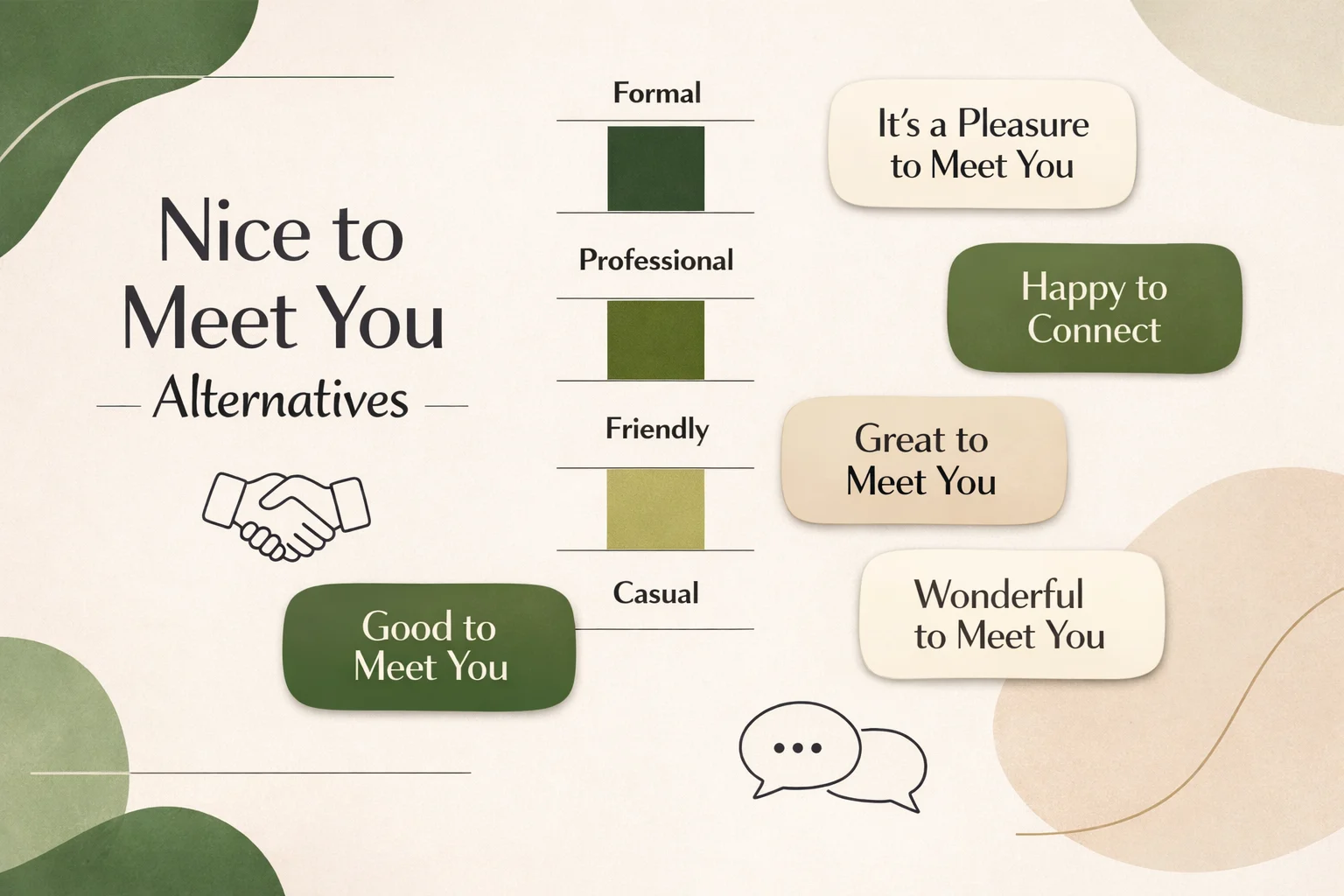
“Nice to meet you” is a polite English greeting used when encountering someone for the first time. It signals warmth, openness, and social courtesy. Whether spoken aloud or written in an email, it helps create a positive first impression.Best alternatives: It’s a pleasure to meet you, Lovely to meet you, Great to meet you, Delighted to make your acquaintance, So glad we finally connected.
Meeting someone new often comes with the familiar phrase “Nice to meet you.” It’s simple, polite, and widely used in both formal and casual situations. However, relying on the same expression every time can make conversations feel repetitive or less personal. That’s why having a variety of alternatives can help you sound more natural, confident, and expressive in different social and professional settings. In this guide, you’ll discover 35+ other ways to say “Nice to meet you,” ranging from formal business-friendly phrases to casual and friendly expressions.
Whether you’re introducing yourself at work, networking at an event, or chatting with someone new in everyday life, these alternatives will help you choose the right tone and leave a stronger first impression.
Why Do People Search “Other Ways to Say Nice to Meet You”?
When someone searches for alternatives to “nice to meet you” or other ways to say nice to meet you, they’re usually trying to do one of three things:
- Sound more professional especially in job interviews, client meetings, or formal emails where “nice” can feel a bit flat.
- Sound more natural native English speakers rarely say “nice to meet you” every single time. Repetition sounds scripted, so people look for fresher, more genuine-sounding options.
- Match the right tone what works in a text to a new friend feels wrong in a board meeting. Understanding which phrase fits which context is the real skill.
This guide covers all three needs. You’ll find professional English phrases, informal expressions in English, email-ready lines, spoken alternatives, and a full tone breakdown so you always know exactly what to say.
The Tone Ladder: From Very Formal to Informal
Before diving into individual phrases, it helps to understand the Tone Ladder a simple ranking system from the most formal expression down to the most casual. Every phrase in this article belongs to one of these five levels.
| Tone Level | What It Sounds Like | Best For |
|---|---|---|
| Very Formal | Polished, traditional, elevated | Executive meetings, diplomatic contexts, written correspondence |
| Formal | Professional, respectful, clean | Job interviews, client introductions, business emails |
| Neutral | Friendly but appropriate anywhere | Networking events, new colleagues, professional small talk |
| Casual | Warm and personal | New acquaintances, social events, friendly workplaces |
| Informal | Relaxed, natural, conversational | Texts, close social circles, casual encounters |
The key insight: tone mismatch is one of the most common communication mistakes. Using a Very Formal phrase in a casual setting sounds stiff. Using an Informal phrase in a job interview can cost you credibility.
Table: Tone Classification of “Nice to Meet You” Alternatives
| Phrase | Tone Level | Formality | Best Situation |
|---|---|---|---|
| It is an honor to make your acquaintance | Very Formal | ★★★★★ | Diplomatic or ceremonial introductions |
| Delighted to make your acquaintance | Very Formal | ★★★★★ | Formal written correspondence |
| I am pleased to meet you | Formal | ★★★★☆ | Business meetings, client intros |
| It’s a pleasure to meet you | Formal | ★★★★☆ | Job interviews, professional networking |
| A pleasure to meet you | Formal | ★★★★☆ | In-person professional first meetings |
| I’m very glad to meet you | Formal | ★★★★☆ | Conference introductions, formal emails |
| It’s wonderful to finally meet you | Neutral | ★★★☆☆ | Meeting someone you’ve communicated with online |
| Great to meet you | Neutral | ★★★☆☆ | Networking events, colleague introductions |
| So good to finally meet you | Neutral | ★★★☆☆ | After email or phone exchanges |
| Lovely to meet you | Neutral | ★★★☆☆ | Friendly professional or social settings |
| Really happy to meet you | Casual | ★★☆☆☆ | Friendly workplaces, new social contacts |
| So glad we finally connected | Casual | ★★☆☆☆ | LinkedIn or social media introductions |
| Good to put a face to the name | Casual | ★★☆☆☆ | When you’ve emailed but never met in person |
| Happy to meet you | Casual | ★★☆☆☆ | Light professional or social settings |
| Always great to meet new people | Casual | ★★☆☆☆ | Group networking, casual events |
| Hey, nice to finally meet! | Informal | ★☆☆☆☆ | Friends of friends, casual social meetups |
| Good to meet you, finally! | Informal | ★☆☆☆☆ | Relaxed, familiar settings |
| Glad we got to meet up | Informal | ★☆☆☆☆ | Casual social introductions |
Quick Selection Guide
Not sure which phrase to use right now? Use this decision block:
- Job interview → It’s a pleasure to meet you or I’m very glad to meet you
- Professional email → I’m delighted to connect or It’s a pleasure to e-meet you
- Networking event → Great to meet you or So good to finally put a face to the name
- LinkedIn message → So glad we’ve connected or Wonderful to connect with you
- Casual social event → Really happy to meet you or Good to finally meet!
- Meeting someone you’ve spoken to online → It’s wonderful to finally meet you in person
- Formal correspondence → Delighted to make your acquaintance or I am pleased to meet you
Real-Life Conversation Transformations
These before-and-after scenarios show how upgrading your greeting changes the entire impression you make.
Scenario 1: Job Interview
Before: “Nice to meet you, thanks for having me.”
After: “It’s a genuine pleasure to meet you. I’ve been looking forward to this conversation.”
Why it works: “Genuine pleasure” sounds intentional and warm without being over-the-top. Adding “I’ve been looking forward to this” shows preparation and enthusiasm two qualities every interviewer notices.
Scenario 2: Networking Event
Before: “Hi, nice to meet you. I work in marketing.”
After: “Great to meet you I’ve heard a lot about the work your team is doing. I’m [Name], I lead content strategy at [Company].”
Why it works: Moving straight from greeting to a specific, genuine comment shows you’ve done your homework and creates an instant conversation hook.
Scenario 3: Professional Email
Before: “Nice to meet you via email! I wanted to reach out about…”
After: “It’s a pleasure to connect with you. I came across your work on [topic] and thought this might be a good moment to introduce myself…”
Why it works: “Nice to meet you via email” is slightly awkward phrasing. “It’s a pleasure to connect” flows naturally in written form and sets a more polished, confident tone.
Scenario 4: Casual Social Introduction
Before: “Nice to meet you.”
After: “So glad we finally got to meet [mutual friend] has told me so much about you!”
Why it works: In casual settings, warmth and personality matter more than formality. Referencing a shared connection instantly creates rapport and makes the greeting memorable.
Other Ways to Say “Nice to Meet You”
Here is the full collection, each one explained with examples, tone ratings, best and worst uses, and context guidance.
1. It’s a pleasure to meet you
Meaning: A warm, refined acknowledgment of the introduction.
Example: “It’s a pleasure to meet you, Dr. Hasan. I’ve admired your research for years.”
Tone: Formal
Best use: Job interviews, meeting senior professionals, client introductions.
Worst use: Casual texts or messages to peers your own age.
Context variability: Works in both spoken and written form. One of the most universally safe choices.
2. Delighted to meet you
Meaning: Expresses genuine happiness at the introduction.
Example: “Delighted to meet you I’ve heard wonderful things.”
Tone: Formal
Best use: Business events, professional correspondence.
Worst use: Casual group chats or text messages, where it reads as stiff.
Context variability: Particularly strong in British English professional contexts.
3. A pleasure to meet you
Meaning: Shortened, slightly clipped version of the above equally polished.
Example: “A pleasure to meet you, Ms. Chen.”
Tone: Formal
Best use: Quick, confident professional introductions.
Worst use: Long emails where it feels abrupt without context.
Context variability: Works well as a standalone opener before getting to business.
4. I’m very glad to meet you
Meaning: Sincere, slightly warmer alternative to “pleased.”
Example: “I’m very glad to meet you I’ve been following your company’s growth closely.”
Tone: Formal
Best use: Client calls, formal networking, opening lines in professional emails.
Worst use: Casual conversation with friends or peers.
Context variability: The word “very” adds genuine warmth without losing formality.
5. Lovely to meet you
Meaning: Expresses warmth and friendliness.
Example: “Lovely to meet you! I didn’t know [mutual friend] had such interesting colleagues.”
Tone: Neutral
Best use: Social-professional crossover events, friendly office introductions.
Worst use: Formal executive meetings or written client correspondence.
Context variability: Very common in British English; slightly less typical in American usage.
6. Great to meet you
Meaning: Enthusiastic, open, and energetic greeting.
Example: “Great to meet you, Jamie I’ve heard you’re the person to talk to about data science.”
Tone: Neutral
Best use: Networking events, informal business meetings, new colleague introductions.
Worst use: Very formal or ceremonial contexts.
Context variability: Extremely versatile. Works for 80% of everyday introductions.
7. It’s wonderful to finally meet you
Meaning: Signals you’ve been looking forward to the meeting, adding extra warmth.
Example: “It’s wonderful to finally meet you we’ve been emailing for months!”
Tone: Neutral
Best use: Meeting someone after a period of online-only communication.
Worst use: Meeting a complete stranger for the first time with no prior exchange.
Context variability: The word “finally” is the key ingredient use it only when there truly was anticipation.
8. So good to finally put a face to the name
Meaning: A warm, relatable phrase acknowledging that you knew of this person before meeting.
Example: “So good to finally put a face to the name! I’ve been reading your emails for six months.”
Tone: Casual / Neutral
Best use: When meeting someone you’ve communicated with remotely.
Worst use: Cold introductions with zero prior context.
Context variability: Very natural in spoken English; slightly informal for formal written communication.
9. It’s an honor to meet you
Meaning: Communicates deep respect and admiration.
Example: “It’s truly an honor to meet you your research changed the way I think about this field.
Tone: Very Formal
Best use: Meeting someone you deeply admire an industry leader, mentor, or public figure.
Worst use: Regular professional introductions, where it can sound sycophantic.
Context variability: Reserve this for moments where you genuinely mean it.
10. I’ve been looking forward to meeting you
Meaning: Communicates anticipation and enthusiasm.
Example: “I’ve been looking forward to meeting you since your talk at last year’s conference.”
Tone: Formal / Neutral
Best use: Planned professional meetings, job interviews, conference introductions.
Worst use: Unplanned or spontaneous meetings.
Context variability: Works especially well when you can follow up with a specific reason.
11. Pleased to make your acquaintance
Meaning: Highly traditional and formal introduction phrase.
Example: “Pleased to make your acquaintance, Professor Malik.”
Tone: Very Formal
Best use: Academic, legal, diplomatic, or ceremonial settings.
Worst use: Anywhere casual it will sound theatrical.
Context variability: Rarely heard in everyday speech; use deliberately for elevated effect.
12. Happy to meet you
Meaning: Simple, light, friendly expression of goodwill.
Example: “Happy to meet you, and excited to hear more about your project.”
Tone: Casual
Best use: Light professional settings, new colleague introductions, social events.
Worst use: Very formal or high-stakes meetings.
Context variability: A safe, neutral-leaning casual phrase that won’t offend anyone.
13. So glad we finally connected
Meaning: Warm acknowledgment, often used in digital or post-digital contexts.
Example: “So glad we finally connected I’ve been meaning to reach out for a while.
Tone: Casual
Best use: LinkedIn, email follow-ups, remote introductions.
Worst use: First-ever in-person meetings with strangers.
Context variability: Particularly common in online professional circles.
14. It’s great to connect
Meaning: Modern, widely-used phrase in professional digital communication.
Example: “It’s great to connect! I came across your work on sustainable logistics and immediately wanted to reach out.”
Tone: Neutral
Best use: LinkedIn messages, virtual meetings, email introductions.
Worst use: In-person introductions “connect” sounds digital in spoken contexts.
Context variability: A go-to phrase for remote or hybrid professional environments.
15. Wonderful to meet you
Meaning: Expressive and warm, with slightly more energy than “nice.”
Example: “Wonderful to meet you I had no idea we were both working in the same space.”
Tone: Neutral
Best use: Networking events, friendly professional circles.
Worst use: Formal written correspondence where it may read as overly effusive.
Context variability: Sounds natural in both British and American English.
16. Really happy to meet you
Meaning: Casual, genuine, and warm.
Example: “Really happy to meet you any friend of Tariq’s is a friend of mine.”
Tone: Casual
Best use: Social introductions, relaxed workplaces.
Worst use: Formal professional meetings.
Context variability: The word “really” signals genuine emotion rather than rote politeness.
17. Good to meet you
Meaning: Short, direct, natural-sounding.
Example: “Good to meet you. I’ve heard you’re doing great things over at the design team.”
Tone: Neutral
Best use: Quick, confident professional or casual introductions.
Worst use: Very formal settings where more warmth is expected.
Context variability: One of the most natural-sounding options in spoken English.
18. I’m so pleased to meet you
Meaning: Formal yet warm expression.
Example: “I’m so pleased to meet you your presentation this morning was exceptional.”
Tone: Formal
Best use: Following someone’s talk or presentation, formal events.
Worst use: Casual everyday introductions where it sounds excessive.
Context variability: Works well as a follow-up greeting, not just a first opener.
19. Thrilled to meet you
Meaning: Expresses high enthusiasm and excitement.
Example: “Thrilled to meet you I’ve admired your startup since the very beginning.”
Tone: Casual / Neutral
Best use: Meetings with someone you’re a genuine fan of professionally.
Worst use: Contexts where calm professionalism is more appropriate.
Context variability: Can read as slightly over-the-top; best used authentically.
20. It’s a privilege to meet you
Meaning: Signals deep respect, stronger than “pleasure.”
Example: “It’s a privilege to meet you, Dr. Noor your policy work has influenced my career.”
Tone: Very Formal
Best use: Meeting a mentor, a renowned expert, or an influential figure.
Worst use: Everyday business introductions.
Context variability: Use sparingly save it for people who genuinely merit the weight.
21. Glad to meet you
Meaning: Warm and simple.
Example: “Glad to meet you pull up a chair and let’s talk.”
Tone: Casual / Neutral
Best use: Everyday professional and social introductions.
Worst use: Formal written correspondence.
Context variability: Sounds relaxed and confident good for making others feel at ease.
22. It’s nice to finally meet you in person
Meaning: Specifically for transitioning from remote/online to face-to-face.
Example: “It’s so nice to finally meet you in person after all those video calls!”
Tone: Neutral
Best use: First in-person meeting after virtual communication.
Worst use: First-ever contact with no prior digital relationship.
Context variability: “In person” is the keyword only use it when that contrast is real and meaningful.
23. I’ve heard so much about you
Meaning: Signals that someone important has spoken highly of this person.
Example: “I’ve heard so much about you from Aisha all wonderful things, I promise.”
Tone: Casual / Neutral
Best use: Being introduced through a mutual contact.
Worst use: Cold introductions with no shared connection.
Context variability: Always soften it with something positive “all good things!” prevents awkwardness.
24. What a pleasure this is
Meaning: Slightly dramatic, elevated greeting that emphasizes the moment.
Example: “What a pleasure this is I’ve been hoping we’d cross paths at this conference.”
Tone: Formal
Best use: Events, launches, and formal meetings where some ceremony is appropriate.
Worst use: Routine daily introductions.
Context variability: Creates a memorable first impression when used at the right moment.
25. Glad we got to meet
Meaning: Post-meeting acknowledgment sometimes used at the end of a first encounter rather than the beginning.
Example: “Glad we got to meet today let’s stay in touch.”
Tone: Casual
Best use: Closing a first conversation, wrapping up a networking chat.
Worst use: As an opening greeting before conversation starts.
Context variability: This one works uniquely well as a farewell rather than a hello.
26. It’s a joy to meet you
Meaning: Warm, genuine, slightly elevated.
Example: “It’s a joy to meet you your energy is exactly what our team needs.”
Tone: Formal / Neutral
Best use: Welcoming someone new to a team, mentoring introductions.
Worst use: Stiff, transactional business meetings.
Context variability: Particularly suitable when meeting someone you’ve helped onboard or invite.
27. Really glad to make your acquaintance
Meaning: A modern-casual blend of formal vocabulary and easy tone.
Example: “Really glad to make your acquaintance I didn’t realize we’d been in the same industry for years without meeting.”
Tone: Neutral
Best use: Events where mixing formal and casual is expected industry dinners, hybrid networking.
Worst use: Very formal correspondence or very casual texting.
Context variability: The “really” softens the formality of “acquaintance” effectively.
28. I’m honored to finally meet you
Meaning: Strong, sincere expression of admiration.
Example: “I’m honored to finally meet you your book changed how I approach leadership.”
Tone: Very Formal
Best use: Meeting a respected author, leader, or mentor.
Worst use: Standard professional introductions.
Context variability: Must feel genuine or it reads as flattery.
29. Always good to meet new people
Meaning: Open, friendly, non-specific welcoming toward any introduction.
Example: “Always good to meet new people! What brings you to this event?”
Tone: Casual
Best use: Group networking, social events, casual professional mixers.
Worst use: Formal one-on-one business introductions.
Context variability: Works well to open a broader conversation about why you’re both somewhere.
30. Pleased to meet you
Meaning: Clean, classic, polite alternative that never goes out of style.
Example: “Pleased to meet you, Mr. Okonkwo. I’ve read your column for years.”
Tone: Formal
Best use: Conservative professional environments, formal written introductions.
Worst use: Casual socializing where it can sound overly restrained.
Context variability: Safe everywhere; memorable nowhere use when you want reliability over flair.
31. So nice to finally meet
Meaning: Casual and warm good when there’s been anticipation.
Example: “So nice to finally meet we’ve been in the same WhatsApp group for months!”
Tone: Casual
Best use: Social and professional casual settings after online-only contact.
Worst use: First-time cold introductions.
Context variability: The informality of “so” and the dropped “you” signals genuine warmth.
32. I feel like I already know you
Meaning: Signals familiarity through shared connections or prior knowledge.
Example: “I feel like I already know you [Name] talks about you constantly!”
Tone: Informal
Best use: Being introduced by a close mutual friend.
Worst use: Professional, formal, or cold introductions.
Context variability: Very conversational best used only when genuinely true.
33. It’s so good to meet you
Meaning: Enthusiastic, warm, natural in everyday spoken English.
Example: “It’s so good to meet you I almost reached out online last year but missed you.”
Tone: Casual / Neutral
Best use: Everyday professional and social introductions.
Worst use: Formal written correspondence.
Context variability: One of the most natural-sounding casual options in both British and American English.
34. Glad to make your acquaintance
Meaning: Slightly formal, respectful, and clear.
Example: “Glad to make your acquaintance, Professor I’m a first-year in your department.”
Tone: Formal / Neutral
Best use: Academic, formal business, or professional settings.
Worst use: Casual social circles where it sounds stiff.
Context variability: Works better in spoken form than in text, where it can feel overwrought.
35. Exciting to meet you
Meaning: Signals enthusiasm and energy.
Example: “Exciting to meet you! I had no idea you were working on this problem too.”
Tone: Casual
Best use: Enthusiastic, energetic settings startup events, creative industries.
Worst use: Conservative, formal, or traditional business environments.
Context variability: Very fresh and engaging when genuine avoid it if it’s not your natural register.
Table: Spoken vs. Written Usage Comparison
| Phrase | Spoken Use | Written Use | Context |
|---|---|---|---|
| It’s a pleasure to meet you | Excellent | Excellent | Universal professional |
| Great to meet you | Excellent | Good | Networking, emails |
| Delighted to make your acquaintance | Okay | Excellent | Formal correspondence |
| Good to put a face to the name | Excellent | Avoid | In-person only |
| It’s great to connect | Okay | Excellent | LinkedIn, virtual meetings |
| I feel like I already know you | Excellent | Avoid | In-person social |
| Pleased to meet you | Good | Good | Safe universal option |
| Thrilled to meet you | Good | Avoid | Sounds exaggerated in writing |
| So glad we finally connected | Okay | Excellent | Digital introductions |
| A pleasure to meet you | Excellent | Excellent | Professional all-purpose |
Email + LinkedIn Ready Expressions
Professional Email Greetings
- “It’s a pleasure to connect with you via email.”
- “I’m delighted to introduce myself I’m [Name], and I lead [role] at [company].”
- “It’s wonderful to finally be in touch.”
- “I’m reaching out to introduce myself and express how glad I am to connect.”
LinkedIn Connection Messages
- “So glad we’ve connected here I’ve been following your work on [topic] for some time.”
- “Wonderful to connect with you. Your post on [subject] really resonated with me.”
- “Great to finally connect! I’d love to learn more about your experience in [field].”
Follow-Up Lines After First Meeting
- “It was truly a pleasure meeting you at [event] I’m looking forward to continuing our conversation.”
- “I’m so glad we got to meet yesterday. I’d love to explore how we might work together.”
- “Delightful meeting you last week let’s find time to connect more formally.”
Native Speaker Insight Box
What native English speakers actually say:
- In casual conversation, native speakers almost always shorten greetings: “Great to meet you!” or “Good to meet you!” rather than the full “It is nice to meet you.”
- In professional British English, “Lovely to meet you” and “Delighted to meet you” are very common and well-regarded.
- In American English, “Great to meet you” and “Good to meet you” dominate everyday professional speech.
- “Pleased to meet you” sounds slightly dated in casual American English it’s still correct but can feel textbook-stiff.
- The full phrase “It is nice to meet you” (uncontracted) sounds oddly formal in spoken English native speakers nearly always say “It’s nice to meet you” or skip “nice” entirely.
- What sounds unnatural: “I am very nice to meet you” (grammar error extremely common ESL mistake), “Nice meeting to you” (wrong word order), “It was nice to meet you” at the start of a conversation (this is a closing phrase, not an opener).
Common Mistakes + What Not to Say
1. “I am very nice to meet you”
This is one of the most common mistakes among English learners. The subject is wrong you are meeting them, so the correct structure is: “It is very nice to meet you” or “I am very pleased to meet you.”
2. Using “nice to meet you” in reply to itself
When someone says “Nice to meet you,” replying with “Nice to meet you” is repetitive. Better responses: “Likewise,” “The pleasure is mine,” “Same here,” or “Mutual.”
3. Over-formal phrases in casual settings
Saying “I am delighted to make your acquaintance” to a new friend at a party will get laughs for the wrong reasons. Match your register to the environment.
4. “It was nice to meet you” as an opener
This is a closing phrase used when leaving someone, not meeting them. Don’t confuse the two; it creates a confusing and slightly rude impression.
5. “Pleased to meet you too” in writing
In emails, “too” adds nothing and can read as slightly passive or rushed. Use “The pleasure is mine” or “Likewise, it’s a pleasure to connect” instead.
Expansion Phrases: Related Expressions to Know
Beyond direct alternatives to “nice to meet you,” here are related English greeting phrases that expand your expressive range:
- When leaving after a first meeting:
“It was wonderful meeting you.” / “Really glad we got to talk.” / “Hope we cross paths again soon.” - Welcoming someone new:
“We’re so glad to have you here.” / “Thrilled to have you join us.” - Group introductions:
“Everyone, I’d love to introduce [Name]…” / “I don’t think you’ve all met [Name] yet…” - Online/virtual first meetings:
“It’s great to finally see your face!” / “Nice to meet you properly at last.” - When a mutual friend introduces you:
“I’ve heard brilliant things so happy to put a face to the name.”
Table: Situation-to-Phrase Decision Table
| Situation | Best Phrase | Why It Works |
|---|---|---|
| Job interview | It’s a pleasure to meet you | Polished, professional, sets confident tone |
| First email to a new contact | It’s a pleasure to connect with you | Natural in written form, warm but professional |
| LinkedIn introduction | So glad we’ve connected | Feels authentic, platform-appropriate |
| Meeting someone after video calls | It’s wonderful to finally meet you in person | Acknowledges prior relationship |
| Casual networking mixer | Great to meet you | Energetic, friendly, universally natural |
| Meeting a mentor or senior leader | It’s truly an honor to meet you | Signals appropriate respect |
| Being introduced by a mutual friend | I’ve heard so much about you all great things | Creates immediate warmth and shared context |
| Group event / conference | Always good to meet new people | Opens a wider conversation naturally |
| First encounter, no shared context | A pleasure to meet you | Safe, elegant, requires no explanation |
| Wrapping up a first conversation | It was so wonderful meeting you | Closes on a warm, memorable note |
Top 10 Best Alternatives
- It’s a pleasure to meet you
- Great to meet you
- Delighted to meet you
- Wonderful to finally meet you
- So glad we connected
- Lovely to meet you
- Good to put a face to the name
- I’m so pleased to meet you
- Really happy to meet you
- A pleasure to meet you
Mini Quiz: Test Your Knowledge
1. You’re at a job interview. Which phrase is most appropriate?
- a) Hey, nice to finally meet!
- b) It’s a pleasure to meet you.
- c) I feel like I already know you.
- d) Always good to meet new people.
(Answer: b)
2. You’ve been emailing a client for three months and are meeting them in person for the first time. Which phrase fits best?
- a) Pleased to make your acquaintance.
- b) It’s an honor to meet you.
- c) It’s wonderful to finally meet you in person.
- d) Glad to meet you.
(Answer: c)
3. A new colleague has just joined your casual, creative-industry team. Which greeting is most natural?
- a) I am delighted to make your acquaintance.
- b) Really happy to meet you welcome to the team!
- c) It is an honor to meet you.
- d) What a privilege this is.
(Answer: b)
4. Someone says “Nice to meet you” to you for the first time. What should you NOT say?
- a) Likewise!
- b) The pleasure is mine.
- c) It was nice to meet you too.
- d) Great to meet you too.
(Answer: c “It was nice to meet you” is a farewell phrase, not a response to a greeting.)
FAQs
Is it polite to say “nice to meet you”?
Yes “nice to meet you” is perfectly polite and widely understood. However, in formal professional settings, alternatives like “It’s a pleasure to meet you” or “Delighted to meet you” often make a stronger impression. “Nice to meet you” is most natural in everyday spoken English.
What is more professional than “nice to meet you”?
“It’s a pleasure to meet you,” “Delighted to meet you,” “I’m very pleased to meet you,” and “A pleasure to make your acquaintance” all rank higher on the formality scale. For written communication, “It’s a pleasure to connect with you” is particularly effective.
Can I use “it’s a pleasure to meet you” in an email?
Absolutely. “It’s a pleasure to connect with you” and “It’s a pleasure to introduce myself” are both strong email openers. Avoid “nice to meet you via email” the phrasing sounds awkward in writing.
What do native speakers say instead of “nice to meet you”?
In everyday speech, native speakers most commonly say “Great to meet you,” “Good to meet you,” or “Lovely to meet you” (British English). The full phrase “It is nice to meet you” sounds formal and slightly stilted in spoken contexts.
What is the best alternative for LinkedIn messages?
“So glad we’ve connected,” “It’s great to connect with you,” and “Wonderful to connect with you” all work well on LinkedIn. They’re professional, warm, and platform-appropriate without sounding stiff.
Is “pleased to meet you” old-fashioned?
In casual American English, yes it can sound slightly dated or textbook-formal. However, in British English and professional settings worldwide, it remains completely appropriate and respected.
Conclusion
The phrase “nice to meet you” does its job but it rarely leaves a lasting impression. With the right alternative, your greeting can set a tone, signal respect, convey warmth, and open a real conversation before the second sentence even begins. The difference between “Nice to meet you” and “It’s truly wonderful to finally meet you in person” isn’t just vocabulary it’s intention, presence, and professional self-awareness.
The real skill isn’t memorizing every phrase on this list. It’s understanding the Tone Ladder, reading the room, and choosing the greeting that matches the moment. Practice these expressions in real situations use one new phrase per week and you’ll quickly find that first impressions become one of your strongest professional tools.
4 thoughts on “35+ Other Ways to Say “Nice to Meet You” | Formal to Casual In 2026”