⚡ Quick Answer
“I appreciate you” is a warm, direct way to thank someone for their support, kindness, or presence in your life. It works in both personal and professional settings, but repeating the same phrase over and over can start to feel flat and automatic.5 Best Alternatives: Thank you for everything you doI’m grateful for youYour support means so much to meI value you more than you knowI couldn’t have done this without you
Saying “I appreciate you” is simple and sincere but it’s also one of the most repeated phrases in both personal and professional life. Whether you’re thanking a colleague for their support, writing a heartfelt note to a friend, or closing out a professional email, the right alternative can make your gratitude feel more specific, more genuine, and far more memorable. This guide breaks down 35+ Other Ways to Say “I Appreciate You” natural ways to express appreciation, organized by tone, situation, and real-life context.
Why People Search for Other Ways to Say “I Appreciate You”
People look for alternatives to this phrase for a few clear reasons. Some want to avoid sounding repetitive after using “I appreciate you” too many times in emails or conversations. Others are searching for professional English phrases that sound polished in a formal work setting, such as a performance review or a thank-you email to a manager. And many are simply looking for more heartfelt, informal expressions in English to use with friends, family, or partners.
There’s also a real difference between spoken and written usage. In conversation, shorter and warmer phrases like “Seriously, thank you” or “You’re amazing” feel natural. In writing especially professional emails or LinkedIn messages fuller expressions like “Your support has meant a great deal to me” carry more weight and read as more considered.
Ultimately, anyone searching for alternatives to “I appreciate you” wants the same outcome: language that matches the emotional weight of the moment, instead of defaulting to a phrase that’s become automatic.
The Tone Ladder: From Very Formal to Informal
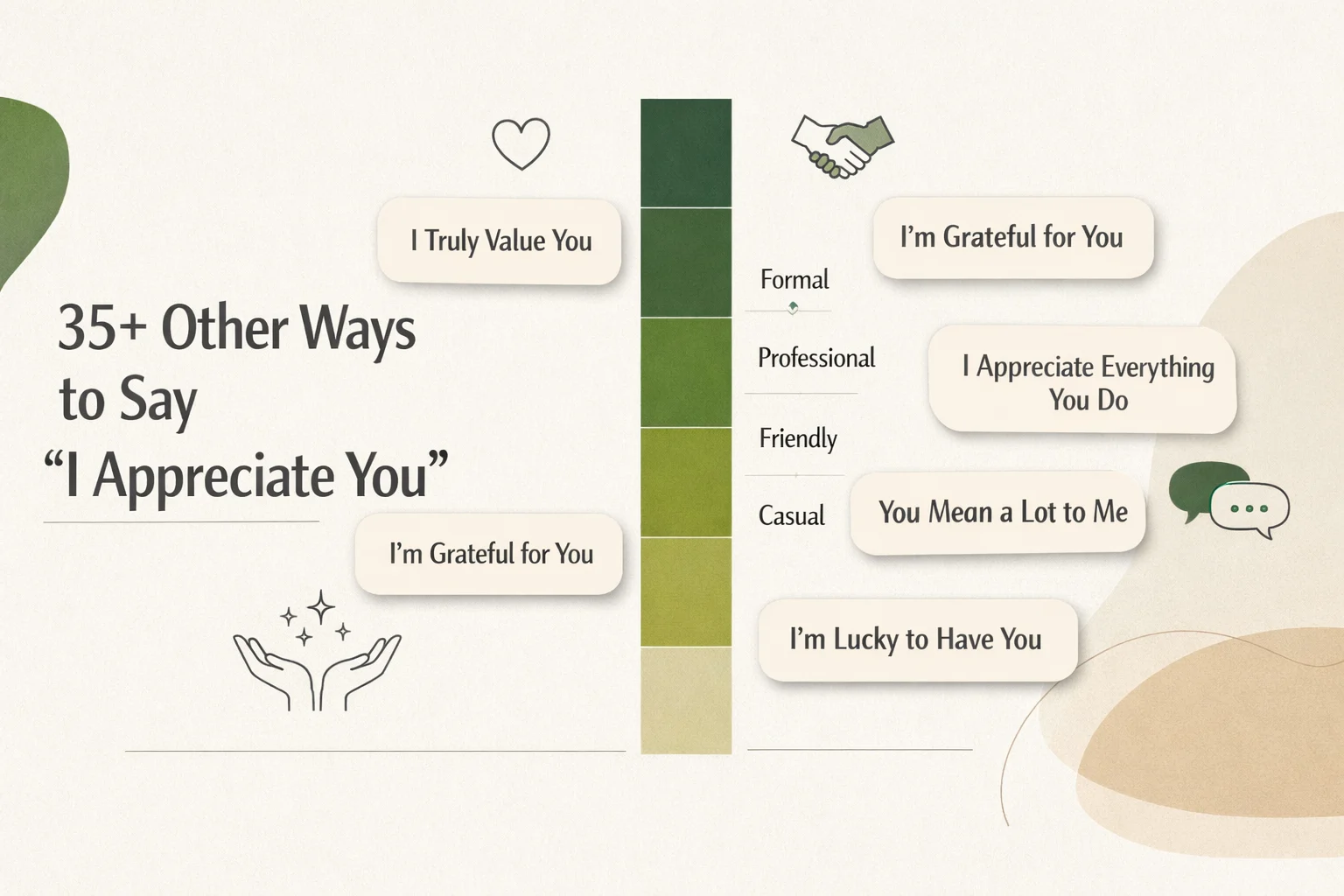
Not every expression of appreciation belongs in every situation. An overly formal phrase with a close friend can feel distant, while a casual phrase in a business email can feel unprofessional. Here’s how the spectrum breaks down:
Very Formal”I would like to express my sincere gratitude for your support.”Official Letters / Recognition
Formal”I sincerely appreciate everything you have done.”Performance Reviews / Work Emails
Neutral”I’m really grateful for your help.”Everyday Personal & Professional
Casual”I appreciate you so much!”Colleagues / Friendly Relationships
Informal”You’re the best, seriously.”Close Friends / Family
For spoken English, casual and neutral phrases sound the most natural they mirror how people actually talk in real time. For written communication, formal and neutral phrases generally work best, since they read as more intentional and polished.
Table: Tone Classification of Key Alternatives
| Phrase | Tone Level | Formality | Best Situation |
|---|---|---|---|
| I sincerely appreciate everything you have done | Formal | High | Performance reviews, professional emails |
| I would like to express my gratitude | Very Formal | Very High | Official letters, formal recognition |
| I’m so grateful for your support | Neutral | Medium | Everyday personal and professional use |
| Thank you for always being there | Neutral | Medium | Friends, family, close colleagues |
| I appreciate you more than you know | Casual | Low–Medium | Friends, partners, supportive colleagues |
| You have no idea how much this means to me | Casual | Low | Personal relationships, heartfelt moments |
| You’re the best, honestly | Informal | Very Low | Close friends, casual texts |
| I owe you one | Informal | Very Low | Casual favors, informal conversations |
Quick Selection Guide: Choose the Right Phrase Instantly
Workplace Email
“I sincerely appreciate your support on this project.”
Professional, specific, and reads naturally in writing.
Performance Review
“I want to express my sincere gratitude for your dedication.”
Formal enough for documentation, still feels personal.
Networking
“I’m really grateful for your guidance and support.”
Neutral, professional tone for mentors and contacts.
Close Friend or Family
“I appreciate you more than you know.”
Carries warmth and emotional sincerity.
Casual Conversation
“Seriously, you’re the best. Thank you.”
Short, natural, fits everyday spoken rhythm.
Thank-You Card
“Your kindness has not gone unnoticed.”
Reads warmly and sincerely on paper.
Real-Life Conversation Transformations
Seeing these phrases in context makes the difference between sounding generic and sounding genuine. Here are four “Before → After” scenarios.
Scenario 1: Workplace Email
❌ Before
“Thanks for your help. I appreciate you.” (Flat, generic, easy to forget.)
✅ After
“I sincerely appreciate the time you took to walk me through this project. Your guidance made a real difference, and I just wanted you to know that.” (Specific, professional, memorable.)
Scenario 2: Performance Recognition
❌ Before
“Good job, I appreciate you.” (Vague no detail about what was valued.)
✅ After
“I want to recognize the dedication you’ve shown this quarter. Your consistency and attention to detail have not gone unnoticed, and I am sincerely grateful for everything you bring to this team.” (Names the specific behavior, makes the recognition feel earned.)
Scenario 3: Close Friendship
❌ Before
“Thanks, I appreciate you.” (Polite but emotionally distant.)
✅ After
“Honestly, I don’t know what I would do without you. You’ve shown up for me in ways I won’t forget, and I appreciate you more than words can really say.” (Matches the emotional depth of a close relationship.)
Scenario 4: Casual Text Message
❌ Before
“I appreciate you.” (Sent alone, sounds oddly formal or even sarcastic in texting.)
✅ After
“Okay but seriously, you’re the best. Thank you for today.” (Matches the natural rhythm and warmth of casual texting.)
35+ Other Ways to Say “I Appreciate You”
Each entry below includes meaning, tone, the best and worst situations to use it, and a real example sentence.
1. I sincerely appreciate everything you have done.
Formal
A formal, heartfelt thank-you that acknowledges effort over time.
“I sincerely appreciate everything you have done to support this team during a difficult quarter.”
Best: Workplace recognition, formal emails
Avoid: Casual texting between friends
2. I would like to express my sincere gratitude.
Very Formal
A very formal way to acknowledge appreciation, often in official communication.
“I would like to express my sincere gratitude for your continued mentorship.”
Best: Official letters, formal recommendations
Avoid: Everyday conversation
3. I’m so grateful for your support.
Neutral
A warm, sincere acknowledgment of help received.
“I’m so grateful for your support during the move, it really made things easier.”
Best: Everyday personal and professional situations
Avoid: Extremely formal documentation
4. Thank you for always being there.
Neutral
Recognizes consistency and reliability over time.
“Thank you for always being there, even when things get hard.”
Best: Friends, family, long-term colleagues
Avoid: First-time professional interactions
5. I appreciate you more than you know.
Casual
Expresses depth of gratitude that may be hard to fully put into words.
“I appreciate you more than you know, especially after everything this year.”
Best: Close friendships, supportive partners
Avoid: Formal workplace settings
6. You have no idea how much this means to me.
Casual
Highlights the emotional impact of someone’s actions.
You have no idea how much this means to me thank you for showing up today.
Best: Personal, emotional moments
Avoid: Routine workplace thank-yous
7. Your support means the world to me.
Neutral
A heartfelt phrase emphasizing the significance of someone’s help.
Your support means the world to me, especially during this transition.
Best: Personal relationships, mentorships
Avoid: Brief transactional interactions
8. I owe you one.
Informal
A casual way to acknowledge a favor, implying you’ll return it.
“I owe you one for covering my shift today.”
Best: Casual favors, friendly workplace relationships
Avoid: Formal or hierarchical professional settings
9. I’m forever grateful for you.
Casual
Expresses long-lasting, deep appreciation.
“I’m forever grateful for you and everything you’ve taught me.”
Best: Mentors, close friends, family
Avoid: Brief professional interactions
10. Thank you from the bottom of my heart.
Neutral
A deeply sincere expression of gratitude.
“Thank you from the bottom of my heart for standing by me.”
Best: Emotional, personal moments
Avoid: Routine business correspondence
11. I want you to know how much I value you.
Formal
A direct statement affirming someone’s worth and contribution.
“I want you to know how much I value you on this team.”
Best: Leadership communication, mentorship
Avoid: Very casual settings
12. Your kindness has not gone unnoticed.
Formal
Acknowledges specific thoughtful behavior.
“Your kindness has not gone unnoticed thank you for checking in on me.”
Best: Workplace recognition, thank-you notes
Avoid: Very casual conversations
13. I can’t thank you enough.
Neutral
Expresses gratitude so large it feels difficult to fully express.
“I can’t thank you enough for helping me prepare for this presentation.”
Best: Significant favors or support
Avoid: Minor, routine interactions
14. I’m lucky to have you in my life.
Casual
A personal, affectionate way to express appreciation for someone’s presence.
“I’m lucky to have you in my life, especially on days like this.”
Best: Close friends, family, partners
Avoid: Professional settings
15. I really value your guidance.
Formal
Specifically acknowledges advice or mentorship.
“I really value your guidance throughout this project.”
Best: Mentorship, professional relationships
Avoid: Casual social settings
16. You’ve made such a difference.
Neutral
Highlights tangible impact rather than general gratitude.
“You’ve made such a difference in how smoothly this transition went.”
Best: Workplace recognition, personal support
Avoid: Very brief, transactional thank-yous
17. I appreciate you taking the time.
Formal
Specifically acknowledges someone’s time investment.
“I appreciate you taking the time to review my application.”
Best: Professional emails, follow-ups
Avoid: Deep personal or emotional contexts
18. Thank you for going above and beyond.
Formal
Recognizes effort that exceeded expectations.
“Thank you for going above and beyond to make sure everything ran smoothly.”
Best: Workplace recognition, formal thank-yous
Avoid: Minor everyday favors
19. I’m beyond thankful for you.
Casual
An intensified, heartfelt version of basic gratitude.
“I’m beyond thankful for you and everything you’ve done this year.”
Best: Personal relationships, heartfelt messages
Avoid: Formal business communication
20. Your help truly made a difference.
Neutral
Connects gratitude directly to outcome or impact.
“Your help truly made a difference in getting this project finished on time.”
Best: Professional and personal situations alike
Avoid: Very casual, lighthearted exchanges
21. I don’t know what I’d do without you.
Casual
Expresses strong reliance and gratitude.
“I don’t know what I’d do without you thank you for always having my back.”
Best: Close friends, partners, family
Avoid: Professional or formal settings
22. I’m endlessly grateful.
Neutral
A slightly more elevated, heartfelt version of basic gratitude.
“I’m endlessly grateful for everything you’ve done to support my growth.”
Best: Mentorship, professional appreciation
Avoid: Very casual texting
23. Thank you for your unwavering support.
Formal
Highlights consistency and reliability.
“Thank you for your unwavering support throughout this entire process.”
Best: Professional recognition, formal speeches
Avoid: Casual everyday conversation
24. You’re truly appreciated.
Neutral
A simple, direct affirmation of someone’s value.
“Please know that you’re truly appreciated, today and always.”
Best: Thank-you cards, workplace recognition
Avoid: Very casual spoken conversation
25. I appreciate everything you bring to the table.
Neutral
Acknowledges someone’s overall contribution and value.
“I appreciate everything you bring to the table your perspective is invaluable.”
Best: Workplace teams, collaborative settings
Avoid: Personal, intimate relationships
26. You’ve been a huge support to me.
Neutral
Recognizes someone’s role during a difficult or important time.
“You’ve been a huge support to me throughout this entire transition.”
Best: Personal and professional relationships
Avoid: Extremely formal documentation
27. I appreciate your patience and understanding.
Formal
Specifically acknowledges patience during a slow or difficult process.
“I appreciate your patience and understanding while we sorted this out.”
Best: Customer service, professional communication
Avoid: Casual personal exchanges
28. I’m so thankful our paths crossed.
Casual
Reflects gratitude for the relationship itself, not just one action.
“I’m so thankful our paths crossed you’ve taught me so much.”
Best: Mentors, meaningful personal relationships
Avoid: Brief or transactional interactions
29. You deserve so much recognition for this.
Neutral
Shifts focus to the other person’s effort and deservingness.
“You deserve so much recognition for this your work has been incredible.”
Best: Workplace praise, public recognition
Avoid: Very casual conversation
30. I appreciate you more than words can say.
Casual
Suggests gratitude too significant to fully express in words.
I appreciate you more than words can say thank you for everything.
Best: Heartfelt personal messages
Avoid: Formal business communication
31. Thank you for showing up for me.
Informal
Recognizes someone’s presence and reliability during a specific moment.
“Thank you for showing up for me when I needed it most.”
Best: Close friends, family, partners
Avoid: Professional settings
32. I’m grateful to have someone like you in my corner.
Casual
Highlights a sense of support and partnership.
“I’m grateful to have someone like you in my corner during this project.”
Best: Supportive colleagues, mentors, friends
Avoid: Very formal documentation
33. Your generosity means a lot to me.
Neutral
Specifically acknowledges generosity, whether of time, resources, or effort.
Your generosity means a lot to me thank you for everything you’ve given.
Best: Personal and professional gratitude
Avoid: Very casual, lighthearted exchanges
34. I appreciate your honesty and effort.
Formal
Specifically values transparency and hard work.
“I appreciate your honesty and effort throughout this whole process.”
Best: Professional feedback, performance reviews
Avoid: Purely emotional or personal contexts
35. Thank you, truly.
Neutral
A short, sincere expression of gratitude with added emphasis.
“Thank you, truly, for everything you’ve done this year.”
Best: Closing lines in emails, spoken thank-yous
Avoid: Long, detailed formal documentation
36. I appreciate you beyond measure.
Casual
An elevated, heartfelt way to express significant gratitude.
“I appreciate you beyond measure thank you for standing by me.”
Best: Heartfelt personal messages, cards
Avoid: Brief professional interactions
Table: Spoken vs. Written Usage Comparison
| Phrase | Spoken Use | Written Use | Context |
|---|---|---|---|
| I sincerely appreciate everything you have done | ✅ Natural | ✅ Excellent | Performance reviews, formal emails |
| I’m so grateful for your support | ✅ Very Natural | ✅ Excellent | Everyday personal and professional use |
| I appreciate you more than you know | ✅ Very Natural | ✅ Works well | Close friendships, supportive relationships |
| I owe you one | ✅ Very Natural | ⚠️ Too casual | Casual favors only |
| Thank you for going above and beyond | ✅ Natural | ✅ Excellent | Workplace recognition |
| I can’t thank you enough | ✅ Very Natural | ✅ Excellent | Universal works in nearly any context |
| Your kindness has not gone unnoticed | ⚠️ Slightly formal | ✅ Excellent | Written thank-you notes, professional recognition |
| You’ve made such a difference | ✅ Natural | ✅ Excellent | Workplace and personal contexts |
| I appreciate your patience and understanding | ✅ Natural | ✅ Excellent | Customer service, professional email |
| Thank you, truly | ✅ Natural | ✅ Excellent | Closing lines in emails or conversations |
Email & LinkedIn-Ready Expressions
📧 Professional Thank-You Email
Subject: Thank You for Your Support Dear [Name], I wanted to take a moment to sincerely thank you for everything you have done over the past few months. Your guidance and support have made a real difference, and I genuinely appreciate the time and effort you have invested in helping me succeed. Thank you, truly, for everything. Warm regards, [Your Name]
💼 LinkedIn Thank-You Message
Hi [Name], I just wanted to reach out and say how much I appreciate your support and guidance. Your advice has genuinely shaped how I approach my work, and I’m grateful to have connected with you. Thank you again, and I hope we can stay in touch. Best, [Your Name]
🤝 Follow-Up Appreciation Note
Hi [Name], I wanted to follow up and say thank you again for your help last week. I really value your input, and it made a noticeable difference in how the project turned out. I appreciate you more than I can fully express here. Best regards, [Your Name]
Native Speaker Insight
🗣️ How Native Speakers Actually Use These Phrases
- In everyday speech, native speakers often shorten longer expressions of gratitude. “I appreciate you” frequently becomes “Seriously, thanks” or “You’re the best” in casual conversation, since these feel quicker and more natural in the moment.
- “I appreciate you” on its own, without further explanation, is common in modern English, especially among younger speakers and in workplace culture but it can sometimes feel slightly abrupt without context.
- “I appreciate you” vs. “I appreciate it”: The first refers to the person, the second refers to the action or favor. Native speakers are precise about this distinction even in casual speech.
- What sounds unnatural: Overly formal phrasing used in casual settings saying “I would like to express my sincere gratitude” to a close friend is accurate but creates unnecessary emotional distance.
- Preferred professional alternative: “I sincerely appreciate your support” specific, warm, and appropriately formal without feeling distant.
Common Mistakes & What Not to Say
❌ Wrong: “I appreciate you.” (with no further context, in a formal email)
It can feel abrupt or incomplete in professional writing. A stronger version specifies what’s being appreciated: “I sincerely appreciate the time you took to review this proposal.”
❌ Wrong: Saying “I appreciate you” when you mean “I appreciate it.
This is a common mix-up. “I appreciate you” refers to the person, while “I appreciate it” refers to the action or favor. Confusing the two can muddy what exactly is being thanked.
❌ Wrong: “I would like to express my sincere gratitude.” (in casual texting)
This creates a tone mismatch that can feel cold or even sarcastic in an informal context.
❌ Wrong: “I appreciate you so so so much.”
✅ Better: “I appreciate you so much” or “I’m endlessly grateful for you.”
Excessive repetition weakens sincerity rather than strengthening it. One well-chosen intensifier beats several stacked together.
Expansion Phrases: Related Expressions to Know
These related expressions strengthen your vocabulary around gratitude, greetings, and polite communication:
- Thank you for your kindness
- I’m thankful for everything you do
- Your effort does not go unnoticed
- I appreciate your time and energy
- You have my full gratitude
- Thanks for always supporting me
- I’m grateful for your trust
- Your help made all the difference
- I appreciate your honesty
- Thank you for being so dependable
Table: Situation-Based Decision Table
| Situation | Best Phrase | Why It Works |
|---|---|---|
| Closing a professional email | I sincerely appreciate your support on this. | Formal, specific, and reads naturally in writing |
| Recognizing a colleague’s hard work | Thank you for going above and beyond. | Specifically acknowledges effort beyond expectations |
| Thanking a mentor | I really value your guidance. | Professional yet warm, ideal for ongoing relationships |
| Messaging someone on LinkedIn | I appreciate your support and guidance. | Matches the platform’s professional but personable tone |
| Thanking a close friend | I appreciate you more than you know. | Emotionally warm and appropriate for personal relationships |
| Responding to a small favor | I owe you one. | Light, casual, and fits everyday spoken English |
| Writing a thank-you card | Your kindness has not gone unnoticed. | Reads warmly and sincerely in written form |
| Acknowledging consistent support | Thank you for always being there. | Recognizes reliability over time |
| Closing a heartfelt message | Thank you, truly, for everything. | Short, sincere, and works as a strong closing line |
| Thanking someone in a formal speech | I would like to express my sincere gratitude. | Matches the elevated tone expected in formal settings |
⚡ Top 10 Best Alternatives Quick Reference
- I sincerely appreciate everything you have done.
- I’m so grateful for your support.
- Thank you for going above and beyond.
- I appreciate you more than you know.
- I can’t thank you enough.
- Your kindness has not gone unnoticed.
- I really value your guidance.
- You’ve made such a difference.
- Thank you for always being there.
- Thank you, truly.
Mini Quiz: Test Your Understanding
1. You’re closing a formal email to a manager who supported you through a difficult project. Which phrase fits best? A. “I owe you one.” B. “I sincerely appreciate your support throughout this project.” C. “You’re the best, honestly.” D. “Thanks, I appreciate you.”Check Answer
2. A close friend helped you move apartments over the weekend. Which response fits best? A. “I would like to express my sincere gratitude.” B. “I appreciate your patience and understanding.” C. “I don’t know what I’d do without you, thank you for today.” D. Your generosity means a lot to me.”Check Answer
3. You’re writing a LinkedIn message to someone who gave you career advice. Which phrase fits best? A. “I owe you one.” B. “I appreciate your guidance and support.” C. “Thanks, I appreciate you.” D. “You deserve so much recognition for this.”Check Answer
4. Which phrase represents a common mistake when used in a formal business email? A. “I sincerely appreciate everything you have done.” B. “I appreciate you taking the time.” C. “I appreciate you so so so much.” D. “Thank you for your unwavering support.”Check Answer
FAQs
Is it polite to say “I appreciate you”?
Yes, it’s generally considered polite and sincere. In formal professional writing, though, it often works better paired with specific context what exactly you’re appreciating.
What is more professional than saying “I appreciate you”?
Phrases like “I sincerely appreciate your support” or “I would like to express my gratitude” are more formal and read as more polished in professional emails and official communication.
Can I use “I appreciate you” in an email?
Yes it works well in emails, especially when followed by specific details about what’s being appreciated. “I appreciate you taking the time to review my proposal” is more effective than the standalone phrase alone.
What do native speakers say instead of “I appreciate you”?
Native speakers often use shorter, more casual alternatives in conversation, such as “Seriously, thank you,” “You’re the best,” or simply “I appreciate it” when referring to a specific action rather than the person.
What’s the best alternative for a thank-you card?
“Your kindness has not gone unnoticed” or “I’m endlessly grateful for you” both work especially well in written thank-you cards, since they carry warmth and read naturally on paper.
Conclusion
Expressing appreciation well is about more than finding a synonym it’s about matching the emotional weight and formality of the moment to the right words. Whether you’re thanking a manager in a formal email, recognizing a colleague’s hard work, or letting a close friend know how much they mean to you, the phrases in this guide give you the flexibility to sound genuine in every context.
The most important takeaway is to stay aware of tone. A phrase that works beautifully in a heartfelt text message may feel out of place in a formal recognition letter, and the reverse is just as true. With consistent practice and attention to context, expressing gratitude will start to feel less like a formality and more like a natural, meaningful part of how you communicate.
Read More Related Articles:
- 30+ Other Ways to Say “It Was Good to See You Again” | For Any Occasion In 2026
- 35+ Other Ways to Say “Happy Monday” | Positive Workplace Communication In 2026
- 50+ Other Ways to Say Happy Friday | Alternatives for Every Situation In 2026

Caleb Dawson is a content writer at synoseek.com, where he works on simple, reader-focused articles across a range of everyday topics. His writing style is practical and grounded, aiming to present information in a clear and relatable way without unnecessary complexity.