Quick Answer
“Thank you so much” is a warm, emphatic expression of gratitude used in both personal and professional situations. It goes slightly beyond a simple “thank you” by adding emotional weight and sincerity.The 5 best alternatives are: I truly appreciate it, I’m so grateful, I can’t thank you enough, Many thanks, and I really appreciate your help.
Saying “thank you so much” is something most of us do dozens of times a day in emails, conversations, messages, and meetings. But when the same phrase repeats itself endlessly, it starts to lose its meaning. This guide gives you 40+ Other Ways to Say “Thank You So Much” natural, well-calibrated alternatives so your gratitude always lands with the right weight, in the right tone, for the right moment.
What People Are Really Looking For When They Search 40+ Other Ways to Say “Thank You So Much”
When someone searches “other ways to say thank you so much,” they are usually not looking for a simple synonym list.
- They want something more specific.
- They want to know which phrase fits a formal email versus a casual text.
- They want to sound natural, not robotic.
- They want their gratitude to feel genuine, not copied from a template.
The search covers several types of users. Professionals want polished, credible language for workplace emails and client communications. Non-native English speakers want to understand how professional English phrases actually work in context. Writers and communicators want conversational English improvements that help them sound warm and real rather than generic.
There is also a spoken versus written divide that matters here. In conversation, “I really appreciate it” or “That means a lot” sounds natural and effortless. In a formal email to a senior colleague or client, “I sincerely appreciate your time and assistance” carries far more weight. Alternatives to “thank you so much” serve both purposes, but only when matched to the right context.
Informal expressions in English like “You’re a lifesaver” or “I owe you one” work brilliantly among friends but fall completely flat in a professional email. Understanding this distinction is what separates competent communicators from truly skilled ones.
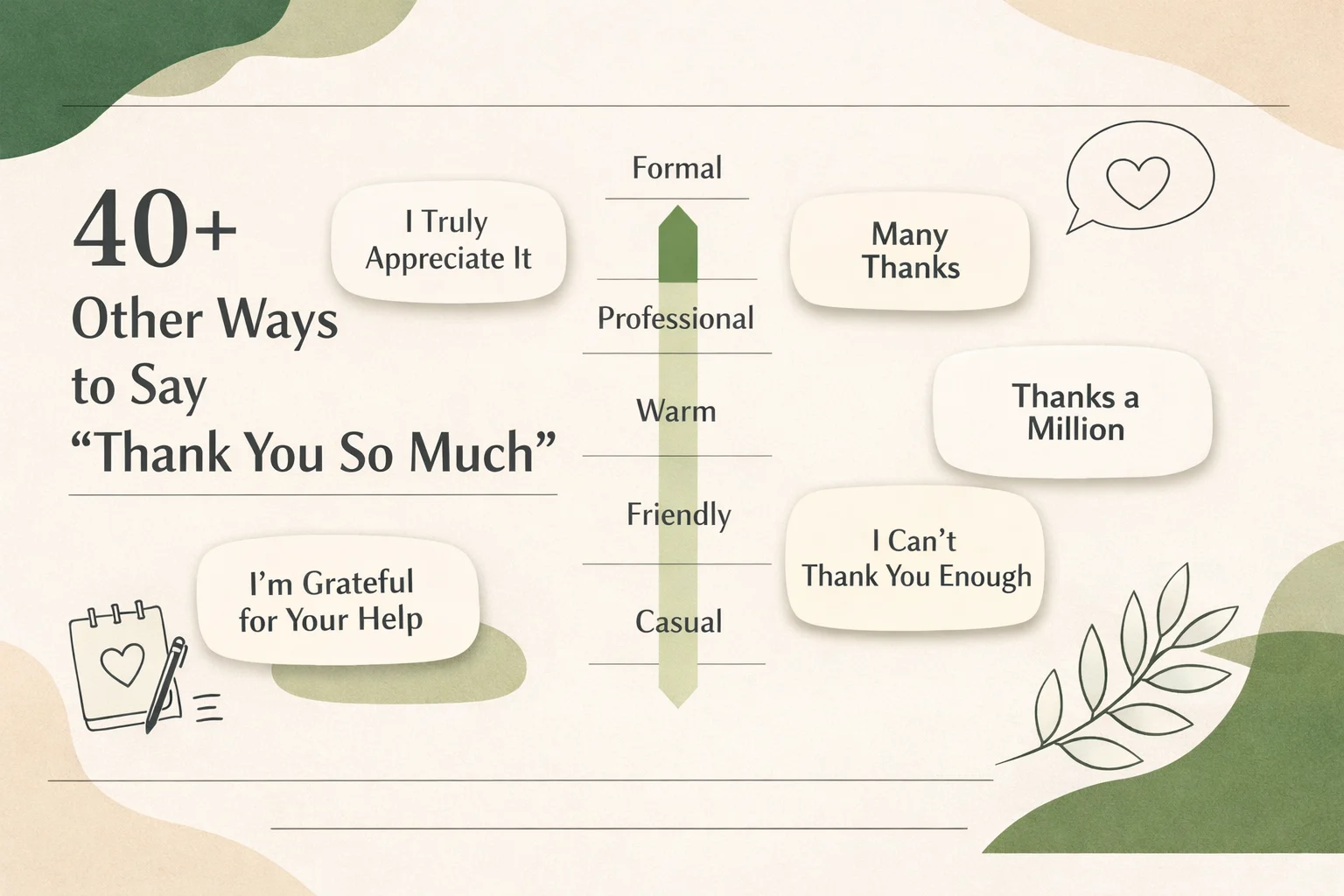
The Tone Ladder: Ranking Every Level of Gratitude Expression
Not all thank-you phrases carry the same weight or fit the same setting. Before choosing your words, it helps to understand where they sit on the tone spectrum.
Very Formal
“I am deeply grateful for your assistance.”
This level is reserved for written communications with executives, clients, academic or legal professionals, and anyone where maximum respect is required. These phrases appear in formal letters, professional reports, and high-stakes emails. They never appear in casual conversation without sounding stiff or even ironic.
Formal
“I sincerely appreciate your time and support.”
This is the everyday professional register. It works in most business emails, client follow-ups, and workplace communications. It sounds polished but not cold. Most professionals live in this tier for their written communication.
Neutral
“I really appreciate it.”
Neutral phrases work in almost any situation. They are appropriate in professional emails to familiar colleagues, spoken in meetings, and used in text messages without sounding out of place. This is the most versatile register and the safest choice when you are unsure.
Casual
“Thanks so much, that was really helpful!”
Casual expressions are warm and energetic. They suit friendly workplace cultures, social-professional conversations, and any interaction where a relaxed tone is welcome. They lose their appeal in formal written communication.
Informal
“You’re the best!” or “I owe you one!”
Informal phrases are for close relationships, friends, family, and teammates in relaxed environments. Using them with a client or senior figure creates an uncomfortable mismatch that can undermine your credibility.
Which sounds most professional? The formal and very formal tiers. Which works best in spoken English? Neutral and casual phrases land most naturally in real-time conversation. Which is best for writing? Formal and neutral phrases, depending on how well you know the recipient.
Table: Tone Classification of Key Alternatives
| Phrase | Tone Level | Formality | Best Situation |
|---|---|---|---|
| I am deeply grateful for your assistance | Very Formal | Very High | Executive emails, formal letters |
| I sincerely appreciate your time and support | Formal | High | Client emails, business communication |
| I truly appreciate everything you have done | Formal | High | Professional follow-ups, thank-you letters |
| Many thanks for your help | Formal | High | Business emails, professional messages |
| I really appreciate it | Neutral | Medium | Colleagues, familiar contacts, spoken use |
| Thank you, that means a great deal to me | Neutral | Medium | Meaningful personal or professional moments |
| I appreciate your time | Neutral | Medium | Meetings, calls, email closings |
| Thanks so much for your help | Casual | Low to Medium | Friendly professional, workplace chats |
| That was incredibly helpful, thank you | Casual | Low to Medium | Informal professional settings |
| You are a lifesaver | Informal | Very Low | Close colleagues, friends, family |
| I owe you one | Informal | Very Low | Friends, casual relationships |
| You really came through for me | Informal | Very Low | Social settings only |
Quick Selection Guide: Choose the Right Phrase in Seconds
Job Interview
Use “I sincerely appreciate the opportunity to speak with you today.” It is formal, respectful, and signals professional maturity.
Follow-Up Email
Use “I truly appreciate your time and look forward to continuing our conversation.” It is warm, professional, and gives them a clear next step.
Networking Event
Use “I really appreciate you taking the time to connect with me this conversation was genuinely valuable.” Neutral tone with personal warmth works best here.
LinkedIn Message
Use “Many thanks for connecting. I really appreciated our chat at the event.” Modern, friendly, and appropriate for the platform.
Casual Conversation With a Colleague
Use “Thanks so much that was really helpful!” Energetic and natural, no need to overthink it.
Text Message to a Friend
Use “You’re a lifesaver, honestly thank you!” Warm, personal, completely appropriate in an informal setting.
Real-Life Conversation Transformations
Seeing how a phrase upgrade actually changes the moment is far more useful than reading a synonym list. Here are four before-and-after scenarios.
Scenario 1: Closing a Job Interview
Before: “Thanks so much for having me.” This is not wrong, but it is forgettable and slightly too casual for the moment.
After: “I sincerely appreciate the opportunity to meet with you today. I’m genuinely excited about this role and look forward to hearing from you.” This is formal, enthusiastic, and leaves a lasting impression.
Scenario 2: Responding to a Helpful Colleague
Before: “Thank you so much!” in a reply-all email with no context. This adds no value and can feel perfunctory.
After: “I really appreciate you pulling those figures together so quickly it made a real difference to the presentation.” Specific gratitude is always stronger than generic phrases.
Scenario 3: Professional Follow-Up Email
Before: “Thanks for your time yesterday.” Flat, minimal, forgettable.
After: “I truly appreciate you taking the time to walk me through the process. Your guidance was incredibly helpful and gave me much greater clarity on the next steps.” Warm, specific, shows they had genuine impact.
Scenario 4: Casual Conversation
Before: “I am deeply grateful for your assistance.” Said to a friend who helped you move furniture this level of formality in a casual setting is jarring and will likely get a laugh for the wrong reasons.
After: “Seriously, you’re a lifesaver I could not have done that without you.” Natural, warm, and proportionate to the situation.
40+ Other Ways to Say “Thank You So Much”
1. I truly appreciate it.
Meaning: A sincere and slightly elevated version of “thank you,” suitable for professional and personal use.
Example: “I truly appreciate everything you’ve done to help me get this off the ground.”
Tone: Formal to Neutral
Best use: Professional emails, spoken thank-yous after meaningful help
Worst use: Very quick, transactional exchanges where it might feel over-the-top
Context variability: Works in both formal writing and natural conversation without adjustment
2. I sincerely appreciate your help.
Meaning: “Sincerely” adds a layer of depth and earnestness that elevates a standard thank-you.
Example: “I sincerely appreciate your help navigating the onboarding process.”
Tone: Formal
Best use: Client emails, workplace communication, formal follow-ups
Worst use: Casual texts or conversations with close friends
Context variability: Well-suited to written communication; slightly stiff in fast-paced spoken conversation
3. I am deeply grateful.
Meaning: Expresses profound, heartfelt appreciation one of the strongest phrases available.
Example: “I am deeply grateful for the support your team provided during this difficult quarter.”
Tone: Very Formal
Best use: Executive-level emails, formal thank-you letters, meaningful personal moments
Worst use: Everyday, routine interactions
Context variability: Reserve for high-stakes or emotionally significant moments; overuse weakens the phrase
4. Many thanks.
Meaning: A concise, British-influenced phrase that conveys polished appreciation without excessive warmth.
Example: “Many thanks for sending the files over so promptly.”
Tone: Formal
Best use: Business emails, professional communications, closings in written messages
Worst use: Verbal thank-yous it sounds unnatural when spoken aloud
Context variability: Strong in written form; rarely used in American professional speech
5. I really appreciate your time.
Meaning: Specifically thanks someone for the resource they gave you their time which carries weight in professional settings.
Example: “I really appreciate your time today. Your advice was genuinely helpful.”
Tone: Neutral
Best use: After meetings, calls, or consultations
Worst use: Thanking someone for a physical gift or non-time-related gesture
Context variability: Works in both spoken and written form seamlessly
6. That means a great deal to me.
Meaning: Moves beyond generic gratitude to express personal significance the gesture or help had real emotional weight.
Example: “Your mentorship over the past year has meant a great deal to me.”
Tone: Neutral to Formal
Best use: Meaningful personal or professional moments, mentorship closings
Worst use: Quick transactional favors
Context variability: Very effective in writing; works spoken but with slightly higher emotional register
7. I can’t thank you enough.
Meaning: Hyperbolically expresses that no amount of thanks feels adequate signals deep appreciation.
Example: “I can’t thank you enough for covering for me last week it meant everything.”
Tone: Neutral to Casual
Best use: Significant personal favors, moments of genuine relief or gratitude
Worst use: Routine help or minor tasks where it will seem disproportionate
Context variability: More natural in speech than in formal writing
8. I’m so grateful for your support.
Meaning: Warm and personal acknowledges ongoing support, not just a single action.
Example: “I’m so grateful for your support throughout this entire process.”
Tone: Neutral
Best use: Long-term thank-yous, team appreciation, mentorship, email closings
Worst use: Quick or one-time thank-yous where “support” would sound out of proportion
Context variability: Works in both professional and personal settings with ease
9. Your help was invaluable.
Meaning: Elevates the person’s contribution by calling it irreplaceable a genuine compliment embedded in gratitude.
Example: “Your help during the product launch was absolutely invaluable.”
Tone: Formal to Neutral
Best use: Professional follow-ups, project wrap-ups, performance recognitions
Worst use: Minor favors where calling something “invaluable” would seem like flattery
Context variability: Strong in writing; effective in formal spoken contexts
10. I appreciate you going out of your way.
Meaning: Acknowledges that the person made an extra effort they did more than was required.
Example: “I appreciate you going out of your way to make this work on such short notice.
Tone: Neutral
Best use: Situations where someone clearly made an exception or extra effort
Worst use: Routine help that required no special effort
Context variability: Equally strong in spoken and written use
11. Thank you from the bottom of my heart.
Meaning: Deeply emotional expression of gratitude sincere and heartfelt.
Example: “Thank you from the bottom of my heart for everything you did for our family.”
Tone: Casual to Neutral (with high emotional weight)
Best use: Personal moments, deeply meaningful gestures
Worst use: Any professional or business context where it will read as overly sentimental
Context variability: Best saved for truly significant personal moments; rarely appropriate in business
12. I owe you one.
Meaning: Implies a debt of gratitude you acknowledge the favour and signal you’ll return it.
Example: “You stayed late to finish the deck for me I owe you one.”
Tone: Informal
Best use: Close colleagues, friends, casual workplace culture
Worst use: Clients, senior figures, formal communications
Context variability: Exclusively for casual or friendly settings
13. This was so helpful, thank you.
Meaning: Focuses specifically on the usefulness of what was provided practical and direct.
Example: “This breakdown was so helpful thank you for taking the time to put it together.”
Tone: Casual to Neutral
Best use: Thanking someone for advice, resources, or explanations
Worst use: Thanking someone for emotional support where “helpful” would feel cold
Context variability: Works in both professional emails and spoken conversation
14. I’m truly thankful.
Meaning: A sincere, slightly formal expression that sits between casual and professional.
Example: “I’m truly thankful for the confidence you’ve shown in me.”
Tone: Neutral to Formal
Best use: Professional and personal moments requiring authentic warmth
Worst use: Very quick, transactional exchanges
Context variability: Versatile works well in both writing and speech
15. You have been so kind.
Meaning: Expresses appreciation for someone’s generosity or warmth, not just their action.
Example: “You have been so kind throughout this entire process I won’t forget it.”
Tone: Formal to Neutral
Best use: When someone showed repeated kindness or went beyond simple task completion
Worst use: Brief, practical exchanges focused on task delivery
Context variability: More common in personal communication; works in professional writing with a personal touch
16. I greatly appreciate your assistance.
Meaning: Classic formal phrasing polished, precise, and professional.
Example: “I greatly appreciate your assistance in resolving this matter so efficiently.”
Tone: Formal
Best use: Formal business correspondence, client communication, official emails
Worst use: Casual conversation sounds robotic when spoken
Context variability: Excellent in formal writing; awkward in relaxed spoken settings
17. Your generosity means everything.
Meaning: A deeply personal expression emphasizes the emotional impact of what was given.
Example: “Your generosity during such a difficult time means everything to us.
Tone: Neutral to Informal (emotionally elevated)
Best use: Personal and community contexts, charitable gestures, meaningful gifts
Worst use: Professional settings where it will seem sentimental
Context variability: Best in personal writing or heartfelt spoken moments
18. You really came through for me.
Meaning: Acknowledges that the person delivered when it counted implies reliability and trust.
Example: “You really came through for me when I needed it most.”
Tone: Casual
Best use: Close colleagues, friends, team members in relaxed settings
Worst use: Formal professional communication
Context variability: Natural in speech; too casual for most written professional communication
19. I’m really thankful for everything you’ve done.
Meaning: Broad, heartfelt appreciation covering multiple things over time.
Example: “I’m really thankful for everything you’ve done to help me settle into this role.”
Tone: Neutral
Best use: End of a project, onboarding periods, team farewells
Worst use: Brief single-instance thank-yous where “everything” would be an overstatement
Context variability: Works in writing and speech across professional and personal contexts
20. I won’t forget this.
Meaning: Implies the gesture was significant enough to be remembered a lasting expression of gratitude.
Example: “You drove two hours to help me I won’t forget this.”
Tone: Casual to Neutral
Best use: Significant personal favours, close relationships
Worst use: Professional settings where it may carry unintended implications
Context variability: Powerful in personal contexts; best avoided in professional communication
21. What would I do without you?
Meaning: Playful and affectionate implies deep reliance and appreciation.
Example: “You’ve sorted everything again. Honestly, what would I do without you?”
Tone: Informal
Best use: Close relationships, familiar colleagues, team members with an informal rapport
Worst use: Anyone you don’t know well it can sound overly dependent or strange
Context variability: Spoken rather than written; best in light-hearted, warm settings
22. I appreciate your kindness.
Meaning: Clean, understated acknowledgement of someone’s thoughtfulness.
Example: “I appreciate your kindness during what has been a very difficult transition.”
Tone: Formal to Neutral
Best use: Professional emails with a personal element, formal but warm communications
Worst use: Purely transactional situations where “kindness” wouldn’t be the right descriptor
Context variability: Works in both writing and spoken language across a wide range of contexts
23. Thank you for thinking of me.
Meaning: Acknowledges that the person voluntarily considered you they didn’t have to, but they did.
Example: “Thank you for thinking of me for this opportunity it means a great deal.
Tone: Neutral
Best use: When someone referred you, nominated you, or offered something unprompted
Worst use: When the person’s gesture was obligatory or part of their job
Context variability: Versatile and genuine in most professional and personal situations
24. I’m forever grateful.
Meaning: Highly emphatic implies the gratitude is permanent and the gesture was significant.
Example: “I’m forever grateful for the opportunity you gave me when no one else would.”
Tone: Neutral to Informal (emotionally elevated)
Best use: Life-changing gestures, mentorship, personal moments
Worst use: Routine professional interactions
Context variability: Occasionally appropriate in heartfelt professional writing; more natural in personal settings
25. Words cannot express my gratitude.
Meaning: Signals that the gesture was so significant that language itself feels insufficient.
Example: “Words cannot express my gratitude for everything your team has done.
Tone: Very Formal (emotionally elevated)
Best use: Formal letters, heartfelt notes, memorial or milestone contexts
Worst use: Everyday professional exchanges it would seem disproportionate
Context variability: Strictly for significant, meaningful written communication
26. I’m so appreciative of your help.
Meaning: Direct and warm a slight grammatical variation of “I appreciate your help” that sounds more conversational.
Example: “I’m so appreciative of your help in getting this across the line.”
Tone: Neutral to Casual
Best use: Email follow-ups, informal professional settings, team communications
Worst use: Highly formal correspondence where more precise language is expected
Context variability: Works well in writing and speech; natural without being overly casual
27. Thank you for your continued support.
Meaning: Acknowledges ongoing help over a period of time, not just a single act.
Example: “Thank you for your continued support throughout this challenging project.”
Tone: Formal
Best use: Long-term professional relationships, project wrap-ups, client communications
Worst use: One-time favours or brief interactions
Context variability: Standard in professional writing; sounds slightly formal in conversation
28. I’m so glad you were there.
Meaning: Personal and specific acknowledges the person’s presence as meaningful.
Example: “I’m so glad you were there to walk me through it I really needed the guidance.”
Tone: Casual
Best use: Personal conversations, informal workplace thank-yous
Worst use: Formal professional writing
Context variability: Warm and natural in speech; can work in friendly professional emails
29. That was above and beyond thank you.
Meaning: Explicitly recognises that the person exceeded expectations.
Example: “Staying late to fix the server issue was above and beyond thank you so much.”
Tone: Neutral to Casual
Best use: Recognising extra effort in a workplace setting
Worst use: Routine help where no extra effort was involved
Context variability: Strong in both spoken and written workplace communication
30. I’m incredibly grateful.
Meaning: Emphatic and personal heightens the standard “I’m grateful” with emotional intensity.
Example: “I’m incredibly grateful for the patience and mentorship you’ve shown me.”
Tone: Neutral
Best use: Mentorship acknowledgements, meaningful professional or personal gestures
Worst use: Minor, everyday exchanges
Context variability: Works in both writing and speech; slightly more natural in spoken form
31. Thank you for your patience.
Meaning: Specifically thanks someone for tolerating delay, repetition, or difficulty without complaint.
Example: “Thank you for your patience while we worked through the technical issues.”
Tone: Formal to Neutral
Best use: Customer-facing emails, client communication, situations involving delay or error
Worst use: When patience was not specifically required
Context variability: Strong in professional writing; commonly used in customer service and client management
32. It was so kind of you.
Meaning: Warm acknowledgement of someone’s thoughtfulness or voluntary effort.
Example: “It was so kind of you to reach out after hearing the news.”
Tone: Neutral to Casual
Best use: Personal moments, kind gestures, informal professional interactions
Worst use: Formal business transactions where “kind” is not the right frame
Context variability: Versatile; works in speech and friendly written communication
33. You saved me so much time.
Meaning: Practical gratitude specifically recognises the efficiency or value of someone’s contribution.
Example: “Your template saved me so much time on the proposal genuinely appreciate it.
Tone: Casual
Best use: Workplace thank-yous for practical help with tasks
Worst use: Emotional or personal gestures where “saving time” would feel trivialising
Context variability: Best in spoken workplace communication or casual professional emails
34. I am in your debt.
Meaning: Formal, slightly literary expression implying a strong sense of obligation and gratitude.
Example: “You have been extraordinarily helpful throughout this process. I am truly in your debt.”
Tone: Very Formal
Best use: Formal correspondence, situations involving a very significant favour
Worst use: Everyday professional interaction it will sound archaic
Context variability: More common in written form; very rare in modern spoken English
35. Thank you it really made a difference.
Meaning: Focuses on impact acknowledges that the help was not just appreciated but actually changed the outcome.
Example: “Thank you for the introduction it really made a difference to how the meeting went.”
Tone: Neutral
Best use: Professional follow-ups where you can point to a tangible outcome
Worst use: When you cannot specify what difference it made
Context variability: Strong in both writing and speech; feels specific and genuine
36. Grateful for everything.
Meaning: Shorthand for broad, heartfelt appreciation casual and warm.
Example: “Grateful for everything couldn’t have pulled this together without you.”
Tone: Casual to Informal
Best use: Texts, social media, casual team messages
Worst use: Professional emails or formal correspondence
Context variability: Informal written or spoken use only; too clipped for formal contexts
37. You’ve been incredibly helpful.
Meaning: Specific and sincere focuses on the person’s contribution rather than just expressing your own feeling.
Example: “You’ve been incredibly helpful throughout this entire onboarding process.”
Tone: Neutral to Formal
Best use: Professional thank-yous after extended help or support
Worst use: Brief, one-time interactions where “incredibly helpful” might seem disproportionate
Context variability: Works in writing and speech across a range of professional contexts
38. I can’t tell you how much this means.
Meaning: Expresses that the gratitude is too large for words emotionally significant.
Example: “I can’t tell you how much this means to me truly, thank you.
Tone: Neutral (emotionally elevated)
Best use: Meaningful personal gestures, significant professional recognition
Worst use: Routine professional communication
Context variability: Better in speech than writing in most cases; requires a genuinely significant context
39. Thank you for everything you do.
Meaning: Broad, ongoing appreciation thanks someone not for one act but for their general contribution.
Example: “I just wanted to take a moment to thank you for everything you do for this team.”
Tone: Neutral
Best use: Team recognition, manager-to-employee or peer-to-peer appreciation
Worst use: Thanking someone for a single specific action
Context variability: Common in workplace communication; works in both writing and speech
40. I’m so lucky to have your support.
Meaning: Frames the gratitude through the lens of fortune the person’s support is a genuine privilege.
Example: “I’m so lucky to have your support as I navigate this transition.”
Tone: Casual to Neutral
Best use: Mentorship relationships, personal support acknowledgements
Worst use: Purely transactional professional communications
Context variability: More natural in personal or semi-personal professional settings
Table: Spoken vs. Written Usage Comparison
| Phrase | Spoken Use | Written Use | Context |
|---|---|---|---|
| I truly appreciate it | Very Natural | Excellent | Any professional or personal setting |
| I am deeply grateful | Slightly stiff | Excellent | Formal letters, executive emails |
| Many thanks | Sounds unnatural | Excellent | Business emails, written closings |
| I can’t thank you enough | Very Natural | Works well | Meaningful personal or professional moments |
| You’re a lifesaver | Very Natural | Too casual | Close relationships, spoken only |
| Your help was invaluable | Natural | Excellent | Professional follow-ups, project wrap-ups |
| I owe you one | Very Natural | Too casual | Close colleagues and friends only |
| Thank you for your continued support | Slightly formal | Excellent | Long-term professional relationships |
| That was above and beyond | Very Natural | Works well | Workplace recognition |
| Words cannot express my gratitude | Sounds rehearsed | Works for formal writing | Milestone letters, formal contexts only |
| I’m incredibly grateful | Very Natural | Excellent | Mentorship, meaningful gestures |
| It really made a difference | Very Natural | Excellent | Follow-ups with a tangible outcome |
Email and LinkedIn-Ready Expressions
Professional Thank-You Email After a Meeting
Subject: Thank You [Your Name]
Dear [Name],
I wanted to take a moment to sincerely thank you for your time today. Our conversation was genuinely valuable, and your insights gave me a great deal to think about.
I truly appreciate your guidance and look forward to putting your suggestions into practice. I hope we can connect again soon.
Warm regards,
[Your Name]
LinkedIn Thank-You Message After Connecting
Hi [Name],
Many thanks for connecting! I really appreciated our conversation at [Event] your perspective on [topic] was eye-opening.
I’d love to stay in touch and continue the discussion. Looking forward to following your work.
Best,
[Your Name]
Email to a Colleague Who Helped You
Hi [Name],
Just a quick note to say how grateful I am for your help with [task] last week. You went above and beyond, and it really made a difference to the final outcome.
I truly appreciate your time and effort. If there’s anything I can do in return, please don’t hesitate to ask.
Thanks again,
[Your Name]
Follow-Up Line Options for Email Closings
“I truly appreciate your time and look forward to speaking again.”
“Many thanks once again for your help I’ll keep you updated on progress.”
“I’m incredibly grateful for your support and would love to stay in touch.”
“Thank you for everything your contribution has not gone unnoticed.”
Native Speaker Insight
How Native Speakers Actually Express Gratitude
Native English speakers almost never say the same thank-you phrase twice in quick succession. When a favour is significant, they pair a verbal thank-you with a specific acknowledgement of what was done. Instead of just saying “thank you so much,” they say “thank you so much seriously, that presentation would have been a disaster without you.”
Shortened spoken versions are extremely common. “Really appreciate it,” “Appreciate that,” and “Cheers, thank you” are all natural, fast-paced alternatives that native speakers use constantly in everyday interaction.
What sounds unnatural? Saying “I am deeply grateful for your assistance” in a spoken, casual workplace conversation. It creates an odd formality mismatch and can feel sarcastic or ironic. Similarly, “Words cannot express my gratitude” in a brief work email comes across as theatrical and disproportionate.
The preferred professional alternative in spoken English is “I really appreciate it” or “Thank you that was genuinely helpful.” These phrases are warm without being excessive, professional without being stiff, and specific enough to feel sincere.
Common Mistakes and What Not to Say
Mistake 1: Using “I am deeply grateful” in a routine email
This phrase belongs in formal letters and executive-level correspondence. In a standard workplace email, it creates tonal whiplash. Use “I truly appreciate your help” instead.
Mistake 2: Saying “thank you so much” repeatedly in the same message
Repeating the same phrase multiple times weakens rather than strengthens the expression of gratitude. Choose one strong phrase and use it deliberately. If you want to add warmth, follow it with a specific detail about why you’re grateful.
Mistake 3: Using “I owe you one” in a client or senior professional context
This phrase implies an informal social debt that is completely inappropriate in client relationships or when communicating upward. It can also create confusion about what is being promised. Stick with “I truly appreciate your help” in professional settings.
Mistake 4: Using “Words cannot express my gratitude” for small favours
This phrase is reserved for moments of genuine significance. Using it when someone forwarded an email for you creates an uncomfortable overstatement that can read as sarcastic.
Mistake 5: Writing “Many thanks” in spoken conversation
“Many thanks” belongs in writing. When spoken aloud, it sounds stilted and slightly formal in a way that disrupts natural conversation. In person or on a call, say “Thank you so much” or “Really appreciate it.”
Expansion Phrases: Related Expressions to Know
Expressing Acknowledgement:
“That was so thoughtful of you.”
“I noticed what you did and it didn’t go unnoticed.”
“You really didn’t have to do that and I’m so glad you did.”
Expressing Ongoing Appreciation:
“I’m always grateful for your support.”
“You’ve been such a consistent source of help.”
This means more than you know.
Polite Communication Alternatives:
“I’d like to extend my sincere thanks.”
“Please accept my heartfelt gratitude.”
“I’m honoured by your generosity.”
Conversational English Upgrades:
“That was so kind genuinely.”
“You’ve been amazing through all of this.”
“Seriously, thank you it made a real difference.”
Table: Situation-Based Decision Table
| Situation | Best Phrase | Why It Works |
|---|---|---|
| Closing a job interview | I sincerely appreciate the opportunity to meet with you. | Formal, respectful, leaves a strong final impression |
| Follow-up email after a meeting | I truly appreciate your time and insights. | Warm and professional in written form |
| Thanking a mentor | Your guidance has meant a great deal to me. | Personal and elevated without being sentimental |
| Responding to a colleague’s help | That was above and beyond thank you. | Recognises extra effort specifically |
| Client email closing | Many thanks for your continued support. | Polished, concise, appropriate for business writing |
| Text to a close friend | You’re a lifesaver seriously, thank you! | Natural, warm, proportionate to a close relationship |
| Team recognition message | Thank you for everything you do. | Broad, genuine, works for group or individual appreciation |
| LinkedIn thank-you message | Really appreciated our conversation great to connect! | Modern, platform-appropriate, friendly |
| Thanking someone for their patience | Thank you for your patience it really means a lot. | Specific, sincere, addresses the exact gesture |
| Response to a significant personal favour | I can’t thank you enough this means everything to me. | Emotionally proportionate and genuine |
Quick Reference List: Top 10 Best Alternatives
- I truly appreciate it.
- I sincerely appreciate your help.
- I’m so grateful for your support.
- Many thanks for everything.
- Your help was invaluable.
- I can’t thank you enough.
- That really made a difference thank you.
- I appreciate you going out of your way.
- I’m incredibly grateful.
- Thank you it means a great deal to me.
Mini Quiz: Test Your Knowledge
Question 1: You just finished a job interview and want to close on a professional note. Which phrase is best?
A. “You’re a lifesaver thanks!”
B. “I sincerely appreciate the opportunity to meet with you today.”
C. “Cheers, really appreciate it.”
D. “Words cannot express my gratitude.”
Correct Answer: B.
Question 2: A close colleague helped you finish a report at the last minute. Which phrase fits best?
A. “Please accept my heartfelt gratitude for your assistance.”
B. “Many thanks for your continued support.”
C. “You really came through for me I owe you one!”
D. “I am in your debt.”
Correct Answer: C.
Question 3: You are writing a follow-up email to a client who gave you extra guidance. Which phrase works best?
A. “I owe you one!”
B. “That was above and beyond you’re the best.”
C. “I truly appreciate your time and guidance. It was invaluable.”
D. I can’t tell you how much this means seriously.
Correct Answer: C.
Question 4: Which of these phrases is a common mistake in formal written communication?
A. “I sincerely appreciate your assistance.”
B. “Many thanks for your continued support.”
C. “I owe you one.”
D. “I am deeply grateful for your help.”
Correct Answer: C.
FAQs
Is it polite to say “thank you so much”?
Yes, “thank you so much” is always polite. However, in formal professional writing it can sound slightly casual. For business emails, “I sincerely appreciate your help” or “I truly appreciate your time” would be a stronger, more polished choice.
What is more professional than “thank you so much”?
Several phrases are more formal: “I sincerely appreciate your assistance,” “I truly value your guidance,” and “I am deeply grateful for your support” all carry a higher level of professionalism and are better suited to formal written communication.
Can I use “thank you so much” in an email?
Yes, but context matters. In a casual professional email to a familiar colleague, it is perfectly appropriate. In a formal email to a senior executive or client, opt for “Many thanks” or “I sincerely appreciate your help” to maintain the right tone.
What do native speakers say instead of “thank you so much”?
Native speakers often use shorter, more natural alternatives in conversation: “Really appreciate it,” “That was so helpful, thank you,” “Appreciate that,” or simply “Cheers, thank you.” These feel effortless and genuine in real-time spoken English.
What is the best alternative to “thank you so much” for a LinkedIn message?
“Many thanks for connecting I really enjoyed our conversation” works well for LinkedIn. It is professional, friendly, and appropriate for the platform’s semi-formal communication style.
What is the difference between “I appreciate it” and “I truly appreciate it”?
Adding “truly” elevates the phrase from a quick acknowledgement to a genuine expression of sincere gratitude. Use the longer version when the help or gesture was meaningful and you want to convey that it had real impact.
Conclusion
The phrase “thank you so much” is not wrong it is warm, natural, and widely understood. But having 40 alternatives at your disposal means you can always find the phrase that fits the exact moment: formal enough for an executive email, casual enough for a text to a friend, and specific enough to show you actually noticed what someone did for you.
Language at its best is proportionate. The right expression of gratitude matches the size of the gesture, the relationship between the people, and the formality of the setting. Practice reading those cues, build a habit of being specific in your thanks rather than generic, and you will find that your gratitude lands differently more genuine, more memorable, and far more impactful.