Quick Answer
A positive impact refers to a meaningful, beneficial effect that an action, person, initiative, or decision has on others, a community, an environment, or an outcome. It suggests improvement, progress, and constructive change. The phrase is used in professional writing, academic research, social media, interviews, and everyday conversation to highlight value and contribution.5 Best Alternatives: beneficial effect, meaningful contribution, constructive influence, lasting difference, transformative effect
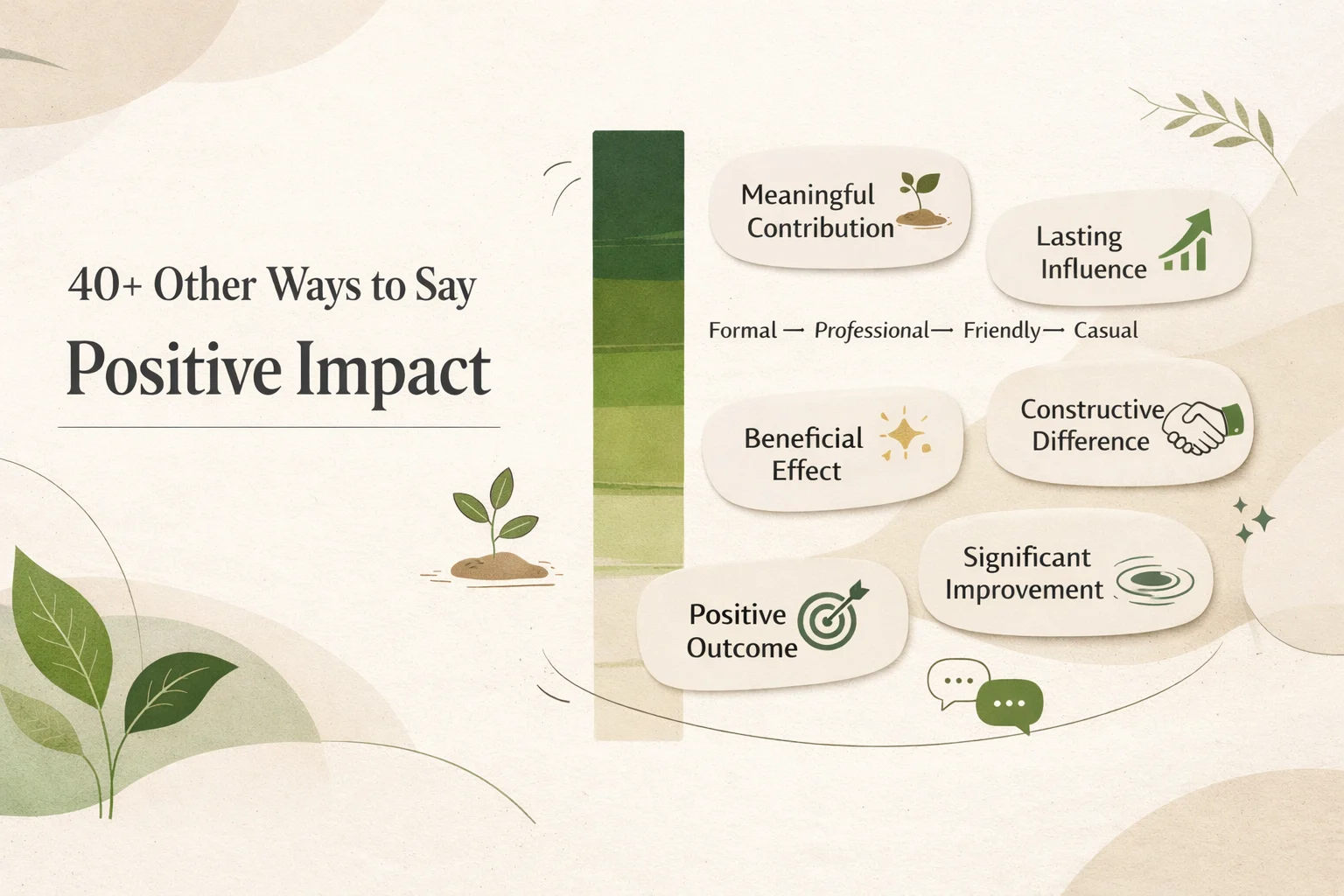
Whether you are writing a professional report, crafting a LinkedIn profile, preparing for a job interview, or simply trying to sound more polished in conversation, repeating the phrase “positive impact” can feel repetitive and flat. Native English speakers and professional communicators rely on a wide range of synonyms and expressions to convey the same idea with more precision, energy, and tone variety. This guide gives you over 40+ Other Ways to Say Positive Impact, organized by tone, context, and use case, so you can always choose the right phrase for the right moment.
What Users Are Actually Looking For Other Ways to Say Positive Impact
When someone searches for other ways to say positive impact, they are usually not looking for a simple synonym list. They want to understand how different phrases behave across contexts. They want to know which expressions sound professional in a formal email, which ones feel natural in spoken conversation, and which ones can strengthen a job application or academic essay.
The phrase “positive impact” is used so frequently in resumes, nonprofit communications, corporate sustainability reports, and motivational content that it has lost some of its punch. People search for alternatives to avoid sounding generic, to match a specific tone, or to elevate the quality of their writing and speech.
Spoken vs Written Use
In spoken English, people tend to prefer shorter, warmer expressions like “make a real difference” or “change things for the better.” In written English, especially formal documents, longer and more precise expressions like “yield measurable outcomes” or “produce a constructive influence” carry more weight. The alternatives in this guide cover both ends of that spectrum.
Formal vs Informal Communication
Choosing between formal and informal language depends entirely on your audience and purpose. A cover letter requires a different register than a casual conversation with a friend. Throughout this article, each alternative is labeled with its tone level so you can match your language to your context instantly.
Tone Ladder System
Not all alternatives to “positive impact” are created equal. Each phrase sits on a tone ladder that ranges from very formal academic language to informal everyday speech. Understanding this ladder helps you avoid tone mismatches, which is one of the most common mistakes non-native English speakers make.
Very Formal
These phrases belong in academic papers, government reports, legal documents, and formal presentations. They carry authority and precision. Examples include “yield significant outcomes,” “produce measurable results,” and “exert a constructive influence.”
Formal
Suitable for professional emails, cover letters, business reports, and LinkedIn posts. These phrases sound polished without being overly stiff. Examples include “make a meaningful contribution” and “drive positive change.”
Neutral
These work across most contexts and are safe to use in both professional and personal communication. Examples include “make a difference” and “have a beneficial effect.”
Casual
These are appropriate for team meetings, friendly professional conversations, and social media captions. Examples include “make things better” and “do some good.”
Informal
Used in everyday conversation, text messages, and informal social settings. Examples include “really help out” and “change things for the better.”
Table: Tone Classification of Key Alternatives
| Phrase | Tone Level | Formality | Best Situation |
|---|---|---|---|
| Yield significant outcomes | Very Formal | Academic / Legal | Research papers, formal reports |
| Exert a constructive influence | Very Formal | Academic | Essays, policy documents |
| Produce measurable results | Formal | Professional | Business reports, performance reviews |
| Make a meaningful contribution | Formal | Professional | Cover letters, LinkedIn profiles |
| Drive positive change | Formal | Professional | Mission statements, interviews |
| Have a beneficial effect | Neutral | Versatile | Emails, conversations, reports |
| Make a lasting difference | Neutral | Versatile | Speeches, articles, social media |
| Do some good | Casual | Conversational | Team discussions, social media |
| Make things better | Casual | Conversational | Everyday speech, friendly emails |
| Really help out | Informal | Spoken | Casual conversations, texts |
Quick Selection Guide
Job Interview: “drive positive change” or “make a meaningful contribution”
Professional Email: “have a beneficial effect” or “produce measurable results”
Networking Event: “create real value” or “make a lasting difference”
Casual Conversation: “make a real difference” or “do some good”
Academic Essay: “yield significant outcomes” or “exert a constructive influence”
LinkedIn Post: “drive meaningful change” or “make an impact that matters”
Cover Letter: “make a meaningful contribution” or “bring lasting value”
Real-Life Conversation Transformations
Seeing a phrase replaced in real context is far more useful than reading a definition. These before and after examples show how swapping “positive impact” for a stronger alternative transforms the quality of communication.
Job Interview Scenario
Before: “I want to make a positive impact at this company.”
After: “I want to drive meaningful change within your team and contribute to results that last beyond my first year.”
Why it works: The revised version is specific, active, and demonstrates long-term thinking. It replaces a vague phrase with purposeful language that interviewers remember.
Networking Event Scenario
Before: “Our organization is trying to create a positive impact in underserved communities.”
After: “Our organization works to bring lasting value to communities that have historically been overlooked by mainstream services.”
Why it works: The revised version is emotionally resonant and tells a story. It sounds confident and mission-driven rather than generic.
Professional Email Scenario
Before: “We hope this initiative will have a positive impact on the team.”
After: “We expect this initiative to produce measurable improvements in team collaboration and output quality.”
Why it works: The revised version is concrete and sets expectations. Readers can picture what success looks like.
Casual Conversation Scenario
Before: “I just want to have a positive impact on people around me.”
After: “I just want to do some real good for the people in my life.”
Why it works: The informal version is warmer and more genuine. It does not sound rehearsed or corporate in a friendly setting.
40+ Other Ways to Say Positive Impact
Each entry below includes a full explanation, example sentence, tone classification, best use, and context guidance so you can apply every phrase with confidence.
1. Beneficial Effect
Meaning: An outcome that brings advantage or improvement to someone or something.
Explanation: This is one of the most versatile and widely accepted alternatives. It works in both formal writing and professional speech without sounding forced.
Example: The new wellness program had a beneficial effect on employee morale across all departments.
Tone: Neutral to Formal
Best Use: Reports, emails, academic writing
Worst Use: Casual text messages or informal chats
Context Variability: Works across industries including healthcare, education, and business
2. Meaningful Contribution
Meaning: An input or effort that adds real, recognizable value.
Explanation: This phrase is ideal for resumes, cover letters, and interviews because it is specific and personal. It implies intentional effort rather than accidental benefit.
Example: She made a meaningful contribution to the research project that shaped its final direction.
Tone: Formal
Best Use: Job applications, performance reviews, professional introductions
Worst Use: Academic papers that require clinical precision
Context Variability: Extremely flexible across professional settings
3. Constructive Influence
Meaning: An influence that builds, improves, or shapes something positively.
Explanation: “Constructive” is a powerful modifier because it implies deliberate effort toward improvement. This phrase suits leadership contexts and academic discussions.
Example: His mentorship had a constructive influence on the entire junior team.
Tone: Formal to Very Formal
Best Use: Leadership profiles, essays, formal evaluations
Worst Use: Casual social contexts
Context Variability: Strong in education, management, and policy writing
4. Lasting Difference
Meaning: A change or contribution that endures beyond the immediate moment.
Explanation: This phrase carries emotional weight and is often used in mission-driven or nonprofit communication. It appeals to the audience’s sense of legacy.
Example: The volunteer program made a lasting difference in the lives of over three hundred families.
Tone: Neutral
Best Use: Charity appeals, speeches, social media, nonprofit reports
Worst Use: Purely clinical or statistical contexts
Context Variability: Works brilliantly in storytelling and motivational content
5. Transformative Effect
Meaning: A profound change that fundamentally alters something for the better.
Explanation: This is the strongest phrase in this list in terms of intensity. It should be used when the change being described is genuinely large-scale or life-changing.
Example: Access to quality education had a transformative effect on the region’s economic growth.
Tone: Formal
Best Use: Policy papers, research summaries, leadership statements
Worst Use: Minor improvements or everyday situations where the impact is modest
Context Variability: Best reserved for genuinely significant changes
6. Drive Positive Change
Meaning: To actively cause or lead improvement.
Explanation: The verb “drive” makes this phrase active and energetic. It implies agency and leadership, making it a favorite in corporate and startup environments.
Example: The new policy was designed to drive positive change across all regional offices.
Tone: Formal
Best Use: Mission statements, interviews, corporate communications
Worst Use: Personal or emotional contexts where “drive” feels too mechanical
Context Variability: Widely used in tech, business, and NGO sectors
7. Make a Real Difference
Meaning: To produce a change that is genuine and noticeable.
Explanation: This is one of the most natural-sounding expressions in everyday English. The word “real” adds authenticity and sincerity without sounding exaggerated.
Example: Every donation, no matter the size, can make a real difference in a child’s education.
Tone: Casual to Neutral
Best Use: Fundraising appeals, social media, speeches, community outreach
Worst Use: Formal academic writing
Context Variability: Very adaptable, works in both personal and professional storytelling
8. Create Real Value
Meaning: To produce something that is genuinely useful or important to others.
Explanation: This phrase is popular in business and entrepreneurship because it emphasizes utility and worth. It sounds credible and grounded.
Example: Our goal is to create real value for customers through innovative solutions.
Tone: Formal to Neutral
Best Use: Business pitches, product descriptions, LinkedIn content
Worst Use: Community or social service contexts where “value” may feel transactional
Context Variability: Extremely common in startup and corporate language
9. Yield Significant Outcomes
Meaning: To produce important and measurable results.
Explanation: This is a strong academic and research phrase. “Yield” implies a productive process and “significant outcomes” signals evidence-based language.
Example: The intervention program yielded significant outcomes in student reading levels within one semester.
Tone: Very Formal
Best Use: Research papers, evaluation reports, grant applications
Worst Use: Everyday speech or informal emails
Context Variability: Best suited to academic, scientific, and policy environments
10. Bring Lasting Value
Meaning: To provide benefits that continue over time.
Explanation: This phrase combines warmth with professionalism. It is particularly effective in service industries and client-facing communication because it promises longevity.
Example: Our team is committed to bringing lasting value to every client relationship we build.
Tone: Formal to Neutral
Best Use: Client proposals, service descriptions, professional introductions
Worst Use: Highly technical or data-driven contexts
Context Variability: Works well in consulting, healthcare, and education
11. Have a Far-Reaching Effect
Meaning: To influence a wide range of people, areas, or outcomes.
Explanation: This phrase emphasizes scope and scale. It is best used when you want to communicate that a change or contribution extends well beyond its immediate context.
Example: The new public health campaign had a far-reaching effect on vaccination rates nationwide.
Tone: Formal
Best Use: Policy discussions, public health writing, social impact reports
Worst Use: Personal or small-scale situations where the scope is limited
Context Variability: Useful in journalism, government, and advocacy writing
12. Foster Growth and Development
Meaning: To actively support improvement, learning, or expansion in someone or something.
Explanation: “Foster” is a warm and caring verb that communicates nurturing. This phrase is popular in education, HR, and community development contexts.
Example: The mentorship program was designed to foster growth and development in emerging leaders.
Tone: Formal
Best Use: HR communications, educational reports, leadership development content
Worst Use: Financial or legal writing where warmth is not the desired tone
Context Variability: Widely applicable in people-oriented professions
13. Advance a Worthy Cause
Meaning: To move forward or support something that deserves attention and effort.
Explanation: This expression has a noble, mission-driven quality. It is often used in philanthropic contexts where the speaker wants to signal values and purpose.
Example: Every hour of volunteer work helps advance a worthy cause and strengthen the community.
Tone: Neutral to Formal
Best Use: Nonprofit campaigns, fundraising events, volunteer appeals
Worst Use: Corporate or commercial settings where it may sound too idealistic
Context Variability: Strong in cause-based and values-driven communication
14. Produce Measurable Results
Meaning: To achieve outcomes that can be tracked, quantified, and evaluated.
Explanation: This phrase is extremely effective in business and professional contexts because it signals accountability and data awareness. It replaces vague impact language with something concrete.
Example: The marketing strategy produced measurable results within the first quarter of implementation.
Tone: Formal
Best Use: Business reports, performance reviews, strategic plans
Worst Use: Creative or emotional narratives where numbers feel out of place
Context Variability: A staple in corporate, consulting, and data-driven industries
15. Improve Lives
Meaning: To make everyday existence better for people.
Explanation: Direct, human, and emotionally resonant. This phrase is short enough to use in headlines, social media posts, and public speeches. It connects instantly with audiences.
Example: The organization’s work continues to improve lives in rural communities across three countries.
Tone: Neutral to Casual
Best Use: Nonprofit storytelling, social campaigns, speeches, social media
Worst Use: Overly technical or statistical reports
Context Variability: Highly effective in human-centered and charitable contexts
16. Empower Others
Meaning: To give others the tools, confidence, or resources to succeed.
Explanation: Empowerment language is highly valued in leadership, education, and social justice communication. It shifts the focus from the actor to the beneficiary, which is a subtle but important distinction.
Example: Our workshops are designed to empower others to take control of their financial futures.
Tone: Neutral to Formal
Best Use: Leadership training, nonprofit missions, educational content
Worst Use: Dry, technical reports where human-centered language may feel out of place
Context Variability: Strong in coaching, advocacy, and community building
17. Catalyze Change
Meaning: To spark or accelerate a process of improvement or transformation.
Explanation: Borrowed from chemistry, “catalyze” suggests that something speeds up a reaction without being consumed by it. In social and professional contexts, it implies powerful, efficient leadership.
Example: The conference aimed to catalyze change in how the industry approaches sustainability.
Tone: Formal
Best Use: Leadership statements, advocacy campaigns, professional speeches
Worst Use: Casual everyday speech where it sounds overly academic
Context Variability: Strong in innovation, policy, and social change communication
18. Add Value
Meaning: To contribute something useful or beneficial beyond what already exists.
Explanation: Simple, clean, and professional. Add value” is one of the most commonly used phrases in business English. It works across departments and industries without any risk of misinterpretation.
Example: I joined this project because I believed I could add value through my experience in data analytics.
Tone: Neutral to Formal
Best Use: Job interviews, cover letters, business emails, team discussions
Worst Use: Emotional or personal narratives where “value” feels too transactional
Context Variability: One of the most universally understood professional expressions
19. Leave a Positive Mark
Meaning: To create a noticeable and favorable impression or legacy.
Explanation: This phrase carries a sense of legacy and permanence. It is slightly more figurative than other options but is widely understood and emotionally effective.
Example: She left a positive mark on every classroom she walked into over her twenty-year teaching career.
Tone: Neutral
Best Use: Tributes, farewell messages, speeches, storytelling
Worst Use: Formal reports or academic papers where figurative language is discouraged
Context Variability: Works well in personal and professional storytelling
20. Uplift Communities
Meaning: To raise the condition, spirit, or quality of life within a group or area.
Explanation: “Uplift” is a warm and inspirational word that works especially well in community service, social work, and nonprofit settings. It has emotional resonance and social weight.
Example: The foundation’s programs continue to uplift communities that have long been underserved.
Tone: Neutral to Formal
Best Use: Nonprofit reports, social impact statements, community events
Worst Use: Corporate or technical documents
Context Variability: Strong in social justice and community development communication
21. Generate Positive Outcomes
Meaning: To produce favorable and intended results.
Explanation: This phrase works like “produce measurable results” but with a slightly softer, more outcomes-based framing. It is common in project management and policy evaluation.
Example: The pilot program was expected to generate positive outcomes for participants within six months.
Tone: Formal
Best Use: Evaluation reports, grant applications, project proposals
Worst Use: Casual or emotional communication
Context Variability: Widely used in program management and government contexts
22. Strengthen Communities
Meaning: To make a community more resilient, connected, or capable.
Explanation: This phrase is particularly popular in government and nonprofit language because it implies both sustainability and solidarity. It sounds purposeful without being abstract.
Example: The new recreation center was built to strengthen communities and bring residents together.
Tone: Neutral to Formal
Best Use: Community development writing, public policy, civic communication
Worst Use: Individual-focused contexts where community is not the beneficiary
Context Variability: Common in civic, public health, and social service settings
23. Champion a Better Future
Meaning: To actively advocate for and work toward improved circumstances for others.
Explanation: “Champion” is a powerful action verb that signals commitment and advocacy. Combined with “a better future,” it creates an inspiring, forward-looking statement.
Example: As educators, we have a responsibility to champion a better future for every child in our care.
Tone: Formal to Neutral
Best Use: Inspirational speeches, advocacy content, educational writing
Worst Use: Technical documents or analytical reports
Context Variability: Strong in leadership and social change communication
24. Improve Outcomes
Meaning: To make results better than they currently are or would otherwise be.
Explanation: Short, direct, and measurable. This phrase is a staple in healthcare, education, and business because of its clarity. It does not need extra decoration to carry meaning.
Example: The new training module was introduced to improve outcomes for frontline healthcare workers.
Tone: Formal
Best Use: Healthcare, education, corporate performance, project management
Worst Use: Personal or emotional contexts
Context Variability: Highly trusted in data-driven and evidence-based industries
25. Create Meaningful Change
Meaning: To bring about improvements that genuinely matter to people.
Explanation: “Meaningful” is a word that elevates simple phrases by adding a sense of depth and purpose. This expression bridges professional and emotional registers effectively.
Example: The nonprofit was founded with one goal: to create meaningful change in how cities handle food insecurity.
Tone: Neutral to Formal
Best Use: Mission statements, social media, fundraising, team communications
Worst Use: Strictly technical or data-only writing
Context Variability: Excellent across nonprofit, education, and corporate social responsibility
26. Deliver Tangible Benefits
Meaning: To produce real, concrete advantages that can be observed or measured.
Explanation: “Tangible” is a key word here. It signals that the benefits are not abstract promises but actual, demonstrable improvements. This phrase appeals to practical-minded audiences.
Example: The infrastructure investment delivered tangible benefits to thousands of residents in the area.
Tone: Formal
Best Use: Government reports, business proposals, impact assessments
Worst Use: Emotional storytelling where “tangible” feels too clinical
Context Variability: Strong in finance, public policy, and development communication
27. Make an Enduring Impact
Meaning: To create effects that persist and continue influencing things long after the initial action.
Explanation: “Enduring” adds the dimension of time and sustainability. It is a confident, slightly elevated phrase that signals ambition and long-term thinking.
Example: Her research made an enduring impact on how scientists approach climate modeling.
Tone: Formal
Best Use: Academic writing, professional bios, speeches, legacy communications
Worst Use: Short-term project reports where long-term impact has not yet been established
Context Variability: Effective in science, education, and leadership contexts
28. Enrich Lives
Meaning: To improve the quality, depth, or fulfillment of someone’s life or experience.
Explanation: “Enrich” is a word that goes beyond simply making things better. It implies adding richness, meaning, and quality. It is commonly used in arts, education, and cultural communication.
Example: The arts program was created to enrich lives through music, storytelling, and creative expression.
Tone: Neutral to Formal
Best Use: Cultural institutions, arts organizations, educational programs
Worst Use: Business or financial reports
Context Variability: Excellent for arts, humanities, and human services
29. Build a Better World
Meaning: To contribute to broad, global improvement through one’s actions or work.
Explanation: This phrase is bold and aspirational. It carries idealism and is best used in brand messaging, nonprofit communication, and inspirational content. Overused in some contexts, so use it thoughtfully.
Example: Every small act of kindness is a step toward building a better world for our children.
Tone: Neutral to Casual
Best Use: Brand missions, social campaigns, inspiring speeches
Worst Use: Corporate reports or contexts where the scope does not support such a large claim
Context Variability: Effective in marketing, social media, and advocacy
30. Spark Positive Momentum
Meaning: To initiate or energize a movement toward improvement.
Explanation: This phrase has an energetic, active quality. “Spark” suggests ignition and “momentum” implies ongoing movement. Together, they communicate dynamic, sustained change.
Example: The community meeting helped spark positive momentum that carried the renovation project forward.
Tone: Neutral to Formal
Best Use: Campaign launches, team motivation, project kick-offs
Worst Use: Static or backward-looking reports
Context Variability: Strong in social campaigns, innovation, and team leadership
31. Contribute to Progress
Meaning: To play a role in advancing development or improvement over time.
Explanation: Humble and professional, this phrase positions the speaker as part of a larger effort rather than the sole driver of change. It is especially effective in team and collaborative contexts.
Example: Each department plays a role in contributing to progress on the company’s sustainability goals.
Tone: Formal to Neutral
Best Use: Team communications, annual reports, collaborative projects
Worst Use: Contexts where individual leadership needs to be highlighted
Context Variability: Excellent in organizational and team-based writing
32. Leave a Legacy
Meaning: To create lasting contributions that outlive one’s direct involvement.
Explanation: Deeply personal and powerful, this phrase is best used in tribute pieces, career reflections, and mission-driven communication. It frames impact in terms of long-term remembrance.
Example: The founder hoped to leave a legacy of equal opportunity that would guide the organization for decades.
Tone: Neutral to Formal
Best Use: Biographical writing, tributes, leadership profiles, organizational histories
Worst Use: Short-term or transactional communication
Context Variability: Strong in storytelling, education, and values-based leadership
33. Be a Force for Good
Meaning: To consistently act in ways that benefit others and improve situations.
Explanation: This phrase has become widely recognized through brand communication and social impact language. It is inspirational and accessible. Native speakers use it in both formal and informal registers.
Example: We believe every business has the potential to be a force for good in its community.
Tone: Neutral
Best Use: Brand values, social impact messaging, motivational speeches
Worst Use: Formal academic or legal writing
Context Variability: Extremely versatile in modern professional communication
34. Promote Well-Being
Meaning: To support and advance the physical, mental, or social health of individuals or groups.
Explanation: This phrase is precise and professional. It is commonly used in healthcare, workplace wellness, and public policy. “Well-being” is broad enough to cover multiple dimensions of human health.
Example: The new workplace policy was designed to promote well-being among all employees, regardless of role.
Tone: Formal
Best Use: Healthcare communication, HR policies, wellness programs
Worst Use: Business or financial contexts where well-being is not the focus
Context Variability: Strong in health, education, and workplace environments
35. Shape a Better Tomorrow
Meaning: To take deliberate action that improves conditions for the future.
Explanation: Forward-looking and hopeful, this phrase is used widely in education, political, and corporate social responsibility communication. It emphasizes intentional effort toward a positive future.
Example: By investing in renewable energy today, we are shaping a better tomorrow for future generations.
Tone: Neutral to Formal
Best Use: Environmental communication, education campaigns, policy advocacy
Worst Use: Purely analytical or retrospective writing
Context Variability: Excellent in sustainability, education, and aspirational brand content
36. Advance the Common Good
Meaning: To work toward outcomes that benefit society as a whole rather than just a few individuals.
Explanation: This phrase has a civic and philosophical weight. It is used in political science, ethics, and public policy to signal social responsibility and collective benefit.
Example: The legislation was drafted to advance the common good by ensuring equal access to public resources.
Tone: Very Formal to Formal
Best Use: Government reports, ethics discussions, policy papers, civic advocacy
Worst Use: Personal or commercial contexts where the phrase may sound overly political
Context Variability: Appropriate in public sector and civic communication
37. Pave the Way for Improvement
Meaning: To create the conditions or foundation that make progress possible for others.
Explanation: “Pave the way” is an idiom that communicates preparation and enabling others to succeed. It is particularly effective when describing pioneering work or foundational contributions.
Example: Her groundbreaking research helped pave the way for improvement in how hospitals manage post-surgical care.
Tone: Neutral to Formal
Best Use: Innovation stories, leadership profiles, historical narratives
Worst Use: Formal academic papers that discourage idiomatic language
Context Variability: Works well in professional storytelling and leadership communication
38. Effect Positive Change
Meaning: To bring about or cause beneficial change through deliberate action.
Explanation: Note the use of “effect” as a verb here, which means “to cause.” This is a common confusion point. “Effect change” (as a verb phrase) is grammatically distinct from “affect change.” It is a sophisticated, formal expression that signals language awareness.
Example: The task force was assembled to effect positive change in the organization’s procurement policies.
Tone: Very Formal
Best Use: Formal reports, legal or policy documents, academic writing
Worst Use: Everyday conversation, as the “effect as verb” usage confuses many listeners
Context Variability: High impact in formal professional writing
39. Create a Ripple Effect
Meaning: To produce initial change that spreads outward and causes further beneficial effects.
Explanation: This metaphorical phrase is visually effective and widely understood. It communicates that a single action can produce multiple layers of positive consequences over time.
Example: Teaching one child to read can create a ripple effect that transforms an entire family’s relationship with education.
Tone: Neutral
Best Use: Speeches, fundraising, social media, impact storytelling
Worst Use: Academic writing where idiomatic expressions are discouraged
Context Variability: Powerful in motivational and narrative-driven communication
40. Elevate Standards
Meaning: To raise the expected level of quality, performance, or behavior in a given area.
Explanation: This phrase is particularly strong in professional and organizational contexts. It implies that the positive impact is not just visible but sets a new benchmark for others to follow.
Example: The team’s work on the new design protocol helped elevate standards across the entire creative department.
Tone: Formal
Best Use: Performance reviews, quality management, professional development
Worst Use: Community or social service contexts where “standards” may feel institutional
Context Variability: Excellent in corporate, academic, and quality-focused environments
41. Cultivate Positive Outcomes
Meaning: To carefully develop and nurture results through sustained effort.
Explanation: “Cultivate” draws on the imagery of gardening, suggesting patient, deliberate care. It communicates that positive outcomes do not happen by accident but through intentional work.
Example: The leadership program was designed to cultivate positive outcomes for participants over the course of two years.
Tone: Formal to Neutral
Best Use: Education, leadership development, long-term project communication
Worst Use: Contexts requiring urgency or short-term impact language
Context Variability: Works well in human development, social work, and educational settings
42. Leave Things Better Than You Found Them
Meaning: To make a situation, place, or community measurably improved through your presence or actions.
Explanation: This is a timeless, informal expression that resonates deeply in coaching, leadership, and mentorship contexts. It is personal, humble, and aspirational at the same time.
Example: The outgoing CEO’s philosophy was simple: leave things better than you found them.
Tone: Casual to Neutral
Best Use: Leadership anecdotes, farewell speeches, mentorship communication
Worst Use: Formal policy documents or academic papers
Context Variability: Excellent in storytelling and values-based communication
Table: Usage Comparison of Key Phrases
| Phrase | Spoken Use | Written Use | Context |
|---|---|---|---|
| Beneficial effect | Moderate | High | Reports, healthcare, education |
| Make a real difference | Very High | Moderate | Speeches, social media, casual |
| Drive positive change | High | Very High | Business, leadership, NGOs |
| Yield significant outcomes | Low | Very High | Academic, research, grants |
| Empower others | High | High | Education, nonprofit, coaching |
| Add value | Very High | Very High | Business, interviews, emails |
| Improve lives | High | High | Nonprofit, public health, social |
| Catalyze change | Moderate | High | Policy, innovation, leadership |
| Be a force for good | High | High | Brand values, social impact |
| Effect positive change | Low | Very High | Formal reports, legal documents |
Email and LinkedIn Ready Expressions
Professional Email Greetings and Openers
When writing a professional email that references your impact, consider these ready-to-use expressions.
- I am writing to share how our initiative has delivered tangible benefits to over five hundred participants this quarter.
- I believe this proposal will produce measurable results in our customer satisfaction scores.
- Our team has worked hard to foster growth and development in every department we support.
- I wanted to highlight some of the meaningful contributions our volunteers have made this year.
LinkedIn Connection Messages
- I came across your work on sustainable development and was inspired by the meaningful change your team is creating. I would love to connect.
- Your research on community health programs is clearly driving positive change. I am eager to learn more about your approach.
- I admire how your organization is committed to improving lives at scale. Would love to connect and exchange ideas.
Follow-Up Lines After Meetings
- Thank you for a great conversation. I am confident that our collaboration has the potential to create real value for both organizations.
- Following up on our discussion, I believe we can build on this momentum to spark meaningful outcomes for our shared goals.
- It was great to connect. I look forward to working together to advance a cause that truly matters.
Native Speaker Insight
How Native Speakers Actually Use These Phrases
In everyday professional speech, native English speakers rarely say “make a positive impact” in conversation. More often, they use shortened, punchy expressions like “make a difference,” “do some real good,” or “actually move the needle.” In writing, especially in reports and applications, they tend to use more precise alternatives like “produce measurable results” or “drive meaningful change.”
One thing that sounds unnatural to native speakers is over-stacking modifiers, such as “create a truly profoundly positive meaningful impact.” It reads as insincere or unfamiliar with natural English rhythm. Choose one strong phrase and let it do the work.
Native speakers also tend to vary their vocabulary across a piece rather than repeating one phrase. If you use “meaningful contribution” in your opening paragraph, switch to “drive positive change” or “produce lasting results” later in the same document.
Common Mistakes and What Not to Say
Unnatural Phrases to Avoid
Saying “make a very positive impact” adds “very” without adding meaning. The word “very” weakens strong nouns and adjectives rather than strengthening them. Use “make a significant impact” or “drive lasting change” instead.
Saying “impact positively” sounds awkward and stilted. While “impact” can be used as a verb, it is far more natural as a noun. Write “have a positive effect” or “influence positively” instead.
Using “positive impact” repeatedly in the same document signals limited vocabulary. Vary your language to demonstrate range and precision.
Avoid “make an impactful positive difference.” The redundancy of “impactful” and “positive difference” creates noise without clarity.
Do not use very formal phrases like “exert a constructive influence” in casual conversations. Tone mismatch is one of the most jarring mistakes in professional communication.
Expansion Phrases for Broader Communication
Beyond direct alternatives to “positive impact,” these related expressions help expand your vocabulary in professional and personal communication.
Greeting and Introduction Variations
- I have had the privilege of contributing to work that truly matters.
- My experience has been centered on creating change that lasts.
- I come from a background dedicated to advancing human well-being.
Polite Communication Alternatives
- I hope this helps move things in a positive direction.
- Our shared effort continues to bear fruit for those who need it most.
- This initiative is already showing signs of meaningful progress.
Conversational English Upgrades
- Instead of: “I want to have a positive impact.” Try: “I want to actually change things for the better.”
- Instead of: “This has a positive impact on students.” Try: “This is genuinely helping students grow.”
- Instead of: “We made a positive impact last year.” Try: “We made real headway last year in areas that matter most.”
Table: Decision-Making Table
| Situation | Best Phrase | Why It Works |
|---|---|---|
| Job interview answer | Drive meaningful change | Active, leadership-oriented, specific |
| Cover letter | Make a meaningful contribution | Personal, professional, intentional |
| Academic essay | Yield significant outcomes | Evidence-based, formal, precise |
| Fundraising email | Improve lives / Make a real difference | Emotionally resonant, clear to all readers |
| LinkedIn bio | Create real value / Be a force for good | Widely understood, professional tone |
| Nonprofit annual report | Deliver tangible benefits | Accountable, measurable, credible |
| Motivational speech | Shape a better tomorrow | Aspirational, forward-looking, inspiring |
| Casual workplace conversation | Make a real difference | Natural, warm, relatable |
| Performance review | Produce measurable results | Quantifiable, professional, accountable |
| Team motivation | Spark positive momentum | Energetic, active, galvanizing |
Quick Fast List of Best Alternatives
- Beneficial effect — safe, professional, and versatile across most contexts
- Meaningful contribution — ideal for resumes, interviews, and cover letters
- Drive positive change — energetic and leadership-focused
- Make a real difference — warm, natural, and widely understood
- Produce measurable results — accountable and data-friendly
- Transformative effect — powerful for large-scale or life-changing impact
- Create real value — strong in business and client-facing communication
- Lasting difference — emotionally resonant for storytelling and advocacy
- Be a force for good — inspiring and accessible in brand or social communication
- Yield significant outcomes — the top choice for academic and research writing
Mini Quiz
Question 1
You are writing a cover letter for a nonprofit position and want to express that your work has helped people over the long term. Which phrase fits best?
A) Make things better
B) Yield significant outcomes
C) Bring lasting value
D) Do some good
Answer: C) Bring lasting value
Explanation: Bring lasting value is warm, professional, and emphasizes long-term impact, making it an excellent choice for nonprofit cover letters.
Question 2
A researcher is writing a published journal article about an educational intervention. Which phrase is most appropriate?
A) Make a real difference
B) Be a force for good
C) Yield significant outcomes
D) Leave a positive mark
Answer: C) Yield significant outcomes
Explanation: Academic writing requires precise, evidence-based language. Yield significant outcomes conveys measurable results and fits the formal tone of scholarly publications.
Question 3
During a casual team meeting, your manager says they want everyone to “do some good” this quarter. What does this communicate?
A) A formal performance expectation
B) A legal obligation
C) An informal, encouraging call to contribute positively
D) A complaint about past performance
Answer: C) An informal, encouraging call to contribute positively
Explanation: Do some good is a friendly, motivational phrase that encourages employees to make a positive contribution without sounding overly formal or demanding.
Question 4
You are writing a LinkedIn post about your company’s community program. Which phrase creates the strongest impression?
A) Yield significant outcomes
B) Create a ripple effect
C) Exert a constructive influence
D) Effect positive change
Answer: B) Create a ripple effect
Explanation: Create a ripple effect is memorable, engaging, and easy to visualize. It resonates well with LinkedIn audiences by emphasizing how one positive action can inspire many others.
FAQs
Is it polite to say “positive impact” in a professional email?
Yes, “positive impact” is a polite and professional phrase for workplace communication. However, because it is widely used, it can sometimes sound generic. If you want your writing to feel more specific and polished, consider alternatives such as “beneficial effect” or “meaningful contribution.” These options often read as more thoughtful in professional emails.
What is more professional than “positive impact” on a resume?
For resumes, phrases that highlight measurable value tend to be stronger than “positive impact.” Alternatives such as “meaningful contribution,” “produce measurable results,” and “drive positive change” emphasize achievements more clearly and demonstrate stronger professional communication.
Can I use “transformative effect” in an email?
Yes, but use it selectively. “Transformative effect” is most appropriate when describing a major improvement or a significant long-term change. Using it for small or routine achievements may sound exaggerated and reduce the credibility of your message.
What do native speakers say instead of “positive impact” in conversation?
In everyday English, native speakers often choose simpler, more natural expressions. Common alternatives include “make a real difference,” “do some good,” “change things for the better,” and “actually help.” These phrases sound conversational, sincere, and easy to understand.
What is the best alternative to “positive impact” for academic writing?
Academic writing benefits from precise, evidence-based language. Strong alternatives include “yield significant outcomes,” “produce measurable results,” and “exert a constructive influence.” These expressions match the formal tone expected in research papers, journal articles, and scholarly reports.
Is “drive positive change” appropriate for a job interview?
Yes. “Drive positive change” is an excellent phrase for interviews because it highlights initiative, leadership, and a results-oriented mindset. For the greatest impact, pair the phrase with a specific example that demonstrates how you created meaningful improvements.
What is wrong with saying “very positive impact”?
Using “very” with an already strong phrase often makes your writing sound less confident instead of more persuasive. Rather than saying “very positive impact,” choose a more precise adjective such as “significant,” “lasting,” or “transformative.” These alternatives communicate greater impact while maintaining a professional tone.
Conclusion
The phrase “positive impact” is widely understood, but it is also widely overused. In a world where every resume, mission statement, and LinkedIn profile uses the same handful of expressions, choosing a more precise and tonally appropriate alternative instantly sets you apart. Whether you are writing a grant proposal, preparing for a job interview, drafting an appeal for a nonprofit, or simply trying to express yourself more clearly in conversation, this guide gives you the full toolkit to communicate value, benefit, and change with confidence and precision.
Language is a skill that improves with intentional practice. The next time you reach for “positive impact,” pause and ask yourself which alternative fits the tone, audience, and purpose of your message. Try “deliver tangible benefits” in your next report. Use “make a real difference” in your next speech. Write “drive meaningful change” in your next cover le35+ Other Ways to Say “Just to Confirm” | Better Business Emails In 2026
tter. Each small upgrade builds your vocabulary, strengthens your communication, and helps you leave exactly the impression you intend.
Read More Related Articles:
- 30+ Other Ways to Say According To | Add Credibility to Your Sentences In 2026
- 30+ Other Ways to Say Please See Attached | Impress Clients with More Professional Wording In 2026
- 35+ Other Ways to Say “Just to Confirm” | Better Business Emails In 2026

Lucas Mitchell is a content writer at synoseek.com. He writes simple, thoughtful pieces that focus on everyday ideas, observations and general knowledge topics. His work is shaped by a calm, realistic tone that keeps the reader engaged without overstatement.