Quick Answer
“I’m sorry you feel that way” is a phrase used to acknowledge someone’s emotional response without necessarily accepting blame. While common, it often sounds dismissive or passive.Better alternatives include: I understand how you feel, I can see why that was upsetting, I genuinely apologize for how this made you feel, I hear you and I’m sorry, That must have been really difficult for you.
Whether you’re navigating a workplace conflict, responding to an upset customer, or trying to repair a personal relationship, the words you choose in tense emotional moments matter enormously. I’m sorry you feel that way” has become one of the most recognized non-apology phrases in the English language and for good reason. It often shifts focus away from the problem and onto the other person’s reaction. This guide gives you 35+ Other Ways to Say “I’m Sorry You Feel That Way” genuine, context-appropriate alternatives so you can respond with empathy, professionalism, and clarity every time.
Why People Search for Other Ways to Say “I’m Sorry You Feel That Way”
When someone looks up alternatives to “I’m sorry you feel that way,” they usually fall into one of three situations. Either they have used the phrase and been told it sounded dismissive, they are looking for something more genuine to say in a difficult conversation, or they are writing a professional response and need language that demonstrates real empathy rather than deflection.
The phrase itself is grammatically neutral but emotionally loaded. In customer service, management, and personal relationships, it has earned a reputation as a way of avoiding accountability. People who search for other ways to say “I’m sorry you feel that way” are almost always looking for professional English phrases that sound sincere rather than defensive.
There is also a spoken versus written divide worth understanding. In spoken conversation, shorter phrases like “I hear you” or “I can see why that upset you” feel natural and immediate. In written communication, especially professional emails or formal responses, fuller expressions like “I sincerely regret that this experience left you feeling that way” carry more weight and demonstrate considered care.
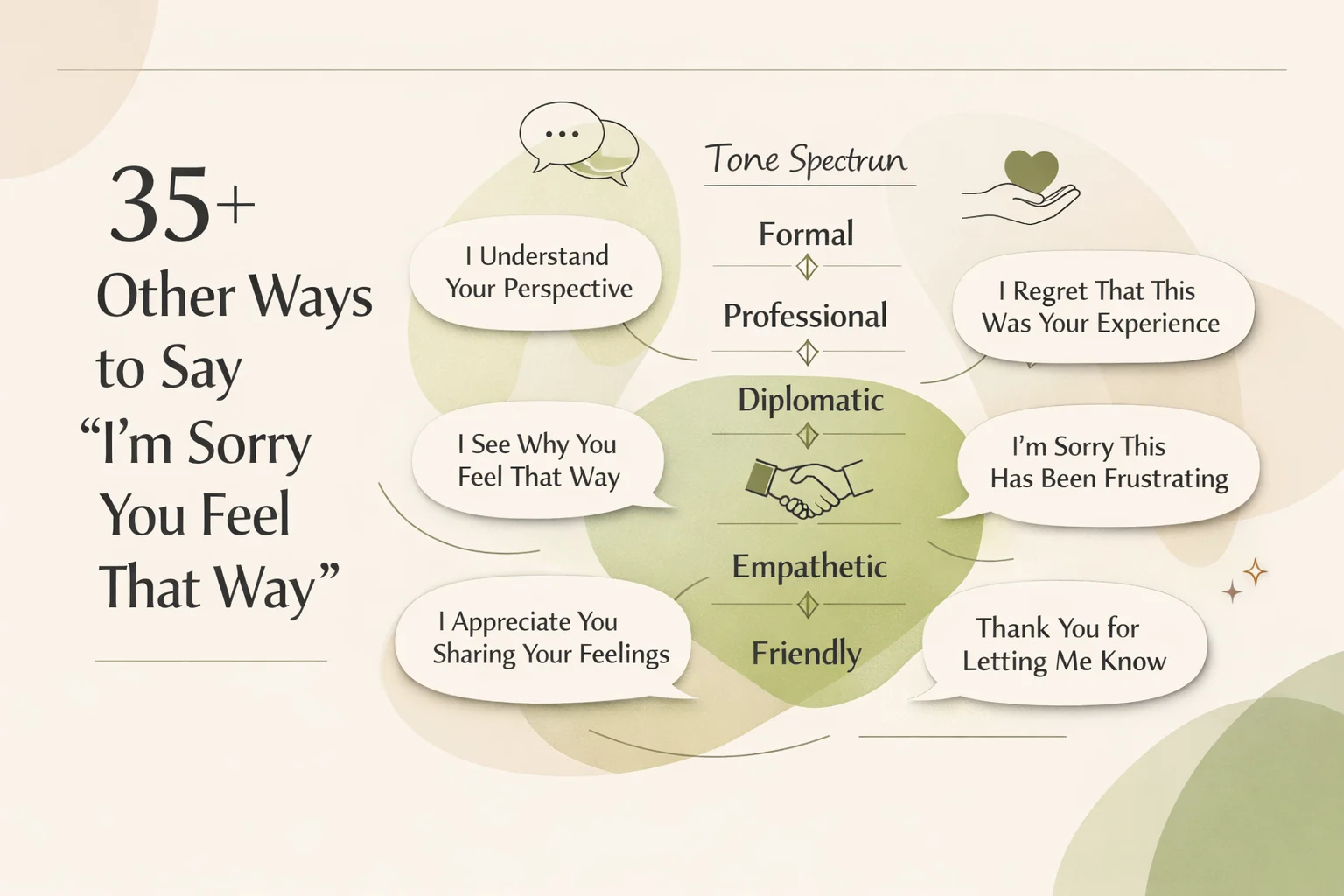
The Tone Ladder: From Very Formal to Informal
Not every apology or empathetic response fits every situation. Using too formal a phrase in a casual conversation can feel cold. Using too casual a phrase in a professional complaint response can feel unprofessional. Here is how the options break down across five tone levels.
Very Formal phrases include expressions like “I sincerely regret any distress this situation may have caused you.” These are used in legal correspondence, formal complaint letters, or executive communications where precision and professionalism are critical.
Formal phrases include “I understand this has been a frustrating experience, and I genuinely apologize.” These work well in customer service emails, HR responses, and professional follow-ups.
Neutral phrases sit comfortably between professional and personal. I can see why you feel that way, and I’m sorry for that” works across most contexts without sounding either robotic or overly casual.
Casual phrases like “I hear you, and I’m really sorry this happened” suit workplace conversations between colleagues, personal relationships, and social settings where warmth matters more than formality.
Informal phrases like “I get it, and I’m sorry that wasn’t okay” belong in close personal relationships, text messages, and genuine heart-to-heart moments where natural language feels more authentic than polished phrasing.
Which tone sounds more professional? Formal and neutral phrases. Which is best for spoken English? Casual and neutral. Which is best for writing? Formal and neutral, especially in customer service or HR contexts.
Table: Tone Classification of Key Alternatives
| Phrase | Tone Level | Formality | Best Situation |
|---|---|---|---|
| I sincerely regret any distress this has caused | Very Formal | Very High | Legal letters, executive complaints |
| I understand this has been frustrating and I apologize | Formal | High | Customer service emails, HR responses |
| I can see why you feel that way, and I’m sorry | Neutral | Medium | Professional conversations, emails |
| I genuinely apologize for how this made you feel | Formal | High | Client relations, written apologies |
| I hear you, and I’m truly sorry this happened | Casual | Low-Medium | Workplace conflict, personal chats |
| That must have been really upsetting for you | Neutral | Medium | Empathetic conversations, counseling |
| I understand your frustration | Neutral | Medium | Customer service, team management |
| I’m sorry this wasn’t the experience you deserved | Formal | High | Customer response, complaint handling |
| I take full responsibility for how this made you feel | Formal | High | Leadership, HR, serious conflicts |
| I get why you’re upset, and I’m sorry | Informal | Very Low | Close relationships, casual settings |
Quick Selection Guide
For a job interview or professional setting, the best phrase is “I can see why that was frustrating, and I sincerely apologize.” It acknowledges the other person’s experience without being defensive and signals emotional maturity.
For a professional email or customer complaint response, use “I sincerely apologize for the experience you had and regret that it left you feeling this way.” It is formal, accountable, and leaves no room to be read as dismissive.
For a networking or colleague conversation, “I hear you that sounds genuinely difficult, and I’m sorry you went through that” works best. It is warm, real, and human.
For a casual personal conversation, “I’m really sorry this affected you the way it did that was never my intention” strikes the right balance of accountability and warmth without being stiff.
Real-Life Conversation Transformations
Job Interview Scenario
Before: The interviewer asks how you handled a conflict with a colleague. You say, “I told them I was sorry they felt that way.”
After: “I acknowledged their perspective and said, ‘I can see why that situation was frustrating for you, and I genuinely wish I’d communicated better. I’m sorry for how it came across.'” This shows emotional intelligence, accountability, and maturity exactly what interviewers want to hear.
Networking Event Scenario
Before: A contact mentions that a previous interaction with your company left them with a bad impression. You respond with, “I’m sorry you feel that way.”
After: “I completely understand why that left you with a negative impression, and I’m genuinely sorry we didn’t meet your expectations. I’d really like to change that.” This opens a door instead of closing one.
Professional Email Scenario
Before: A client complaint email receives the reply, “We’re sorry you feel that way about our service.
After: “Thank you for bringing this to our attention. I sincerely apologize for the experience you had, and I fully understand why it was frustrating. We take this seriously and would like to make it right.” This is accountable, warm, and actionable.
Casual Personal Conversation Scenario
Before: A friend tells you something you said hurt them. You reply, “Sorry you feel that way.”
After: “I’m really sorry I didn’t realize how that landed and I genuinely didn’t mean to hurt you. Thank you for telling me.” Short, honest, and real. The original phrase would have ended the conversation badly. This one repairs it.
35+ Other Ways to Say “I’m Sorry You Feel That Way”
1. I Understand How You Feel, and I’m Sorry
Meaning: A compassionate apology that acknowledges the other person’s emotions before expressing regret.
Example: “I understand how you feel, and I’m truly sorry this situation caused you distress.”
Tone: Neutral to Formal
Best Use: Customer service, workplace conversations, HR discussions, and professional emails.
Worst Use: Close personal relationships where a more direct and personal apology may be expected.
Context Variability: Highly adaptable and appropriate for most professional and semi-personal situations.
2. I Can See Why That Was Upsetting
Meaning: Shows empathy by recognizing that the other person’s reaction is understandable.
Example: “I can see why that was upsetting. Your expectations were completely reasonable.”
Tone: Neutral
Best Use: Conflict resolution, customer support, team management, and workplace discussions.
Worst Use: Formal legal or contractual correspondence.
Context Variability: Very flexible for both spoken and written communication.
3. I Sincerely Regret That This Experience Left You Feeling This Way
Meaning: A formal apology that focuses on the experience rather than questioning the person’s emotions.
Example: “I sincerely regret that this experience left you feeling undervalued. That is never acceptable.”
Tone: Formal to Very Formal
Best Use: Executive responses, formal complaints, healthcare, and legal communication.
Worst Use: Casual conversations with friends or family.
Context Variability: Best suited to professional written communication.
4. I Hear You, and I’m Genuinely Sorry
Meaning: Combines active listening with a sincere apology.
Example: “I hear you, and I’m genuinely sorry. You deserved better from us.”
Tone: Casual to Neutral
Best Use: Team discussions, workplace conflicts, and personal conversations.
Worst Use: Formal complaint letters or official correspondence.
Context Variability: Works naturally in both spoken conversations and informal writing.
5. I’m Sorry This Wasn’t the Experience You Deserved
Meaning: Acknowledges that the outcome fell below the standard the other person should have received.
Example: “I’m truly sorry this wasn’t the experience you deserved. We’ll do better.”
Tone: Formal
Best Use: Customer service, client communication, and professional apologies.
Worst Use: Deeply personal emotional conversations.
Context Variability: Most effective in customer-facing and business settings.
6. Your Feelings Are Completely Valid, and I’m Sorry
Meaning: Explicitly recognizes the person’s emotions while offering a heartfelt apology.
Example: “Your feelings are completely valid, and I’m sorry my actions contributed to this.”
Tone: Neutral
Best Use: Personal relationships, counseling, coaching, and HR conversations.
Worst Use: Legal matters or highly formal business communication.
Context Variability: Highly effective in emotionally sensitive situations.
7. I Genuinely Apologize for How This Made You Feel
Meaning: A sincere and professional apology that takes responsibility for the emotional impact.
Example: “I genuinely apologize for how this made you feel. That was never my intention.”
Tone: Formal
Best Use: Professional emails, complaint responses, and workplace communication.
Worst Use: Very casual conversations.
Context Variability: Suitable for both spoken and written professional settings.
8. That Must Have Been Really Difficult for You
Meaning: Leads with empathy by acknowledging how challenging the experience must have been.
Example: “That must have been really difficult for you. I can only imagine how frustrating it felt.”
Tone: Neutral
Best Use: Personal conversations, counseling, and emotional support.
Worst Use: Customer complaints that require immediate accountability.
Context Variability: Best used in compassionate, one-on-one conversations.
9. I Take Full Responsibility for How This Made You Feel
Meaning: A strong apology that openly accepts responsibility without making excuses.
Example: “I take full responsibility for how this made you feel, and I’m committed to making it right.”
Tone: Formal
Best Use: Leadership communication, serious conflicts, and formal apologies.
Worst Use: Minor misunderstandings where such a strong statement would feel excessive.
Context Variability: Reserved for situations requiring clear accountability.
10. I Can Imagine How Frustrating That Must Have Been
Meaning: Expresses empathy by recognizing the frustration someone likely experienced.
Example: “I can imagine how frustrating that must have been, especially after the time you invested.”
Tone: Neutral to Casual
Best Use: Customer service, workplace discussions, and personal conversations.
Worst Use: Highly formal written complaints.
Context Variability: Works naturally across many everyday situations.
11. I’m Sorry If My Actions Contributed to How You’re Feeling
Meaning: Offers a measured apology when you’re uncertain about your role but still want to acknowledge the possibility.
Example: “I’m sorry if my actions contributed to how you’re feeling. I should have communicated more clearly.”
Tone: Neutral
Best Use: Situations where responsibility is shared or unclear.
Worst Use: Circumstances requiring direct and complete accountability.
Context Variability: Best reserved for situations involving some ambiguity.
12. I Want You to Know That Your Feelings Matter to Me
Meaning: Reassures someone that their emotions are important and taken seriously.
Example: “I want you to know that your feelings matter to me, and I’m committed to making things right.”
Tone: Casual to Informal
Best Use: Close relationships, meaningful personal conversations, and family discussions.
Worst Use: Customer service or formal workplace communication.
Context Variability: Most effective in personal and emotionally significant conversations.
13. I’m Sorry This Situation Caused You Pain
Meaning: A compassionate apology that recognizes the emotional impact of what happened.
Example: “I’m sorry this situation caused you pain. That was the last thing I ever wanted.”
Tone: Neutral
Best Use: Personal apologies, relationship conversations, and emotionally sensitive situations.
Worst Use: Formal business complaints where a more professional tone is expected.
Context Variability: Works well in both spoken and written personal communication.
14. I Understand Your Frustration, and I Apologize
Meaning: A professional apology that acknowledges someone’s frustration while taking responsibility.
Example: “I understand your frustration, and I sincerely apologize for the inconvenience this has caused.”
Tone: Formal
Best Use: Customer service, business emails, and workplace communication.
Worst Use: Close personal conversations where a warmer response would feel more genuine.
Context Variability: Well suited to professional written and spoken communication.
15. I Wish I Had Handled That Differently
Meaning: Expresses regret by reflecting on your own actions rather than focusing on the other person’s reaction.
Example: “Looking back, I wish I had handled that differently. I can see how it came across.”
Tone: Casual to Neutral
Best Use: Personal conversations, team retrospectives, and workplace feedback.
Worst Use: Formal complaint responses requiring a direct apology.
Context Variability: Flexible for both personal and professional discussions.
16. I’m Sorry My Words Didn’t Come Across the Way I Intended
Meaning: Acknowledges that your message had a different impact than you intended.
Example: “I’m sorry my words didn’t come across the way I intended. I understand how they sounded.”
Tone: Neutral
Best Use: Misunderstandings, workplace conversations, and personal discussions.
Worst Use: Situations involving actions rather than miscommunication.
Context Variability: Most appropriate when the issue centers on communication.
17. I Regret That Things Went This Way
Meaning: Expresses sincere regret about the outcome without assigning blame.
Example: “I regret that things went this way. I value our relationship and want to make things better.”
Tone: Neutral to Formal
Best Use: Team conflicts, workplace disagreements, and relationship repair.
Worst Use: Customer complaints that require a more direct apology.
Context Variability: Suitable for both personal and professional settings.
18. I’m Sorry You Experienced That It Wasn’t Right
Meaning: Validates someone’s experience while clearly acknowledging that the situation was unacceptable.
Example: “I’m sorry you experienced that. It wasn’t right, and I understand why you’re upset.”
Tone: Casual to Neutral
Best Use: Team discussions, customer conversations, and personal apologies.
Worst Use: Formal legal correspondence.
Context Variability: Works naturally in most spoken conversations.
19. That Wasn’t Fair to You, and I’m Sorry
Meaning: A direct apology that recognizes the unfairness of the situation.
Example: “That wasn’t fair to you, and I’m genuinely sorry it happened.”
Tone: Casual
Best Use: Personal relationships, close coworkers, and family conversations.
Worst Use: Highly formal business communication.
Context Variability: Most effective in sincere, one-on-one conversations.
20. I Can See This Has Really Affected You, and I’m Truly Sorry
Meaning: Acknowledges the emotional impact before offering a heartfelt apology.
Example: “I can see this has really affected you, and I’m truly sorry. That was never my intention.”
Tone: Neutral
Best Use: HR conversations, emotional discussions, and meaningful personal apologies.
Worst Use: Brief or transactional interactions.
Context Variability: Works well in emotionally significant conversations.
21. I Hear Your Frustration, and I Want to Make This Right
Meaning: Combines empathy with a commitment to resolve the problem.
Example: “I hear your frustration, and I want to make this right. Let’s discuss how we can fix it.”
Tone: Neutral
Best Use: Customer service, management, conflict resolution, and workplace discussions.
Worst Use: Personal situations where emotional support should come before problem-solving.
Context Variability: Highly versatile in professional settings.
22. I’m Sorry for Any Hurt I Caused
Meaning: A simple and sincere apology that acknowledges emotional harm without making assumptions.
Example: “I’m sorry for any hurt I caused. That was never my intention.”
Tone: Neutral
Best Use: Personal relationships, workplace conversations, and professional apologies.
Worst Use: Formal complaint responses requiring more detailed accountability.
Context Variability: One of the most flexible options for everyday use.
23. Thank You for Telling Me How You Feel I’m Sorry It Came to This
Meaning: Acknowledges the person’s honesty before expressing regret.
Example: “Thank you for telling me how you feel. I’m sorry it came to this, and I want to do better.”
Tone: Casual to Neutral
Best Use: Personal relationships, team conversations, and difficult discussions.
Worst Use: Formal business correspondence.
Context Variability: Especially effective when someone has opened up about their feelings.
24. I Didn’t Mean to Make You Feel That Way, and I’m Sorry
Meaning: Clarifies your intention while still accepting responsibility for the impact.
Example: “I didn’t mean to make you feel that way, and I’m truly sorry. I know the impact matters more than my intention.”
Tone: Casual to Neutral
Best Use: Personal conversations, workplace discussions, and relationship repair.
Worst Use: Situations where intent is irrelevant or could sound like an excuse.
Context Variability: Works well when paired with genuine accountability.
25. I’m Sorry You Had to Go Through That
Meaning: A compassionate expression of sympathy for someone’s difficult experience.
Example: “I’m sorry you had to go through that. You didn’t deserve any of it.”
Tone: Casual to Neutral
Best Use: Personal conversations, emotional support, and situations where you’re offering comfort.
Worst Use: Professional complaints that require direct accountability.
Context Variability: Best suited to supportive conversations rather than formal apologies.
26. I Understand This Wasn’t Acceptable, and I Apologize
Meaning: A professional apology that acknowledges the problem and accepts responsibility.
Example: “I understand this wasn’t acceptable, and I sincerely apologize for the experience.”
Tone: Formal
Best Use: Customer service, workplace issues, and formal complaint responses.
Worst Use: Personal relationship conflicts where a warmer tone is more appropriate.
Context Variability: Ideal for professional written and spoken communication.
27. I Appreciate You Sharing How This Made You Feel
Meaning: Thanks someone for being open about their feelings while showing a willingness to listen.
Example: “I appreciate you sharing how this made you feel. I want to understand so I can do better.”
Tone: Neutral
Best Use: HR conversations, team discussions, coaching, and personal relationships.
Worst Use: Situations that require an immediate apology before further discussion.
Context Variability: Works well when encouraging honest and respectful communication.
28. That Was Not the Outcome We Wanted for You, and I’m Sorry
Meaning: A customer-focused apology that acknowledges the disappointing result without placing blame on the recipient.
Example: “That was not the outcome we wanted for you, and I sincerely apologize.”
Tone: Formal
Best Use: Customer service, client communication, and official complaint responses.
Worst Use: Personal or emotionally sensitive conversations.
Context Variability: Primarily used in professional service environments.
29. I’m Sorry This Fell Short of What You Needed
Meaning: Recognizes that the outcome failed to meet the other person’s expectations or needs.
Example: “I’m sorry this fell short of what you needed. Let me see how I can make it right.”
Tone: Formal to Neutral
Best Use: Service recovery, workplace communication, and professional relationships.
Worst Use: Personal emotional discussions where empathy should come first.
Context Variability: Effective in both spoken and written professional communication.
30. I Get It, and I’m Sorry That Wasn’t Okay
Meaning: A straightforward apology that combines understanding with personal accountability.
Example: “I get it, and I’m sorry. That wasn’t okay, and I should have handled it better.”
Tone: Informal
Best Use: Close friends, family members, and trusted coworkers.
Worst Use: Formal business emails or official correspondence.
Context Variability: Best reserved for casual, face-to-face, or text conversations.
31. I’m Sorry My Response Made Things Harder for You
Meaning: Acknowledges that your words or actions unintentionally made the situation worse.
Example: “I’m sorry my response made things harder for you. I should have handled it better from the beginning.”
Tone: Neutral
Best Use: Follow-up conversations, workplace disagreements, and relationship repair.
Worst Use: Initial complaint responses where the main issue has not yet been addressed.
Context Variability: Works well in both personal and professional settings.
32. You Deserved Better, and I’m Sorry
Meaning: A direct and heartfelt apology that recognizes the other person deserved to be treated differently.
Example: “You deserved better than how that was handled, and I’m genuinely sorry.”
Tone: Casual to Neutral
Best Use: Personal relationships, close workplace relationships, and meaningful conversations.
Worst Use: Highly formal corporate or legal communication.
Context Variability: A powerful choice for sincere, one-on-one apologies.
33. I Want to Better Understand What You’re Going Through
Meaning: Invites the other person to share more before you respond, showing empathy and a willingness to listen.
Example: “I want to better understand what you’re going through. Would you mind telling me more?”
Tone: Neutral
Best Use: Complex conflicts, coaching, counseling, HR discussions, and relationship conversations.
Worst Use: Situations where an immediate apology is clearly expected.
Context Variability: Works well when active listening is the priority.
34. I Acknowledge That This Situation Was Handled Poorly, and I’m Sorry
Meaning: Accepts responsibility for how the situation was managed rather than focusing solely on the outcome.
Example: “I acknowledge that this situation was handled poorly, and I sincerely apologize.”
Tone: Formal
Best Use: Leadership communication, management responses, HR matters, and formal apologies.
Worst Use: Casual conversations with friends or family.
Context Variability: Best suited to professional and organizational settings.
35. I’m Sorry I Let You Down
Meaning: A simple, personal apology that focuses on broken trust or unmet expectations.
Example: “I’m sorry I let you down. You trusted me, and I didn’t come through.”
Tone: Casual to Neutral
Best Use: Personal relationships, close coworkers, mentors, and meaningful professional relationships.
Worst Use: Legal or highly formal corporate correspondence.
Context Variability: One of the most sincere and widely applicable personal apologies.
36. I Wish Your Experience Had Been Different, and I’m Sorry It Wasn’t
Meaning: Expresses regret that someone had a disappointing experience while acknowledging the outcome.
Example: “I wish your experience had been different, and I’m sorry it wasn’t. We’ll continue working to improve.”
Tone: Formal to Neutral
Best Use: Written apologies, customer service, client communication, and follow-up emails.
Worst Use: Real-time emotional conversations where a more direct apology is needed.
Context Variability: Most effective in thoughtful, written professional communication.
Table: Spoken vs. Written Usage Comparison
| Phrase | Spoken Use | Written Use | Context |
|---|---|---|---|
| I hear you, and I’m genuinely sorry | Excellent | Slightly informal | Workplace conversations, personal chats |
| I sincerely regret any distress this caused | Sounds stiff | Excellent | Formal letters, executive responses |
| I can see why that was upsetting | Excellent | Good | Conflict resolution, emails |
| I take full responsibility | Very Natural | Excellent | HR, leadership, formal apologies |
| I understand your frustration and I apologize | Natural | Excellent | Customer service, business emails |
| You deserved better, and I’m sorry | Very Natural | Good | Personal, close professional |
| I’m sorry this fell short of what you needed | Slightly formal | Excellent | Service contexts, professional emails |
| I get it, and I’m sorry that wasn’t okay | Excellent | Too casual | Personal close relationships only |
| I wish I had handled that differently | Very Natural | Good | Personal and team conversations |
| That was not the outcome we wanted for you | Sounds scripted | Excellent | Customer service formal responses |
Email and LinkedIn-Ready Expressions
Professional Email After a Complaint
Subject: Following Up on Your Recent Experience
Dear [Name],
Thank you for reaching out and sharing your experience with us. I want to begin by saying that I sincerely apologize for the frustration this situation has caused you. And I fully understand why you felt let down, and I want to assure you that this is not the standard we hold ourselves to.
I take full responsibility for how this was handled and I would like the opportunity to make this right. Please do not hesitate to contact me directly at [contact details] and we will resolve this as a priority.
Warm regards,
[Your Name]
LinkedIn Message After a Professional Misunderstanding
Hi [Name],
I wanted to reach out directly regarding our last interaction. I can see that things didn’t go as smoothly as they should have, and I genuinely apologize for any frustration that caused you. Your experience matters and I’d welcome the chance to reconnect when you’re ready.
Best,
[Your Name]
Follow-Up Message in a Personal Professional Context
Hi [Name],
I’ve been thinking about our conversation and I want to say again how sorry I am that things landed the way they did. You deserved a better response from me, and I’m committed to doing better going forward. Thank you for your patience.
[Your Name]
Native Speaker Insight
Native speakers almost never say “I’m sorry you feel that way” in genuinely emotional conversations. The phrase has become so widely recognized as a deflection that using it even unintentionally signals to the listener that you are not taking their experience seriously.
What native speakers say instead depends entirely on the relationship and the situation. In casual personal conversations, short direct phrases like “I’m so sorry, that wasn’t okay” or “I hear you I’m sorry” are far more common and feel much more genuine. In professional settings, the word “experience” tends to replace “feelings” for example, “I’m sorry about your experience” rather than “I’m sorry you feel that way” because it places the apology on something concrete rather than the person’s emotional state.
What sounds unnatural to most native speakers is over-formal language in casual contexts. Saying “I sincerely regret any distress this may have caused you” to a close friend sounds robotic and can actually make the situation worse. Match the register to the relationship.
The preferred professional alternative that native speakers in customer-facing roles default to is: “I understand your frustration and I want to make this right.” It is action-oriented, validating, and forward-looking three things a genuine apology needs to be.
Common Mistakes and What Not to Say
The most common mistake is using “I’m sorry you feel that way” in a situation that clearly calls for accountability. When someone has been genuinely wronged a delayed order, a broken commitment, an unkind comment responding with this phrase signals that you do not accept any responsibility. Even if that is not your intention, that is how it is received.
Using “I’m sorry if you feel that way” is even worse. The word “if” implies doubt about whether their feelings are even valid. This is one of the most common passive-aggressive constructions in the English language and almost always makes the situation worse.
Responding with “I’m sorry but…” is another pattern to avoid. Anything after “but” negates the apology. “I’m sorry you feel that way but I was just being honest” is not an apology it is a justification.
Over-formal language in personal settings creates emotional distance at exactly the moment when closeness is needed. Saying “I sincerely regret any distress this situation may have caused” to a friend who is hurt by something you said will feel cold, scripted, and disconnected.
Finally, avoid making the apology about yourself. “I’m sorry you feel that way I’ve been so stressed lately” redirects the emotional focus onto the speaker, which invalidates the other person’s experience entirely.
Expansion Phrases: Related Expressions to Know
Beyond the core alternatives, the following related expressions strengthen your ability to respond to conflict and emotional tension with genuine care and professional fluency.
Empathy-opening phrases include: I can hear that this has been hard for you. I can see this has really affected you. I want to understand what you went through.
Accountability phrases include: I should have done better. That was my mistake and I own it. I didn’t handle that as well as I should have.
Resolution-focused phrases include: What can I do to make this right? I want to find a way forward that works for you. Let me see what I can do to fix this.
Relationship-repair phrases include: This relationship matters to me. I value the trust we’ve built and I don’t want this to damage it. I’d like the chance to do better.
Table: Situation-Based Decision Table
| Situation | Best Phrase | Why It Works |
|---|---|---|
| Customer complaint email | I sincerely apologize for the experience you had | Formal, accountable, no deflection |
| Job interview discussing past conflict | I can see now why that was frustrating, and I genuinely wish I had handled it better | Shows self-awareness and growth |
| Friend is hurt by something you said | I’m sorry I let you down that wasn’t okay | Direct, human, no defensiveness |
| Manager addressing a team member’s concern | I hear you and I take full responsibility for how this landed | Validates experience, signals leadership |
| LinkedIn response to a professional complaint | I genuinely apologize for your experience I’d welcome the chance to reconnect | Professional and open |
| Partner or close relationship conflict | You deserved better, and I’m sorry | Relational, warm, removes all defensiveness |
| Client services follow-up | I’m sorry this fell short of what you needed let me make it right | Action-oriented and respectful |
| HR conversation | Your feelings are completely valid and I take this very seriously | Safe, empathetic, professional |
| Text message after a misunderstanding | I’m really sorry I didn’t mean for it to come across like that | Casual, real, and proportionate |
| Formal written apology letter | I sincerely regret that this experience caused you distress | Elevated tone appropriate to the format |
Top 10 Best Alternatives: Quick Reference
- I understand how you feel, and I’m truly sorry.
- I can see why that was upsetting.
- I sincerely apologize for how this experience made you feel.
- I hear you, and I’m genuinely sorry.
- I take full responsibility for how this landed.
- That must have been really difficult, and I’m sorry.
- You deserved better, and I’m sorry.
- I’m sorry I let you down.
- I wish I had handled that differently.
- I hear your frustration and I want to make this right.
Mini Quiz: Test Your Understanding
1. A customer sends a formal complaint saying your team was unhelpful. Which response is the most appropriate?
A. I’m sorry you feel that way about our team.
B. I sincerely apologize for the experience you had and want to make this right.
C. I get it, that wasn’t okay.
D. I’m sorry if you feel that way.
Answer: B. I sincerely apologize for the experience you had and want to make this right.
Why: This response is professional, accepts responsibility, and focuses on resolving the issue. It shows accountability without sounding defensive.
2. A close friend tells you that something you said at dinner hurt their feelings. Which response fits best?
A. I understand this wasn’t acceptable, and I apologize.
B. I sincerely regret any distress this may have caused.
C. I’m sorry I let you down. That wasn’t okay, and I should have been more thoughtful.
D. I’m sorry you feel that way.
Answer: C. I’m sorry I let you down. That wasn’t okay, and I should have been more thoughtful.
Why: This response feels genuine, personal, and empathetic. It acknowledges the mistake directly and takes responsibility without sounding overly formal.
3. During a job interview, you’re asked how you handled an upset coworker. Which response demonstrates the strongest emotional intelligence?
A. I told them I was sorry they felt that way.
B. I told them I could see why they were frustrated and genuinely apologized for my part in it.
C. I said, “I get it, and I’m sorry.”
D. I explained that I sincerely regret any distress the situation may have caused.
Answer: B. I told them I could see why they were frustrated and genuinely apologized for my part in it.
Why: It demonstrates empathy, accountability, and effective conflict-resolution skills qualities employers value in professional settings.
4. Which phrase is one of the most common mistakes people make when apologizing?
A. I’m sorry I let you down.
B. I’m sorry if you feel that way.
C. I can see why that was upsetting.
D. I take full responsibility.
Answer: B. I’m sorry if you feel that way.
Why: Using “if” can make the apology sound insincere because it questions whether the other person’s feelings are valid. A sincere apology acknowledges the impact of your actions instead of casting doubt on their experience.
FAQs
Is it polite to say “I’m sorry you feel that way”?
It can appear polite on the surface, but most people receive it as dismissive rather than empathetic. It shifts focus onto the other person’s emotional state rather than taking any accountability for the situation that caused those feelings. In most contexts, a more direct and accountable phrase will land far better.
What is more professional than “I’m sorry you feel that way”?
“I sincerely apologize for the experience you had” is significantly more professional. It is direct, accountable, and focused on the situation rather than the person’s emotional reaction. For formal written contexts, “I sincerely regret any distress this situation has caused and I want to find a way to make it right” carries even more weight.
Can I use “I’m sorry you feel that way” in an email?
Technically yes, but it is not advisable. In written form, readers have time to study your words carefully, and this phrase almost always reads as passive or dismissive. Better written alternatives include “I truly apologize for how this experience made you feel” or “I can see why this situation was frustrating, and I sincerely apologize.”
What do native speakers say instead of “I’m sorry you feel that way”?
In casual settings, native speakers say things like “I’m really sorry, that wasn’t okay” or “I hear you I’m sorry.” In professional contexts, the most common alternatives are “I understand your frustration and I apologize” and “I’m sorry your experience fell short of what you deserved.” The key is that the apology centers on the experience or the action rather than the feeling.
What is the best alternative for a professional email response?
“I sincerely apologize for the experience you had and I want to assure you that this is not the standard we hold ourselves to.” This phrase works because it names the failure, takes clear accountability, and signals that improvement is coming all without using any language that sounds defensive or dismissive.
Why does “I’m sorry you feel that way” make people more upset?
Because it implies that the problem is in how they are feeling rather than in what happened. It subtly suggests that if they simply felt differently, there would be no issue which removes the speaker’s responsibility entirely. People in conflict need to feel that their experience is recognized as real and that the other person owns some part of it.
Conclusion
The phrase “I’m sorry you feel that way” is one of the most loaded expressions in the English language. What sounds like a polite acknowledgment is often received as the exact opposite a quiet refusal to take responsibility. The 35+ alternatives in this guide give you the tools to respond to conflict, complaint, and emotional tension with genuine empathy, professional precision, and exactly the right tone for the moment.
Mastering these expressions is not just about choosing better words. It is about understanding that how we respond in difficult moments defines the quality of our relationships personal and professional alike. Practice using the phrases from this guide in real situations, pay attention to tone and context, and remember that the most powerful apology is almost always the one that makes the other person feel genuinely seen and heard.
Read More Related Articles:
- 35+ Other Ways to Say Happy Thursday | Make Your Greetings More Engaging In 2026
- 35+ Other Ways to Say “Nice to Meet You” | Formal to Casual In 2026
- 35+ Other Ways to Say “Did You Sleep Well” | For Better Communication In 2026

Zoe Chambers works as a content writer at synoseek.com, contributing thoughtful pieces on everyday subjects and ideas. She writes in a simple, grounded way, often drawing from real-world experiences. Her focus is on keeping content natural, clear and easy for readers to connect with.