Quick Answer
“Don’t mention it” is a polite response to “thank you” that dismisses the need for further gratitude. It signals that the favor was small or gladly given.
Best alternatives include: “You’re welcome,” “My pleasure,” “No problem,” “Happy to help,” and “Anytime.”
Don’t mention it” is a classic response to someone thanking you, but using the same phrase every time can sound repetitive. Whether you’re replying in a professional email, chatting with a friend, or helping a customer, choosing the right alternative can make your response feel warmer, more natural, or more polished. In this guide, you’ll explore 50+ other ways to say “Don’t mention it”, complete with meanings, examples, tones, and the best situations to use each expression.
Why People Search for Other Ways to Say Don’t Mention It
When users search for “other ways to say don’t mention it,” they typically need to expand their conversational repertoire. Most are looking to avoid sounding repetitive or want to match their response to the appropriate level of formality. Some users may feel that “don’t mention it” sounds old-fashioned or too dismissive in certain contexts.
The search reflects a desire for professional English phrases for workplace communication, as well as informal expressions in English for everyday conversations. Many users want to understand the subtle differences between alternatives so they can choose the right phrase for emails, interviews, or casual chats with friends. This is about conversational English improvements and sounding more natural in spoken interactions.
Spoken vs written usage matters significantly here. In spoken English, shorter, casual phrases like “no worries” or “anytime” flow naturally. In written communication, especially emails, more formal options like “my pleasure” or “you’re very welcome” tend to work better. Understanding this distinction helps users avoid tone mismatches.
Tone Ladder System
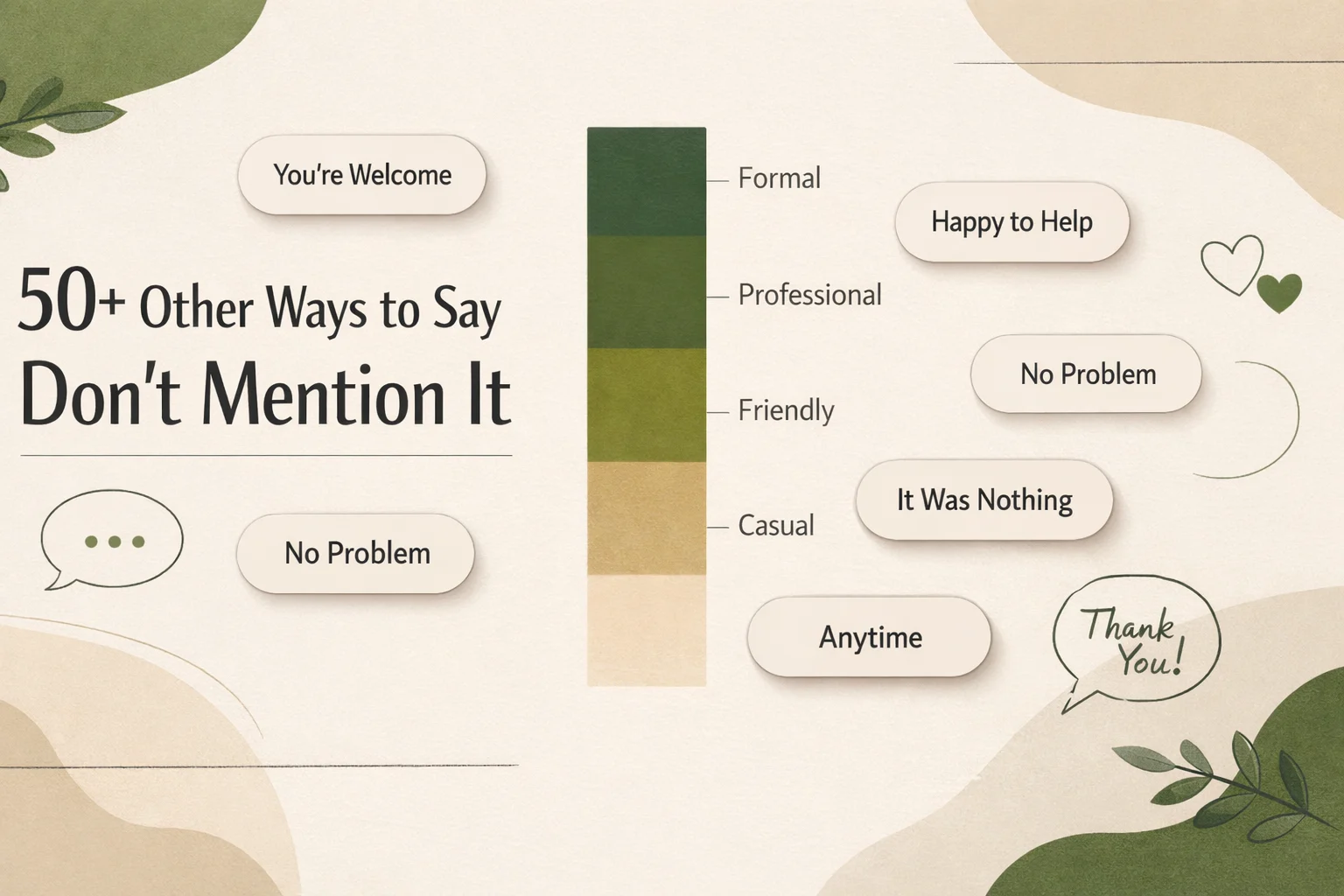
Different situations call for different levels of formality. This tone ladder ranks phrases from Very Formal to Informal, helping you choose the right response.
Very Formal
These phrases convey deep respect and are appropriate for high-stakes professional situations, formal events, or communicating with senior executives and dignitaries.
Formal
These work well in business settings, professional emails, and situations where you need to maintain a respectful but not overly stiff tone.
Neutral
These phrases are safe for most situations and don’t lean too heavily toward either formality or casualness. They’re versatile and generally acceptable anywhere.
Casual
These suit everyday conversations with colleagues you know well, acquaintances, and social situations where you want to be friendly but not overly familiar.
Informal
Reserved for close friends, family members, and very relaxed settings. These phrases show warmth and closeness but would be inappropriate in professional contexts.
Table: Tone Classification
| Phrase | Tone Level | Formality | Best Situation |
|---|---|---|---|
| I am most grateful for your kind words | Very Formal | 10/10 | Formal speeches, letters to dignitaries |
| I appreciate your gratitude | Very Formal | 9/10 | Executive communications, formal correspondence |
| It was my distinct pleasure | Very Formal | 9/10 | Formal events, professional ceremonies |
| You are most welcome | Formal | 8/10 | Professional emails, client meetings |
| My pleasure | Formal | 7/10 | Business settings, customer service |
| Happy to help | Formal | 7/10 | Workplace communication, service interactions |
| You’re very welcome | Formal | 7/10 | Professional and personal settings |
| You’re welcome | Neutral | 6/10 | Most everyday situations |
| Of course | Neutral | 5.5/10 | Responding to thanks for expected help |
| I’m glad I could help | Neutral | 5.5/10 | When you want to express genuine satisfaction |
| No problem | Casual | 4/10 | Everyday conversation, informal workplace |
| Not a problem | Casual | 4/10 | Casual workplace, friendly interactions |
| Sure thing | Casual | 3.5/10 | Friendly conversations, retail settings |
| No worries | Casual | 3/10 | Among friends, laid-back environments |
| Anytime | Informal | 2/10 | Close friends, family, very relaxed settings |
| It was nothing | Informal | 2/10 | Close relationships, downplaying minor favors |
| Don’t even worry about it | Informal | 1/10 | Close friends, reassuring someone |
Quick Selection Guide
In a job interview: Use “My pleasure” or “Happy to help.” These show professionalism and enthusiasm without being overly familiar.
In an email: Choose “You’re very welcome” or “My pleasure” for a polished, professional tone that respects the formality of written business communication.
In a networking situation: “Happy to help” or “Of course” works well they’re professional but friendly, helping build rapport without being too casual.
In casual conversation with friends: Go with “No worries,” “Anytime,” or “Don’t even worry about it” for a natural, warm response.
Real-Life Conversation Transformations
Job Interview Scenario
Before (awkward):
Interviewer: “Thank you for coming in today.”
Candidate: “Don’t mention it.” ❌
After (polished):
Interviewer: “Thank you for coming in today.”
Candidate: “Thank you for the opportunity. It was my pleasure to learn more about your team.” ✅
Why this works: The improved response acknowledges the interviewer’s thanks while adding value showing enthusiasm for the role and company. “Don’t mention it” feels dismissive in this high-stakes context.
Networking Event Scenario
Before (too casual):
Contact: “Thanks for sharing your insights about the industry.”
You: “No problem.” ❌
After (professional):
Contact: “Thanks for sharing your insights about the industry.”
You: “Happy to help I always enjoy discussing these trends with people who are equally passionate.” ✅
Why this works: “Happy to help” sounds professional and enthusiastic, and adding a follow-up comment builds the connection. No problem” can feel dismissive when someone is genuinely appreciating your expertise.
Email Scenario
Before (abrupt):
Email: “Thank you for sending the documents so quickly.”
Your reply: “Don’t mention it.” ❌
After (professional):
Email: “Thank you for sending the documents so quickly.”
Your reply: “You’re very welcome. Please let me know if you need any additional information.” ✅
Why this works: The improved reply acknowledges the thanks professionally and offers further assistance. “Don’t mention it” in an email can come across as terse and unprofessional.
Casual Conversation Scenario
Before (stiff):
Friend: “Thanks for helping me move that couch.”
You: “You’re welcome.” ❌
After (natural):
Friend: “Thanks for helping me move that couch.”
You: “Anytime! That’s what friends are for.” ✅
Why this works: “Anytime” sounds warm and open, and adding a friendly sentiment makes the interaction feel genuine. “You’re welcome” alone can sound formal and stiff among close friends.
50+ Other Ways to Say Don’t Mention It
Very Formal Alternatives
I am most grateful for your kind words
Meaning: Expresses deep appreciation for someone’s thanks
Explanation: This elevated response acknowledges the thank you while showing humility
Example: “I am most grateful for your kind words about my presentation.
Tone: Very Formal
Best Use: Responding to thanks from senior executives or in formal ceremonies
Worst Use: Casual conversations with friends
Context Variability: Rarely used; reserved for highly formal situations
I appreciate your gratitude
Meaning: Acknowledges and values the thanks you’ve received
Explanation: This phrase flips the gratitude back to the thanker in a respectful way
Example: “I appreciate your gratitude for my work on the project.”
Tone: Very Formal
Best Use: Formal correspondence, professional recognition settings
Worst Use: Everyday conversation
Context Variability: Professional written communication mainly
It was my distinct pleasure
Meaning: Emphasizes that helping brought significant satisfaction
Explanation: “Distinct” adds weight, making this more emphatic than “my pleasure”
Example: “It was my distinct pleasure to assist with your inquiry.
Tone: Very Formal
Best Use: High-end customer service, formal events
Worst Use: Casual settings
Context Variability: Mostly spoken at formal gatherings or high-end service contexts
Formal Alternatives
You are most welcome
Meaning: A gracious, slightly elevated version of “you’re welcome”
Explanation: Adding “most” increases the sincerity and formality
Example: “You are most welcome. I was happy to assist.”
Tone: Formal
Best Use: Professional emails, client communications
Worst Use: Among friends in casual settings
Context Variability: Safe for most professional written communication
My pleasure
Meaning: Indicates you genuinely enjoyed helping
Explanation: Frames the act of helping as personally satisfying rather than a chore
Example: “Thank you for explaining the process.” / “My pleasure.
Tone: Formal
Best Use: Customer service, professional interactions, business emails
Worst Use: Very relaxed social situations
Context Variability: One of the most versatile formal options; works spoken and written
Happy to help
Meaning: Expresses willingness and enthusiasm in assisting
Explanation: Conveys positivity and approachability
Example: “Happy to help with your project anytime.”
Tone: Formal
Best Use: Workplace communication, team environments
Worst Use: Formal ceremonies or very formal letters
Context Variability: Excellent for both spoken and written professional contexts
I’m glad I could help
Meaning: Shows satisfaction in being able to assist
Explanation: Focuses on the positive outcome of your assistance
Example: “I’m glad I could help resolve that issue for you.”
Tone: Formal
Best Use: After providing significant assistance
Worst Use: For very small, routine favors
Context Variability: Works well in professional and personal contexts
It was the least I could do
Meaning: Suggests helping was a moral obligation or minimal effort
Explanation: Humble phrase that downplays the significance of what you did
Example: “It was the least I could do after all your support.”
Tone: Formal
Best Use: When you’ve received significant help from the person
Worst Use: When the favor was genuinely minor
Context Variability: More common in spoken English
You’re very welcome
Meaning: A sincere, slightly amplified standard response
Explanation: Adding “very” gives warmth that plain “you’re welcome” often lacks
Example: “Thank you for the thoughtful gift.” / “You’re very welcome.”
Tone: Formal
Best Use: Professional and personal settings
Worst Use: Very casual text messages
Context Variability: A safe choice for most situations
Neutral Alternatives
You’re welcome
Meaning: The classic, standard response to thanks
Explanation: Universally understood and accepted in virtually any situation
Example: “Thanks for your help.” / “You’re welcome.”
Tone: Neutral
Best Use: Any situation where you’re unsure of appropriate formality
Worst Use: None it’s always acceptable
Context Variability: Works everywhere, making it the safest choice
Of course
Meaning: Implies help was a natural and expected thing to do
Explanation: Makes the other person feel their request was completely reasonable
Example: “Thanks for covering for me.” / “Of course.”
Tone: Neutral
Best Use: When you want to minimize the significance of the favor
Worst Use: When the favor required substantial effort
Context Variability: Works well in both spoken and written contexts
Certainly
Meaning: A polite, affirmative response to thanks
Explanation: Formal but not stiff; shows willingness
Example: “Thank you for taking my call.” / “Certainly.”
Tone: Neutral
Best Use: Professional settings, phone conversations
Worst Use: Casual conversations with friends
Context Variability: More common in spoken British English
I understand
Meaning: Shows empathy and acknowledges someone’s position
Explanation: This validates the other person’s perspective without dismissing it
Example: “I’m sorry the report is late.” / “I understand.”
Tone: Neutral
Best Use: When someone thanks you for being patient or understanding
Worst Use: Standard thank-you responses
Context Variability: Excellent for reassuring someone
No need to apologize
Meaning: Directly lifts the burden of an apology
Explanation: Works when someone thanks you for being forgiving or understanding
Example: “I’m sorry to ask for help again.” / “No need to apologize.”
Tone: Neutral
Best Use: When someone seems worried or overly apologetic
Worst Use: For routine thank-yous
Context Variability: More spoken than written
That’s perfectly fine
Meaning: Clear, unambiguous statement of acceptance
Explanation: Adding “perfectly” removes any doubt about your approval
Example: “I’ll need to reschedule our meeting.” / “That’s perfectly fine.”
Tone: Neutral
Best Use: Accepting apologies or requests
Worst Use: Thank-you responses
Context Variability: Mostly spoken
Rest assured
Meaning: Confident reassurance that everything is under control
Explanation: Very formal way to calm concerns
Example: “I’m worried about the deadline.” / “Rest assured, we’re on track.”
Tone: Neutral
Best Use: Calming nervous clients or managers
Worst Use: Casual conversations
Context Variability: More written than spoken
Casual Alternatives
No problem
Meaning: Indicates the favor was easy and caused no inconvenience
Explanation: A widely used casual response to thanks
Example: “Thanks for grabbing that file.” / “No problem.”
Tone: Casual
Best Use: Everyday conversation, informal workplace
Worst Use: Formal emails, job interviews
Context Variability: One of the most common spoken alternatives
Not a problem
Meaning: Similar to “no problem” with slightly more emphasis
Explanation: Slightly less casual than “no problem” but still informal
Example: “Thank you for covering my shift.” / “Not a problem.”
Tone: Casual
Best Use: Friendly work environments
Worst Use: Formal professional settings
Context Variability: Good for both spoken and written casual contexts
Sure thing
Meaning: Affirmative, friendly acknowledgment
Explanation: Shows willingness with a positive, can-do attitude
Example: “Thanks for the coffee.” / “Sure thing.”
Tone: Casual
Best Use: Retail, service settings, casual conversation
Worst Use: Formal business communication
Context Variability: Mostly spoken
You got it
meaning: Confident, casual acknowledgment meaning “you’re welcome” or “I’ll handle it
Explanation: Has a cool, friendly vibe
Example: “Thanks for handling that request.” / “You got it.”
Tone: Casual
Best Use: Informal workplace, friends
Worst Use: Professional emails
Context Variability: Almost exclusively spoken
Thanks for letting me know
Meaning: Focuses on the person’s communication rather than the mistake
Explanation: Turns a negative into a positive by valuing the information
Example: “I made a mistake on the spreadsheet.” / “Thanks for letting me know.”
Tone: Casual
Best Use: When someone thanks you for being understanding
Worst Use: Simple thank-you responses
Context Variability: Works in both spoken and written contexts
No harm done
Meaning: Confirms a mistake had no negative consequences
Explanation: Practical and direct reassurance
Example: “Sorry, I sent the draft to the wrong person.” / “No harm done.”
Tone: Casual
Best Use: When mistakes were made but resolved
Worst Use: For thank-you responses
Context Variability: More spoken than written
It’s all good
Meaning: Relaxed signal that everything is fine
Explanation: Modern, warm, and reassuring
Example: “Sorry I’m late.” / “It’s all good.”
Tone: Casual
Best Use: Friends, family, very close colleagues
Worst Use: Any professional context
Context Variability: Informal spoken English only
Informal Alternatives
Anytime
Meaning: Open invitation to ask for help again
Explanation: Friendly and warm; tells someone your support is always available
Example: “Thanks for the ride!” / “Anytime.”
Tone: Informal
Best Use: Close friends, family
Worst Use: Professional emails, formal settings
Context Variability: Common in both spoken and written casual contexts
It was nothing
Meaning: Humbles the assistance as minimal effort
Explanation: Downplays your contribution to make the other person feel less obligated
Example: “Thanks for grabbing me a coffee.” / “It was nothing.”
Tone: Informal
Best Use: Small favors, close relationships
Worst Use: When you’ve made significant effort
Context Variability: Mostly spoken
Don’t even worry about it
Meaning: Strongly reassures someone who seems genuinely stressed
Explanation: The word “even” makes it clear the issue is too minor to think about
Example: “I am so sorry I forgot to send that link.” / “Don’t even worry about it.”
Tone: Informal
Best Use: Reassuring anxious friends
Worst Use: Professional contexts
Context Variability: Spoken only
No worries
Meaning: Casual, reassuring response
Explanation: Very common in informal English, especially in British and Australian contexts
Example: “Thanks for your help!” / “No worries!”
Tone: Informal
Best Use: Friends, casual conversation
Worst Use: Formal emails, interviews
Context Variability: Mostly spoken; occasionally appears in casual messages
No big deal
Meaning: Downplays a favor or mistake
Explanation: Tells someone not to overthink a minor issue
Example: “I’m sorry I spilled coffee.” / “No big deal.”
Tone: Informal
Best Use: Friends, very casual settings
Worst Use: Professional situations
Context Variability: Spoken only
Think nothing of it
Meaning: Graciously dismisses thanks or apology
Explanation: Suggests the issue is too small to warrant concern
Example: “I’m sorry about the noise.” / “Think nothing of it.”
Tone: Informal
Best Use: Showing magnanimity in social situations
Worst Use: Professional emails (sounds dated)
Context Variability: More common in spoken British English
Table: Usage Comparison
Email and LinkedIn Ready Expressions
Professional Email Greetings
- “Thank you for your email.” Standard professional opening
- “I appreciate you reaching out.” Warmer professional opening
- “Thanks for getting in touch.” Slightly more casual but still professional
Email Responses to Thanks
- “You’re very welcome please don’t hesitate to reach out if you need anything further.”
- “It was my pleasure to assist. Let me know if I can help with anything else.”
- “Happy to help I hope the information proves useful.”
LinkedIn Connection Messages
- “Thank you for connecting I appreciate the opportunity to expand my network.”
- “Thanks for accepting my invitation. I’m impressed by your work in [industry/field].”
- “I appreciate you taking the time to connect with me.”
Professional Follow-Up Lines
- “Thank you for your response. I look forward to our continued collaboration.”
- “I appreciate your quick reply and value your input.”
- “Thanks for getting back to me so promptly.”
Native Speaker Insight
Natural Native Usage Patterns
Native speakers rarely use “don’t mention it” in very formal contexts. They tend to match the tone of the thankew if someone says “Thanks so much,” a warmer response like “Of course!” or “My pleasure” sounds natural. “Don’t mention it” often appears among acquaintances or in service settings but can sound slightly dated to younger speakers.
Shortened Spoken Versions
In fast speech, native speakers might say:
- “‘Preciate it” (I appreciate it) Very casual
- “No prob” Short for “no problem,” common in texting
- “Sure” or “Mm-hmm” Very casual acknowledgment
What Sounds Unnatural
- “No mention” is incorrect and sounds like non-native English
- “Mention not” is grammatically incorrect and never used
- “Don’t mention” without “it” is incomplete
Preferred Professional Alternatives
In professional settings, native speakers lean toward “My pleasure,” “Happy to help,” and “You’re welcome.” These sound gracious without being dismissive, unlike “Don’t mention it,” which can feel like you’re brushing off someone’s gratitude.
Common Mistakes and What Not to Say
Unnatural Phrases
- ❌ “No mention” This is grammatically incorrect. Native speakers don’t shorten “don’t mention it” this way
- ❌ “Mention not” A direct translation from other languages that’s not English
- ❌ “No mention please” Sounds like Chinglish and is not idiomatic
Tone Mismatch
- ❌ Using “No worries” in a job interview: Too casual
- ❌ Using “It was nothing” when you’ve done significant work: Downplays your effort
- ❌ Using “Anytime” with a senior executive: Too familiar
- ❌ Using “My pleasure” in a text to a close friend: Too formal, stiff
- ❌ “Don’t mention it” used as a warning: Incorrect. The phrase is only for responding to thanks
- ❌ “Don’t mention it” confused with “no comment”: These have different meanings “no comment” means refusing to answer
Awkward Usage
- Overusing the same response repeatedly: Sounds robotic
- Using formal responses in casual settings: Creates distance
- Using informal responses professionally: Damages credibility
Expansion Phrases
Related Expressions
- “You’re welcome” The classic response
- “My pleasure” Adds warmth and sincerity
- “Happy to help” Professional and positive
- “No worries” Casual and reassuring
- “Anytime” Open and friendly
- “Of course” Natural and expected help
- “Certainly” Polite and formal
Greeting Variations
- “Glad to help” Simple, professional
- “Delighted to assist” More formal, shows enthusiasm
- “Pleased to be of service” Old-fashioned but polite
Introduction Phrases with Gratitude
- “Thank you for having me” After attending an event
- “I appreciate the opportunity” After an interview
- “Thanks for your time” After a meeting
Polite Communication Alternatives
- “I’m grateful for your support” Acknowledging help received
- “Thank you for your understanding” Accepting apologies
- “I value your input” Showing appreciation for feedback
Table: Decision-Making Guide
Quick Fast List
Best Alternatives for Any Situation
- My pleasure Professional, warm, and gracious
- Happy to help Professional and positive
- You’re welcome Universal, always appropriate
- Of course Makes helping sound natural
- Anytime Warm, open invitation for future help
- No problem Casual, common, friendly
- It was nothing Humble, downplays effort
- Sure thing Friendly, positive acknowledgment
- I’m glad I could help Shows genuine satisfaction
- No worries Relaxed, reassuring
Mini Quiz
Test your understanding of when to use each alternative:
1. You’re in a job interview. The interviewer says “Thank you for coming.” Which response is best?
- A) “No worries”
- B) “My pleasure”
- C) “Anytime”
- D) “No problem”
Answer: B
2. A close friend thanks you for helping them move apartments. What’s the most natural response?
- A) “You’re most welcome”
- B) “I am grateful for your gratitude”
- C) “Anytime”
- D) “Certainly”
Answer: C
3. You’re writing a professional email response to a client. Which works best?
- A) “No worries”
- B) “No problem”
- C) “You’re very welcome”
- D) “It was nothing”
Answer: C
4. A colleague thanks you for covering their shift. You want to be friendly but professional. What’s best?
- A) “Don’t even worry about it”
- B) “Happy to help”
- C) “It’s all good”
- D) “No big deal”
Answer: B
5. Someone says “I’m sorry for the confusion” and thanks you for being understanding. What’s the best response?
- A) “No need to apologize”
- B) “Rest assured”
- C) “It’s not a big deal”
- D) “That’s perfectly fine”
Answer: A
FAQs
Is it polite to say “don’t mention it”?
Yes, “don’t mention it” is a polite response to thanks. However, in very formal contexts, phrases like “my pleasure” or “you’re welcome” may be more appropriate. Some people find “don’t mention it” slightly dismissive, as it can seem like you’re brushing off their gratitude.
What is the best alternative to “don’t mention it” for customer service?
“My pleasure” is the gold standard in customer service. It suggests genuine satisfaction in helping and is warm without being overly familiar. “Happy to help” is also excellent for service contexts.
Can I use “no worries” in professional settings?
Generally, no. “No worries” is informal and best reserved for casual conversations with friends or close colleagues. In professional emails or business meetings, use “You’re welcome” or “My pleasure” instead.
Is “no mention” a valid alternative?
No. “No mention” is grammatically incorrect and not used by native speakers in this context. The correct phrase is “don’t mention it.” Saying “no mention” would confuse native speakers or sound like non-native English.
How do I respond when someone thanks me profusely?
For heartfelt or enthusiastic thanks, respond with warmth: “I was so happy to help,” “It was my absolute pleasure,” or “I’m really glad I could make a difference.” This acknowledges the depth of their gratitude without being dismissive.
What if I want to show appreciation for their thanks?
You can say “Thank you for saying that” or “I appreciate you taking the time to thank me.” This acknowledges their kindness in expressing gratitude while staying gracious about your contribution.
Conclusion
Having a diverse vocabulary for responding to thanks helps you navigate social and professional situations with confidence. The alternatives to “don’t mention it” range from very formal options like “I am most grateful for your kind words” to casual phrases like “No worries” and “Anytime.” Understanding this range lets you match your response to the context whether you’re in a job interview, writing a professional email, or chatting with friends.
The key is matching your response to the situation. In professional contexts, “My pleasure” and “Happy to help” project warmth and competence. Among friends, “No worries” and “Anytime” sound natural and warm. By practicing these variations and paying attention to tone, you’ll develop more natural, context-appropriate conversations. Remember, the goal is to make the other person feel valued while staying true to the level of formality the situation demands.
Read More Related Articles:
- 30+ Other Ways to Say “It Was Good to See You Again” | For Any Occasion In 2026
- 35+ Other Ways to Say “Happy Monday” | Positive Workplace Communication In 2026
- 50+ Other Ways to Say Happy Friday | Alternatives for Every Situation In 2026

Zoe Chambers works as a content writer at synoseek.com, contributing thoughtful pieces on everyday subjects and ideas. She writes in a simple, grounded way, often drawing from real-world experiences. Her focus is on keeping content natural, clear and easy for readers to connect with.