Quick Answer
“Please note” is a polite directive used to draw attention to important information. While professional, it can feel repetitive or impersonal.Top 5 alternatives:
- Please be aware
- Kindly note
- For your reference
- Please keep in mind
- It’s worth noting
Looking for other ways to say “Please Note”? While this phrase is clear and professional, using different expressions can make your writing sound more natural and engaging. In this guide, you’ll discover 55+ Other Ways to Say Please Note, complete with meanings, examples, and the best use cases for emails, business communication, customer service, and everyday conversations.
Why Do People Search About Other Ways to Say Please Note
When users search for alternatives to “please note,” they typically need to vary their language to match different contexts. Understanding search intent helps you choose the right phrase for the right situation.
What users are looking for:
- Professional phrases for emails and business communication
- Softer, more polite alternatives
- Casual expressions for everyday conversation
- Formal options for legal or official documents
- Ways to avoid sounding repetitive
Why they search this phrase:
Many professionals feel “please note” can sound robotic or overly direct. They want to sound more natural, empathetic, or authoritative depending on their communication goals.
Spoken vs. written usage:
In spoken English, “please note” often sounds overly formal. Native speakers tend to use phrases like “just so you know” or “heads up” in conversation. In writing, especially professional emails, “please note” remains common but can be varied to maintain reader engagement.
Formal vs. informal communication intent:
Formal settings demand more structured phrases like “please be advised” or “it should be noted.” Informal settings favor phrases like “just a heads-up” or “quick reminder.”
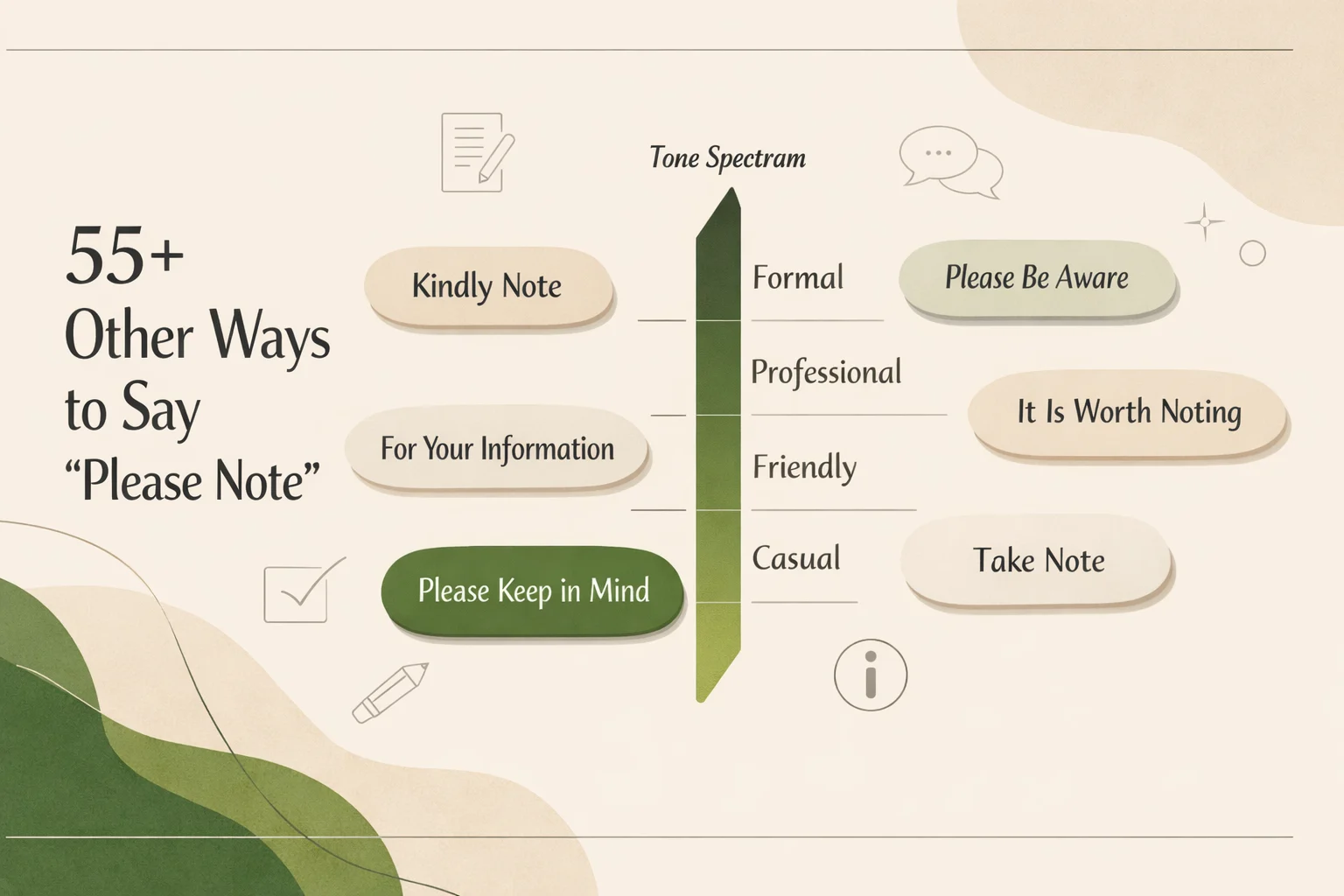
Tone Ladder System
Understanding where phrases fall on the tone spectrum helps you choose the right expression for every situation. Here’s how alternatives to “please note” rank from very formal to informal.
Very Formal Phrases
Best for legal documents, official notices, and executive communication
- Please be advised – Sounds authoritative and official
- It should be noted – Common in academic and legal writing
- Nota bene – Latin phrase meaning “note well,” used in scholarly work
- For the record – Used to establish official documentation
- May I draw your attention to – Extremely polite and formal
Formal Phrases
Best for professional emails, business reports, and client communication
- Kindly note – Polite and respectful
- Please be aware – Professional and clear
- For your information – Standard business phrase
- Please keep in mind – Professional but approachable
- It’s worth noting – Polished and thoughtful
Neutral Phrases
Best for everyday workplace communication and general use
- Take note – Direct but not overly formal
- Keep in mind – Common and versatile
- Please remember – Friendly but professional
- Note that – Simple and effective
- For your reference – Informational and neutral
Casual Phrases
Best for team communication and friendly emails
- Just so you know – Relaxed and warm
- As a reminder – Helpful and approachable
- Just bringing to your attention – Considerate and collaborative
- Worth mentioning – Conversational and light
Informal Phrases
Best for text messages, chats, and very casual conversations
- Heads up – Very casual but common
- FYI – Quick and informal
- Just a quick reminder – Friendly and brief
- Mind you – Conversational and informal
Table: Tone Classification
| Phrase | Tone Level | Formality | Best Situation |
|---|---|---|---|
| Please be advised | Very Formal | 10/10 | Legal notices, official policy changes |
| It should be noted | Very Formal | 10/10 | Academic writing, formal reports |
| Nota bene | Very Formal | 10/10 | Scholarly articles, footnotes |
| Kindly note | Formal | 9/10 | Client emails, polite reminders |
| Please be aware | Formal | 9/10 | Professional updates, policy changes |
| For your information | Formal | 8/10 | Sharing relevant information without action |
| Please keep in mind | Formal | 8/10 | Important reminders in business contexts |
| It’s worth noting | Formal | 8/10 | Highlighting significant details |
| Take note | Neutral | 7/10 | Presentations, instructional content |
| Keep in mind | Neutral | 7/10 | General reminders and advice |
| Please remember | Neutral | 7/10 | Friendly professional reminders |
| For your reference | Neutral | 6/10 | Attaching documents or sharing resources |
| Just so you know | Casual | 5/10 | Internal team communication |
| As a reminder | Casual | 5/10 | Follow-ups and gentle nudges |
| Just bringing to your attention | Casual | 5/10 | Collaborative team messages |
| Heads up | Informal | 3/10 | Quick alerts among colleagues |
| FYI | Informal | 3/10 | Chat messages and informal updates |
Quick Selection Guide: Decision Block
Choose the perfect alternative instantly based on your situation.
| Situation | Best Phrase | Why it works |
|---|---|---|
| Job interview follow-up | “Please be aware” | Professional without being demanding |
| Email to CEO | “Kindly note” | Shows respect and polish |
| Networking event conversation | “Just so you know” | Friendly but professional |
| Casual conversation with colleague | “Heads up” | Relaxed and natural |
| Formal business proposal | “It should be noted” | Adds authority and importance |
| Team meeting reminder | “As a quick reminder” | Helpful without being bossy |
| Email to a client | “Please keep in mind” | Professional but approachable |
| Text message to a friend | “FYI” | Quick and informal |
Real-Life Conversation Transformations
See how replacing “please note” with better alternatives transforms real communication scenarios.
Job Interview Scenario
Before: “Please note that I have five years of experience in project management.”
After: “I want to highlight that I have five years of experience in project management, which has prepared me to handle complex timelines and cross-functional teams.”
Why it works: Using “I want to highlight” sounds more confident and personal. It positions you as someone who takes ownership of your achievements rather than simply presenting facts.
Networking Event Scenario
Before: “Please note that our company specializes in digital marketing solutions.”
After: “Just so you know, our company specializes in digital marketing solutions we’ve helped over 200 brands grow their online presence.”
Why it works: “Just so you know” sounds conversational and approachable at a networking event. It doesn’t feel like a formal announcement or a sales pitch.
Professional Email Scenario
Before: “Please note that the deadline has been moved to Friday.”
After: “I’d like to bring to your attention that the deadline has been moved to Friday. Please let me know if this creates any challenges for your team.”
Why it works: “I’d like to bring to your attention” is more collaborative and shows you’re considering how the change affects the recipient. The follow-up question demonstrates empathy.
Casual Conversation Scenario
Before: “Please note that we’re meeting at 3 PM instead of 2 PM.”
After: “Heads up we’re meeting at 3 PM instead of 2 PM today.”
Why it works: “Heads up” is natural and friendly for casual conversations. It signals that you’re sharing helpful information without sounding like a boss giving instructions.
55+ Other Ways to Say Please Note
1. Kindly Note
Meaning: A polite way to ask someone to pay attention to important information.
Explanation: The word “kindly” adds courtesy and respect, making this phrase a strong choice for professional communication. It sounds polite without being overly authoritative.
Example: “Kindly note that our office hours have changed to 9:00 AM–6:00 PM.”
Tone: Polite, Professional
Best Use: Client emails, formal notices, professional reminders
Worst Use: Casual conversations or text messages
Context: Excellent for formal written communication across most industries.
2. Please Be Advised
Meaning: A formal way to inform someone about important information.
Explanation: This phrase carries an authoritative tone and is frequently used in legal, corporate, and policy-related communication. It emphasizes that the information should be taken seriously.
Example: “Please be advised that the terms of service have been updated.”
Tone: Formal, Authoritative
Best Use: Legal documents, policy updates, official notices
Worst Use: Friendly emails or casual workplace conversations
Context: Best suited for legal, compliance, and executive communication.
3. For Your Information
Meaning: Information shared solely to keep someone informed.
Explanation: This neutral phrase communicates information without requesting action. It is one of the most common alternatives in professional writing and is often shortened to FYI in informal settings.
Example: “For your information, the project timeline has been adjusted.”
Tone: Neutral, Informative
Best Use: Business updates, notifications, informational emails
Worst Use: Situations where immediate action is expected
Context: Professional in full form; FYI is better suited for casual communication.
4. Please Be Aware
Meaning: A polite request for someone to be aware of important information.
Explanation: This phrase emphasizes awareness while maintaining a respectful and professional tone. It informs without sounding demanding.
Example: “Please be aware that the system will be down for maintenance tonight.”
Tone: Formal, Professional
Best Use: Business emails, announcements, and service updates
Worst Use: Informal conversations or text messages
Context: Appropriate across most professional environments.
5. It Should Be Noted
Meaning: Highlights an important detail that deserves attention.
Explanation: Common in reports and formal documents, this phrase draws attention to significant information in an objective and professional way.
Example: “It should be noted that all submissions must be completed before Friday.
Tone: Formal, Serious
Best Use: Reports, academic writing, business memos, formal correspondence
Worst Use: Casual emails or friendly chats
Context: Particularly effective in academic and corporate writing.
6. For Your Reference
Meaning: Provides information for future use or reference.
Explanation: This phrase is commonly used when attaching documents or sharing supporting materials. It informs the reader without requiring immediate action.
Example: “For your reference, I’ve attached the updated project schedule.”
Tone: Professional, Courteous
Best Use: Emails with attachments, supporting documents, and resources
Worst Use: Situations requiring an immediate response or action
Context: Ideal when sharing files, reports, or reference materials.
7. May I Draw Your Attention To
Meaning: A highly polite way to direct someone’s focus toward something important.
Explanation: This elegant expression is commonly used in formal presentations, reports, and executive communication where courtesy is essential.
Example: “May I draw your attention to the revised terms in Section Three?”
Tone: Respectful, Polished
Best Use: Formal letters, presentations, reports, and executive communication
Worst Use: Casual conversations or internal chats
Context: Best reserved for highly formal situations.
8. I Want to Highlight
Meaning: Indicates that a particular point deserves special attention.
Explanation: This phrase feels more personal than passive alternatives while remaining professional. It works well when emphasizing key information.
Example: “I want to highlight that the deadline remains unchanged.”
Tone: Professional, Direct
Best Use: Business emails, project updates, and presentations
Worst Use: Legal documents or highly formal correspondence
Context: Effective for emphasizing important points in workplace communication.
9. I’d Like to Emphasize
Meaning: Places strong focus on an important point.
Explanation: This phrase conveys confidence and clarity while drawing attention to critical information. It is especially effective in leadership communication.
Example: “I’d like to emphasize that all reports must be submitted by the end of the day.”
Tone: Confident, Clear
Best Use: Meetings, presentations, leadership communication, and formal emails
Worst Use: Casual conversations with friends
Context: Appropriate whenever a key message needs extra emphasis.
10. Please Keep in Mind
Meaning: A polite reminder to remember something important.
Explanation: This phrase balances professionalism with warmth, making it ideal for gentle reminders without sounding forceful.
Example: “Please keep in mind that the session starts promptly at 9:00 AM.”
Tone: Respectful, Kind
Best Use: Internal communication, reminders, and workplace notices
Worst Use: Formal legal documents
Context: Versatile enough for both professional and semi-formal communication.
11. Take Note
Meaning: A direct way to draw attention to important information.
Explanation: This phrase is concise and authoritative. It clearly signals that the information is important and should not be overlooked.
Example: “Take note of the new safety guidelines before entering the worksite.”
Tone: Firm, Authoritative
Best Use: Official announcements, workplace policies, and critical updates
Worst Use: Friendly conversations or casual text messages
Context: Best suited for formal instructions and organizational communication.
12. Keep in Mind
Meaning: Encourages someone to remember an important detail.
Explanation: Friendly and approachable, this phrase works well in both professional and everyday communication. It serves as a gentle reminder rather than a strict instruction.
Example: “Keep in mind that all expense reports are due by Monday.”
Tone: Friendly, Advisory
Best Use: Reminders, workplace instructions, and helpful advice
Worst Use: Excessive repetition within the same conversation
Context: Highly versatile for emails, meetings, and spoken conversations.
13. Bear in Mind
Meaning: Reminds someone to remember information that may become important later.
Explanation: Similar to “keep in mind,” but with a slightly more formal tone. It encourages thoughtful consideration without sounding demanding.
Example: “Bear in mind that we have not yet finalized all the project details.”
Tone: Formal, Polite
Best Use: Professional reminders, reports, and business discussions
Worst Use: Casual chats among close friends
Context: Appropriate for most professional and semi-formal settings.
14. It’s Worth Noting
Meaning: Highlights a detail that deserves attention.
Explanation: This phrase balances professionalism with warmth, making it an excellent choice when emphasizing useful or noteworthy information.
Example: “It’s worth noting that prices will increase next quarter.”
Tone: Professional, Thoughtful
Best Use: Business reports, project updates, presentations, and emails
Worst Use: Highly informal conversations
Context: Works naturally in both written and spoken professional English.
15. Please Remember
Meaning: A polite reminder about something important.
Explanation: This phrase sounds caring and respectful while encouraging the reader to keep something in mind. It feels less forceful than many formal alternatives.
Example: “Please remember to submit your timesheet by Friday.”
Tone: Warm, Respectful
Best Use: Friendly reminders, workplace communication, and educational settings
Worst Use: Legal documents or formal contractual notices
Context: Effective for gentle reminders in professional and educational environments.
16. Be Mindful
Meaning: Encourages someone to think carefully about a situation or detail.
Explanation: This considerate phrase softens instructions while maintaining professionalism. It is particularly useful when discussing sensitive topics or ongoing situations.
Example: “Please be mindful that we are still reviewing the final proposal.”
Tone: Polite, Considerate
Best Use: Sensitive workplace communication, HR messages, and client interactions
Worst Use: Highly formal legal documents
Context: Common in professional communication that requires tact and diplomacy.
17. For Your Awareness
Meaning: Shares important information for someone’s knowledge.
Explanation: This phrase informs the reader without requesting immediate action. It is especially useful for status updates and informational notices.
Example: “For your awareness, the project will enter Phase Two next week.”
Tone: Neutral, Respectful
Best Use: Professional memos, informational updates, and internal announcements
Worst Use: Situations requiring a direct response or action
Context: Frequently used in business communication to keep stakeholders informed.
18. As a Quick Note
Meaning: Introduces a brief piece of helpful information.
Explanation: This conversational phrase keeps the tone friendly while remaining professional. It works well when adding a small but important detail.
Example: “As a quick note, we’ve extended the early-bird registration period by one week.”
Tone: Light, Friendly
Best Use: Informal emails, team messages, and semi-formal communication
Worst Use: Contracts, legal documents, or official notices
Context: Best suited for internal communication and friendly professional correspondence.
19. Just So You Know
Meaning: A casual way to share helpful or relevant information.
Explanation: This phrase sounds natural and conversational. It informs someone without creating pressure or implying that action is required.
Example: “Just so you know, the design team will need an extra day to finish the project.”
Tone: Friendly, Relaxed
Best Use: Team chats, internal emails, and casual workplace conversations
Worst Use: Formal business correspondence or legal documents
Context: Common in everyday spoken and written English.
20. As a Gentle Reminder
Meaning: A soft and considerate way to remind someone about something important.
Explanation: This phrase avoids sounding demanding or critical, making it ideal for polite follow-ups and friendly reminders.
Example: “As a gentle reminder, registration closes tonight at midnight.”
Tone: Warm, Empathetic
Best Use: Friendly reminders, follow-up emails, and customer communication
Worst Use: Legal notices or formal policy announcements
Context: Excellent for maintaining a positive and respectful tone in professional communication.
21. Just Bringing It to Your Attention
Meaning: A polite and conversational way to highlight something important.
Explanation: This phrase sounds helpful rather than demanding. It lets the recipient know you’re simply pointing out information they may find useful or need to address.
Example: “Just bringing it to your attention that the invoice is still pending.”
Tone: Warm, Helpful
Best Use: Team communication, client follow-ups, and internal emails
Worst Use: Legal documents or highly formal correspondence
Context: Common in collaborative workplace communication.
22. Worth Mentioning
Meaning: Highlights a detail that deserves attention.
Explanation: This expression introduces useful information in a natural, conversational way. It sounds informative without being overly formal.
Example: “It’s worth mentioning that the latest update includes several new security features.”
Tone: Balanced, Informative
Best Use: Business updates, presentations, and professional conversations
Worst Use: Formal legal or regulatory documents
Context: Suitable for both spoken and written workplace communication.
23. Just a Quick Reminder
Meaning: A friendly way to remind someone about something already discussed.
Explanation: This phrase softens the reminder, making it feel like a helpful nudge instead of a demand. It’s one of the most common reminder phrases in professional English.
Example: “Just a quick reminder that the payment is due tomorrow.
Tone: Warm, Conversational
Best Use: Friendly work emails, follow-up messages, and team reminders
Worst Use: Formal legal notices
Context: Ideal for workplace communication where maintaining a friendly tone is important.
24. In Case It Helps
Meaning: Offers information in a thoughtful and supportive way.
Explanation: This phrase shows consideration by presenting information as something that may be useful rather than necessary. It creates a collaborative and helpful tone.
Example: “In case it helps, here’s the revised project checklist.”
Tone: Helpful, Caring
Best Use: Team collaboration, client support, and workplace guidance
Worst Use: Formal legal or contractual communication
Context: Works particularly well in collaborative environments.
25. You Might Like to Know
Meaning: A thoughtful way to share useful or interesting information.
Explanation: This phrase suggests that the information could benefit the recipient without sounding forceful. It feels personal and considerate.
Example: “You might like to know that the webinar recording is now available.”
Tone: Gentle, Kind
Best Use: Customer communication, educational content, and friendly updates
Worst Use: Executive reports or formal business documentation
Context: Excellent for customer service and relationship-focused communication.
26. Heads Up
Meaning: An informal way to warn or alert someone about something important.
Explanation: This is one of the most common conversational alternatives. It prepares someone for upcoming information or a potential issue in a friendly, relaxed way.
Example: “Heads up—the team meeting has been moved to 2:00 PM.”
Tone: Casual, Friendly
Best Use: Team chats, quick alerts, and informal workplace emails
Worst Use: Formal letters, legal documents, or executive communication
Context: Best suited for casual workplace and personal conversations.
27. FYI
Meaning: Short for “For Your Information.”
Explanation: This abbreviation provides information quickly without requesting action. It is widely used in emails, messaging apps, and workplace chats.
Example: “FYI, the documents need to be submitted by Friday.”
Tone: Casual, Direct
Best Use: Internal emails, chat messages, and informal workplace updates
Worst Use: Formal client communication or official correspondence
Context: Extremely common in modern workplace communication.
28. Mind You
Meaning: Draws attention to an important exception or additional point.
Explanation: This conversational expression is often used to introduce clarification or emphasize a contrasting detail. It is much more common in spoken English than formal writing.
Example: “Mind you, this change only applies to the marketing team.”
Tone: Informal, Emphatic
Best Use: Casual conversations and conversational writing
Worst Use: Professional reports, legal documents, or formal emails
Context: Primarily used in spoken English, especially in British English.
29. Just Wanted to Point Out
Meaning: A relaxed way to highlight something important.
Explanation: This phrase sounds friendly and helpful rather than critical. It works well when drawing attention to details without sounding overly direct.
Example: “Just wanted to point out that the file name has been updated.”
Tone: Warm, Conversational
Best Use: Team chats, internal emails, and informal workplace communication
Worst Use: Executive correspondence or formal business writing
Context: Common in collaborative workplace environments.
30. Friendly Heads-Up
Meaning: A casual way to alert someone about upcoming information or changes.
Explanation: Adding “friendly” softens the message and emphasizes that you’re sharing information to be helpful, not critical.
Example: “Just a friendly heads-up that the file format has changed.”
Tone: Warm, Informal
Best Use: Casual emails, workplace chats, and friendly reminders
Worst Use: Legal documents, contracts, or formal notices
Context: Best suited for relaxed workplace communication and conversations with colleagues.
Table: Usage Comparison
| Phrase | Spoken Use | Written Use | Context |
|---|---|---|---|
| Please be advised | Rare sounds overly formal | Common legal notices | Formal written documents |
| Kindly note | Occasionally sounds very polite | Common professional emails | Formal correspondence |
| Please be aware | Sometimes professional conversations | Common business emails | Professional contexts |
| For your information | Common informal conversations | Very common emails | Both spoken and written |
| Keep in mind | Very common everyday conversation | Common writing | Versatile all contexts |
| It’s worth noting | Somewhat common meetings | Common reports | Professional contexts |
| Just so you know | Very common casual conversation | Common informal emails | Casual contexts |
| Heads up | Very common spoken English | Sometimes chat messages | Very casual contexts |
| FYI | Very common spoken and written | Very common messages | Informal contexts |
| Take note | Common presentations | Common instructions | Instructional contexts |
Email + LinkedIn Ready Expressions
Use these polished alternatives in your professional communication.
Email Greetings
- I hope this email finds you well. Kindly note that our policy has been updated…
- “Good morning. Please be aware that the meeting time has changed…”
- “Following up on our last conversation, please keep in mind that…”
Professional Introductions
- “I’d like to bring to your attention that our team has developed a new approach…”
- “For your information, I’ve attached the proposal for your review…”
- “It’s worth noting that we’ve seen significant growth in this area…”
LinkedIn Connection Messages
- “For your reference, I came across your profile and was impressed by…”
- “Just so you know, I’m reaching out because we share mutual connections…”
- “I want to highlight that my background aligns well with your work in…”
Follow-Up Lines
- “As a quick reminder, I wanted to follow up on our previous conversation…”
- “Just bringing to your attention that I haven’t received a response yet…”
- “Gentle reminder that the deadline is approaching…”
Native Speaker Insight
Natural Native Usage Patterns
Native English speakers use “please note” primarily in written communication, especially in professional emails and formal documents. In spoken English, they prefer more natural alternatives.
Common spoken alternatives:
- “Just so you know…” (most common in casual speech)
- “Keep in mind…” (professional but natural)
- “Heads up…” (very casual)
- “FYI…” (quick and informal)
Shortened Spoken Versions
In fast conversation, native speakers often shorten phrases:
- “Just so you know” → “Jus’ so ya know”
- “Keep in mind” → “Keep in mind” (usually unchanged but spoken quickly)
- Heads up” → often pronounced as one quick word
What Sounds Unnatural
- Using “please note” in casual conversation sounds stiff
- Using “nota bene” outside academic writing sounds pretentious
- Using “I want to emphasize” too often sounds aggressive
- Using “FYI” in formal documents sounds unprofessional
Preferred Professional Alternatives
In professional contexts, native speakers gravitate toward:
- “Please keep in mind” (polite and professional)
- “It’s worth noting” (thoughtful and polished)
- “For your reference” (informational without being demanding)
- “I’d like to highlight” (personal and professional)
Common Mistakes + What Not to Say
Unnatural Phrases to Avoid
- “Please note that…” followed by unimportant information makes the phrase meaningless
- Using “please note” in every email becomes repetitive and robotic
- “It is important to note” for obvious information sounds patronizing
Tone Mismatch Examples
Too formal for casual context:
❌ “Please be advised that we’re having lunch at noon.”
✓ “Heads up lunch is at noon.”
Too casual for formal context:
❌ “FYI, the contract terms have changed.”
✓ “Please be aware that the contract terms have been updated.”
Grammar Mistakes
- Missing object: “Please note.” (needs an object what should be noted?)
✓ “Please note the updated schedule.” - Using “please note” for past events: “Please note that the meeting was yesterday.” (better: “As you may recall…”)
- Overusing in one message: “Please note X. Please note Y.” ✓ Vary your language
Over-Formal or Awkward Usage
- “Kindly note” used with close colleagues sounds too formal
- “Take note” in friendly emails sounds like an order
- “It should be noted” in everyday conversation sounds academic
- “Please be advised” for casual updates sounds like a warning
Expansion Phrases:
Related expressions to enhance your communication:
Greeting Variations
- “I hope you’re doing well…”
- “I trust this message finds you well…”
- “I wanted to reach out regarding…”
Introduction Phrases
- “I’d like to share…”
- “I wanted to bring to your attention…”
- “It’s important to consider…”
Polite Communication Alternatives
- “If you could kindly…”
- “I would appreciate it if…”
- “Could you please…”
Conversational English Upgrades
- “I just wanted to mention…”
- “On a related note…”
- “Speaking of which…”
Table: Decision-Making Table
| Situation | Best Phrase | Why It Works |
|---|---|---|
| Legal document | Please be advised | Formal and authoritative |
| Academic paper | It should be noted | Scholarly and precise |
| Client email | Kindly note | Polite and respectful |
| Team update | Please keep in mind | Professional but warm |
| Meeting reminder | As a quick reminder | Helpful and friendly |
| Casual email | Just so you know | Natural and approachable |
| Group chat | Heads up | Quick and casual |
| Formal report | For your reference | Informational and neutral |
| Presentation | Take note | Direct and clear |
| Follow-up email | Gentle reminder | Considerate and not pushy |
Quick Fast List: Top 10 Alternatives
- Please be aware – Professional and clear
- Kindly note – Polite and respectful
- It’s worth noting – Thoughtful and polished
- Please keep in mind – Warm and professional
- For your information – Neutral and informative
- Take note – Direct and clear
- Just so you know – Casual and friendly
- Heads up – Very casual and quick
- For your reference – Informational and helpful
- Keep in mind – Versatile and approachable
Mini Quiz: Test Your Knowledge
Scenario 1: You’re sending a formal policy update to all employees. Which phrase should you use?
A) Heads up
B) FYI
C) Please be advised ✓
D) Just so you know
Scenario 2: You’re chatting with a colleague about a meeting time change. Which is most natural?
A) Please note the meeting time has changed
B) Heads up meeting time changed ✓
C) It should be noted that the meeting time has changed
D) May I draw your attention to the meeting time change
Scenario 3: You’re attaching a document for a client to review. Which phrase is best?
A) Nota bene
B) For your reference ✓
C) Mind you
D) FYI
Scenario 4: You need to remind your team about a deadline approaching next week. Which is most professional?
A) Just wanted to point out the deadline
B) As a reminder, the deadline is next week ✓
C) Take heed of the deadline
D) Please be advised of the deadline
Scenario 5: You’re writing a formal business proposal. Which phrase should you choose?
A) It’s worth noting ✓
B) FYI
C) Heads up
D) Mind you
Answers: 1-C, 2-B, 3-B, 4-B, 5-A
FAQs
Is it polite to say “please note”?
Yes, “please note” is polite and professional when used in the right context. The word “please” softens the instruction, making it courteous rather than demanding. It works well in professional emails, formal documents, and official communication . However, in casual conversation or with close colleagues, it can sound too formal. Native speakers rarely use “please note” in spoken English.
What is more professional than “please note”?
Several phrases are more professional depending on the context:
- “Please be advised” is more formal and authoritative, often used in legal or official communication
- “Kindly note” adds extra politeness and sophistication
- “I’d like to highlight” sounds more personal and engaged
- “It should be noted” is more formal and academic
For most professional emails, “please be aware” and “please keep in mind” are excellent professional alternatives.
Can I use “please note” in a professional email?
Yes, “please note” is absolutely acceptable in professional emails. It’s considered standard business English and is polite and clear. However, using it too frequently can make your writing feel repetitive and robotic. Professionals recommend varying your language with alternatives like “please keep in mind,” “it’s worth noting,” or “I’d like to highlight” .
What do native speakers say instead of “please note”?
Native English speakers use different phrases in different contexts:
Casual conversation:
- “Just so you know…”
- “Heads up…”
- “FYI…”
- “Keep in mind…”
Professional settings:
- “I’d like to highlight…”
- “For your information…”
- “As a reminder…”
- “Please be aware…”
Formal writing:
- “It should be noted…”
- “Kindly note…”
- “Please be advised…”
What is the best alternative for “please note” in an email?
The best alternative depends on your relationship with the recipient:
- For a formal email to a client or executive:
“Kindly note that…” or “Please be aware that…” - For a professional but friendly email to a colleague:
“Please keep in mind that…” or “It’s worth noting that…” - For a casual internal email:
“Just so you know…” or “As a reminder…” - For a follow-up email:
“Just a quick reminder…” or “Bringing to your attention…”
Conclusion
Mastering alternatives to “please note” transforms your communication from repetitive and robotic to nuanced and engaging. The key to effective communication isn’t just knowing alternatives it’s understanding when to use them. Formal settings demand polished phrases like “please be advised” or “kindly note,” while casual conversations welcome relaxed options like “just so you know” or “heads up.”
The 55+ alternatives in this guide equip you to handle any situation with confidence. Start by choosing one or two new phrases to practice this week. Notice how native speakers communicate in different contexts and mirror their choices. With practice, selecting the perfect alternative will become natural, making your communication more effective, professional, and authentic.
Read More Related Articles:
- 35+ Other Ways to Say Happy Thursday | Make Your Greetings More Engaging In 2026
- 35+ Other Ways to Say “Nice to Meet You” | Formal to Casual In 2026
- 35+ Other Ways to Say “Did You Sleep Well” | For Better Communication In 2026

Lucas Mitchell is a content writer at synoseek.com. He writes simple, thoughtful pieces that focus on everyday ideas, observations and general knowledge topics. His work is shaped by a calm, realistic tone that keeps the reader engaged without overstatement.