Quick Answer
“I’m sorry for your loss” is a sincere expression of sympathy used when someone has experienced the death of a loved one or any significant loss. It conveys empathy and acknowledgment of grief. While widely used, many people search for more personal or context-specific alternatives that feel warmer, more genuine, or better suited to the relationship and setting.5 Best Alternatives: My deepest condolences, I’m so deeply sorry, My heart goes out to you, Please accept my heartfelt sympathies, Words cannot express how sorry I am.
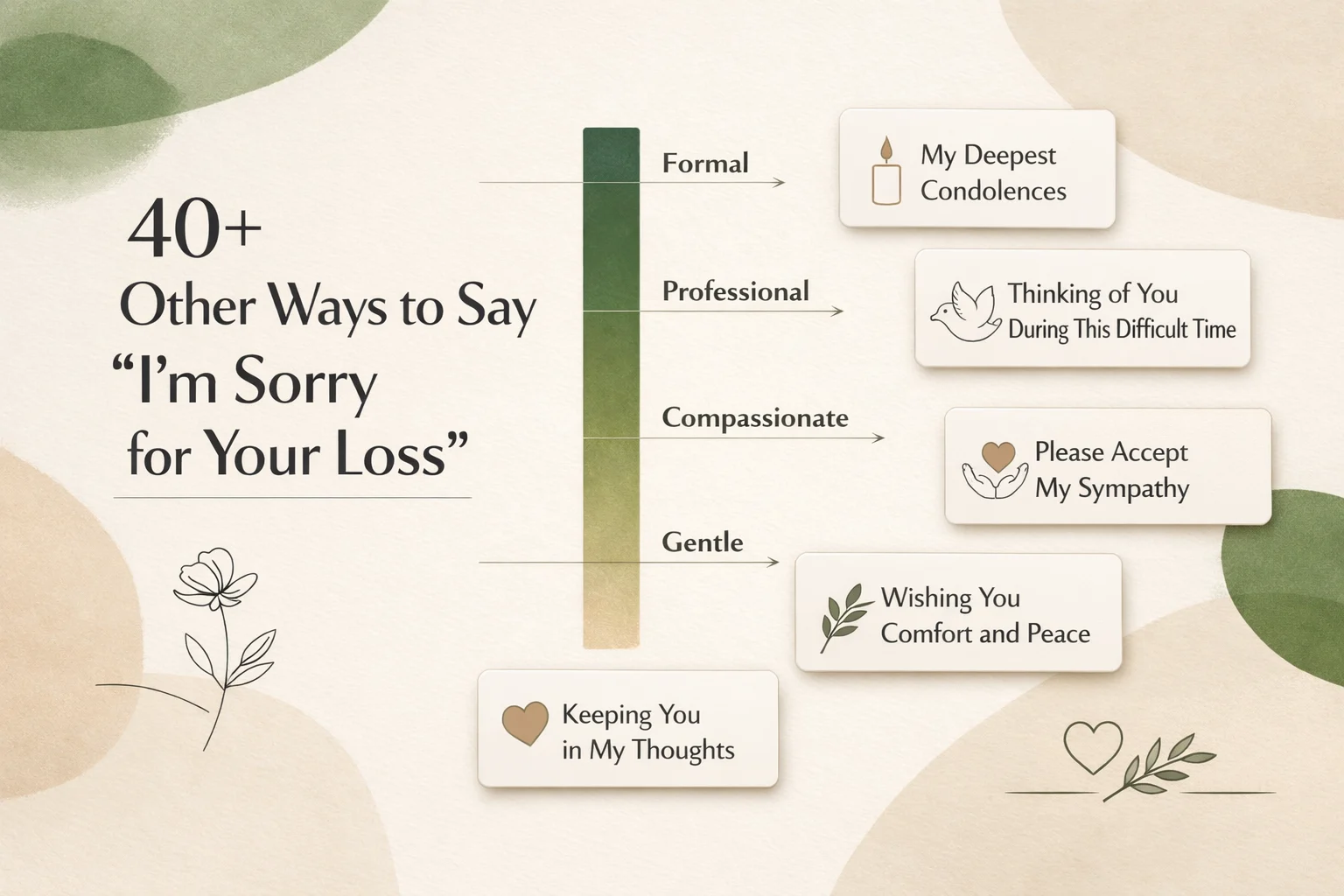
Finding the right words during someone’s grief is one of the hardest things to do. “I’m sorry for your loss” is sincere, but it can sometimes feel formulaic, especially when the person grieving is someone you are close to. Whether you are writing a condolence card, sending a professional email, attending a funeral, or texting a close friend, the right phrase can make your support feel real and meaningful. This article gives you over 40 alternatives with tone guidance, real examples, usage tables, and scenario-based advice so you always say exactly the right thing.
What Users Are Actually Searching For Other Ways to Say “I’m Sorry for Your Loss”
The Intent Behind This Search
When people look up other ways to say “I’m sorry for your loss,” they are not simply hunting for synonyms. They are navigating a sensitive emotional situation and want language that matches the depth of the moment. The search reflects several needs at once: avoiding cliché, sounding natural rather than scripted, matching the formality of the setting, and genuinely comforting the person who is grieving.
Spoken condolences carry a different weight than written ones. In person, your tone of voice, eye contact, and presence fill the gap that words alone cannot. In writing, the words must do more of the emotional labor. That is why people seek phrases that work specifically in cards, emails, LinkedIn messages, and text messages, not just in face-to-face conversations.
The search also reflects cross-cultural and professional nuance. A colleague who has lost a parent needs a different expression than a close friend who has lost a child. A formal business email requires different language than a heartfelt handwritten note. Understanding these layers helps you choose the phrase that truly fits.
Spoken Versus Written Condolences
In spoken English, shorter and warmer phrases land best. Native speakers rarely use long formal constructions in person because they can feel rehearsed. In writing, especially in emails or formal letters, slightly longer and more deliberate expressions feel appropriate and professional. The tables and tone ladder below will guide you toward the right register for your exact situation.
Tone Ladder System
Understanding the Five Tone Levels
Not every condolence expression fits every situation. Using very formal language with a close friend can feel cold and distant. Using casual language at a professional memorial can seem disrespectful. The five-level tone ladder below helps you place every phrase correctly.
Very Formal: Used in official correspondence, business settings, public statements, or when addressing someone you do not know personally. These phrases maintain professional distance while expressing genuine respect.
Formal: Appropriate for colleagues, acquaintances, professional relationships, or in written cards and letters to someone you know moderately well. Warm but measured.
Neutral: Works across most relationships and contexts. Neither stiff nor overly casual. A safe default for most situations.
Casual: Best for friends, extended family, or people you interact with regularly but are not extremely close to. Natural and conversational.
Informal: Reserved for close friends and family members. These expressions feel personal, unguarded, and emotionally connected. They would sound out of place in a professional setting.
Table 1: Tone Classification of Condolence Phrases
| Phrase | Tone Level | Formality | Best Situation |
|---|---|---|---|
| Please accept my sincere condolences | Very Formal | High | Business email, formal letter |
| My deepest condolences to you and your family | Very Formal | High | Professional relationship, memorial card |
| I offer my heartfelt sympathies | Formal | High | Written card, colleague |
| Please accept my heartfelt sympathies | Formal | High | Email, acquaintance |
| I am deeply sorry for your loss | Formal | Medium-High | Most written settings |
| My heart goes out to you | Neutral | Medium | Card, spoken, text |
| Words cannot express how sorry I am | Neutral | Medium | Card, close colleague |
| I am thinking of you during this difficult time | Neutral | Medium | Email, text, card |
| I am so sorry to hear about your loss | Neutral | Medium | Spoken or written, broad use |
| You are in my thoughts | Casual | Low-Medium | Text message, social media |
| I am here for you, always | Casual | Low | Close friend, in person |
| I cannot imagine how hard this must be | Casual | Low | Friend, spoken |
| Sending you so much love right now | Informal | Very Low | Close friend, text |
| I love you and I am here | Informal | Very Low | Family, very close friend |
| This breaks my heart for you | Informal | Very Low | Best friend, close family |
Quick Selection Guide
Choose Your Phrase in Seconds
Job interview or workplace setting: “Please accept my sincere condolences” or “I am deeply sorry to hear of your loss.”
Professional email: “My deepest condolences to you and your family. Please take all the time you need.”
Networking or LinkedIn: “I was saddened to hear of your loss. My sincere sympathies to you and your family.”
Casual conversation with a friend: “I am so sorry. I cannot imagine how you are feeling right now. I am here for whatever you need.”
Condolence card to a colleague: “My heart goes out to you during this difficult time. You are in my thoughts.”
Text message to a close friend: “Sending you all my love right now. I am here whenever you need me.”
Funeral or memorial service: “I am so deeply sorry. [Name] was such a wonderful person.”
Real-Life Conversation Transformations
Scenario 1: Job Interview Context
Before (awkward): “Oh yes, sorry for the loss, anyway let us get started.”
After (appropriate): “Before we begin, I want to say that I was truly sorry to hear of your recent loss. Please know that there is no rush and I appreciate your time today.”
The key difference is pausing to acknowledge the person before moving on. Skipping over grief to get to business signals emotional unawareness.
Scenario 2: Networking Event
Before (generic): “Sorry for your loss. So, how has business been?”
After (thoughtful): “I heard about [name’s] passing. I am truly sorry. She spoke about you often and it was clear how much you meant to each other. Please take care of yourself.”
Adding a personal detail, even a small one, transforms a formulaic phrase into a genuine moment of connection.
Scenario 3: Professional Email
Before (cold): “Sorry for your loss. Let me know when you are back in the office.”
After (warm and professional): “I was deeply saddened to learn of your loss. Please accept my sincerest condolences. Your absence from work is completely understood and there is no expectation for you to respond to anything until you feel ready. We are thinking of you.”
Scenario 4: Casual Conversation with a Close Friend
Before (robotic): “I am sorry for your loss.”
After (genuine): “I am so, so sorry. I loved [name] too. This does not feel real. I am here and I am not going anywhere. Tell me what you need.”
With close friends, emotional availability matters more than formal language. Let your care show through simplicity and presence.
40+ Other Ways to Say “I’m Sorry for Your Loss”
Very Formal Alternatives
Please accept my sincere condolences.
Meaning: A formal acknowledgment of grief offered with genuine respect.
Example: “Please accept my sincere condolences on the passing of your father.”
Tone: Very Formal | Best use: Business letter, formal email | Worst use: Casual text to a close friend
My deepest condolences to you and your family.
Meaning: Extends sympathy beyond the individual to the entire family unit.
Example: “My deepest condolences to you and your family during this heartbreaking time.”
Tone: Very Formal | Best use: Cards, emails, professional relationships | Worst use: Quick in-person spoken moment
I wish to express my profound sympathies.
Meaning: A deliberate and measured statement of sorrow, used in formal written contexts.
Example: “On behalf of our organization, I wish to express our profound sympathies.”
Tone: Very Formal | Best use: Organizational letters, official statements | Worst use: Casual spoken settings
We extend our heartfelt condolences.
Meaning: A collective expression of sympathy, often used by companies or groups.
Example: “The entire team extends its heartfelt condolences to your family.”
Tone: Very Formal | Best use: Corporate communications, group cards | Worst use: Personal one-on-one communication
Please accept our most heartfelt sympathies in this time of sorrow.
Meaning: Combines warmth with formality, acknowledging both grief and solidarity.
Example: “Please accept our most heartfelt sympathies in this time of sorrow.”
Tone: Very Formal | Best use: Formal condolence letters | Worst use: In-person brief conversation
Formal Alternatives
I am deeply sorry for your loss.
Meaning: A direct and earnest expression of sorrow, stronger than the standard phrase.
Example: “I am deeply sorry for your loss. Your mother was a remarkable person.”
Tone: Formal | Best use: Cards, emails, workplace | Worst use: None, this phrase is highly versatile
I offer my heartfelt sympathies.
Meaning: Presents sympathy as something given intentionally and sincerely.
Example: “I offer my heartfelt sympathies to you and everyone who loved him.”
Tone: Formal | Best use: Written condolences, emails | Worst use: Overly casual spoken conversations
I was deeply saddened to hear of your loss.
Meaning: Communicates personal emotional impact, showing the news genuinely affected you.
Example: “I was deeply saddened to hear of your grandmother’s passing.”
Tone: Formal | Best use: Email, LinkedIn, professional card | Worst use: Very casual setting
My thoughts are with you and your family.
Meaning: A broad expression of emotional presence and sustained attention.
Example: “My thoughts are with you and your family as you navigate this difficult time.”
Tone: Formal | Best use: Emails, cards, professional contexts | Worst use: Can feel slightly generic if not paired with something personal
This is an incredibly difficult time, and I am thinking of you.
Meaning: Validates the difficulty while offering emotional presence.
Example: “This is an incredibly difficult time, and I want you to know I am thinking of you.”
Tone: Formal to Neutral | Best use: Cards, workplace emails | Worst use: Rushed spoken conversation
Neutral Alternatives
My heart goes out to you.
Meaning: An idiom expressing deep emotional sympathy and solidarity.
Example: “My heart goes out to you and everyone who loved her.”
Tone: Neutral | Best use: Card, text, spoken, email | Worst use: Very formal corporate letters
I am thinking of you during this time.
Meaning: Communicates sustained mental and emotional presence.
Example: “Just wanted to reach out and say I am thinking of you during this time.
Tone: Neutral | Best use: Text, email, card | Worst use: Very formal business context
Please know that I am here for you.
Meaning: Offers practical and emotional availability, not just words.
Example: “Please know that I am here for you, whatever you need.”
Tone: Neutral | Best use: Card, text, spoken | Worst use: Professional correspondence where you cannot realistically offer that support
I am so sorry you are going through this.
Meaning: Centers the person’s experience rather than the event of death itself.
Example: “I am so sorry you are going through this. No one should have to feel this pain.”
Tone: Neutral | Best use: Spoken or text, friend or colleague | Worst use: Official business communication
My sincere sympathies on your loss.
Meaning: A polished, slightly formal alternative that works in both written and spoken contexts.
Example: “My sincere sympathies on your loss. I hope you are surrounded by people who love you.”
Tone: Neutral to Formal | Best use: Cards, emails | Worst use: Very casual conversations
Casual Alternatives
I cannot imagine how hard this must be for you.
Meaning: Expresses empathy and humility without projecting emotions onto the grieving person.
Example: “I cannot imagine how hard this must be for you. I am so sorry.”
Tone: Casual | Best use: Spoken, text to a friend | Worst use: Corporate communication
Thinking of you and sending love.
Meaning: A warm, low-effort but genuine expression, ideal for digital communication.
Example: “Thinking of you and sending love. Let me know if you need anything at all.
Tone: Casual | Best use: Text, social media comment | Worst use: Formal card or email to a colleague
I am here for you, no matter what.
Meaning: An open-ended offer of support that puts no conditions or timeline on availability.
Example: “I know this is overwhelming. I am here for you, no matter what.”
Tone: Casual | Best use: Close friends, spoken | Worst use: Professional or acquaintance relationships
Take all the time you need. I am not going anywhere.
Meaning: Removes pressure and communicates long-term emotional commitment.
Example: “You do not have to talk right now. Take all the time you need. I am not going anywhere.”
Tone: Casual | Best use: Best friend, sibling, close partner | Worst use: Workplace or professional setting
This is heartbreaking and I am so sorry.
Meaning: An honest, emotionally direct response that validates the weight of the loss.
Example: “This is heartbreaking and I am so sorry you are going through it.”
Tone: Casual | Best use: Friend, text message | Worst use: Formal condolence card
Informal Alternatives
Sending you so much love right now.
Meaning: An emotionally warm expression that centers love rather than sorrow.
Example: “Sending you so much love right now. I miss you and I am thinking of you every day.”
Tone: Informal | Best use: Close friend, family, text | Worst use: Any professional context
I love you and I am with you through this.
Meaning: The most personal and emotionally open form of condolence. Reserved for the closest relationships.
Example: “I love you and I am with you through this, every single step.”
Tone: Informal | Best use: Family members, life partner, best friend | Worst use: Any non-intimate relationship
This breaks my heart for you.
Meaning: Expresses that the speaker is genuinely moved and pained by the other person’s loss.
Example: “This breaks my heart for you. He was so young and so loved.”
Tone: Informal | Best use: Close friend, in person or text | Worst use: Formal or professional relationship
I have no words. I am just so sorry.
Meaning: An honest acknowledgment that language falls short, paired with genuine sorrow.
Example: “I have no words. I am just so sorry. I love you.”
Tone: Informal | Best use: Extremely close relationships | Worst use: Professional or formal settings
You should not have to go through this alone.
Meaning: A statement of solidarity that actively combats isolation during grief.
Example: “You should not have to go through this alone. I am coming over.”
Tone: Informal | Best use: Close friend, in person | Worst use: Any professional or distant relationship
Faith-Based and Spiritual Alternatives
You and your family are in my prayers.
Meaning: Expresses spiritual support, appropriate when both speaker and recipient share religious beliefs.
Example: “You and your family are in my prayers during this painful time.”
Tone: Neutral to Formal | Best use: Shared faith community, religious card | Worst use: When the recipient’s spiritual beliefs are unknown
May God bring you comfort and peace.
Meaning: A blessing that acknowledges grief while offering spiritual hope.
Example: “May God bring you comfort and peace in the days ahead.”
Tone: Formal | Best use: Faith-based condolence card or note | Worst use: Secular professional settings
May [Name] rest in eternal peace.
Meaning: A traditional blessing for the deceased, common across many religious traditions.
Example: “May your father rest in eternal peace. He lived a life worth celebrating.”
Tone: Neutral | Best use: Card, spoken at a service, email | Worst use: Non-religious contexts when the family’s beliefs are unclear
Additional Versatile Alternatives
I am sorry for everything you and your family are going through.
Tone: Neutral | Best use: Card or email to a colleague or friend when the loss involves extended family grief
Losing someone you love is never easy, and I am so sorry.
Tone: Neutral | Best use: Written card, when you want to validate the universality of grief while still making it personal
Please reach out if there is anything at all I can do.
Tone: Neutral | Best use: Any context, usually paired with another phrase to close a condolence message
Your loved one clearly meant so much to so many people.
Tone: Neutral | Best use: When you can speak from observation or shared knowledge of the deceased
I will carry [Name] in my heart always.
Tone: Casual to Informal | Best use: When you personally knew and cared for the person who passed
Table: Usage Comparison Table
| Phrase | Spoken Use | Written Use | Context |
|---|---|---|---|
| Please accept my sincere condolences | Possible but stiff | Excellent | Formal letter or email |
| My deepest condolences to you and your family | Natural in formal settings | Excellent | Business, memorial card |
| I am deeply sorry for your loss | Very natural | Excellent | Most written and spoken settings |
| My heart goes out to you | Very natural | Good | Casual to neutral, broad use |
| Words cannot express how sorry I am | Good in emotional moments | Excellent | Heartfelt card, close relationship |
| I am thinking of you | Natural | Good | Text, quick email, social media |
| You are in my thoughts | Natural | Good | Text, social media, quick note |
| I am here for you no matter what | Excellent | Good | Close friend, in person or text |
| Sending you so much love | Good informally | Casual only | Text or social media to close friend |
| This breaks my heart for you | Excellent | Good | Very close relationships only |
| You and your family are in my prayers | Natural | Good | Religious community, card |
| I was deeply saddened to hear of your loss | Possible | Excellent | Email, professional written setting |
| I cannot imagine how hard this must be | Excellent | Good | Friend, casual spoken conversation |
| I share in your grief | Natural when appropriate | Good | When speaker also knew the deceased |
| I have no words, I am just so sorry | Excellent | Good | Closest relationships only |
Email and LinkedIn Ready Expressions
Professional Email Opening Lines
I was deeply saddened to learn of the passing of your [mother/father/partner]. Please accept my sincerest condolences during this incredibly difficult time. There is absolutely no expectation for you to respond to any work correspondence until you are ready, and please know that our thoughts are with you and your family.
On behalf of the entire team, I want to express our heartfelt sympathies for your loss. [Name] was spoken of with so much love and warmth, and it is clear how much they meant to you and your family.
LinkedIn Condolence Messages
I was truly sorry to hear of your recent loss. While words feel inadequate at a time like this, I wanted you to know that your professional community is thinking of you and wishing you peace and strength in the days ahead.
I admired [Name] greatly through your stories and posts about them. Please accept my sincere condolences. Wishing you and your family comfort during this painful time.
Follow-Up Lines to Close a Condolence Message
Please do not hesitate to reach out if there is anything I can do, however small it might seem.
I am only a call or message away whenever you are ready.
You do not have to go through this alone. We are all here for you.
Wishing you moments of peace amid the grief.
Native Speaker Insight
How Native English Speakers Actually Talk About Loss
Native English speakers, especially in American and British English, often use shorter phrases in spoken conversation and save longer expressions for writing. In person, silence followed by a brief sincere phrase (“I am so sorry. I loved him too.”) is often more powerful than a long rehearsed statement.
Common shortened spoken versions include: “So sorry for your loss,” “I am so sorry,” and “I just wanted you to know I am thinking of you.” These feel natural because they leave room for the grieving person to speak rather than filling every gap with words.
What sounds unnatural: overly scripted phrases delivered without eye contact, condolences that quickly pivot to a different topic, and expressions that minimize grief (“at least they lived a long life,” “everything happens for a reason”). Native speakers recognize these immediately as tone-deaf, regardless of good intentions.
Preferred professional alternatives in English-speaking workplaces tend to be brief but warm. A well-crafted three-sentence email is more respected than a formal two-paragraph letter that the recipient must spend energy reading during an emotionally exhausting time.
Common Mistakes and What Not to Say
Phrases and Habits to Avoid
Saying “I know how you feel”: Unless you have experienced the exact same type of loss, this can feel dismissive. Even if you have lost someone, every grief is different. Say “I cannot imagine how you feel” instead.
Saying “Everything happens for a reason”: To a grieving person, this can feel like their pain is being explained away or minimized. It offers no comfort and often lands badly, regardless of the speaker’s spiritual intent.
Saying “At least they lived a long life” or “At least they are not suffering”: The “at least” construction is almost always problematic in grief. It implicitly asks the person to qualify or justify their sadness. Avoid it.
Using generic phrases with no follow-through: “Let me know if you need anything” is kind but easy to ignore. A more powerful alternative is offering something specific: “I am going to drop dinner off on Thursday. I will text you first.” Specificity shows genuine care.
Tone mismatch in writing: Using very casual language in a formal condolence card (“So sorry babe, thinking of u”) can come across as not taking the loss seriously. Conversely, using stiff formal language (“I extend my sincerest condolences on this solemn occasion”) in a text to a best friend can feel cold and disconnected.
Grammar mistake to watch for: “I’m sorry for you’re loss” is a very common typo. Always write “your loss” (possessive pronoun), not “you’re loss” (you are loss). In professional writing, this error undermines the sincerity of your message.
Over-formal language at the wrong moment: Saying “Please accept my sincerest condolences” to your best friend face-to-face after their parent has just died can feel almost robotic. Read the emotional temperature of the relationship first.
Expansion Phrases and Related Expressions
Grief Acknowledgment Phrases
These work alongside condolence expressions to deepen the message: “Your grief is valid,” “There is no right way to feel right now,” “Take all the time you need to heal,” and “It is okay to not be okay.
Memorial and Tribute Language
When honoring the memory of the deceased directly: “Her legacy lives on in everyone she touched,” “He left the world better than he found it,” “The love she gave will never be forgotten,” and “His kindness was felt by everyone who knew him.”
Long-Term Support Language
Grief does not end after the funeral. These phrases are powerful days or weeks later: “I have been thinking about you,” “I wanted to check in and see how you are really doing,” “I know it has been a few weeks but grief does not work on a schedule, and I am still here,” and “His name is still welcome in conversation with me whenever you want to talk about him.”
Polite Communication Alternatives for Different Settings
In a workplace announcement: “It is with deep sadness that we share the news of the passing of [Name]. Our thoughts are with their family and loved ones.”
In a sympathy text: “Hey, I just heard. I am so sorry. No need to respond, just wanted you to know I am thinking of you.”
In a handwritten card: “Some losses leave a permanent mark on the heart. I hope the love of the people around you helps ease the pain, even a little.”
Table: Decision-Making Table
| Situation | Best Phrase | Why It Works |
|---|---|---|
| Formal business email | Please accept my sincere condolences | Professional, respectful, widely recognized |
| Condolence card to a colleague | My deepest condolences to you and your family | Warm but formal, inclusive of the whole family |
| Text to a close friend | Sending you so much love. I am here for you, always | Personal, emotionally available, non-pressuring |
| In-person at a funeral or service | I am so deeply sorry. [Name] was truly special | Personal and specific, honors the deceased |
| LinkedIn or professional network message | I was truly sorry to hear of your loss. My sincerest sympathies | Appropriate register for professional platform |
| Handwritten note to someone you know well | Words cannot express how sorry I am for what you are going through | Acknowledges the limits of language, feels genuine |
| Email to a client or customer | I was deeply saddened to hear of your loss. Please know we are thinking of you | Warm but maintains appropriate professional boundary |
| Social media comment | Thinking of you and sending love | Brief, warm, appropriate for public platform |
| Follow-up message weeks after the loss | I have been thinking about you. I hope you are okay. No need to respond | Shows sustained care without creating pressure |
| Spoken to a religious acquaintance | You and your family are in my prayers | Honors their faith while expressing genuine care |
| When you also knew the deceased | I share in your grief. They meant so much to me too | Creates a shared moment of mourning, feels real |
| When you cannot attend the service | I am so deeply sorry I cannot be there. Please know I am thinking of you every moment | Addresses absence while reinforcing emotional presence |
Top 10 Best Alternatives at a Glance
- My deepest condolences to you and your family.
- I am so deeply sorry for your loss.
- My heart goes out to you during this difficult time.
- Please accept my heartfelt sympathies.
- Words cannot express how sorry I am.
- I am thinking of you and sending love.
- I was deeply saddened to hear of your loss.
- You are in my thoughts and prayers.
- Please know that I am here for you, whatever you need.
- I cannot imagine how hard this must be, and I am so sorry.
Mini Quiz: Test Your Usage
1. Your colleague’s mother has recently passed away, and you’re sending a professional email. Which response is the most appropriate?
A) Sending you so much love, thinking of you!
B) Please accept my sincere condolences. You and your family are in my thoughts.
C) I have no words. I am just so sorry.
D) At least she lived a long and happy life.
Answer: B) Please accept my sincere condolences. You and your family are in my thoughts.
Why: This response is respectful, compassionate, and professional. It expresses sympathy without becoming overly personal, making it appropriate for workplace communication.
2. Your best friend’s sibling has passed away unexpectedly, and you’re texting them as soon as you hear the news. Which response fits best?
A) Please accept my heartfelt sympathies during this solemn occasion.
B) I know how you feel. I lost my dog last year.
C) I have no words. I love you, and I’m on my way.
D) Everything happens for a reason. Stay strong.
Answer: C) I have no words. I love you, and I’m on my way.
Why: In moments of profound grief, emotional presence matters more than polished wording. This response offers immediate comfort, love, and practical support.
3. You’re commenting on a LinkedIn post announcing the passing of someone’s mentor. Which response is the most appropriate?
A) This breaks my heart for you.
B) My sincere condolences. [Name] clearly had a lasting impact on so many people.
C) LOL so sad, RIP.
D) I cannot imagine how you feel. Stay strong, king.
Answer: B) My sincere condolences. [Name] clearly had a lasting impact on so many people.
Why: This response is professional, respectful, and acknowledges the mentor’s legacy, making it well suited to a public professional platform like LinkedIn.
4. You’re attending a funeral and speaking with the grieving spouse. You knew the deceased through work. Which response is the most appropriate?
A) I know how you feel. My uncle passed away last year.
B) Let me know if you need anything.
C) I am so deeply sorry. [Name] was such a warm and kind person. They will be greatly missed.
D) At least they’re in a better place now.
Answer: C) I am so deeply sorry. [Name] was such a warm and kind person. They will be greatly missed.
Why: Personal condolences that honor the person who passed away are often the most meaningful. This response is sincere, respectful, and offers comfort without making assumptions or comparisons.
FAQs
Is it polite to say “I’m sorry for your loss” in every situation?
“I’m sorry for your loss” is polite and sincere in most contexts. However, it can feel formulaic when used repeatedly or without warmth. Adding a personal element, such as the name of the deceased or a specific memory, always makes the phrase land better. In very close relationships, a more personal and emotionally open phrase often feels more genuine.
What is more professional than “sorry for your loss”?
In professional contexts, phrases like “Please accept my sincere condolences,” “I was deeply saddened to learn of your loss,” and “My deepest condolences to you and your family” carry more weight and feel appropriately formal without being cold. Pair any of these with a line offering support or acknowledging the person’s need for time away from work.
Can I use “my condolences” in an email?
Yes, “my condolences” or the fuller “please accept my sincere condolences” are both well-suited for professional emails. They are concise, respectful, and widely understood. In a formal email, follow the phrase with one or two sentences that acknowledge the specific loss or offer support.
What do native speakers say instead of “sorry for your loss”?
In casual spoken English, native speakers often say “I am so sorry,” “I am thinking of you,” “my heart goes out to you,” or simply “I am here for you.” In writing, they tend to use “my deepest condolences,” “heartfelt sympathies,” or “I was so saddened to hear this.” The most natural native expressions are brief, warm, and specific to the relationship.
What is the best alternative for a sympathy card?
For a handwritten sympathy card, the most effective phrases combine sincerity with a personal touch. Strong choices include “Words cannot express how deeply sorry I am,” “My heart goes out to you and your family,” or “I am thinking of you every day.” Where possible, mention the name of the person who passed and share a brief memory or acknowledgment of who they were.
What should I avoid saying to someone who is grieving?
Avoid phrases that minimize grief (“at least they are not suffering”), project certainty about emotions (“I know how you feel”), or offer easy explanations for tragedy (“everything happens for a reason”). Also avoid vague offers of help without follow-through. The most respectful approach is to acknowledge the loss, express genuine sorrow, and offer specific, actionable support.
Is “I’m sorry for your loss” appropriate for pet loss?
Yes, absolutely. Grief over the loss of a pet is real and valid. “I am so sorry for your loss” works well. You can also say “Losing a pet is like losing a member of the family. I am so sorry” or “I know how much [Pet’s Name] meant to you. I am thinking of you.” Acknowledging the depth of the bond shows true empathy.
Conclusion
Finding the right words during someone’s grief is not about selecting the perfect phrase from a list. It is about choosing language that reflects your genuine care for the person, honors the weight of their loss, and matches the nature of your relationship and the setting you are in. This article has given you over 40 alternatives to “I’m sorry for your loss,” organized by tone, context, and use case, so you are never caught searching for words when someone needs your support most.
The most important rule across all of these phrases is this: sincerity outperforms eloquence every time. A simple “I love you and I am here” said with presence and warmth will always mean more than a perfectly worded formal sentence delivered without feeling. Use this guide to build your vocabulary of compassion, practice matching tone to relationship, and become someone others trust to show up with the right words at the hardest moments.
Read More Related Articles:
- 35+ Other Ways to Say Happy Thursday | Make Your Greetings More Engaging In 2026
- 35+ Other Ways to Say “Nice to Meet You” | Formal to Casual In 2026
- 35+ Other Ways to Say “Did You Sleep Well” | For Better Communication In 2026

Caleb Dawson is a content writer at synoseek.com, where he works on simple, reader-focused articles across a range of everyday topics. His writing style is practical and grounded, aiming to present information in a clear and relatable way without unnecessary complexity.