Quick Answer
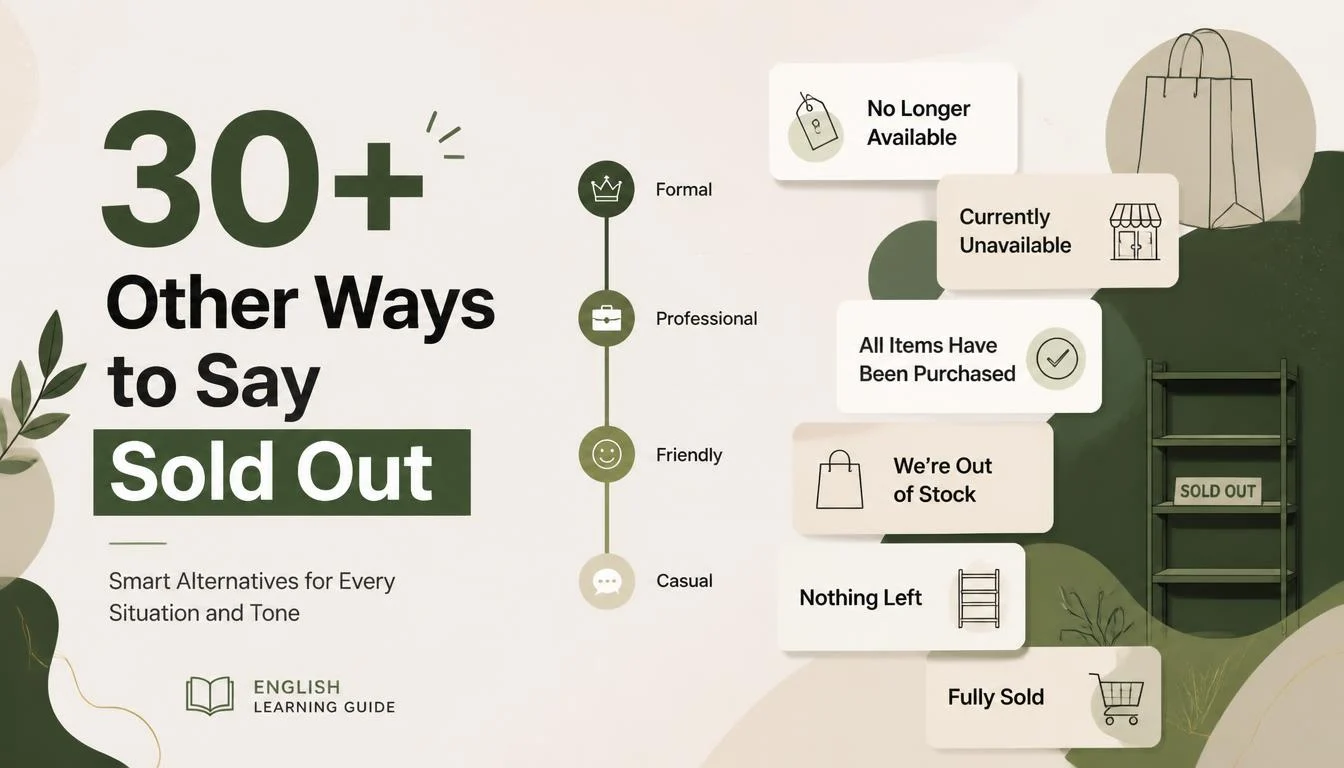
“Sold out” means every unit of a product, every ticket, or every seat has already been purchased and none remain available. Five quick alternatives you can use right away are out of stock, no longer available, fully booked, all gone, and unavailable at this time.
Looking for other ways to say “sold out”? Whether you are writing a product update, event announcement, or customer message, the right phrase can make the information sound clearer and more natural.
In this guide, you will find 30+ alternatives to “sold out” for different situations. These phrases can help you communicate limited availability, completed sales, or unavailable products in a professional and engaging way.
Why People Search For Other Ways to Say Sold Out
Most people looking for other ways to say sold out are trying to solve a real, practical problem.
- Maybe they run a small shop and are tired of typing “sold out” on every product page.
- Maybe they manage a restaurant and need a nicer way to tell a customer the special is gone.
- Maybe they’re writing marketing copy and want something that sounds exciting instead of disappointing.
There’s also a language-learning angle. Non-native English speakers often search alternatives to sold out because they want to sound more natural, both in spoken conversation and in written communication like emails or social media captions. Understanding professional English phrases versus informal expressions in English helps you match your tone to your audience a customer service email needs a different register than a text to a friend.
In spoken English, people tend to reach for short, punchy expressions (“we’re all out,” “nothing left”). In writing, especially business writing, people lean toward more polished phrasing (“currently unavailable,” “inventory has been depleted”). Knowing this difference is the real skill behind sounding natural, not just memorizing synonyms.
Tone Ladder: From Very Formal to Informal
Not every “sold out” alternative fits every situation. Here’s how the common phrases rank on a tone ladder, from most formal to most casual.
Very formal phrases like “currently unavailable due to demand” or “inventory has been fully depleted” work well in official statements, press releases, or corporate emails.
Formal phrases such as “no longer in stock” or “fully booked” suit professional emails and business websites.
Neutral phrases like “out of stock” or “not available” are safe defaults for almost any written context, including product pages.
Casual phrases such as “all gone” or “nothing left” suit friendly customer service chats or social media captions.
Informal phrases like “we’re tapped out” or “cleaned out” belong in texts, casual conversation, or a brand voice that’s deliberately playful.
Generally, the more formal a phrase, the more professional it sounds in writing, while shorter, punchier phrases sound more natural when spoken out loud.
Tone Classification Table
| Phrase | Tone Level | Formality | Best Situation |
|---|---|---|---|
| Inventory has been fully depleted | Very Formal | High | Press release, corporate notice |
| Currently unavailable | Formal | High | Business email, website |
| No longer in stock | Formal | Medium-High | Product page |
| Fully booked | Neutral | Medium | Reservations, events |
| Out of stock | Neutral | Medium | Retail, e-commerce |
| All gone | Casual | Low | Social media, chat |
| Nothing left | Casual | Low | Spoken conversation |
| Cleaned out | Informal | Very Low | Texts, casual talk |
| Snapped up | Informal | Very Low | Casual storytelling |
| Not a single one left | Neutral-Casual | Medium-Low | Spoken, storytelling |
Quick Selection Guide
If you’re short on time, here’s how to pick the right phrase for common situations.
- For a customer email, use “currently unavailable” or “no longer in stock” clear and professional without sounding cold.
- For a product listing, use “out of stock” it’s the industry standard and instantly understood.
- For a reservation or event, use “fully booked” the natural term for spots or tables rather than physical goods.
- For casual conversation, use “all gone” or “nothing left” simple, friendly, and easy to say out loud.
- For social media hype, use “snapped up” or “flying off the shelves” (past tense once it’s gone) these carry excitement instead of disappointment.
Real-Life Conversation Transformations
Customer Service Scenario
Before: “Sorry, it’s sold out.” After: “Thanks so much for checking that item is currently unavailable, but I can notify you the moment it’s back in stock.”
Retail Website Scenario
Before: “SOLD OUT” After: “Out of stock join the waitlist to be first in line for our next restock.”
Restaurant Scenario
Before: “We’re sold out of the special.” After: “The chef’s special has all gone for tonight, but I’d recommend the second option it’s just as popular.”
Casual Conversation Scenario
Before: “The concert tickets are sold out.” After: “Yeah, those tickets got snapped up within an hour nothing left by the time I checked.”
Notice how each “after” version doesn’t just swap in a synonym. It softens the delivery, adds context, or offers a next step, which is what makes English sound natural rather than robotic.
30 Other Ways to Say Sold Out
1. Out of Stock
Meaning: No inventory remains.
Example: “This shade of blue is currently out of stock.”
Tone: Neutral
Best use: E-commerce and retail listings.
2. No Longer Available
Meaning: The item can’t be purchased anymore.
Example: “This model is no longer available online.”
Tone: Formal
Best use: Product pages and discontinued items.
3. Fully Booked
Meaning: Every slot, seat, or reservation is taken.
Example: “The hotel is fully booked for the weekend.”
Tone: Neutral
Best use: Hotels, restaurants, and appointments.
4. All Gone
Meaning: Nothing physical remains.
Example: “The croissants are all gone by 9 a.m.”
Tone: Casual
Best use: Bakeries, cafés, and informal chats.
5. Nothing Left
Meaning: Zero units remain.
Example: “We checked the shelf, nothing left.”
Tone: Casual
Best use: Spoken conversation.
6. Currently Unavailable
Meaning: Temporarily impossible to buy or book.
Example: “This size is currently unavailable, check back soon.”
Tone: Formal
Best use: Websites and customer emails.
7. Snapped Up
Meaning: Bought very quickly, often unexpectedly fast.
Example: “The limited sneakers were snapped up in minutes.”
Tone: Informal
Best use: Storytelling and social media.
8. Flying Off the Shelves
Meaning: Selling extremely fast while stock is still available, or describing how quickly something sold.
Example: “These flew off the shelves within a day.”
Tone: Casual
Best use: Marketing copy and hype posts.
9. Cleaned Out
Meaning: Completely emptied of stock.
Example: “The store was cleaned out before noon.”
Tone: Informal
Best use: Casual conversation.
10. Fully Subscribed
Meaning: All spots in a program or event are filled.
Example: “The workshop is fully subscribed this term.”
Tone: Formal
Best use: Courses, memberships, and events.
11. Waitlist Only
Meaning: No open spots are available, but interested people can be added to a list.
Example: “The class is waitlist only right now.”
Tone: Neutral
Best use: Events, courses, and restaurants.
12. Inventory Depleted
Meaning: A business term for stock reaching zero.
Example: “Inventory has been depleted for this SKU.”
Tone: Very Formal
Best use: Internal reports and supplier communication.
13. Not a Single One Left
Meaning: An emphatic way of saying that zero remain.
Example: “I called five stores, not a single one left.”
Tone: Neutral-Casual
Best use: Spoken storytelling.
14. Tapped Out
Meaning: The supply has run dry.
Example: “We’re tapped out on the small sizes.”
Tone: Informal
Best use: Texts and casual staff conversation.
15. Gone in a Flash
Meaning: Sold extremely quickly.
Example: “Concert seats were gone in a flash.”
Tone: Casual
Best use: Recapping an event and social posts.
16. Unavailable at This Time
Meaning: A polite and neutral way to describe temporary unavailability.
Example: “This item is unavailable at this time.”
Tone: Formal
Best use: Automated messages and customer service scripts.
17. Out of Supply
Meaning: Similar to “out of stock” with a slightly more formal tone.
Example: “The warehouse reports the part is out of supply.”
Tone: Formal
Best use: B2B communication and logistics.
18. Sold Through
Meaning: A retail term meaning that all units have been purchased.
Example: “The seasonal line sold through in two weeks.”
Tone: Formal
Best use: Retail and merchandising reports.
19. Booked Solid
Meaning: Every appointment slot is filled.
Example: “The salon is booked solid until Friday.”
Tone: Casual-Neutral
Best use: Salons, clinics, and service businesses.
20. No Vacancies
Meaning: No rooms or spots remain, typically for lodging.
Example: “The inn has no vacancies this holiday.”
Tone: Formal
Best use: Hotels and rentals.
21. Zero Units Remaining
Meaning: Precise inventory language indicating that no units are left.
Example: “The system shows zero units remaining.”
Tone: Very Formal
Best use: Inventory management systems.
22. All Spots Taken
Meaning: No open positions or seats are left.
Example: “All spots for the retreat are taken.”
Tone: Neutral
Best use: Workshops, retreats, and classes.
23. Fully Claimed
Meaning: Everything offered has been reserved or taken.
Example: “The free samples were fully claimed by noon.”
Tone: Neutral
Best use: Promotions and giveaways.
24. Ran Out
Meaning: The supply was used up.
Example: “We ran out of the popular flavor fast.”
Tone: Casual
Best use: Everyday spoken English.
25. Off the Market
Meaning: No longer available for sale.
Example: “That property went off the market this week.”
Tone: Neutral
Best use: Real estate and resale goods.
26. Discontinued
Meaning: The product will not be restocked at all.
Example: “That fragrance has been discontinued.”
Tone: Formal
Best use: Permanent removals from a catalog.
27. Reserved by Others
Meaning: Someone else has already claimed the item or slot.
Example: “That table is reserved by others tonight.”
Tone: Neutral
Best use: Restaurants and bookings.
28. Not in Stock Right Now
Meaning: A softer and more conversational version of “out of stock.”
Example: “That color isn’t in stock right now, sorry.”
Tone: Casual
Best use: Customer service chats.
29. All Booked Up
Meaning: Every appointment or reservation slot is full.
Example: “The photographer is all booked up for June.”
Tone: Casual
Best use: Freelancers and service providers.
30. None Remaining
Meaning: A simple and direct statement that no stock remains.
Example: “Checked the back room, none remaining.”
Tone: Neutral
Best use: Staff communication and inventory checks.
Usage Comparison Table
| Phrase | Spoken Use | Written Use | Context |
|---|---|---|---|
| Out of stock | Common | Very Common | Retail |
| Fully booked | Common | Common | Reservations |
| All gone | Very Common | Rare | Casual, kids, cafés |
| Currently unavailable | Rare | Very Common | Formal email, web |
| Snapped up | Common | Common | Storytelling, marketing |
| Tapped out | Common | Rare | Casual speech |
| Discontinued | Rare | Very Common | Product catalogs |
| No vacancies | Rare | Common | Hotels, signage |
| Ran out | Very Common | Common | Everyday English |
| Zero units remaining | Rare | Common | Systems, reports |
Email and LinkedIn Ready Expressions
For an email greeting, try opening with “Thanks for your interest in [product].” Follow it with the update: “Unfortunately, this item is currently unavailable, but here’s what I can offer instead.”
For a professional introduction around scarcity, you might write: “I wanted to give you a heads-up before our next release, since the last one sold out within hours.”
For a LinkedIn connection message tied to a launch: “Loved seeing your product sell out on day one would love to connect and hear how you planned the launch.”
A useful follow-up line once stock returns: “Good news the item you were interested in is back in stock. Let me know if you’d still like to place an order.”
Native Speaker Insight
Native speakers rarely say the full phrase “sold out” in casual speech. It often gets shortened to “all gone” or just “nothing left, man.” In writing, though, “sold out” and “out of stock” stay standard because they’re instantly recognizable.
What sounds unnatural is overusing very formal phrases like “inventory has been fully depleted” in casual conversation it comes across stiff and overly corporate. Native speakers reserve that kind of phrasing for reports or official statements, not everyday chat.
A preferred professional alternative for customer-facing writing is usually a blend: clear and polite, but not overly technical. “Currently unavailable” strikes that balance better than either extreme.
Common Mistakes and What Not to Say
A common mistake is mixing tone within the same message, such as writing “Inventory has been fully depleted, my bad!” the very formal phrase clashes with the casual apology.
Another mistake is using “discontinued” when something is only temporarily out of stock. Discontinued implies it’s gone for good, which can confuse or upset customers who expect a restock.
Grammar-wise, people sometimes write “it’s sold out of stock,” combining two phrases that already mean the same thing. Stick to one: either “it’s sold out” or “it’s out of stock.”
Over-formal phrasing in a friendly context, like texting a friend “The tickets are currently unavailable,” also feels off. Save that language for business communication.
Related Expressions Worth Knowing
Some useful greeting variations when delivering this kind of news include “Thanks for checking in” or “Appreciate your patience.” For polite communication alternatives, try “I wish I had better news” before explaining the item is unavailable. Conversational English upgrades like “just missed it” or “right before you got here” soften the message in person.
Decision-Making Table
| Situation | Best Phrase | Why It Works |
|---|---|---|
| Job interview storytelling | Sold through, snapped up | Sounds confident and results-driven |
| Formal business email | Currently unavailable | Professional without sounding cold |
| Retail product page | Out of stock | Instantly understood by shoppers |
| Restaurant conversation | All gone | Friendly and easy to say aloud |
| Event or class signup | Fully booked, waitlist only | Standard industry phrasing |
| Casual text to a friend | Nothing left, ran out | Natural, everyday tone |
Fast List: Top Alternatives
- Out of stock
- Fully booked
- Currently unavailable
- All gone
- Nothing left
- Snapped up
- Waitlist only
- Discontinued
- Ran out
- No vacancies
Quick Quiz
1. Which phrase fits best on an e-commerce product page?
A) All gone
B) Out of stock
C) Tapped out
Answer: B
2. Which phrase best suits a formal business email?
A) Currently unavailable
B) Nothing left
C) Cleaned out
Answer: A
3. What’s the best way to describe a fully reserved restaurant?
A) Discontinued
B) Fully booked
C) Off the market
Answer: B
4. Which phrase implies a product will never return?
A) Out of stock
B) Discontinued
C) Waitlist only
Answer: B
5. Which phrase works best in casual spoken conversation?
A) Inventory has been fully depleted
B) All gone
C) Fully subscribed
Answer: B
FAQs
Is It Polite to Say “Sold Out” to a Customer?
Yes, but softening it with an explanation or alternative can sound more considerate. For example, you can say, “Currently unavailable. Here’s a similar option.”
What Is More Professional Than “Sold Out”?
“Currently unavailable” or “no longer in stock” both sound more polished for business writing.
Can I Use “All Gone” in an Email?
It is better suited to casual chats or social captions. For emails, “out of stock” or “currently unavailable” fits more naturally.
What Do Native Speakers Say Instead of “Sold Out” in Conversation?
Shorter, casual phrases like “nothing left” or “all gone” are common in everyday speech.
What’s the Best Alternative for a Product That Will Never Be Restocked?
“Discontinued” clearly signals that the item is permanently gone. “Out of stock,” on the other hand, usually suggests that the product may be restocked.
Conclusion
“Sold out” is a simple phrase, but the way you replace it says a lot about tone, professionalism, and context. Whether you’re writing a formal notice, updating a product page, or just telling a friend the tickets are gone, matching the phrase to the situation makes your English sound natural rather than repetitive.
Keep this list handy the next time you’re writing customer emails, product descriptions, or casual messages. With a little practice, choosing the right tone becomes second nature and your writing will sound more confident and more human every time.