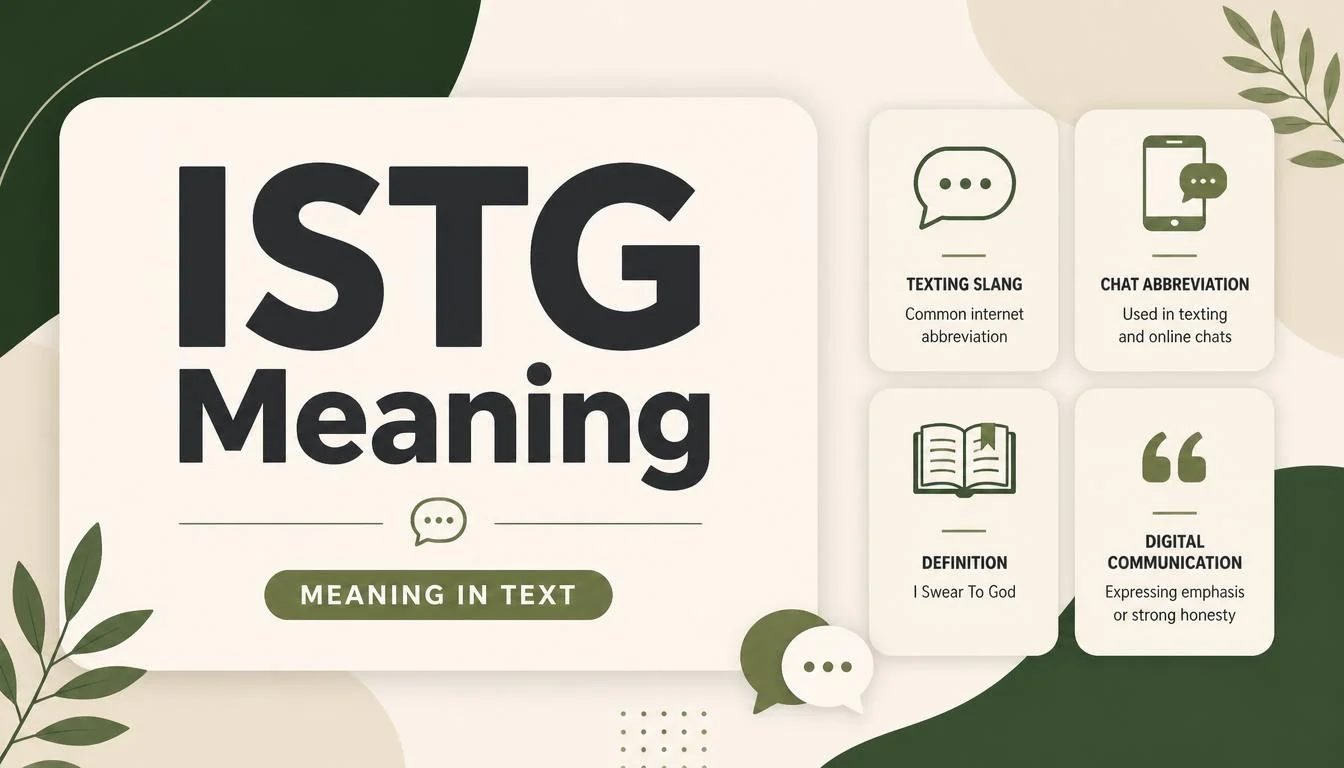
Quick Answer
ISTG stands for “I Swear to God.” It’s a common texting abbreviation used to express honesty, frustration, surprise, or strong emotions. People often use ISTG in text messages, social media comments, and online chats to emphasize that they’re serious about what they’re saying.
The ISTG meaning is “I Swear to God,” a popular abbreviation used in texting and online conversations. People use it when they want to sound serious, emphasize a point, or show how strongly they feel about something.
You might see ISTG in messages between friends, TikTok comments, Snapchat chats, or other social media posts. Depending on the context, it can express frustration, excitement, disbelief, or a promise that someone is telling the truth.
What Does ISTG Mean in Texting and Chat?
The ISTG meaning in text depends on the message surrounding it. Friends may use it to defend themselves, complain about something annoying or react to an unbelievable situation.
Here are the most common ways people use ISTG in online conversations.
1. To Emphasize Honesty
Sometimes, people add ISTG when they want someone to believe them. It strengthens a statement when the other person seems doubtful or needs reassurance.
Example:
“ISTG, I didn’t tell anyone your secret.”
Meaning: The sender insists they’re telling the truth and wants the other person to believe them.
2. To Express Frustration
ISTG can also show that someone feels annoyed, impatient or completely fed up. The expression often appears before a complaint or a statement about something that keeps going wrong.
Example:
“ISTG, my internet stops working whenever I need it most.”
Meaning: The sender is frustrated with their internet connection. They’re using ISTG to make the complaint sound more emotional.
3. To Show Surprise or Disbelief
When something seems shocking or hard to believe, ISTG can emphasize the reaction. People often use it when sharing unexpected news or reacting to something unusual.
Example:
“ISTG, he actually showed up wearing that!”
Meaning: The sender is surprised by what happened and wants to emphasize their reaction.
4. To Express Excitement or Amusement
Not every ISTG message carries anger or seriousness. People also use it to make a funny comment or express excitement about something they genuinely enjoy.
Example:
“ISTG, this is the best pizza I’ve ever had.”
Meaning: The sender is emphasizing how much they love the pizza. The expression adds excitement rather than frustration.
5. To Make a Promise or Strong Statement
Sometimes, ISTG introduces a promise, warning or firm declaration. The sender wants the reader to understand that they’re serious about what comes next.
Example:
“ISTG, I’ll help you finish the assignment tonight.”
Meaning: The sender strongly emphasizes their intention to help.
Remember that ISTG doesn’t automatically make a promise reliable. It communicates emphasis but can’t prove whether someone will follow through.
ISTG Meaning on Snapchat, TikTok, Instagram and WhatsApp
You might encounter ISTG on several social media platforms. Although the setting changes, its basic definition remains the same.
ISTG Meaning on Snapchat
On Snapchat, friends may use ISTG in private chats, replies to snaps and casual conversations. For example, “ISTG, I sent you that snap already” emphasizes that the sender believes they’ve already sent it.
ISTG Meaning on TikTok
TikTok users may write ISTG in comments, captions or replies to videos. For example, “ISTG, this video describes my life” expresses a strong sense of recognition or amusement.
ISTG Meaning on Instagram
On Instagram, ISTG can appear in direct messages, comments and Story replies. Someone might write, “ISTG, your new haircut looks amazing” to emphasize a compliment.
ISTG Meaning on WhatsApp
WhatsApp users may type ISTG in individual chats or group messages. For example, “ISTG, we took the wrong turn again” expresses frustration or disbelief about a situation.
The important point is that ISTG doesn’t have a separate definition for each platform. The surrounding words and the relationship between the people chatting help reveal its intended tone.
How to Use ISTG in a Sentence
If you’re learning internet slang, the easiest way to understand ISTG is to see how it works in everyday messages. These examples show different ways to use it naturally.
| Example sentence | Intended meaning |
|---|---|
| “ISTG, I’m telling the truth.” | Emphasizing honesty |
| “ISTG, this homework never ends.” | Expressing frustration |
| “ISTG, that was unbelievable.” | Showing surprise |
| “ISTG, you’re making me laugh so hard.” | Expressing amusement |
| “ISTG, I’ll be there at six.” | Emphasizing a promise |
| “ISTG, I thought today was Friday.” | Showing confusion or disbelief |
| “ISTG, that song is stuck in my head.” | Emphasizing a familiar experience |
| “ISTG, I didn’t mean to upset you.” | Reassuring someone |
Can You Write ISTG in Capital Letters?
Yes. Both ISTG and istg are common ways to write the abbreviation. Some people use lowercase letters because they type casually, while others prefer uppercase letters for emphasis.
Punctuation can also affect how a message feels. “ISTG!” may sound more intense than “istg lol,” which can suggest a playful or joking reaction.
However, capitalization alone doesn’t reveal someone’s mood. Read the entire message before deciding whether the sender sounds angry, sincere or amused.
How Do You Respond to ISTG?
When someone sends you ISTG, you don’t need a special slang reply. Your response should match what the person means and how the conversation feels.
When Someone Uses ISTG to Tell the Truth
If someone is trying to convince you that they’re being honest, respond according to how you feel about the situation.
Example conversation:
Friend: “ISTG, I didn’t read your messages.”
You: “Okay, I believe you.”
You could also say “Got it” or “Thanks for explaining.” If you still have doubts, ask a calm follow up question instead of assuming the person is lying.
When Someone Uses ISTG to Complain
If a friend uses ISTG because they’re frustrated, acknowledge the problem or respond with a little humor.
Example conversation:
Friend: “ISTG, my phone battery dies so fast.”
You: “That’s so annoying. You might need a new battery.”
You could also reply with “I know, right?” if you’ve experienced the same problem.
When Someone Uses ISTG as a Joke
A playful ISTG message usually calls for a lighthearted response. You can agree with the joke or add one of your own.
Example conversation:
Friend: “ISTG, that cat has more attitude than both of us.”
You: “Honestly, that cat runs the whole house.”
There’s no need to interpret every ISTG message as a serious declaration. In casual chats, the abbreviation can simply make a reaction sound funnier or more dramatic.
When Someone Uses ISTG During an Argument
An argument requires a little more care. If the other person sounds upset, focus on what they’re trying to communicate rather than the abbreviation itself.
For example, you could respond with “I hear you. Let’s figure this out” or “Can you explain what happened?”
If the message includes threats or aggressive language, don’t assume it’s harmless just because ISTG is common slang. Consider the full message and the circumstances.
Is ISTG Rude, Offensive or a Swear Word?
ISTG isn’t automatically rude, but its full form can make it sensitive for some readers. The phrase “I swear to God” invokes God to emphasize a statement. Some people use it casually while others consider it inappropriate.
Whether ISTG sounds offensive depends on the audience and situation.
It may sound harmless when:
- Friends use it while joking around.
- Someone emphasizes a funny story.
- A person uses it to express excitement.
- Two people regularly communicate using informal slang.
It may sound inappropriate when:
- Someone uses it aggressively during an argument.
- The recipient considers religious expressions sacred.
- You’re communicating in a formal or professional setting.
- The phrase appears alongside insults or threatening language.
Is ISTG Considered Swearing?
Yes, some people consider ISTG a form of swearing because it stands for “I swear to God.” Others use it as a casual expression without intending a serious religious oath.
If you’re unsure whether someone is comfortable with the phrase, choose a more neutral alternative. You can say “I promise,” “Honestly,” “I’m serious” or “I’m telling the truth.”
These alternatives communicate sincerity without invoking religious language.
What Does ISTG Mean From a Girl or a Guy?
People sometimes search for the ISTG meaning from a girl or a guy because they want to understand a specific message. However, ISTG doesn’t have a different definition based on the sender’s gender.
ISTG Meaning From a Girl
If a girl texts “ISTG, I’m not lying,” she may be emphasizing that she’s telling the truth. If she writes “ISTG, you’re so annoying,” she may be frustrated or teasing you, depending on your relationship.
Likewise, “ISTG, you’re hilarious” can express genuine amusement. The words surrounding ISTG offer more useful clues than gender alone.
ISTG Meaning From a Guy
A guy might use ISTG to defend a statement, react to something surprising or complain about an irritating situation. For example, “ISTG, I left my wallet at home” could express frustration or disbelief.
If a guy writes “ISTG, I’ll call you later,” he may be emphasizing his intention to call. Still, the abbreviation alone doesn’t reveal whether he’s flirting, angry or being completely serious.
The best approach: Consider the message, the conversation before it and your relationship with the sender. Don’t assign a hidden meaning to ISTG without additional context.
ISTG vs. ONG, FR, NGL and TBH
ISTG belongs to a larger group of internet slang abbreviations. Although these expressions can overlap, each one has a slightly different purpose.
| Abbreviation | Full form | How people use it |
|---|---|---|
| ISTG | I Swear to God | Emphasizes sincerity or a strong reaction |
| ONG | On God | Emphasizes a claim or expresses agreement |
| FR | For Real | Shows agreement or asks whether something is serious |
| NGL | Not Gonna Lie | Introduces an honest opinion |
| TBH | To Be Honest | Introduces a candid thought |
| OMG | Oh My God | Expresses surprise, excitement or shock |
| SMH | Shaking My Head | Shows disappointment or disbelief |
| IKR | I Know, Right? | Expresses agreement |
What Is the Difference Between ISTG and ONG?
ISTG means “I swear to God,” while ONG means “On God.” Both can emphasize sincerity or show that someone feels strongly about a statement.
For example, “ISTG, I didn’t touch your bag” strongly emphasizes a denial. “ONG, that concert was amazing” emphasizes how much the speaker enjoyed the concert.
Their uses overlap, but the phrases aren’t identical.
What Is the Difference Between ISTG and FR?
FR stands for “For Real.” People use it to agree with someone, confirm something or emphasize that they’re serious.
For example, “That movie was incredible, FR” reinforces an opinion. “ISTG, that movie was incredible” adds a stronger emotional emphasis.
What Is the Difference Between ISTG and NGL?
NGL means “Not Gonna Lie.” It often introduces an honest opinion, including one the speaker thinks another person might not expect.
For example, “NGL, I didn’t enjoy the movie” introduces a candid opinion. “ISTG, that movie was terrible” expresses a stronger reaction.
The main difference is that NGL introduces honesty while ISTG intensifies a statement.
ISTG Pronunciation and Meaning in English
ISTG is an initialism rather than a conventional English word. Each letter represents the beginning of a word in the phrase “I swear to God.”
Some people say the letters individually when reading the abbreviation aloud. Others simply say the complete phrase. There’s no single spoken form that everyone uses.
In plain English, ISTG communicates a strong feeling of sincerity or emphasis. Depending on the context, you could replace it with “I promise,” “Seriously,” “Believe me” or “I’m not kidding.”
For example, “ISTG, I saw him at the mall” means the sender strongly insists that the statement is true. In contrast, “ISTG, this weather is ridiculous” expresses frustration.
Is ISTG Gen Z Slang?
ISTG is often associated with Gen Z slang because younger internet users commonly use abbreviations in social media conversations. However, it isn’t exclusive to one generation.
The abbreviation appeared in online communication before modern platforms such as TikTok became popular. Wiktionary records an example from a 2003 Usenet discussion, showing that ISTG was already in use during the early internet era. You can explore its documented usage in the Wiktionary ISTG entry.
Today, people may use ISTG in text messages, online gaming chats, social media comments and everyday digital conversations. Its continued use reflects how people shorten familiar expressions when communicating online.
When Should You Use ISTG?
ISTG works best in informal conversations where the other person understands internet slang. It’s a convenient way to emphasize a message without typing the full expression.
Consider using it when chatting with friends, reacting to a funny video or expressing frustration about something minor. It can also help emphasize a sincere statement when the context makes your intention clear.
However, avoid using ISTG in formal reports, academic assignments or professional emails. The abbreviation can sound too casual for those settings.
If you’re communicating with someone who dislikes swearing, choose a neutral expression instead. Words such as “honestly” and “seriously” often communicate the same idea without the religious reference.
The goal isn’t to use slang in every conversation. It’s to choose language that fits the person you’re talking to and the situation you’re in.
FAQs
What Does ISTG Mean in a Text Message?
ISTG means “I swear to God.” People use it in text messages to emphasize honesty, express frustration or show a strong reaction. The surrounding words help determine its intended tone.
What Is the Full Form of ISTG?
The full form of ISTG is “I Swear to God.” Each letter represents the first letter of one word in the phrase.
Does ISTG Always Mean I Swear to God?
In common internet slang, yes. ISTG generally stands for “I swear to God.” The emotional meaning can change with context, but the standard expansion remains the same.
Is ISTG a Bad Word?
Not necessarily. ISTG is an informal abbreviation rather than a direct insult. However, some people consider it inappropriate because its full form uses a religious expression.
What Does ISTG Mean on Snapchat?
On Snapchat, ISTG usually means “I swear to God.” Friends use it in messages and replies to emphasize sincerity, frustration or excitement.
What Does ISTG Mean on TikTok?
On TikTok, ISTG has the same basic meaning. People may use it in comments and captions to emphasize a reaction to a video or express a strong opinion.
What Does ISTG Mean From a Girl?
A girl may use ISTG to emphasize honesty, express annoyance or react to something surprising. Its meaning depends on the conversation rather than the sender’s gender.
What Does ISTG Mean From a Guy?
A guy may use ISTG to make a statement sound more serious or express a strong reaction. The abbreviation doesn’t have a special meaning when a guy uses it.
How Do You Reply to ISTG?
Match your reply to the situation. You could say “I believe you” when someone insists they’re telling the truth or “I know, right?” when they express a shared frustration.
Can You Use ISTG in Formal Writing?
It’s best to avoid ISTG in formal writing. Use expressions such as “I assure you,” “Honestly” or “I can confirm” when communicating professionally.
Conclusion
Understanding the ISTG meaning is simple once you know the phrase behind it. ISTG stands for “I swear to God” and serves as an informal way to emphasize honesty, frustration, surprise or excitement.
You’ll encounter it in text messages, Snapchat conversations, TikTok comments, Instagram DMs and other online chats. Although the basic definition stays consistent, the intended tone can change with the situation.
When you see ISTG in a message, read the surrounding words before interpreting the sender’s feelings. And if you decide to use it yourself, consider your audience and the setting. A little context goes a long way in digital communication.