Quick Answer:
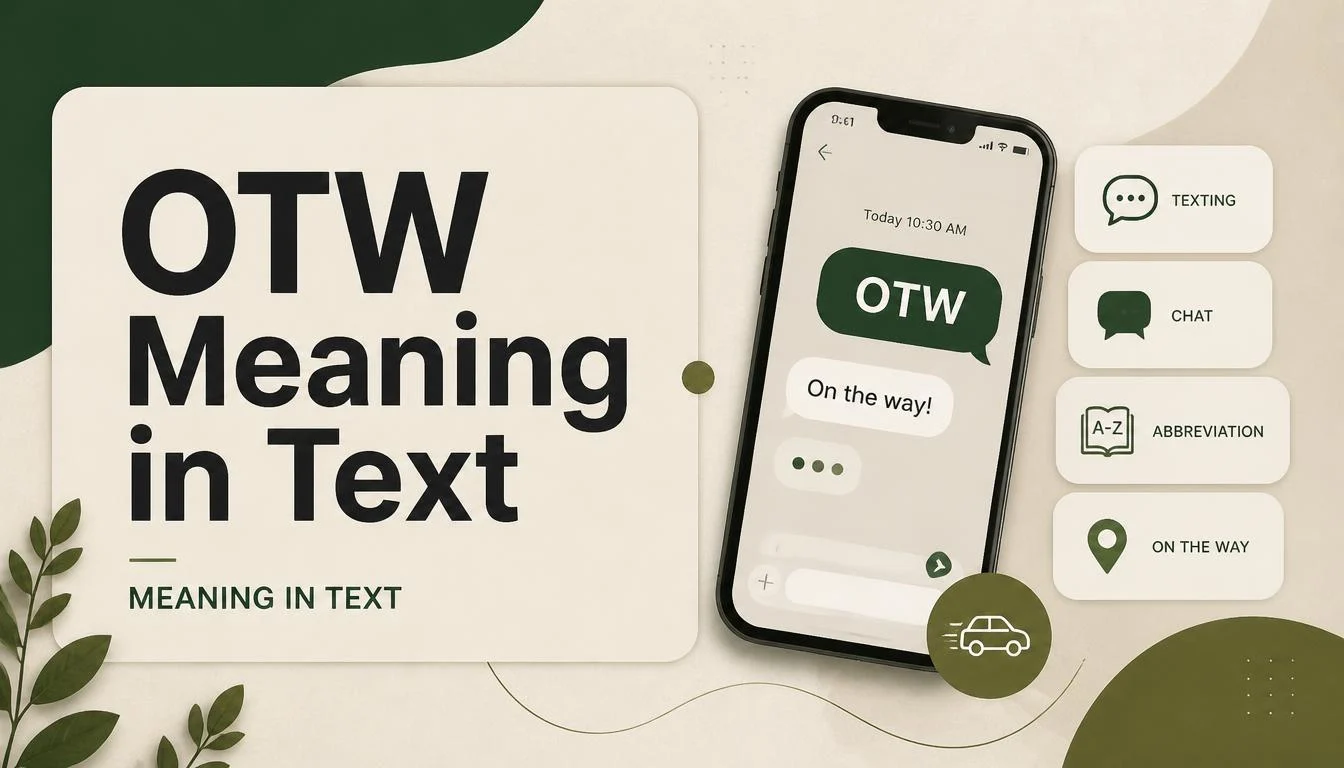
OTW is an acronym for “on the way.” In its literal sense, it signals that someone has departed and is actively traveling to a destination. But in practice, especially among younger people in casual digital communication, it often means something softer: I intend to leave soon, I’m preparing to head out, or simply I haven’t forgotten about our plans.
If you have seen OTW meaning in text and wondered what these three letters stand for, you are not alone. OTW is a common texting abbreviation used in casual conversations, chats, and social media.
Understanding OTW can help you quickly follow messages about plans, travel, or meeting up. Its meaning is usually simple, but the exact tone can depend on the context in which someone uses it.
The Origins of a Two-Letter Habit
OTW didn’t arrive with a formal announcement. It emerged organically from the same soil that produced BRB (“be right back”), TBH (“to be honest”), and IDK (“I don’t know”) the early texting era of the late 1990s and 2000s. Back then, character limits were real constraints, and efficiency mattered.
The acronym’s rise tracks with the broader normalization of digital shorthand. What started as a pragmatic workaround for tiny phone keyboards became a genuine part of how people talk. OTW sits in that curious category of terms that work in both directions: casual enough for a friend group chat, formal enough to use in a quick email to a coworker.
Its staying power, though, comes from something beyond convenience. “On the way” describes a state that is inherently temporary and almost always imprecise. The phrase has always carried a little wiggle room. The acronym just made that wiggle room easier to type.
OTW vs. OMW: A Small Difference With Real Implications
Most people use OTW and OMW interchangeably. In practice, the distinction is subtle but real.
| Acronym | Stands For | Typical Framing | Who Says It |
|---|---|---|---|
| OTW | On the Way | Objective, destination-focused | Anyone, any context |
| OMW | On My Way | Personal, possessive, direct | More common in one-on-one chats |
| OTW | On the Way | Slightly more distant, sometimes status-like | Group chats, social media updates |
The choice between them often says more about the speaker’s relationship to the person they’re texting than about their actual location. OMW, with its explicit “my,” feels more intimate it implies a direct promise to a specific person. OTW can function almost like a broadcast, a general announcement that the speaker is generally in motion. Someone might use OTW in a group chat and OMW when they’re texting their partner.
Neither is more “correct.” The distinction lives entirely in tone.
The Buffer Time Phenomenon: OTW as Intention, Not Geography
Here’s where the term gets genuinely interesting.
Research into digital communication patterns has identified a behavioral shift: many people, particularly younger users, send OTW before they have actually left their starting point. The message functions less as a location report and more as a commitment signal a way of saying I’m locked in, I’m coming, don’t leave without me.
This has spawned a related concept in some online communities: buffer time. The idea is that people need a transitional period between deciding to go somewhere and actually being on the road. That period might involve choosing clothes, finishing a conversation, or simply sitting still for a few minutes to mentally shift gears before facing the outside world.
From a communication standpoint, this is not necessarily dishonest. It’s a culturally learned shorthand. When someone sends OTW, the recipient often understands without needing to say so that the message means “I’ve started the process.” The frustration comes when that unspoken understanding isn’t shared, when one person is reading OTW literally and the other is using it aspirationally.
Why OTW Traveled So Well
Not every English texting acronym goes global. OTW did.
Part of the reason is linguistic simplicity. “On the way” is short, and the acronym is shorter. It requires no special knowledge to decode once you’ve seen it a few times. But the bigger reason is that the phrase maps onto a nearly universal human experience: the act of moving toward something you’ve agreed to do.
In Indonesia, for instance, OTW became widely adopted in digital communication, sometimes with a meaning that drifts further from literal travel than in English-speaking countries. A 2024 Indonesian radio program discussing the trend noted that OTW and OMW have become fixtures of casual messaging, valued for their efficiency and informal tone. The same basic dynamic a short signal of impending arrival worked across languages because the underlying social need was identical.
That adaptability is a small case study in how language spreads online. A term doesn’t need official adoption or dictionary approval. It just needs to solve a problem that enough people share.
What OTW Reveals About Digital Trust
There’s a reason people get annoyed when OTW doesn’t match reality. The acronym is a tiny social contract.
When you type those three letters, you’re asking someone to hold space for you to wait, to keep the door open, to not start without you. That’s a real ask, even if it takes half a second to send. And when the message turns out to be aspirational rather than accurate, the other person feels the gap between the promise and the outcome.
This isn’t about punctuality in the traditional sense. Many people who send early OTWs are perfectly capable of being on time when it matters. The issue is calibration. In a culture where “I’m leaving now” and “I’m thinking about leaving” can collapse into the same three letters, everyone has to learn the local dialect of their specific relationships.
Some friend groups treat OTW as pure intention. Others treat it as literal. Most operate somewhere in between, with an unspoken understanding that the message means “I’m on the clock” rather than “I’m on the road.”
How to Use OTW Without Losing Friends
If you want to keep using the acronym without generating unnecessary frustration, a few practical adjustments help.
Match your audience. A close friend who knows your habits will read OTW differently than a colleague you barely know. Calibrate accordingly.
Follow up when you can. A quick “leaving in 5, sorry” after an early OTW costs almost nothing and fills the gap between intention and action.
Consider OMW for real motion. If you are genuinely in transit and want the person to know it, OMW carries a slightly stronger commitment signal.
Watch the context. OTW in a group chat about a casual hangout carries different weight than OTW in a message about a job interview or a medical appointment. The stakes change the meaning.
None of this is about policing language. It’s about recognizing that even a two-letter acronym carries social information, and that information lands differently depending on who’s reading it.
FAQs
Is OTW the Same as OMW?
They are similar, but OMW means “on my way” and usually feels more personal and direct. OTW can work as a general status update, while OMW often sounds like a direct message to someone who is waiting for you.
Does OTW Always Mean the Person Has Left?
No. In casual conversations, OTW can mean that someone is about to leave or is almost ready to go. The exact meaning depends on the context and the relationship between the people communicating.
Can I Use OTW in Professional Messages?
Yes, depending on the situation. A quick “OTW” to a colleague about a meeting may be perfectly acceptable in many workplaces. In formal emails or professional communication, spelling out “on my way” is usually a safer choice.
Why Do People Send OTW When They Haven’t Left Yet?
It is often a way of signaling commitment rather than deliberately misleading someone. The sender may be trying to show that they have not forgotten and are actively preparing to leave.
Is OTW Used Outside English Speaking Countries?
Yes. OTW has become common in digital communication across many countries and languages. Its meaning can sometimes shift slightly depending on the local communication style and context.
What Should I Do If Someone’s OTW Is Always Inaccurate?
A direct and respectful conversation is usually more helpful than silently becoming frustrated. The person may not realize that their use of OTW is causing confusion or inconvenience until you point it out.
Conclusion
OTW is a tiny piece of language doing a surprisingly complicated job. It signals movement, manages expectations, and when used loosely buys a little extra time. The acronym’s meaning in text isn’t fixed. It shifts with the relationship, the context, and the cultural habits of the people typing it.
That flexibility is what makes it useful. It’s also what makes it occasionally maddening. Understanding both sides of that coin is the difference between using OTW well and being the person everyone learns to add twenty minutes for.
The next time you type those three letters, you’ll know exactly what you’re promising and exactly how much room you’re leaving.