Quick Answer
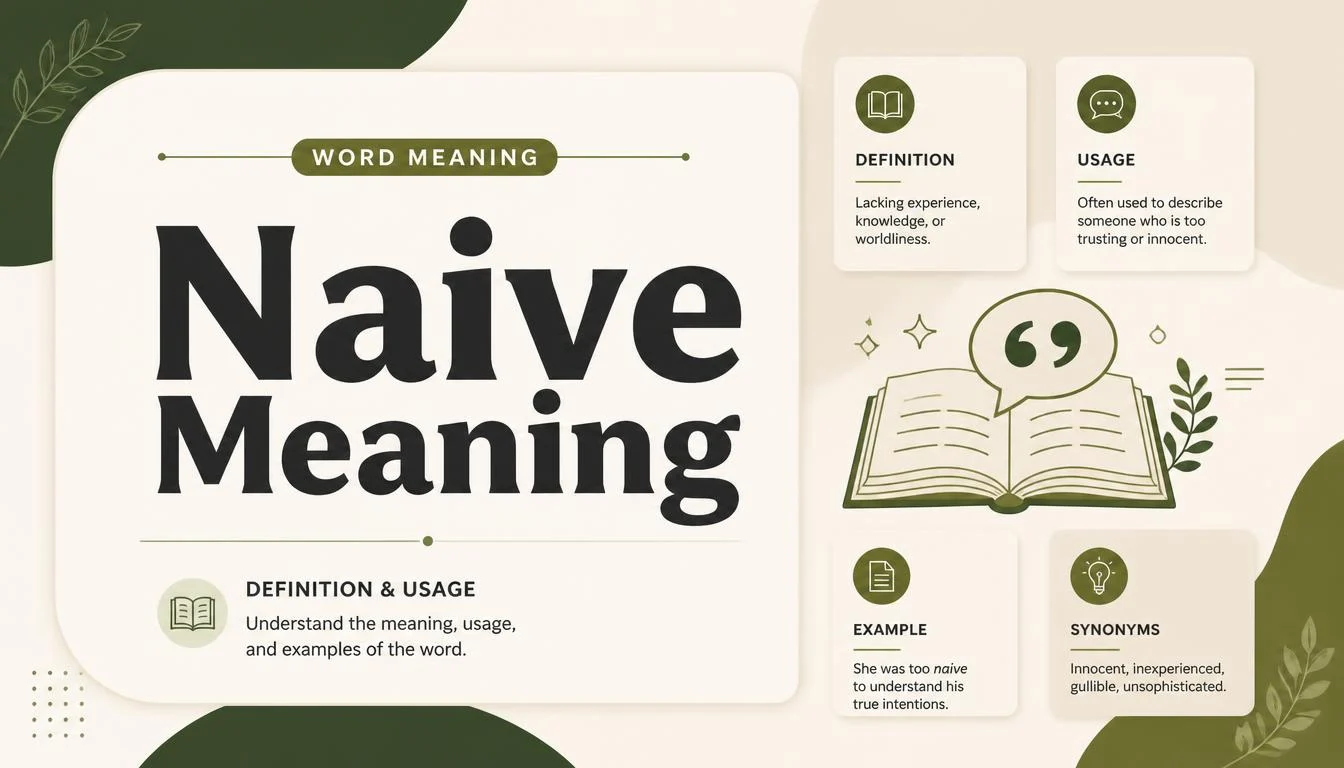
Naive means lacking experience, knowledge, or judgment about how the world works. It describes someone who is innocent, trusting, or unaware of the risks and intentions of others. For example, “He was naive to believe that everyone would tell the truth.”
The word naive describes someone who trusts others easily or has little experience with certain situations. It often refers to a person who sees things simply and believes people are honest without questioning their intentions.
However, being naive doesn’t always mean someone is foolish. It can also suggest innocence, sincerity, or a lack of exposure to difficult experiences. The meaning depends on the situation and how the word is used.
What Does Naive Mean in Simple Terms?
In simple words, naive means being inexperienced or lacking the practical knowledge needed to understand a situation fully. A naive person may believe something without questioning it because they haven’t learned what to look for.
For example, imagine someone buying a used car because the seller promises it runs perfectly. They don’t inspect the vehicle or check its history. Later, they discover expensive mechanical problems. Their decision was naive because they trusted a promise without checking the facts.
Naivety can appear in many areas of life. Someone might be naive about relationships, business, money, friendships, or workplace expectations. The common thread is a lack of experience or realistic judgment in a particular situation.
Being naive doesn’t automatically mean someone lacks intelligence. An intelligent person can still make naive decisions when dealing with unfamiliar circumstances.
Naive Definition and Dictionary Meaning
The word naive means lacking experience, sophistication, or awareness of the practical realities of a situation. It can also describe a belief or approach that seems overly simple or unrealistic.
Here are the main ways people use the word:
- Inexperienced: Someone hasn’t learned enough about a particular subject or situation.
- Overly trusting: Someone accepts what others say without asking enough questions.
- Unsophisticated: Someone doesn’t understand the complexities of a social or practical situation.
- Unrealistically optimistic: Someone expects a favorable outcome without considering likely difficulties.
For instance, calling a business plan naive suggests that its creator hasn’t considered important risks. Describing a person as naive may suggest that they trust others too easily or lack real world experience.
The exact meaning depends on what the word describes.
Naive Pronunciation and Word Forms
The word naive is pronounced nah EEV. It can also be written as naïve, with two dots over the letter i. Both spellings are accepted in American English.
Here are its related word forms:
| Word | Meaning | Example |
|---|---|---|
| Naive | Lacking experience or practical judgment | He was naive about business. |
| Naively | In an inexperienced or overly trusting way | She naively accepted the offer. |
| Naivety | The quality of being naive | His naivety surprised his colleagues. |
| Naïveté | An alternative spelling of naivety | Her naïveté was understandable. |
You may encounter both naivety and naïveté in books and articles. They refer to the same general quality.
What Is a Naive Person Like?
A naive person often approaches unfamiliar situations with limited knowledge or an overly simple understanding. They may assume that people mean exactly what they say or that good intentions guarantee good outcomes.
For example, a new employee might believe that working hard automatically leads to a promotion. They haven’t considered office politics, company budgets, or promotion policies. Their expectation may be naive because it overlooks factors that influence workplace decisions.
However, not every naive person behaves the same way. Someone can be experienced in their career but naive about romantic relationships. Another person may understand money well yet struggle to recognize manipulation in social situations.
Naivety often depends on the subject rather than defining someone’s entire character.
Common Signs of Naive Behavior
Certain behaviors may suggest that someone lacks experience or practical judgment in a particular area.
1. Trusting people too quickly
A naive person may believe someone’s promises before that person has earned their trust. They might share personal information with a new acquaintance without considering the possible consequences.
2. Taking everything at face value
They may accept statements literally instead of questioning whether the speaker has another motive. This can cause confusion when dealing with sarcasm, sales tactics, or misleading claims.
3. Expecting everyone to have good intentions
A trusting person may assume others are as honest as they are. Although this outlook can come from kindness, it can also make someone vulnerable to deception.
4. Ignoring warning signs
Sometimes a person notices small problems but dismisses them because they want a situation to work out. For example, they may overlook repeated broken promises from a friend.
5. Underestimating risks
A naive person may focus on the best possible outcome without preparing for setbacks. This can affect financial decisions, career plans, and personal relationships.
These signs don’t prove that someone has a naive personality. They may simply lack experience with a particular situation.
Naive Personality vs. Naive Behavior
A naive personality generally suggests a tendency to approach certain situations with limited suspicion or experience. Naive behavior describes a specific action or decision that reflects that tendency.
Consider someone who usually makes careful decisions but trusts a dishonest business partner. That single mistake may be naive without making the person naive in every area of life.
This distinction matters because people learn from experience. A person who once overlooked a warning sign may become much better at recognizing similar problems later.
Naive Examples in Everyday Life
Examples make the meaning of naive easier to understand. The word can describe a person’s expectations, assumptions, questions, decisions, or general approach to a situation.
Naive in a Sentence
Here are several examples of naive used naturally in everyday English.
- “It was naive of me to believe every promise he made.”
The speaker trusted someone without considering whether the promises were genuine. - “His naive approach to business cost him money.”
He overlooked important risks because he lacked practical knowledge. - “She had a naive belief that everyone would agree with her.”
She expected agreement without considering different opinions. - “The new traveler was naive about the challenges of visiting a foreign country.”
The traveler hadn’t fully understood the difficulties involved. - “It’s naive to assume that success comes without hard work.”
The statement challenges an unrealistic expectation. - “His question wasn’t foolish. He was simply naive about the subject.”
The person lacked knowledge rather than intelligence.
Real Life Examples of Naive Thinking
Naive thinking can appear in ordinary situations, often without someone realizing it.
| Situation | Naive assumption | Why it may be naive |
|---|---|---|
| Friendship | Everyone who acts friendly is trustworthy. | Friendliness doesn’t always prove someone’s intentions. |
| Work | Doing good work guarantees a promotion. | Promotions depend on several factors. |
| Money | An investment promising high returns must be safe. | High returns may involve significant risks. |
| Relationships | Love will solve every disagreement. | Healthy relationships also require communication and effort. |
| Shopping | The cheapest product is always the best deal. | Quality and long term costs matter too. |
These examples show how limited experience can lead to unrealistic assumptions. Learning to ask questions and check facts can help people make better decisions.
Is Naive a Positive or Negative Word?
The word naive often sounds critical, but it isn’t always an insult. Its meaning depends on the situation and the speaker’s tone.
When someone calls a business plan naive, they’re usually pointing out a lack of preparation or an unrealistic assumption. When someone describes a child as naive, they may simply mean the child hasn’t experienced enough of the world to recognize certain risks.
Naivety can also overlap with positive qualities such as sincerity, openness, and optimism. Someone who expects the best from others may have a generous outlook on life. However, that outlook can become a problem when they ignore clear evidence that a situation isn’t safe or fair.
Is being naive a weakness? Not necessarily. Everyone lacks experience in some areas. Problems arise when a person refuses to question assumptions or learn from mistakes.
The goal isn’t to become suspicious of everyone. It’s to balance trust with good judgment.
Naive vs. Innocent vs. Gullible
The words naive, innocent, and gullible have related meanings, but they aren’t interchangeable. Understanding their differences helps you choose the right word in conversation.
| Word | Main meaning | Example |
|---|---|---|
| Naive | Lacking experience or realistic judgment | He was naive about how business deals worked. |
| Innocent | Free from guilt or wrongdoing, or lacking harmful intent | She was innocent of the accusation. |
| Gullible | Too willing to believe things that may be false | He was gullible enough to believe the obvious scam. |
Naive vs. Innocent
The difference between naive and innocent comes down to experience versus guilt or intent.
A naive person may not understand how a situation works. An innocent person may have done nothing wrong or may approach life with a sincere, childlike outlook.
For example, a teenager who believes every online advertisement may be naive about marketing tactics. A person wrongly accused of stealing may be innocent because they didn’t commit the act.
Someone can be both naive and innocent. However, one word doesn’t automatically imply the other.
Naive vs. Gullible
Naive describes limited experience or an unrealistic understanding. Gullible specifically describes someone who readily believes things that aren’t true.
Imagine a person who has never rented an apartment before. They may be naive about rental agreements. If they believe a stranger’s claim that they must pay a deposit through an untraceable payment method without verifying the listing, they may also be gullible.
The distinction is subtle but useful. A person can lack experience without believing every claim they hear.
Naive vs. Ignorant
The word ignorant means lacking knowledge or information about a particular subject. It doesn’t necessarily mean someone is unintelligent.
For example, a person may be ignorant of tax rules because they’ve never filed a tax return. They may be naive if they also assume filing taxes is always simple and requires no preparation.
Both words describe different kinds of gaps in understanding. However, ignorant can sound harsher or more insulting in everyday conversation.
Naive Synonyms and Antonyms
Choosing the right synonym depends on what you want to communicate. Some words emphasize inexperience, while others suggest excessive trust or poor judgment.
Common Synonyms for Naive
| Synonym | Meaning | Example |
|---|---|---|
| Inexperienced | Lacking practical experience | She was inexperienced in negotiations. |
| Gullible | Easily persuaded to believe false claims | He was gullible enough to fall for the trick. |
| Trusting | Inclined to believe others | She’s trusting with new friends. |
| Unsophisticated | Lacking familiarity with complex situations | His unsophisticated approach missed important details. |
| Credulous | Too ready to believe something | The credulous buyer accepted the claim without proof. |
| Unworldly | Lacking knowledge of real life or social affairs | He was unworldly despite his academic success. |
| Idealistic | Guided by high hopes or ideals | Her idealistic plan overlooked practical obstacles. |
| Impressionable | Easily influenced by others | Young children can be impressionable. |
| Green | Informally inexperienced | The green recruit needed more training. |
| Artless | Natural, sincere, or lacking guile | Her artless response revealed her surprise. |
These synonyms aren’t exact replacements in every sentence. For example, idealistic can be positive, while gullible usually suggests vulnerability to deception.
Antonyms of Naive
An antonym is a word with an opposite or contrasting meaning. The best opposite of naive depends on the context.
- Experienced: Someone who has practical knowledge gained over time.
- Worldly: Someone familiar with social situations and real world affairs.
- Sophisticated: Someone who understands complex matters or social conventions.
- Discerning: Someone who can recognize differences and make sound judgments.
- Shrewd: Someone who makes sharp, practical judgments.
- Perceptive: Someone who notices details and understands situations well.
- Street smart: Someone who uses practical knowledge to navigate everyday challenges.
- Skeptical: Someone who questions claims rather than accepting them immediately.
- Wary: Someone who stays alert to possible risks.
Words such as discerning, experienced, and worldly often work well when describing a person who has developed stronger practical judgment.
What Does Naive Mean in a Relationship?
In a relationship, being naive often means having limited experience with love or holding unrealistic expectations about a partner.
A naive person may believe that genuine love prevents arguments, that promises always lead to action, or that a relationship will succeed without effort. These expectations may come from inexperience rather than a lack of intelligence.
For example, someone in their first serious relationship might assume that their partner will automatically understand their feelings. When misunderstandings arise, they may struggle to see why honest communication matters.
Naivety can also affect trust. A person may overlook repeated dishonesty because they want to believe their partner has good intentions. While forgiveness can be valuable, ignoring a consistent pattern of harmful behavior can create problems.
Is Being Naive in Love a Bad Thing?
Not always. Being open to love can help people build meaningful connections. A trusting attitude can also make it easier to communicate honestly and give a relationship room to grow.
However, trust should develop alongside understanding. Pay attention to whether a partner’s actions match their words. Set boundaries and discuss concerns instead of dismissing them.
You don’t need to assume the worst about everyone. You simply need to recognize that love and good judgment work best together.
What Does Naive Mean in Texting and Everyday Conversation?
The word naive keeps the same basic meaning in texting as it does in spoken English. People use it to describe someone who seems inexperienced, overly trusting, or unrealistic about a situation.
Here are a few examples:
- “That’s a little naive.” This suggests that someone’s idea or assumption overlooks important facts.
- “I was naive to think it would be easy.” The speaker recognizes that their earlier expectations were unrealistic.
- “You’re too trusting.” This communicates a similar idea but may sound gentler than calling someone naive.
- “Don’t be so naive.” This can sound blunt or dismissive, especially during an argument.
The tone depends on the relationship between the speakers. Friends may use the word casually, while a coworker might use it as a serious criticism of someone’s decision.
If someone calls you naive, consider what they were responding to. They might be pointing out a genuine risk, expressing a different opinion, or simply being unkind. The word alone doesn’t tell you which interpretation is correct.
Can a Person Be Naive but Intelligent?
Yes. Intelligence and experience are different things.
An intelligent person can solve complex problems, understand difficult concepts, and learn quickly. However, they may still lack practical knowledge in an unfamiliar area.
For example, an excellent software engineer might be naive about buying a house. They may understand technical systems but have little experience with mortgages, inspections, or property negotiations.
Similarly, someone with strong academic skills may struggle to recognize manipulation in a personal relationship. Their intelligence doesn’t automatically give them experience with every human situation.
Naive Meaning in Psychology
In everyday psychological discussions, naivety can describe a tendency to interpret situations too simply or place too much trust in others. It may relate to limited experience, unrealistic expectations, or difficulty recognizing another person’s motives.
However, naive isn’t a formal mental health diagnosis. The word alone can’t establish someone’s intelligence, emotional maturity, or personality.
A person’s judgment develops through experience, reflection, and learning. Asking questions, considering alternative explanations, and checking evidence can improve decision making without making someone less kind or optimistic.
How to Become Less Naive Without Losing Your Kindness
You don’t have to stop trusting people to become wiser. The aim is to recognize when trust needs to be supported by evidence, experience, and careful judgment.
Here are practical ways to avoid naive decisions.
1. Verify important claims. If someone makes a promise involving money, work, or a major commitment, check the details before agreeing. A little research can prevent costly mistakes.
2. Let trust develop naturally. Give people time to show whether their actions match their words. You don’t need to share everything or make commitments before you feel comfortable.
3. Ask questions when something seems unclear. If an offer sounds unusually good or a situation feels confusing, seek more information. Asking questions isn’t rude. It helps you make informed decisions.
4. Learn to recognize warning signs. Repeated broken promises, pressure to make quick decisions, and explanations that don’t add up deserve attention. One warning sign doesn’t prove bad intentions, but a pattern shouldn’t be ignored.
5. Consider different outcomes. Before making a decision, think about what could go wrong as well as what could go right. This helps you prepare without assuming that every situation will end badly.
6. Learn from your mistakes. Everyone makes poor judgments sometimes. Instead of blaming yourself for being naive, identify what you missed and how you can respond differently next time.
The most important lesson is that experience should improve your judgment without taking away your kindness. You can remain optimistic while learning to recognize risks and protect your boundaries.
FAQs
What does naive mean in simple terms?
Naive means lacking experience or practical understanding of a situation. A naive person may trust others too easily or believe something without considering the facts. For example, believing every promise from a stranger without checking its credibility may be naive.
Is naive the same as foolish?
No. Naive and foolish don’t mean the same thing. Naivety usually involves limited experience, knowledge, or judgment in a particular situation. An intelligent person can still be naive about something they’ve never encountered before.
What does it mean when someone calls you naive?
When someone calls you naive, they usually mean you seem inexperienced, overly trusting, or unrealistic about something. The comment can be constructive or insulting depending on the context, the speaker’s tone, and the situation.
Is being naive a bad thing?
Being naive can create problems when it leads to poor decisions, misplaced trust, or unrealistic expectations. However, a trusting and optimistic outlook isn’t automatically harmful. The key is to balance openness with practical judgment and awareness.
What is the difference between naive and gullible?
Naive describes someone who lacks experience or realistic understanding. Gullible describes someone who readily believes claims that may be false. A person can be naive without being gullible, although the two qualities sometimes overlap.
What is the opposite of naive?
Common opposites of naive include experienced, discerning, worldly, sophisticated, and shrewd. The best choice depends on the context. For example, experienced emphasizes practical knowledge, while discerning emphasizes the ability to judge situations well.
Can a person be naive but smart?
Yes. Intelligence doesn’t guarantee practical experience in every area of life. Someone can be highly intelligent but naive about relationships, finances, or workplace dynamics because they haven’t encountered those situations often enough.
What does naive mean in a relationship?
In a relationship, naive usually describes someone who has limited romantic experience or unrealistic expectations about love. They may trust a partner too quickly or assume that affection alone will resolve every problem.
Conclusion
The meaning of naive comes down to inexperience, limited practical understanding, or an overly simple view of a situation. It doesn’t mean someone is unintelligent or incapable of learning.
Whether you’re describing a person, a decision, or a relationship, context helps determine the word’s exact meaning. With experience and thoughtful judgment, you can become wiser without losing your kindness or willingness to trust others.