Quick Answer
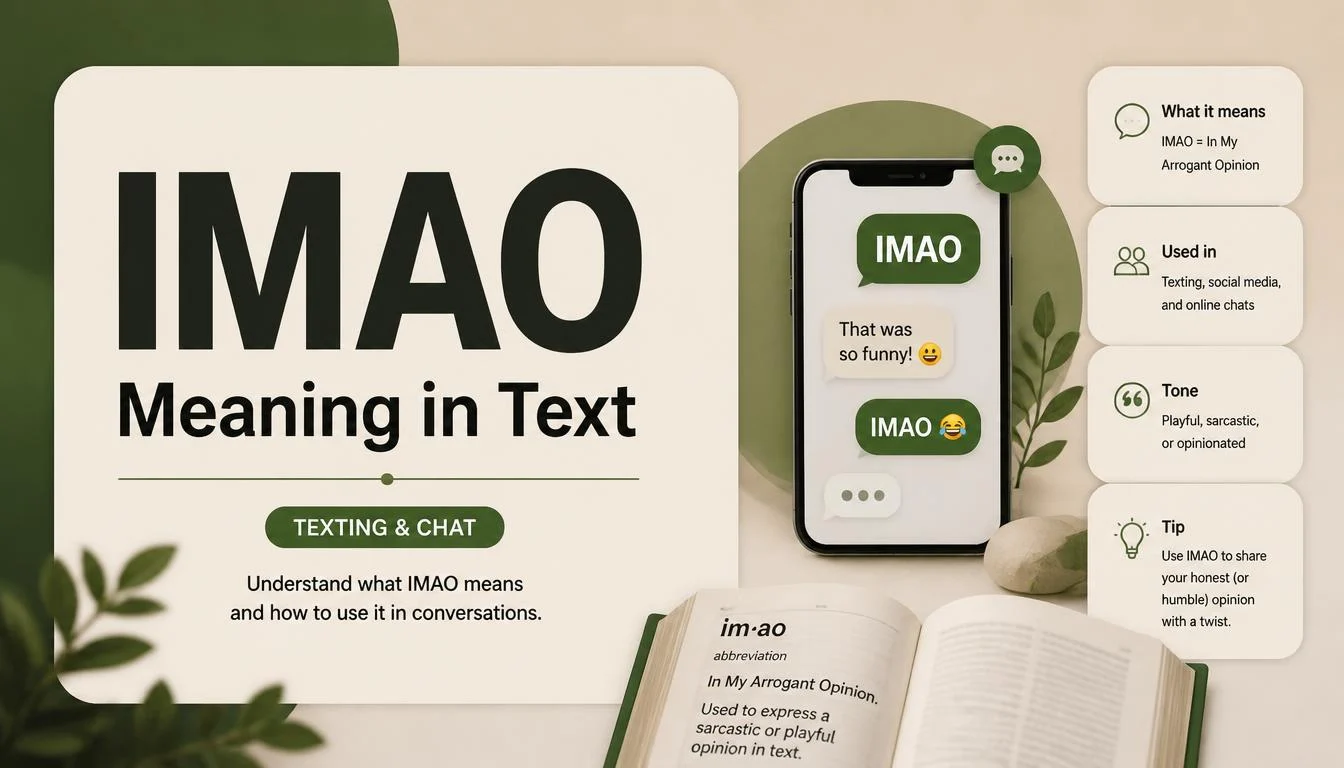
IMAO stands for “in my arrogant opinion.” It’s a deliberate, sarcastic play on the more common IMHO, which means “in my humble opinion.” People use IMAO when they want to signal that they’re fully aware their take is opinionated, possibly stubborn, and maybe even a little obnoxious and they’re fine with that. It’s rarely meant literally; most of the time, it’s self-aware humor.
If you have seen IMAO meaning in text and wondered what this abbreviation stands for, you are not alone. Texting slang can be confusing because similar abbreviations often have slightly different meanings depending on the conversation and context.
In most casual online conversations, IMAO is used as a variation of a common laughter abbreviation. Understanding the intended meaning and tone can help you interpret texts, social media posts, and chat messages more accurately.
What IMAO Actually Stands For
The letters spell out a phrase you’d almost never say out loud with a straight face: in my arrogant opinion . The word “arrogant” is doing heavy lifting here. It’s not a typo, and it’s not a gentler version of anything. It’s an admission wrapped in a joke.
Think of it this way. When someone types IMHO, they’re softening their take. They’re saying, “This is just my two cents, no big deal.” IMAO flips that script entirely. The writer is essentially announcing, “I know I sound like a know-it-all right now, and I’m leaning into it.” The humor comes from the honesty. Most people who dominate a conversation don’t admit they’re doing it. IMAO is a rare case of someone calling their own bluff before anyone else can.
That self-awareness is what keeps the acronym from being genuinely rude. It’s a wink, not a punch.
The IMHO Family Tree: Humble, Honest, and Arrogant
To understand IMAO, you have to know its ancestor. IMHO has been around since at least the mid-1980s, when it appeared in Usenet discussions and early internet glossaries . The H originally stood for “humble.” Over time, some people started reading it as “honest,” which sparked a surprisingly heated debate online . The Atlantic even ran a piece arguing that “humble” was the only defensible meaning, backed by old PC Magazine glossaries and the Jargon File .
IMAO branched off as a direct parody of that humble attitude. The Jargon File, a famous document cataloging hacker slang, lists IMAO alongside IMNSHO (“in my not-so-humble opinion”) as a variant of the original IMHO . So this isn’t a new invention. It’s been floating around tech and forum culture for decades.
The family tree looks like this:
- IMO In My Opinion. Neutral, no humility required.
- IMHO In My Humble (or Honest) Opinion. Softening.
- IMAO In My Arrogant Opinion. Ironic self-roast.
- IMNSHO In My Not-So-Humble Opinion. Usually sincere bragging, often backfires .
How IMAO Got Its Start
The exact origin is fuzzy, but the trail points to Usenet and early internet forums in the late 1980s and early 1990s. One source claims IMAO was actually more popular than IMHO in some early discussions before mellowing into its current sarcastic role . The Jargon File’s inclusion is the strongest evidence that it emerged from the same “SF fandom via Usenet” pipeline that produced IMHO itself .
What’s clear is the intent. IMAO was designed as a joke from the start. It’s not a phrase that evolved accidentally. Someone looked at IMHO, thought “what’s the opposite of humble,” and typed it out. That kind of deliberate wordplay is classic early internet humor nerdy, self-referential, and just a little bit smug.
By the late 1990s and early 2000s, IMAO had settled into its niche as the acronym you use when you want to be emphatic but also want plausible deniability. The “arrogant” label does double duty: it signals strong conviction while preemptively defusing any accusation of actually being arrogant.
When to Use IMAO (and When It Backfires)
The safest place for IMAO is low-stakes opinion-sharing where everyone’s already joking around. Think group chats about which pizza topping is objectively best, or a subreddit thread ranking Taylor Swift albums. Dropping “IMAO, pineapple belongs on pizza” lands because the absurdity is part of the fun.
It works best when the opinion is genuinely strong but the topic is trivial. The gap between the intensity of your take and the unimportance of the subject is where the humor lives.
Where it backfires: serious debates. If you type “IMAO, this policy is going to hurt small businesses” in a political discussion, you’re not being cute. You’re just being annoying. The “arrogant” label reads as a confession rather than a joke when the stakes feel real to other people.
There’s also a generational angle. IMAO is not as common as IMHO or IMO in mainstream texting, especially among younger users who might not recognize it. Using it with someone who doesn’t know the acronym can create genuine confusion. They might think you made a typo, or they might confuse it with LMAO.
IMAO vs. IMHO vs. IMNSHO: A Comparison
The differences between these acronyms are subtle but real. Here’s how they stack up:
| Acronym | Meaning | Tone | Typical Context |
|---|---|---|---|
| IMO | In My Opinion | Neutral | Everyday opinions, no humility or arrogance implied |
| IMHO | In My Humble Opinion | Softening, polite | Disagreements, subjective takes, trying not to offend |
| IMAO | In My Arrogant Opinion | Ironic, self-aware | Jokes, hot takes, low-stakes debates |
| IMNSHO | In My Not-So-Humble Opinion | Sincere or mock-sincere bragging | When someone wants to sound authoritative |
The key distinction: IMHO lowers the volume. IMAO raises it while winking. IMNSHO raises it without the wink, which is why it’s less popular. Nobody likes a bragger .
The Confusion with LMAO
This is the practical problem with IMAO. It’s one letter away from LMAO, the far more common acronym for “laughing my ass off” . The visual similarity is striking, and in fast-moving chats, typos happen constantly.
Some people lean into this. The accidental swap can itself become a joke typing “IMAO” when you meant “LMAO” reads as an unintentional self-own. But most of the time, the confusion just creates a small pause. The reader has to decide whether you’re laughing or being arrogant. Usually context makes it obvious, but not always.
If you’re going to use IMAO, be aware that you might get a “did you mean LMAO?” reply. It comes with the territory.
Why IMAO Stays Niche
IMAO has never broken into the mainstream the way IMHO or IMO have. There are a few reasons for that.
First, “arrogant” is a strong word. Even in jest, some people don’t want to type it about themselves. It feels like tempting fate. IMHO is safe. IMAO requires a certain willingness to look like a jerk on purpose.
Second, the humor depends on the reader knowing the IMHO backstory. If you don’t know that IMHO means “humble,” the sarcasm of IMAO loses its target. For a lot of casual texters, IMHO is just a general “here’s my opinion” marker. The humble/honest distinction doesn’t register. Without that context, IMAO is just an odd way to say “I’m being arrogant,” which isn’t funny.
Third, internet slang moves fast. IMAO had its moment in the Usenet and forum era, but newer acronyms like TBH, NGL, and IMO have taken over the opinion-signaling space. IMAO survives mostly in communities that remember its roots tech forums, older Reddit users, and people who enjoy the specific flavor of self-aware internet irony .
That said, niche doesn’t mean dead. IMAO still pops up in comment sections and group chats where someone wants to drop a spicy take without pretending it’s humble. It’s a tool for a specific job, and it does that job well.
FAQs
Is IMAO meant seriously?
Almost never. The phrase “in my arrogant opinion” is inherently self-aware. If someone were genuinely arrogant, they wouldn’t label their own opinion that way. The acronym exists to signal that the writer knows they’re being opinionated and is choosing to be anyway. It’s a joke about confidence, not an actual display of it.
Can I use IMAO in professional settings?
No. It’s firmly informal. Even in casual workplace chats, IMAO is risky because not everyone will recognize the irony. IMHO is safer if you want to soften a take. IMO is neutral. IMAO is for friends and forums, not Slack channels with your boss.
What’s the difference between IMAO and IMNSHO?
Both signal strong opinions, but the intent differs. IMAO is usually ironic the writer is mocking their own confidence. IMNSHO (“in my not-so-humble opinion”) is often sincere, or at least ambiguous. It’s used when someone genuinely believes their take deserves attention. IMAO laughs at itself. IMNSHO doesn’t .
Did IMAO really exist in the 1980s?
Evidence points to yes, though it wasn’t as widely documented as IMHO. The Jargon File, which originated in the 1970s and was maintained through the 1990s, lists IMAO as a known variant . Usenet archives from the late 1980s and early 1990s contain instances of it in discussions. It wasn’t mainstream, but it was there, circulating in the same nerd communities that gave us IMHO in the first place.
Why do people confuse IMAO with LMAO?
One letter. I-M-A-O versus L-M-A-O. On a phone keyboard, the I and L are close enough that thumbs slip. And LMAO is so much more common that the brain often autocorrects. In practice, the confusion usually resolves quickly, but it’s a real hazard of using the acronym.
Conclusion
IMAO is a small, weird piece of internet history. It takes the most polite opinion-signaling acronym in existence and flips it into a joke about knowing you’re being insufferable. That’s a very online kind of humor. It doesn’t work everywhere, and it never became a mainstream texting staple. But when it lands, it lands because the writer is willing to be the butt of their own joke. IMHO, that’s a rare kind of confidence.