Quick Answer
In text and chat, DND stands for “Do Not Disturb” a signal that someone is unavailable or doesn’t want to be contacted right now. But its meaning has split into two distinct layers: the literal phone setting that silences notifications, and a social shorthand that says “I need space.” For younger users, DND has evolved from a temporary mode into a permanent state of digital boundaries.
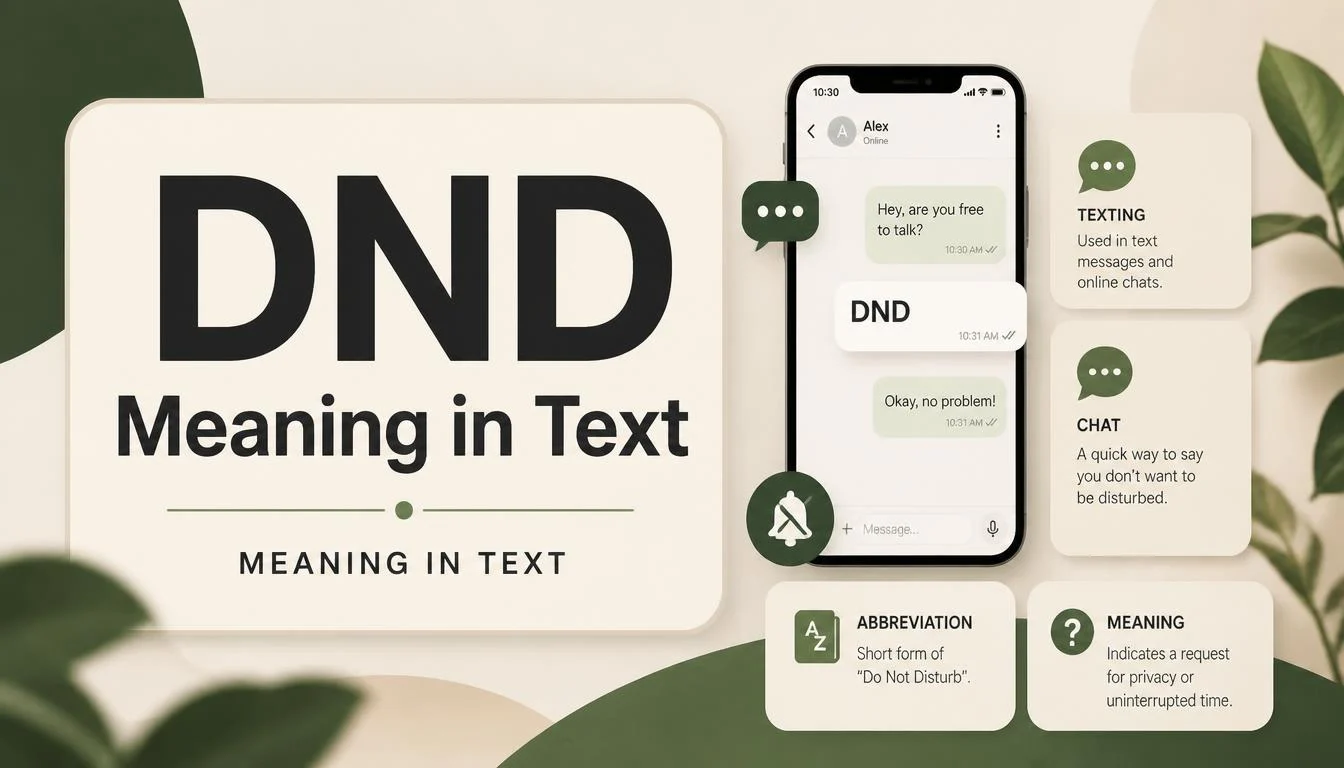
If you have seen DND meaning in text and wondered what it stands for, the most common meaning is “Do Not Disturb.” People use DND in texts, chats, and social media to indicate that they are unavailable or prefer not to receive notifications.
The meaning can vary slightly depending on the context. Someone might use DND to say they are busy, sleeping, studying, working, or simply taking a break from their phone. Understanding the surrounding message helps clarify the intended meaning.
The Two Layers of DND
Most people encounter DND on two levels, and confusing them creates unnecessary friction.
The first layer is technical. Every modern smartphone has a built-in Do Not Disturb mode that mutes calls, texts, and app notifications. Flip it on, and your screen stays dark. Messages still arrive they just don’t ping you. This is the DND that lives in your settings menu, a simple toggle that millions of people use daily without thinking twice.
The second layer is social. When someone types “DND” into a text or drops it in a group chat, they’re not talking about their settings. They’re making a statement. It means: don’t expect a reply, don’t take it personally, and don’t keep texting. The acronym has become a compact way to announce a boundary without writing a paragraph explaining why you’re unavailable.
The overlap between these two layers is where most confusion happens. If your friend’s phone is on DND mode, your message still delivers they just won’t see it until they check. If your friend texts you “DND,” they’re probably not even looking at their phone, which means your reply might sit unread for hours.
DND vs. DND Mode: The Critical Difference
| Signal | What It Means | What To Do |
|---|---|---|
| “DND” sent in a text | A social boundary announcement | Respect it. Don’t keep messaging. |
| DND mode enabled on a phone | A technical setting silencing alerts | Messages deliver; expect delayed replies. |
| “DND 24/7” in a bio or caption | A lifestyle statement about digital minimalism | Understand they’re not ignoring you specifically. |
| DND sign on a hotel door | Physical request for privacy | Housekeeping skips the room. |
That table captures the surface-level distinctions, but the real story is messier. A person can text “DND” while their phone isn’t actually in DND mode. They can leave DND mode on for weeks and still respond to messages they care about. The acronym and the setting don’t always align, and that’s where relationships get tested.
Why “DND 24/7” Became a Gen Z Identity
Here’s something that would have sounded absurd five years ago: a growing number of young adults never turn DND mode off. It stays on all day, every day. Not because they’re avoiding something specific, but because the default state of constant availability feels unsustainable.
On TikTok, videos tagged “DND 24/7” rack up millions of views. The creators aren’t teaching a technical trick. They’re describing a psychological shift. Madeline Kerestman, a 21-year-old pre-med student, told HuffPost that a single Snapchat notification during study time could send her “into a downward spiral of scrolling for several minutes”. For her, DND isn’t about being rude. It’s about protecting her ability to focus.
Therapists see this as a boundary-setting tool, not antisocial behavior. Lauren Larkin, a psychotherapist in New York, describes DND as a way for young people to “create a sense of control over relationships that aren’t serving them”. That framing matters. Previous generations equated being reachable with being a good friend. Gen Z is rewriting that equation.
There’s a practical edge to this too. Spam calls and texts have gotten worse, not better. Leaving DND on 24/7 filters out the noise automatically. The people who actually matter know how to reach you they call twice, or they use a favorite contact exception that lets their calls through even when DND is active.
DND in Different Apps: A Breakdown
The acronym means the same thing everywhere, but the implementation varies by platform.
iPhone and Android both have system-level DND. On iPhone, it lives under Settings > Focus > Do Not Disturb. You can schedule it, allow specific contacts through, and even set an auto-reply for messages that says you’re unavailable. Android’s version works similarly, accessible through the Quick Settings panel.
Instagram calls its version “Quiet Mode.” It’s essentially DND with a softer name. Turn it on, and the app stops sending you notifications. Your profile shows a small “In quiet mode” note if you enable the share setting.
Snapchat has its own DND toggle buried in notification settings. You can silence the whole app or mute specific contacts. There’s no visible badge on your profile, so the social signal is weaker than a text that says “DND” outright.
Discord and other gaming platforms use DND as a status indicator. Set it, and your name shows a red icon next to it. Everyone in the server knows you’re not available for chat. It’s a cleaner system than texting because the status is always visible nobody has to guess.
The common thread: every platform treats DND as a toggle, but the social weight of using it varies. A Discord status is low-stakes. A text that just says “DND” carries more emotional charge.
The Business Side: When DND Means Legal Trouble
There’s a version of DND that has nothing to do with personal boundaries, and it can cost companies serious money.
In several countries, “DND” refers to a Do Not Disturb registry an official list of phone numbers that telemarketers are legally forbidden to contact. India’s telecom regulator, TRAI, maintains one of the strictest systems. Sending a promotional SMS to a DND number can result in the sender’s phone connection being disabled and their details blacklisted for two years.
The United States has the National Do Not Call Registry, which requires telemarketers to scrub their databases against the list every 31 days. Nigeria’s Communications Commission launched a similar service in 2016, allowing users to text “STOP” to 2442 to block all unsolicited marketing messages, or use a partial DND option to choose which categories banking, real estate, education they’re willing to receive.
This regulatory layer is completely separate from the casual texting meaning. But it explains why some businesses react with visible panic when a customer mentions DND. They’re not thinking about phone settings. They’re thinking about fines.
How to Respond When Someone Texts You DND
The response depends entirely on context, and getting it wrong can turn a small boundary into a bigger conflict.
If someone sends “DND” with no other explanation, the safest reply is a short acknowledgment. “Got it” or “Talk later” works fine. Adding “Good luck” or “Hope everything’s okay” is appropriate if you know they have an exam or interview coming up.
What you shouldn’t do is ask “Why?” or send follow-up messages explaining why your original message was important. The whole point of the acronym is that it’s a pre-emptive boundary. Treating it as a negotiation defeats the purpose.
If someone has DND 24/7 and you’re frustrated by their unavailability, that’s a different conversation one that probably shouldn’t happen over text. The HuffPost piece on the trend notes that older family members often struggle with this habit, wondering why someone would carry a phone they refuse to answer. The answer, for many young users, is that the phone is for their convenience, not everyone else’s.
FAQs
Does a text still go through if someone’s phone is on DND mode?
Yes. Messages still deliver normally when someone’s phone is on DND mode. The recipient simply won’t receive a notification right away. They can see the message whenever they check their phone.
Is “DND” rude?
Not inherently. DND is a direct way to communicate that someone is unavailable. Whether it sounds rude depends on the situation. A friend using DND during finals week feels very different from a partner using it every time you try to talk.
What if it’s a real emergency and someone’s on DND?
Most phones let users allow calls from specific favorite contacts to come through DND. If you’re not on their allowed list, try calling twice. Many devices can allow a second call within a short period to bypass DND for urgent situations.
Can I use DND mode without telling anyone?
Absolutely. DND mode is private by default. On an iPhone, however, someone may see that your notifications are silenced if you have enabled Share Focus Status.
What does “DND Warrior” mean?
“DND Warrior” is a joking term for someone who keeps DND turned on almost all the time. The phrase is often used in TikTok comments, memes and casual conversations to describe someone who is rarely bothered by notifications.
Is DND the same as airplane mode?
No. DND and airplane mode work differently. Airplane mode disables network connections such as calls, texts and mobile data unless you manually turn some connections back on. DND keeps your phone connected while simply silencing or limiting notifications.
Conclusion
DND started as a phone setting. It’s now a social language. The three letters carry different weights depending on who sends them, where they appear, and what’s happening in that person’s life. For some, it’s a quick way to say “I’m busy.” For others, it’s a permanent boundary against a world that assumes instant response. Learning to read the difference is a skill worth having especially since the acronym isn’t going anywhere.