Quick Answer
GTG almost always stands for “got to go.” It tells the other person you’re leaving the conversation, usually right now or very soon. Less often, it means “good to go,” as in ready or approved. Context decides which one you’re reading, and the “got to go” version covers the vast majority of texts.
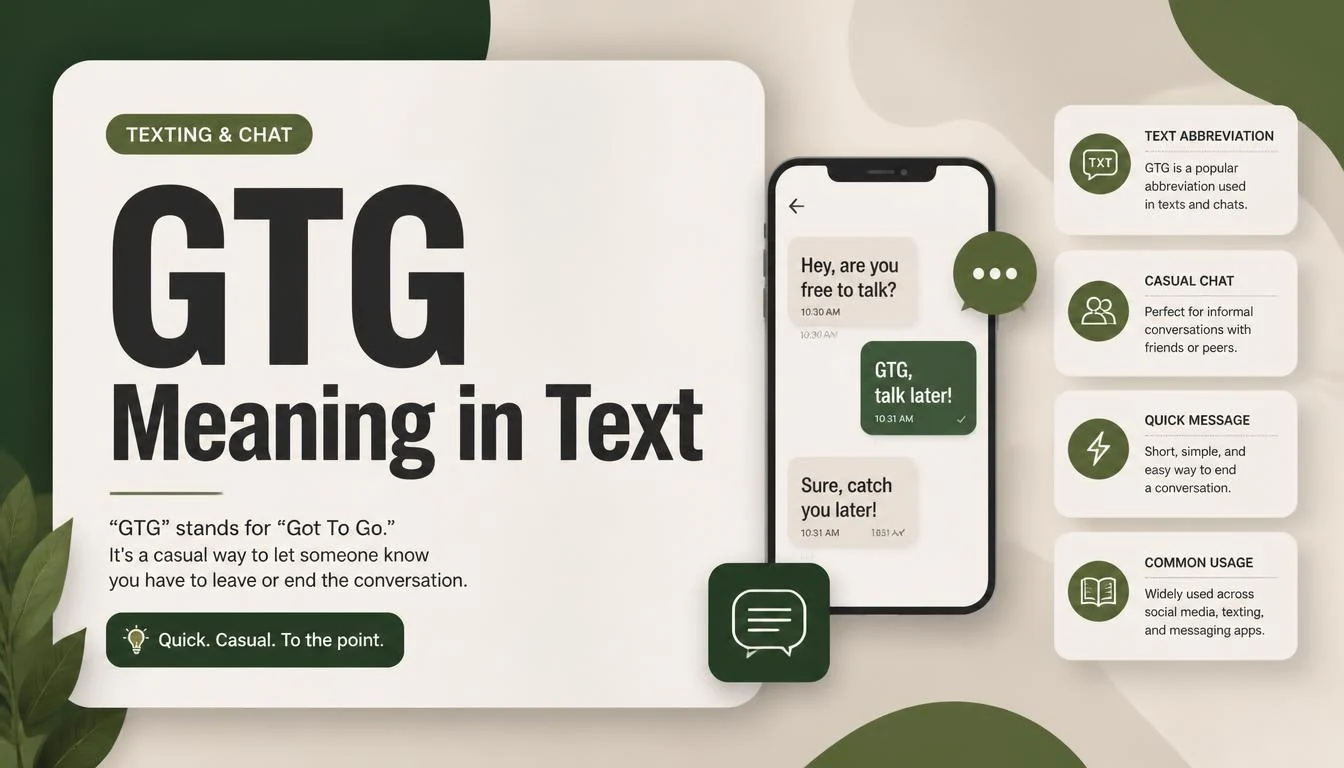
Wondering about the GTG meaning in text? GTG most commonly stands for “Got to Go” and is used when someone needs to leave a conversation, end a chat, or get back to something else. It is a short and casual expression commonly seen in texting and online messaging.
However, GTG can have another meaning depending on the context. In some conversations, it means “Good to Go,” which indicates that something is ready, approved, or all set. Knowing the surrounding conversation can help you understand which meaning is intended.
What the Letters Stand For
Most of the time, the three letters mean “got to go.” You’ll see it at the end of a chat, usually after a message like “this was fun” or “okay, my ride’s here.” It works as a verbal wave at the door.
The second reading is “good to go.” This one shows up when someone confirms that a plan, a document, or a person is ready. A coworker who texts “gtg on the slides” isn’t leaving. They’re telling you the slides are done. The phrase has older roots in military and aviation speech, where “good to go” meant a system or person was cleared and ready.
A third, rarer reading is “got to get,” which usually trails off into something else, like “gtg groceries before they close.” You’ll spot it when the abbreviation is followed by a noun or a task instead of standing alone. If a message has more words after the three letters, read it as an action, not a farewell.
Where the Abbreviation Came From
Shorthand like this didn’t start with smartphones. It grew out of early internet chat, including IRC (Internet Relay Chat) rooms and AOL Instant Messenger in the 1990s. Typing was slow, conversations moved fast, and nobody wanted to be the person still composing a sentence while everyone else had moved on.
Phones added a second push. The first text message, sent in December 1992, was a simple holiday greeting, and standard SMS messages ended up capped at 160 characters. Many people paid per message, so every saved letter counted. Abbreviations that cut a goodbye from three words to three letters were an easy win.
Dictionaries eventually noticed. The Oxford English Dictionary added LOL and OMG in 2011, a signal that chat shorthand had left the teenage bedroom and entered the general language. GTG hasn’t received the same attention, but it follows the same path: born in a chat window, spread by thumbs, and now understood by almost everyone who texts.
GTG vs. G2G vs. gtg: A Quick Comparison
Small differences in spelling and case change how the message lands. Here’s how the common variants stack up.
| Variant | Usual Meaning | Typical Tone | Where You’ll See It |
|---|---|---|---|
| GTG | Got to go | Neutral, slightly urgent | Texts, DMs, group chats |
| gtg | Got to go | Casual, relaxed | Friends, social apps |
| G2G | Got to go (or good to go) | Casual, older-internet feel | Chat rooms, gaming lobbies |
| gtg! | Got to go, with warmth | Friendly, upbeat | Close friends, family |
| GTG. | Got to go, with edge | Clipped, possibly annoyed | Arguments, tense threads |
| “gotta go” | Got to go, spelled out | Soft, personal | Voice-like texting |
The “2” in G2G swaps in a number for a word, a trick that goes back to early chat days. Neither version is more correct. Younger users lean toward the lowercase three-letter form, while G2G tends to signal someone who grew up with desktop chat windows.
The Soft Exit: Why GTG Works Like a Social Hall Pass
Here’s the part nobody explains. GTG is less about information and more about permission. When you send it, you’re asking the other person to let you leave without a fuss.
Think about a real conversation. Walking away mid-sentence feels rude, so people build exits: “Well, I should let you go,” or “I won’t keep you.” GTG is the digital version of that move. It’s quick, it’s recognized, and it spares both people the awkwardness of a long goodbye.
That’s why it’s popular with people who struggle to end chats. If you’re the type to keep replying out of politeness for forty minutes, three letters can save you. It sounds firm without sounding harsh, because the abbreviation signals that the reason is outside your control. Something “has” to happen, and nobody can argue with that.
There’s a quiet trade-off. The softness only works if the other person believes you. Send GTG and then reappear online two minutes later, and the exit stops being a hall pass and starts looking like an excuse.
The Tone Check: Capitals, Periods, and Silence
Texting has no face or voice, so tiny formatting choices do the emotional work. Three details matter most with this abbreviation.
Capitals versus lowercase. Lowercase “gtg” reads as relaxed. Uppercase “GTG” can feel a little more urgent, as if something is pulling you away right now. Neither is wrong, but if you’re texting someone who reads tone carefully, lowercase is the safer, friendlier pick.
Punctuation. An exclamation point softens it. A period hardens it. “gtg, talk later!” feels warm, while “GTG.” feels like a door closing. Many people over 30 use periods out of habit and have no idea how final they sound to a younger reader.
What follows it. A bare GTG with no reason or promise can feel abrupt. Adding even a tiny follow-up changes everything: “gtg, dinner’s ready, text you after” gives the other person somewhere to land. Without it, they’re left wondering whether they said something wrong.
One more signal is timing. If you’ve been trading rapid replies and suddenly send GTG, it reads as a natural stop. If the other person just shared something personal or upsetting and your reply is GTG, it can feel like a brush-off, even if you meant nothing by it.
The Two-Step Goodbye
The smoothest texters tend to use a two-step pattern. First comes the exit signal, then the reconnection promise. It looks like this:
- “gtg, meeting starts in five. Call you tonight?”
- “gtg, my bus is here. Let’s pick this up tomorrow!”
- “gtg, battery’s about dead. I’ll text when I’m charged.”
The first half tells the person you’re leaving. The second half tells them the connection isn’t over. That small second step is what separates a polite goodbye from a message that feels like being dropped.
You don’t need to do it every time. With close friends, a bare “gtg” is fine because they already know you’ll be back. The pattern matters most with people you’re newer to, people who are anxious about replies, or anyone in the middle of a heavy topic. Treat it like a habit worth building, not a rule.
Group Chats, Work Chats, and Other Tricky Spots
Group chats have their own etiquette, and GTG behaves differently there. In a busy thread, leaving without a word is normal, since nobody expects a farewell to the whole room. A quick “gtg, catch you all later” is a courtesy, not a requirement. It works best in small groups where your absence will actually be noticed.
Workplace chat is a different story. On platforms like Slack or Microsoft Teams, GTG is widely understood but sits at the casual end of professional language. With teammates you know well, it’s fine. With a client, a new manager, or anyone senior, “I have to jump off, thanks for the help” feels sturdier and costs you only a few extra seconds.
Then there’s the “good to go” confusion. In a work setting, that second meaning shows up often, and it can trigger misreadings. If your boss writes “gtg?” after a draft, they’re asking whether it’s ready, not announcing a departure. When the stakes are real, a quick clarification beats a wrong guess.
Dating apps add another wrinkle. A GTG during an early conversation can read as polite, or as disinterest, depending on whether a plan follows it. Pairing it with a promise to continue, even a casual one, keeps the door open.
GTG Next to Other Sign-Off Shorthand
GTG belongs to a small family of chat exits. They sound similar, but they promise different things.
| Abbreviation | Full Phrase | What It Promises | Best Used When |
|---|---|---|---|
| GTG | Got to go | Leaving, return unclear | You need to end the chat |
| BRB | Be right back | Return within minutes | Stepping away briefly |
| TTYL | Talk to you later | A future conversation | Wrapping up warmly |
| BBL | Be back later | Return after a longer gap | Gone for hours |
| HMU | Hit me up | Invitation to contact you | Leaving the door open |
| AFK | Away from keyboard | Temporarily unavailable | Gaming or desktop chat |
The real difference is the promise of return. BRB says “I’ll be back soon.” TTYL says “we’ll speak again.” GTG, on its own, says only “I’m leaving,” which is why many people stack them: “gtg, ttyl” delivers the exit and the reassurance in one line. That combo is common enough that some people mash it into a single chunk without spaces.
The Vanishing Act Problem
This is the topic that gets the least attention and probably causes the most friction. GTG has become a favorite tool for people who want to leave a conversation without explaining themselves. Used honestly, that’s healthy. Used as a vague escape, it can blur into something closer to ghosting.
Ghosting means cutting off contact with no explanation. GTG isn’t ghosting, since you’ve at least announced you’re leaving. But a GTG with no follow-up, sent right after an awkward or emotional message, can feel nearly the same to the person receiving it. They don’t know whether you’re busy, upset, or finished with them.
A few habits keep it honest. Don’t use it to dodge a hard topic you plan to ignore later. Don’t send it and then post online within the hour, since people notice. And if the conversation was important, circle back, even with a short “sorry, had to run, still thinking about what you said.”
Texting is full of small signals, and this one carries more weight than its three letters suggest. People generally forgive a quick exit. They’re less forgiving of the feeling that they were left hanging.
Common Mistakes
A handful of slip-ups come up again and again. Some people use GTG when they actually mean BRB, leaving the other person waiting for a return that never comes. Others use it in formal emails, where it looks out of place. And some forget that the “good to go” meaning exists, then misread a coworker’s confirmation as a goodbye.
Another quiet mistake is overusing it. If every conversation with a friend ends in an abrupt GTG, the pattern starts to feel like avoidance, even when you’re just busy. Varying your sign-offs, with a real sentence now and then, keeps the abbreviation from sounding like a reflex.
FAQs
Is GTG considered rude?
Not by itself. GTG can sound rude if someone uses it immediately after you share something serious or meaningful. It can also feel dismissive when there is no follow up. Adding a brief reason or saying they will talk later usually makes the message feel more considerate.
Should I capitalize GTG?
Capitalization is not important when using GTG in texts. Lowercase “gtg” often feels more casual and friendly. Uppercase “GTG” can feel slightly more urgent. The best choice is usually to match the texting style of the person you are talking to.
Can I use GTG in a work email?
It is better to avoid GTG in a formal work email. Email communication generally calls for clearer and more professional wording. You can use it in casual workplace chats with colleagues you know well. Otherwise, phrases such as “I need to go” or “I have to leave now” are safer choices.
What is the difference between “gtg” and “gotta go”?
Both expressions mean that someone needs to leave or end the conversation. “Gotta go” sounds more conversational and personal because it reflects everyday speech. “GTG” is shorter and faster which makes it especially common in texting and instant messaging.
Do I have to reply when someone sends GTG?
No, you do not have to reply. A short response such as “Bye!” or “Talk later” is a friendly way to acknowledge that the person is leaving. If they clearly want to end the conversation, there is no need to send a long response that could keep the conversation going.
Why does GTG sometimes make people anxious?
GTG can sometimes create uncertainty because it does not explain why the person is leaving or when they might return. This can make the other person wonder if something is wrong. A short explanation or a simple message such as “GTG, talk to you later” can make the meaning feel much clearer.
Conclusion
GTG is a small piece of shorthand doing a surprisingly social job. It lets people end a conversation without the stiffness of a formal goodbye, and it’s understood almost everywhere. The meaning is simple, but the way you use it shapes how the other person feels afterward.
Pay attention to the little details: lowercase for warmth, a follow-up for reassurance, and a bit more care in professional spaces. Do that, and three letters can close a chat cleanly, with nobody wondering what just happened.