Quick Answer
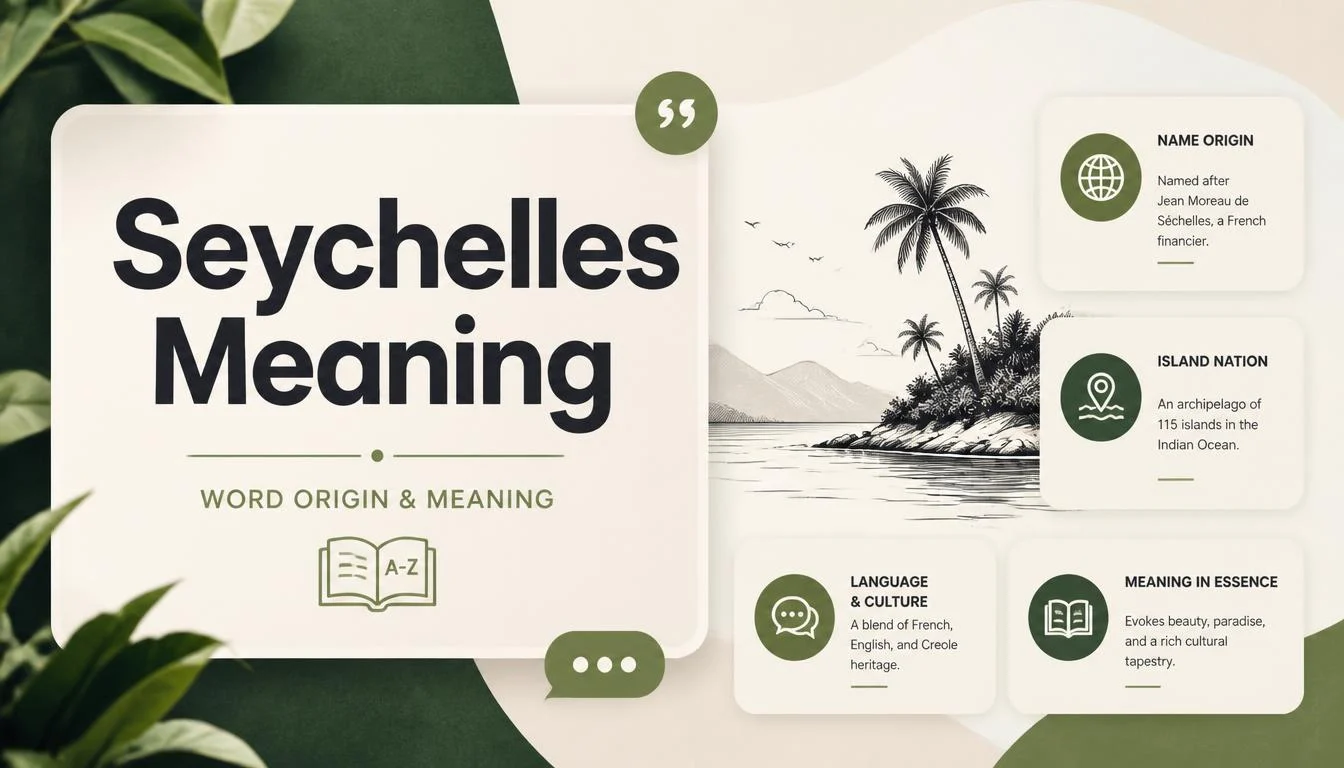
Seychelles is the name of an island country in the Indian Ocean, located northeast of Madagascar and off the eastern coast of Africa. The name comes from Jean Moreau de Séchelles, a French finance official during the 18th century. Seychelles is famous for its tropical beaches, crystal-clear waters, unique wildlife, and rich Creole culture.
The Seychelles meaning is closely connected to the name of an island country in the Indian Ocean, famous for its turquoise waters, white-sand beaches, and lush tropical landscapes. Officially known as the Republic of Seychelles, this island nation lies off the eastern coast of Africa and consists of 115 islands. Its name has historical roots linked to French colonial history rather than a direct meaning in the English language.
The word Seychelles is most commonly used as a geographical name, but people also search for its meaning to understand its origin and cultural significance. The country is known for its rich biodiversity, distinctive granite rock formations, and diverse Creole culture. Learning the Seychelles meaning offers a glimpse into the history, identity, and natural beauty of this remarkable island nation.
What Does Seychelles Mean?
Unlike descriptive place names such as Greenland or New Zealand, Seychelles is not a phrase that directly describes the islands’ appearance. It is a geographical proper noun, meaning that it identifies a specific place rather than an ordinary object or quality.
The name is connected to Jean Moreau de Séchelles, a French official who served under King Louis XV. French authorities applied the name to the island group during the eighteenth century, and the spelling later developed into the English form used today.
This distinction is important because popular descriptions sometimes treat Seychelles as though it literally means “heaven on earth,” “island paradise,” or “beautiful sea.” Those phrases capture the country’s appeal to visitors, but they are not the historical meaning of its name.
In simple terms, the name identifies the country, while descriptions such as tropical paradise express how people perceive its scenery and atmosphere.
Is Seychelles a French Word?
The name has a French historical origin, but it is a proper name rather than a common French word with a direct English translation. Its earlier spelling, Séchelles, reflects the name associated with the French official.
French influence remains visible throughout the country. Place names such as Mahé, Praslin, and La Digue reflect the islands’ colonial history, while French is one of the country’s three official languages alongside English and Seychellois Creole.
The modern country, however, is not simply an extension of French culture. Its identity has developed through African, European, and Asian influences, creating a society with its own traditions and language.
Where Does the Name Come From?
The history of the name begins with French exploration in the Indian Ocean during the eighteenth century.
In 1742, French navigator Lazare Picault explored the islands on an expedition connected with Bertrand-François Mahé de La Bourdonnais, the governor of the French island colony of Île de France, now Mauritius. Picault later returned to the area and gave the largest island the name Mahé in honor of the governor.
A few years later, France formally claimed the archipelago. On November 1, 1756, Captain Corneille Nicolas Morphey took possession of the islands on behalf of the French crown. The islands were named in honor of Jean Moreau de Séchelles, the French official responsible for financial administration under Louis XV.
The name was therefore linked to French political history, rather than to a local word for beaches, islands, or wildlife.
The spelling changed over time as British influence replaced French rule. Seychelles became a British colony and eventually gained independence on June 29, 1976. The country retained the established name after independence.
The sequence is worth remembering: a French official’s surname became the name of an island group, and that geographical name survived changes in colonial administration and the creation of an independent state.
How the Islands Got Their Name
The naming of Seychelles is part of a larger pattern in the history of exploration. European navigators frequently named islands after rulers, government officials, patrons, saints, or people who financed their expeditions.
Several familiar names in Seychelles reflect this practice.
- Mahé: The largest island is named after Bertrand-François Mahé de La Bourdonnais, the French governor associated with early French exploration of the archipelago.
- Praslin: The island’s name honors César Gabriel de Choiseul, Duke of Praslin, a French statesman who served as a minister under Louis XV.
- La Digue: Its name is associated with the French expedition ship La Digue used during the period of exploration.
- Victoria: The capital city was originally known as L’Établissement du Roi during French administration. The British renamed it Victoria in 1841, in honor of Queen Victoria.
 Seychelles National Museum+2
These examples show how historical names can preserve traces of political power long after the original circumstances have disappeared.
The story also needs a wider perspective. The islands were known to Indian Ocean sailors before permanent European settlement, and historical accounts discuss possible earlier contacts involving Arab and Portuguese navigators. The exact details of early visits are not always certain, so it would be misleading to claim that European explorers were necessarily the first people ever to see the archipelago.
The first recorded landing and the establishment of a permanent settlement are separate historical events. The Seychelles National Museums identifies a recorded landing in 1609, while the first lasting French settlement was established on Sainte-Anne Island in 1770.
Where Seychelles Is Located
Seychelles is an island country in the western Indian Ocean, northeast of Madagascar and off the eastern coast of Africa. It is part of the African region, even though it lies far from the continent’s mainland.
The country consists of 115 islands, spread across a large area of ocean. Its total land area is approximately 455 square kilometres, although figures can vary slightly depending on the source and measurement method.
The islands are generally divided into two broad geographical groups:
- Inner Islands: These include the main inhabited islands, such as Mahé, Praslin, and La Digue. Many are formed from ancient granite rock and have steep hills, forested interiors, and distinctive coastal formations.
- Outer Islands: These include coral islands and atolls, such as Aldabra. Many are low-lying and remote, with ecosystems shaped by reefs, lagoons, and ocean conditions.
The difference between these groups is more than a geographical detail. Granite formations create the dramatic boulders and mountainous scenery seen in photographs of Mahé and La Digue, while coral islands often have flatter terrain and extensive reef systems.
This combination gives the country a wider range of natural environments than its reputation for beach holidays might suggest.
Seychelles at a Glance
| Feature | Key information |
|---|---|
| Official country name | Republic of Seychelles |
| Geographic region | Western Indian Ocean, part of Africa |
| Capital | Victoria |
| Number of islands | 115 |
| Main inhabited islands | Mahé, Praslin, and La Digue |
| Official languages | Seychellois Creole, English, and French |
| Currency | Seychellois rupee |
| Independence | June 29, 1976 |
| UNESCO World Heritage Sites | 2 |
| National identity | Seychellois |
The country’s three official languages reflect its layered history. Seychellois Creole is a French-based creole language that developed in a society shaped by people from different regions and backgrounds. English and French remain important in public life, education, and administration.
Its population is small compared with many mainland countries, but the islands have long been connected to international shipping, fishing, trade, and tourism. Those connections helped shape the cultural identity that exists today.
What Makes Seychelles Distinctive?
The name itself comes from a historical figure, but the country’s identity is now closely associated with its remarkable biodiversity, cultural traditions, and marine environment.
1. Rare Plants and Animals
Seychelles is home to species found naturally nowhere else in the world. Such species are called endemic, meaning they are native to a particular place and do not naturally occur elsewhere.
One of the best-known examples is the coco de mer palm (Lodoicea maldivica), which grows naturally on Praslin and Curieuse. Its enormous seed is famous for its distinctive shape and size, making it one of the country’s most recognizable natural symbols.
Another notable species is the Seychelles black parrot (Coracopsis barklyi), a rare bird associated with Praslin’s palm forests. The Seychelles paradise flycatcher (Terpsiphone corvina) is another endemic bird, found on La Digue.
These examples help explain why the country attracts not only beach tourists but also birdwatchers, botanists, and conservation researchers.
2. Two UNESCO World Heritage Sites
Seychelles has two properties inscribed on the UNESCO World Heritage List: Aldabra Atoll and Vallée de Mai Nature Reserve. Aldabra was inscribed in 1982, followed by Vallée de Mai in 1983.
UNESCO World Heritage Convention
Aldabra Atoll
A remote coral atoll with a large population of giant tortoises and important marine habitats.
Vallée de Mai
A protected palm forest on Praslin, known for the coco de mer and distinctive native vegetation.
Aldabra is particularly notable for its giant tortoises. UNESCO describes it as home to the world’s largest population of these reptiles, with an estimated population of around 152,000. The atoll’s isolation has helped preserve habitats that support a high proportion of distinctive native species.
Vallée de Mai offers a different experience. Its palm forest provides habitat for native wildlife and preserves a rare example of Seychelles’ natural vegetation.
3. A Distinctive Cultural Identity
Seychellois culture developed through the meeting of African, European, and Asian influences. The country’s history includes French settlement, British administration, migration, and the forced movement of enslaved Africans during the colonial period.
These experiences shaped the languages, food, music, religious practices, and family traditions found across the islands. Creole culture is especially important because it reflects a local identity that cannot be reduced to any single outside influence.
The French origin of the country’s name is therefore only one part of its story. The modern national identity belongs to the Seychellois people and reflects centuries of cultural development.
Seychelles vs. Other Indian Ocean Island Nations
Seychelles is sometimes confused with other island destinations because they share tropical climates, beaches, and histories influenced by European colonial powers. However, each country has its own name origin, geography, and cultural identity.
| Country | Location | Name and historical background | Distinguishing feature |
|---|---|---|---|
| Seychelles | Western Indian Ocean, northeast of Madagascar | Named after French official Jean Moreau de Séchelles | Granite islands, coral atolls, and endemic wildlife |
| Mauritius | East of Madagascar | Named by Dutch navigators in honor of Prince Maurice of Nassau | Volcanic landscapes and a diverse multicultural population |
| Maldives | Indian Ocean, southwest of India and Sri Lanka | The name has historical linguistic roots associated with the islands; its exact derivation is discussed in different accounts | Low-lying coral islands and atolls |
| Madagascar | Off the southeastern coast of Africa | The name was used in medieval European geographical accounts and became attached to the large island | Exceptional endemic biodiversity and varied terrain |
The most useful distinction is that Seychelles is a country name derived from a person’s surname, not a generic term for tropical islands.
Its national identity also differs from that of Mauritius and the Maldives, even though all three countries have strong connections to the ocean. Geography, settlement history, language, and local traditions have shaped each one in different ways.
Common Misunderstandings About the Name
A few common assumptions can make the history of Seychelles confusing.
First, the name does not literally mean paradise. The country’s scenery has inspired that description, but its historical name comes from a French official’s surname.
Second, Seychelles is not a French-speaking country in the same sense as France. French is one of its official languages, but Seychellois Creole and English are also official languages. Local culture has developed its own character over generations.
Third, the country is not part of the Caribbean. Its beaches may resemble those of Caribbean destinations, but Seychelles is located in the Indian Ocean, near the eastern side of Africa.
Finally, the name’s French origin does not mean the islands were always French or that their history began with French settlement. The archipelago has a broader maritime history, followed by periods of French and British colonial rule and eventual independence.
These distinctions help separate the historical meaning of a place name from the associations people develop around it.
FAQs
1. How do you pronounce Seychelles?
Seychelles is commonly pronounced say-SHELZ in English. The final syllables sound like “shelz,” rather than being pronounced as separate letters. French pronunciation differs slightly, but the English form is widely understood internationally.
2. What are people from Seychelles called?
People from the country are called Seychellois. The term can describe an individual, the country’s people collectively, or something associated with its national culture. For example, Seychellois Creole refers to the country’s French-based creole language.
3. What does the Seychelles flag represent?
The Seychelles flag has five diagonal bands of blue, yellow, red, white, and green. These colors represent different aspects of the country’s national identity, including the sea and sky, sunlight, the people and their determination, social justice, and the natural environment. The flag was adopted in its current form in 1996.
4. Is Seychelles an island or a country?
Seychelles is a sovereign country made up of an archipelago, which is a group of islands. It includes 115 islands, with Mahé serving as the largest and most populated island. Victoria, the national capital, is located on Mahé.
5. Why is Seychelles famous around the world?
Seychelles is known for its beaches, clear waters, granite rock formations, coral reefs, and rare wildlife. Its protected natural areas, including Aldabra Atoll and Vallée de Mai, also attract people interested in biodiversity and conservation. Tourism is a major part of its international reputation, but its cultural history and marine ecosystems are equally important to understanding the country.
Conclusion
The name Seychelles carries a piece of eighteenth-century French history, but the country it identifies has grown into a distinctive island nation with its own languages, traditions, and cultural identity. Its natural beauty attracts visitors, while its rare wildlife and protected ecosystems make it important to conservation. Understanding the name’s origin offers a useful starting point for appreciating the much broader story of these Indian Ocean islands.