Quick Answer
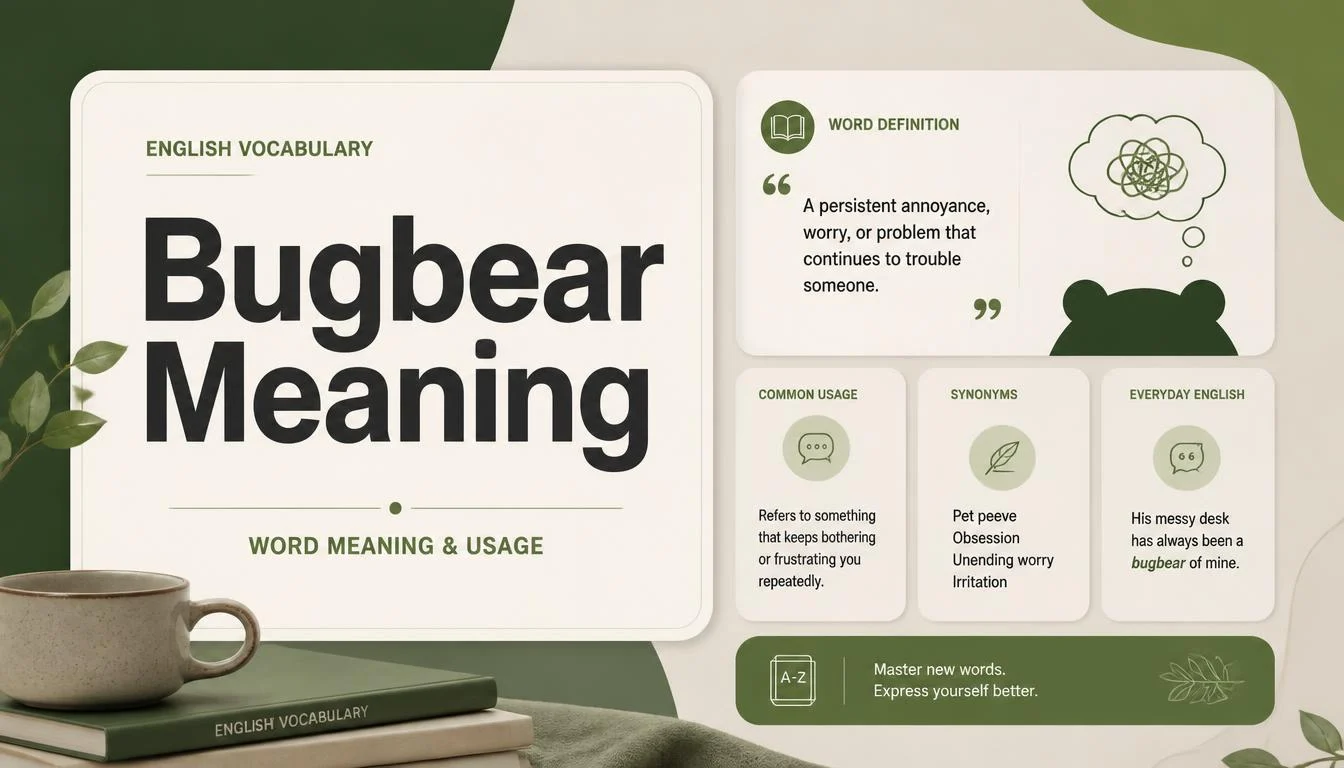
A bugbear is something that causes persistent worry, fear, or annoyance, especially a problem someone frequently complains about. In folklore and fantasy, a bugbear is a frightening imaginary creature used to scare people or serve as a monster in fictional stories. For example, someone might say, “Slow internet is my biggest bugbear,” meaning it is a recurring source of frustration.
The Bugbear meaning can vary depending on the context in which the word is used. In everyday English, a bugbear refers to something that causes persistent worry, fear, or irritation, such as a bad habit or a problem that repeatedly frustrates someone. The word can also describe a frightening imaginary creature used in traditional folklore to scare children.
In fantasy literature and role-playing games, a bugbear is often portrayed as a large, intimidating creature with a fearsome appearance. The term has become especially recognizable through fantasy games and stories, where bugbears are commonly depicted as powerful humanoid monsters. Understanding the bugbear meaning helps you recognize whether the word refers to a personal annoyance, a source of fear, or a fictional creature.
What Does Bugbear Mean?
A bugbear is a persistent source of irritation, concern, or frustration. The word usually describes something that repeatedly bothers a person rather than a single unpleasant experience.
For instance, someone might find unnecessary meetings frustrating because they interrupt productive work. Another person might dislike people who interrupt conversations or leave shared spaces untidy. These recurring frustrations can become personal bugbears.
The word can also describe a subject that attracts disproportionate concern or criticism. In a public discussion, a politician might repeatedly complain about government paperwork, while a business owner might identify rising administrative costs as a major problem. In either case, the issue can be described as a bugbear.
Three common shades of meaning help explain how the term works:
- Annoyance: Something that repeatedly irritates a person, such as loud chewing.
- Worry: An issue that causes ongoing concern, such as the possibility of missing a deadline.
- Persistent objection: A problem that someone regularly criticizes, such as unnecessary rules or excessive paperwork.
The precise meaning depends on context. Most often, the word refers to a familiar irritation that keeps returning.
Is Bugbear a Noun?
Yes. Bugbear is a noun, meaning it names a person, thing, idea, or problem. In modern everyday English, it is usually used to identify a source of annoyance or concern.
Common expressions include:
- A personal bugbear: Something that particularly bothers one person.
- A major bugbear: A significant source of frustration.
- A longstanding bugbear: An issue that has caused irritation for a long time.
- A common bugbear: Something that frustrates many people.
For example, “Unclear instructions are my biggest bugbear at work” means that unclear instructions are a particularly frustrating workplace problem for the speaker.
The word is often used with possessive terms such as my, his, her, or their because the irritation may be specific to an individual’s preferences.
Where Did the Word Bugbear Come From?
The history of the word is more unusual than its modern meaning suggests. Bugbear dates back to an older tradition of frightening creatures in folklore and children’s stories.
The word combines bug, an older term associated with a frightening supernatural being, and bear, referring to the animal or a creature imagined to resemble one. In this historical context, bug did not simply mean the small insect familiar today.
Early uses of the word referred to a frightening creature or imaginary monster. Such figures were used in stories to frighten children or represent something threatening and mysterious.
5Over time, the word developed a figurative meaning. Instead of referring only to a frightening creature, it began to describe something that causes persistent fear, concern, or irritation.
This development is not unusual in English. Words associated with physical danger or frightening experiences often acquire figurative meanings connected to emotional discomfort. A problem that repeatedly troubles someone can feel like a creature that will not leave them alone.
Today, the original monster-related meaning is much less common in ordinary conversation. The figurative meaning, referring to a persistent annoyance or worry, is the one most readers will encounter in modern writing.
How Bugbear Is Used in Everyday English
The term appears in conversations about personal habits, workplaces, public policy, technology, and everyday inconveniences. It is especially useful when a problem is not necessarily serious but continues to irritate someone.
1. Personal Habits and Pet Peeves
People often use the word when discussing behaviors they find irritating. These may include interrupting others, arriving late, chewing loudly, or leaving messes in shared spaces.
For example:
“People who interrupt others are my biggest bugbear.”
The speaker is not describing a major danger. Instead, they are identifying a behavior that repeatedly gets on their nerves.
2. Workplace Frustrations
In professional settings, the word often describes inefficient processes or recurring organizational problems.
Examples include unnecessary meetings, unclear instructions, poor communication, and complicated approval procedures.
A sentence such as “Endless paperwork has become a major bugbear for small business owners” describes an ongoing source of frustration rather than a single administrative task.
This usage is particularly common in British English, where bugbear can sound natural in formal articles, workplace discussions, and everyday conversation.
3. Technology and Digital Problems
Technology provides plenty of examples. Slow internet connections, confusing software updates, unreliable applications, and repeated login failures can all become personal bugbears.
Consider this sentence:
“My biggest bugbear with the new app is that it logs me out every few minutes.”
The word identifies the feature that repeatedly frustrates the user. It does not suggest that the entire app is useless; it simply highlights one persistent problem.
4. Public Issues and Policy
Writers sometimes use bugbear to describe a topic that a person, organization, or political group repeatedly criticizes.
For example, excessive government paperwork might be a longstanding bugbear for business owners. Traffic congestion could be a major bugbear for commuters in a busy city such as London.
In these situations, the word can describe an issue that affects a group rather than one individual. It may also suggest that the issue attracts repeated attention or strong objections.
Common Examples of Bugbears
The following examples show how the word can fit different situations. Notice that the source of frustration changes, but the idea of a recurring concern remains consistent.
| Situation | Example sentence | Meaning |
|---|---|---|
| Everyday manners | “Loud chewing is one of my bugbears.” | A habit that repeatedly annoys the speaker |
| Workplace | “Unproductive meetings are a major bugbear for our team.” | A recurring professional frustration |
| Technology | “Unexpected software updates are his biggest bugbear.” | A feature or process he dislikes |
| Education | “Unclear grading criteria are a bugbear for many students.” | A recurring source of concern |
| Travel | “Long security lines are a common bugbear for frequent flyers.” | An inconvenience that regularly frustrates travelers |
| Public policy | “Complex tax rules remain a bugbear for small businesses.” | A persistent objection to a system |
| Household life | “Leaving dirty dishes overnight is my partner’s bugbear.” | A habit that particularly irritates someone |
| Folklore | “The children imagined a bugbear hiding in the woods.” | An imaginary frightening creature |
These examples also demonstrate that the word can appear in both casual and formal contexts. It works in a personal conversation, a newspaper article, or a discussion about public administration.
More Natural Sentences With Bugbear
Here are several additional examples that show how the word sounds in context:
- “One of my biggest bugbears is being kept waiting without an explanation.”
- “Poor communication has long been a bugbear for the department.”
- “He has a particular bugbear about people who fail to keep their promises.”
- “For many homeowners, unexpected repair costs are a constant bugbear.”
- “The editor’s main bugbear was the unnecessary use of complicated language.”
In each sentence, the word points to something that causes repeated dissatisfaction. It does not require the issue to be objectively serious; the person’s experience and the context determine its importance.
Bugbear vs. Pet Peeve vs. Phobia vs. Grievance
Several English words can describe things that bother people, but their meanings differ in useful ways. Choosing the right one helps communicate whether an issue is irritating, frightening, or connected to a perceived wrong.
| Word | Main meaning | Typical example |
|---|---|---|
| Bugbear | A persistent source of annoyance, worry, or objection | Unnecessary workplace meetings |
| Pet peeve | A particular behavior or habit that irritates someone | People leaving cupboard doors open |
| Phobia | An intense, disproportionate fear associated with a particular object or situation | An intense fear of spiders |
| Grievance | A complaint about something considered unfair or wrong | An employee disputing unfair treatment |
| Nuisance | A person, thing, or situation that causes inconvenience or irritation | Repeated construction noise |
| Obsession | A persistent preoccupation with a thought, subject, or activity | Constantly worrying about minor details |
Bugbear vs. Pet Peeve
These are the closest in everyday meaning. A pet peeve is usually a specific habit or behavior that irritates someone, while a bugbear can cover a wider range of persistent problems, including policies, worries, and complicated systems.
For example, someone might describe loud chewing as a pet peeve and complicated insurance paperwork as a bugbear. However, the words can overlap, and either may fit some situations.
Bugbear vs. Phobia
A phobia involves an intense fear, often strong enough to cause avoidance or significant distress. A bugbear does not necessarily involve fear at all; it may simply be an annoyance.
Calling a difficult meeting a bugbear is natural. Calling it a phobia would be inaccurate unless the person is describing a genuine fear response.
Bugbear vs. Grievance
A grievance usually involves a complaint about unfair treatment, an alleged wrong, or a problem someone believes should be addressed. A bugbear can be much less serious.
For example, a worker might have a grievance about unpaid wages but consider unnecessary meetings a personal bugbear. The first involves a perceived injustice, while the second describes recurring frustration.
Why People Have Different Bugbears
Not everyone finds the same things irritating. One person may barely notice background noise, while another struggles to concentrate whenever a television is playing in the next room.
Personal experiences, expectations, routines, and individual preferences all influence what people find frustrating. Someone who values punctuality may become irritated by repeated lateness, while a person who values flexibility may be less concerned about minor delays.
The same issue can also become more annoying when it happens repeatedly. A single software error might be easy to forgive, but a problem that interrupts work every day can gradually become a major frustration.
Expectations matter, too. People often become annoyed when an experience differs from what they believe should happen. Someone who expects clear communication may find vague instructions particularly frustrating, even if another person considers them acceptable.
Recognizing these differences can improve everyday communication. Describing something as your own bugbear makes it clear that you are explaining a personal frustration rather than claiming everyone should feel the same way.
Can a Bugbear Be Something Serious?
Yes. Although the word often refers to minor irritations, it can describe significant, ongoing concerns as well.
For example, repeated administrative delays might become a major problem for a company trying to deliver essential services. A long-standing issue with poor public transport may be a bugbear for people who depend on it every day.
However, the word can sometimes sound understated when used for a severe problem. If someone is describing discrimination, abuse, or a serious safety risk, a more direct term may communicate the issue more accurately.
The best choice depends on the situation and the seriousness of the problem.
Common Mistakes When Using Bugbear
Although the word is straightforward once understood, a few common mistakes can make its use less natural.
1. Assuming It Always Refers to a Monster
The historical meaning is interesting, but most modern uses refer to a recurring frustration or concern. Unless the context involves folklore or fantasy, the figurative meaning is usually intended.
2. Treating It as a Synonym for Every Problem
A bugbear is not simply anything that goes wrong. The word generally suggests an issue that repeatedly annoys, worries, or attracts criticism.
A broken glass may be an accident. Constantly unreliable kitchen equipment, however, could become a household bugbear.
3. Confusing It With a Phobia
An irritation is not the same as an intense fear. Use bugbear for a recurring annoyance or concern and phobia when discussing a strong fear response.
4. Using It Without Context
Because the word can refer to a range of frustrations, a sentence becomes clearer when it identifies the specific issue.
Instead of saying, “That is my bugbear,” you might say, “Unclear instructions are my biggest bugbear at work.” The second version tells readers exactly what causes the frustration.
FAQs
1. Is bugbear a British or American word?
The word is used in both British and American English, although it is often more familiar in British writing and conversation. In either variety, it can describe a persistent source of annoyance or concern.
2. What is the plural of bugbear?
The plural is bugbears. For example, “Poor communication and unnecessary delays are two of the team’s biggest bugbears.”
3. Is bugbear formal or informal?
It works in both settings. You can use it casually to describe a personal irritation or formally in an article about business, politics, or public policy. Its tone is usually conversational but perfectly acceptable in standard written English.
4. Can bugbear describe a person?
It can refer to a person who repeatedly causes annoyance, although it more commonly describes the source of frustration itself. For example, someone might say, “Unreliable contractors have become a bugbear for the property manager.” In that sentence, the people are associated with the recurring problem.
5. What is a synonym for bugbear?
Depending on the context, synonyms include annoyance, irritation, pet peeve, nuisance, worry, and persistent concern. These words are not exact replacements in every sentence, so choose one that matches the intended meaning.
Conclusion
Bugbear is a useful English word for describing the small frustrations and persistent concerns that can make everyday life difficult. Its connection to frightening creatures in folklore gives it an unusual history, while its modern meaning makes it relevant to conversations about work, habits, technology, and public issues. When you use it, think of something that repeatedly gets under someone’s skin or remains a source of concern. That is what makes a bugbear more than just an ordinary inconvenience.