Quick Answer
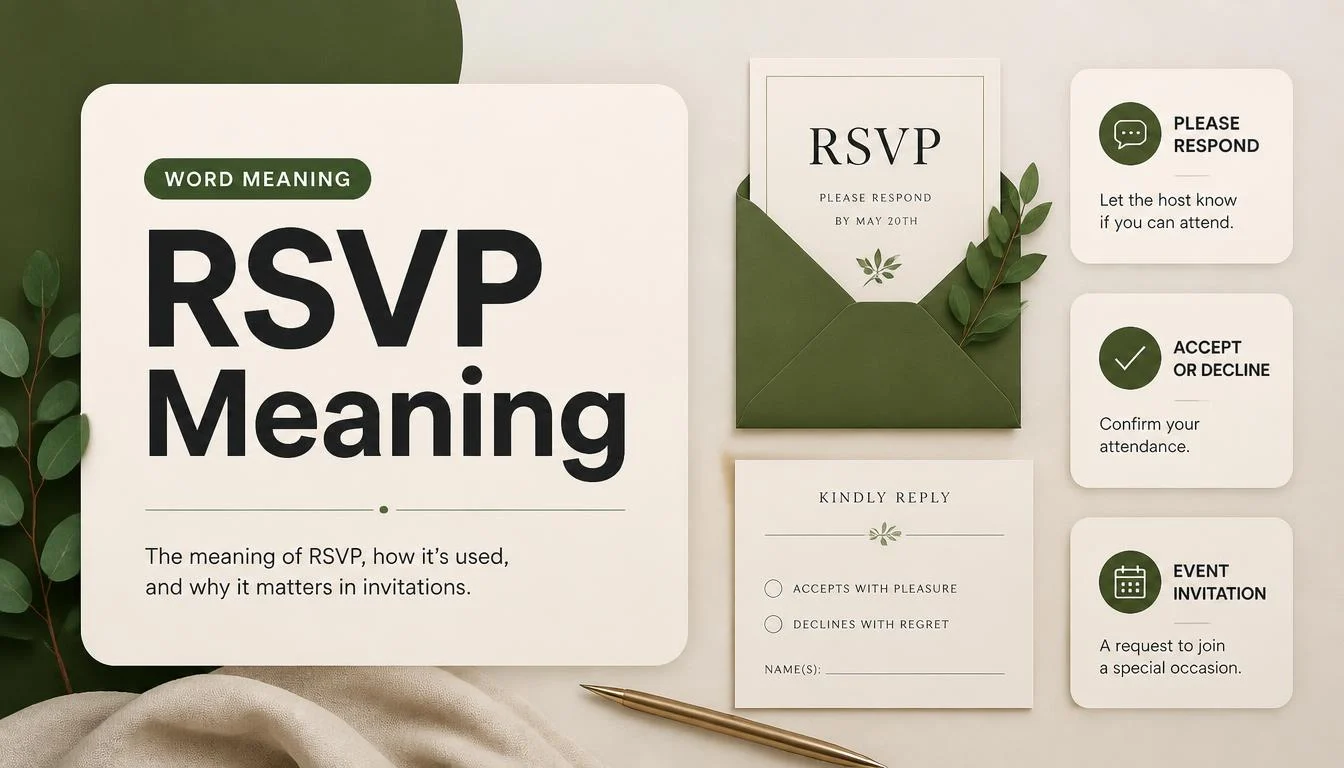
RSVP meaning: RSVP stands for Répondez s’il vous plaît, a French phrase meaning “Please respond.” It asks invited guests to confirm whether they will attend an event. You can RSVP by accepting or declining the invitation, usually before the stated deadline.
The RSVP meaning is important to understand when you receive an invitation to a wedding, party, business meeting, or other special event. This common abbreviation asks you to let the host know whether you plan to attend.
RSVP comes from the French phrase Répondez s’il vous plaît, which means “Please respond” in English. Whether you receive an invitation by text, email, or a printed card, understanding RSVP helps you respond politely and lets the host plan the event accordingly.
What Does RSVP Mean?
RSVP is an abbreviation taken from the French expression répondez s’il vous plaît. In English, it translates to “please respond” or “please reply.” When you see these letters on an invitation, the sender wants you to communicate your attendance decision.
For example, a wedding invitation might say, “Kindly RSVP by November 10.” The couple needs to know which guests plan to attend before finalizing arrangements. Your response tells them whether to count you among the expected guests.
The abbreviation is used in both personal and professional settings. You might see it on a birthday invitation, a dinner party announcement, a conference registration page, or a formal business event.
One important distinction is that RSVP does not mean “yes.” It asks you to answer. Your reply can be an acceptance, a decline, or a request for clarification if you need more information before deciding.
Where Does RSVP Come From?
RSVP comes from the French phrase répondez s’il vous plaît. The expression is a polite request for someone to reply, and it became established in English-language invitation etiquette.
Each part of the French expression contributes to its meaning:
- Répondez means “respond” or “reply” in the formal or plural form.
- S’il vous plaît means “please.”
Together, they form a courteous request for a response. English speakers adopted the abbreviation rather than translating every word on invitations.
The phrase is still recognizable in modern English, even among people who do not speak French. It has become a conventional part of invitation wording, much like “dress code” or “regrets only.”
You may also encounter the lowercase form “rsvp” in text messages and online event pages. The capitalization does not change its meaning. In formal invitations, RSVP is the most familiar presentation.
How RSVP Works on Invitations
An RSVP request gives the host a way to estimate attendance before the event takes place. That information can affect seating, food orders, venue arrangements, name badges, and other preparations.
Consider a couple planning a wedding reception. They need to know how many people will attend before confirming the final guest count with the caterer. If invited guests do not respond, the couple may have to follow up individually or make uncertain estimates.
The same principle applies to smaller gatherings. A host organizing a dinner party needs to know how much food to prepare. A business organizing a workshop may need to arrange enough seats and printed materials for participants.
What information should you look for?
An invitation containing RSVP instructions may include several details.
| Invitation detail | What it tells you |
|---|---|
| RSVP deadline | The date by which you should respond |
| Contact information | Where to send your answer |
| Reply card | A form to complete and return |
| Online RSVP link | A website where you can confirm attendance |
| Guest instructions | Whether additional guests are permitted |
| Meal selection | Whether you must choose a food option |
| Regrets only | You need to reply if you cannot attend |
Not every invitation includes all these details. Follow the instructions provided by the host rather than assuming every event uses the same process.
Types of RSVP Requests
Although the basic purpose remains the same, invitations can ask for different kinds of responses. Recognizing the wording helps you understand what the host expects.
1. Standard RSVP
A standard RSVP usually asks you to confirm whether you will attend. You should send a reply regardless of your decision.
Example: “Please RSVP by December 5.”
If you plan to attend, accept the invitation. If you cannot make it, politely decline. Leaving the invitation unanswered does not give the host a reliable attendance count.
2. RSVP by a Deadline
Some invitations specify a response date because the host must make arrangements in advance.
Example: “Kindly respond by March 15.”
Treat this as the requested deadline, not as a suggestion to reply whenever convenient. If you are uncertain about your availability, contact the host before the deadline and explain the situation.
3. Regrets Only
A “regrets only” invitation generally asks you to respond only if you cannot attend. If you plan to come, the host assumes you will be there unless the instructions say otherwise.
This wording is sometimes used for informal gatherings and selected professional events. However, do not assume it applies to every invitation. Read the complete instructions carefully.
4. Online RSVP
An online RSVP lets guests submit their answers through a website, email, event platform, or digital invitation.
For example, a wedding website may ask you to select “Accept” or “Decline,” enter your name, and choose a meal. Some systems also allow guests to update their response if their plans change.
Complete all required fields. Clicking a link without submitting the form may not register your answer.
RSVP Examples for Different Occasions
The best way to understand the expression is to see how it appears in everyday situations. The wording may change, but the request for a clear response stays the same.
Wedding invitation
“Please RSVP by August 20 so we can finalize our guest list.”
The couple wants to know which guests will attend the ceremony or reception. Depending on the invitation, you may also need to indicate your meal preference or confirm the number of permitted guests.
Birthday party
“Let me know if you can come to my birthday party. RSVP by Friday!”
This is a casual request. You can respond through a text message, a phone call, or the method the host prefers.
Business meeting
“Please RSVP to confirm your attendance at the annual planning meeting.”
Here, the organizer needs a reliable count of participants. Your answer may help with room capacity, scheduling, and meeting materials.
Conference or networking event
“Kindly RSVP through the registration page by October 12.”
The invitation may direct you to an online form. You should complete the registration process and check for a confirmation message if one is provided.
Dinner party
“RSVP by Wednesday so I know how much food to prepare.”
This example explains why replying matters. Even a small gathering requires some planning, and the host may need to shop for ingredients or arrange seating.
How to Reply to an RSVP
Responding does not need to be complicated. A good reply is clear, polite, and appropriate for the relationship you have with the host.
If you can attend
A simple acceptance is enough for most events.
Examples:
- “Thank you for the invitation. I’d be happy to attend.”
- “Yes, I’ll be there. Thanks for inviting me!”
- “Thank you for including me. I look forward to the event.”
- “I can attend the meeting and will be there on time.”
For a formal occasion, use complete sentences and follow any instructions about guest names, meal preferences, or registration.
If you cannot attend
You can decline without providing a lengthy explanation.
Examples:
- “Thank you for inviting me, but unfortunately, I won’t be able to attend.”
- “I appreciate the invitation. I have another commitment that day.”
- “Thanks for thinking of me. I’m sorry I can’t make it.”
- “Unfortunately, I won’t be available for the meeting. Thank you for the invitation.”
A brief, respectful answer is usually better than leaving the host waiting.
If you are not sure yet
Sometimes your schedule is uncertain. In that case, communicate before the deadline rather than remaining silent.
You could write, “Thank you for inviting me. I’m checking my schedule and will confirm by Thursday. Would that be okay?”
This approach gives the host an opportunity to explain whether a later answer is possible. For events with strict booking deadlines, you may need to make a decision sooner.
If you need to change your response
Plans can change after you have accepted an invitation. If you can no longer attend, notify the host as soon as possible.
For example: “I’m sorry, but an unexpected commitment means I can no longer attend. I wanted to let you know as soon as possible.”
If you originally declined but become available, ask whether the host can still accommodate you. Do not assume a place is available after final arrangements have been made.
RSVP vs. Regrets Only vs. Save the Date
These expressions are related to event planning, but each serves a different purpose.
| Term | Main meaning | What you should do |
|---|---|---|
| RSVP | Please respond to the invitation | Accept or decline as requested |
| Regrets only | Reply if you cannot attend | Send a response if you will be absent |
| Save the date | Reserve the date for a future event | Keep the date available and wait for the full invitation |
| Invitation | A request to attend an event | Read the details and follow the response instructions |
| Registration | The process of signing up for an event | Complete the required registration steps |
A save-the-date message is not always a formal request for an immediate attendance decision. It usually alerts you to an upcoming event before the complete invitation arrives.
Registration can overlap with an RSVP, particularly for conferences and ticketed events. However, registering may involve additional steps, such as submitting personal details or paying a fee. An RSVP alone does not necessarily reserve a paid ticket or guarantee admission.
Why RSVP Etiquette Matters
Replying promptly is a basic courtesy, but it also helps the host make practical decisions. Good RSVP etiquette means respecting the time, budget, and arrangements involved in organizing an event.
Respond before the deadline
Do not wait until the last minute if you already know your plans. An early response gives the host more time to finalize arrangements and contact other guests if necessary.
If you miss the deadline, reply as soon as you can. Apologize briefly and ask whether the host can still accommodate you.
Do not assume you can bring a guest
An invitation addressed to you does not automatically include a partner, friend, or family member. Check whether a guest is permitted before confirming additional attendees.
This is especially important at weddings, formal dinners, and events with limited seating.
Be honest about your decision
Do not accept an invitation simply to avoid disappointing someone if you already know you cannot attend. A clear decline allows the host to plan accurately.
Likewise, avoid accepting multiple invitations for the same time unless you can genuinely attend each event as planned.
Tell the host about important changes
If you accepted but later cannot attend, send an update. If the event requires meal selections or accessibility arrangements, share relevant information through the method requested by the organizer.
For large events, follow the official RSVP process even if you have already discussed your attendance informally with the host.
Common RSVP Mistakes
A few small errors can create confusion, even when your intentions are good.
Ignoring the invitation: Silence does not always mean acceptance or rejection. Reply according to the instructions provided.
Responding after the deadline: Late replies can make catering, seating, and scheduling more difficult. Contact the host promptly if you have missed the requested date.
Giving an unclear answer: Messages such as “Maybe” or “I’ll see” may not help the host plan. If you need time, state when you can provide a final answer.
Bringing unlisted guests: Additional attendees may exceed the host’s budget or venue capacity. Ask before including anyone who was not invited.
Assuming an online form was submitted: After completing a digital RSVP, look for a confirmation screen or email when the system provides one.
Treating RSVP as a command to attend: The expression asks for a response. It does not require you to accept, and a polite decline is a valid answer.
FAQs
Is RSVP considered formal or informal?
RSVP is appropriate for both formal and informal invitations. It appears on wedding stationery, corporate event announcements, birthday invitations, and casual party messages. The expression itself is neutral, while the rest of the invitation determines the level of formality.
Is it correct to say “Please RSVP”?
Yes. Although the French expression already includes a polite request, “Please RSVP” is widely used in English. It may sound repetitive when translated literally, but it is a conventional English expression and is generally accepted in everyday writing.
What does RSVP stand for in French?
It stands for répondez s’il vous plaît, which means “please respond.” The phrase uses a polite form of the verb “to respond” followed by “please.” English speakers commonly retain the French abbreviation on invitations.
Can you RSVP by text message?
Yes, if the host permits or uses text messages for replies. For a casual party, a short message is often sufficient. For a formal event, use the reply card, website, or contact method specified on the invitation.
What happens if you do not RSVP?
The host may be unable to count you as an attending guest or may contact you to confirm your plans. Depending on the event, you could miss a place at the table, a meal selection, or access to a limited-capacity gathering. The exact consequence depends on the organizer’s arrangements.
Should you RSVP if you are unable to attend?
Yes, unless the invitation specifically says “regrets only” and you intend to attend. For a standard RSVP, send a polite decline so the host knows not to count you among the expected guests.
Conclusion
RSVP is a small abbreviation with a practical purpose: it helps people plan events with fewer uncertainties. When you receive an invitation, read the instructions, respond on time, and make your decision clear. A thoughtful reply takes only a moment and makes organizing a gathering easier for everyone involved.