Quick Answer
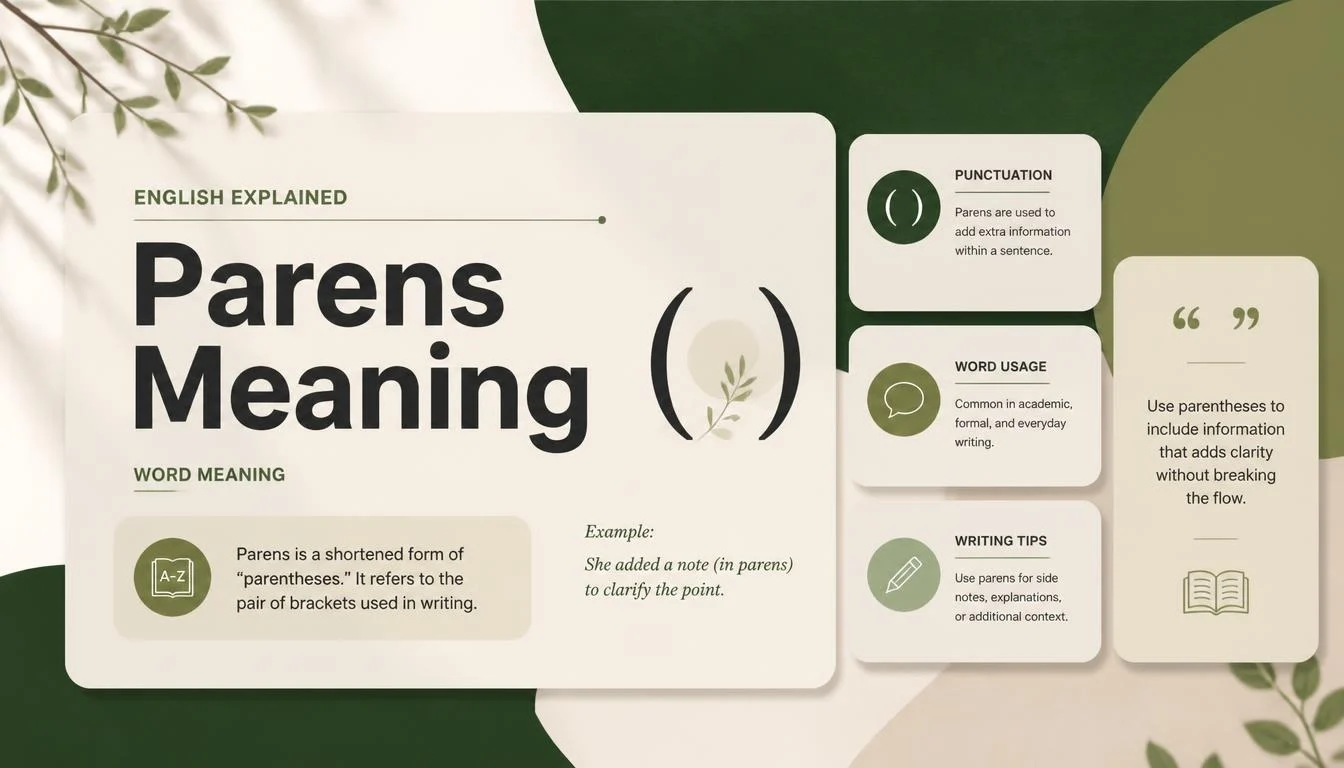
Parens is a shortened form of parentheses, the curved punctuation marks( ). They are used to add extra details, explanations, or side comments to a sentence. Example: I’ll meet you tomorrow (around 3 PM) at the café.
The term parens meaning refers to the informal name for parentheses, the curved punctuation marks ( ) used in writing, texting, and everyday communication. People use parens to add extra information, explain a point, or include a side comment without interrupting the main sentence.
In digital conversations, parens can also make messages clearer by adding context or a quick explanation. Understanding the meaning of parens helps you interpret texts, read online discussions, and use punctuation correctly in emails, essays, and casual messages.
What Does Parens Mean?
Parens is the plural form of paren, an informal shortening of parenthesis. It refers to the curved punctuation marks that look like this: ( ).
Writers use these marks to include additional information without making it the main focus of a sentence. For example, in “Maya arrived early (before the meeting started),” the words inside the parentheses provide extra context.
The shortened term appears frequently in situations where people discuss punctuation quickly. Instead of spelling out parentheses, a person may simply say parens, especially when talking about editing, formatting, or computer code.
Here are the main points to remember:
- Parens: An informal short form of parentheses.
- Paren: The singular short form of parenthesis.
- Parentheses: The full name for the curved punctuation marks ( ).
- Purpose: To enclose extra information, group expressions, or organize written material.
The word is not generally considered a texting acronym. It is an abbreviated word that people use in digital communication, professional writing discussions, and technical settings.
Does Parens Mean One Bracket or Two?
Technically, paren refers to one parenthesis mark, while parens refers to the plural form. In practical conversation, however, people often use parens to refer to the pair of marks surrounding a word, phrase, or expression.
For example, a colleague might say, “Please add parens around the date.” The instruction means to place an opening parenthesis before the date and a closing parenthesis after it.
The surrounding sentence usually makes the intended meaning clear. You do not need to interpret the word as a special code or slang expression.
Where Does the Word Parens Come From?
The word parens developed as a shortened form of parentheses, a term with roots in Greek. The Greek word parenthesis refers to an insertion or something placed alongside the main statement.
The English word parenthesis came through Latin from Greek. Its original sense fits the modern function of the punctuation: information is inserted into a sentence without becoming its central message.
The punctuation marks themselves have a long history in written language. Their use developed over centuries as writers and printers adopted ways to separate additional comments from the main flow of a sentence.
Today, parens is particularly convenient in fields where punctuation is discussed frequently. Editors, proofreaders, programmers, and technical writers may use the shorter term because it saves time and is easy to recognize.
Unlike a newly invented internet expression, the word does not depend on a particular social media platform or generation. It is an established abbreviation that appears in technical documentation and informal discussions.
How Parens Are Used in Different Contexts
The meaning stays relatively consistent across settings, but the reason for using the word can change.
1. Parens in Texting and Online Chats
In text messages, people may use parens when discussing punctuation, clarifying a sentence, or explaining how something should be written.
For example:
- “Put the date in parens.”
- “The extra detail should go in parens.”
- “I added parens so the sentence reads more clearly.”
- “Can you remove the parens around that phrase?”
These messages refer to ordinary punctuation rather than a hidden slang meaning. The word itself does not communicate an emotion, relationship status, or special internet trend.
It may also appear when someone explains how to format a message. A teacher, editor, or coworker might use it to give quick instructions without writing the full word.
2. Parens in English Writing
In writing, parentheses separate extra information from the main sentence. The enclosed material may explain a point, identify a person, provide a date, or add a brief comment.
Consider this example:
“Jordan submitted the report (three days before the deadline) and left the office.”
The parenthetical phrase gives additional information about the submission. Removing it leaves a grammatically complete sentence: “Jordan submitted the report and left the office.”
This is one of the main reasons writers use parentheses. They can add context without requiring a separate sentence or interrupting the main point too heavily.
3. Parens in Programming and Technology
In programming, parens is common shorthand for parentheses used in source code. These marks can group mathematical operations, contain function arguments, or control how an expression is evaluated.
For example, in Python:
total = (5 + 3) * 2The parentheses group the addition operation. The result is 16 because the grouped sum is calculated before multiplication.
A programmer might also say, “The function needs two arguments in parens,” referring to values placed inside the parentheses following a function name.
The exact rules depend on the programming language. Parentheses are required in some contexts, optional in others, and used for different purposes across languages.
4. Parens in Editing and Proofreading
Editors use the term when reviewing punctuation, adjusting sentence structure, or discussing a document’s style.
For example, an editor may write, “The sentence has too many parens. Consider moving one explanation into the main text.”
This instruction concerns readability. Parentheses can be useful, but too many can make a paragraph feel crowded or cause important information to seem secondary.
In professional documents, it is often better to keep essential information in the main sentence and reserve parentheses for details that genuinely support it.
Parens Examples in Sentences and Messages
The following examples show how the word appears in ordinary communication.
| Example | Meaning |
|---|---|
| “Put the year in parens.” | Enclose the year in parentheses. |
| “I removed the parens from the heading.” | The curved punctuation marks were deleted. |
| “The note in parens is optional.” | The information inside parentheses is not essential to the main statement. |
| “Check the parens in this formula.” | Review the grouping marks in the expression. |
| “Add the function arguments in parens.” | Place the arguments inside the appropriate parentheses. |
| “There are unmatched parens in the code.” | An opening or closing parenthesis is missing or incorrectly placed. |
| “Can you explain the text in parens?” | Clarify the information enclosed by the punctuation marks. |
Examples of Parens in Realistic Conversations
Conversation 1: Editing a message
Alex: “Should I include the delivery date?”
Sam: “Yes, just put it in parens after the order number.”
Here, parens means parentheses used to add a detail to the message.
Conversation 2: School assignment
Student: “My teacher marked the sentence and mentioned parens.”
Friend: “They probably mean the parentheses around your extra explanation.”
The word refers to punctuation, not a special academic abbreviation.
Conversation 3: Programming discussion
Developer A: “The function is throwing an error.”
Developer B: “Check the closing parens after the arguments.”
The developer is referring to a possible punctuation problem in the code.
Conversation 4: Workplace document
Editor: “There are too many parens in the second paragraph.”
Writer: “I’ll move the most important detail into the sentence.”
In this example, the term helps the writer identify a style issue and improve readability.
Parens vs. Parentheses vs. Brackets
These words are related, but they are not always interchangeable. The most useful distinction is between the informal shortened term and the names of the punctuation marks themselves.
| Term | Meaning | Example |
|---|---|---|
| Parens | Informal short form of parentheses | “Put the note in parens.” |
| Parenthesis | One curved punctuation mark, or an inserted statement | “Add a closing parenthesis.” |
| Parentheses | The plural form, usually referring to the pair ( ) | “Place the explanation in parentheses.” |
| Brackets | A broad term that may refer to several types of punctuation, depending on regional usage | “Put the editor’s note in square brackets.” |
| Square brackets | The marks [ ] | “The original text says [sic].” |
| Braces | The marks | “The code uses braces to group the block.” |
Are Parens and Parentheses the Same Thing?
For most practical purposes, yes. Parens is simply a shorter, less formal way to refer to parentheses.
The difference is mainly one of register, or level of formality. In a casual conversation with a colleague, parens is perfectly understandable. In a formal style guide or a document intended for a broad audience, parentheses may be the clearer choice.
Neither term automatically changes the punctuation’s function. Both refer to the same familiar curved marks.
Are Parentheses and Brackets Different?
The answer depends partly on regional English.
In American English, parentheses usually means the curved marks ( ), while brackets generally refers to square marks [ ]. In British English, brackets can be used as a general term for curved parentheses, although square brackets identifies [ ] specifically.
Context helps avoid confusion. If precision matters, use the full name of the punctuation mark rather than relying on the broader word brackets.
How Parentheses Work in Grammar
Parentheses have several common uses in English writing. Knowing these uses helps explain why people discuss them so frequently.
Adding Extra Information
Parentheses can provide information that supports a sentence without being essential to its basic meaning.
Example: “The conference begins on Monday (October 19) at nine o’clock.”
The date clarifies the schedule. The sentence still communicates its main point without the parenthetical detail.
Explaining an Abbreviation
Writers often introduce an abbreviation by placing its full form in parentheses after the first mention.
Example: “The organization follows the guidelines of the World Health Organization (WHO).”
This approach gives readers the full name before using the shorter form later in the document.
Including Dates or Identifying Details
Parentheses can identify the years associated with a historical figure, publication, or event.
Example: “Jane Austen (1775–1817) wrote several influential novels.”
The dates provide useful background without requiring a separate sentence.
Grouping Information in Mathematics
In mathematics, parentheses can show which operation should be performed first.
For example:
\[ (4 + 6) \times 3 = 30 \]
Without the parentheses, the standard order of operations would produce a different result:
\[ 4 + 6 \times 3 = 22 \]
The marks are not decorative. They change how the expression is interpreted.
Maintaining Correct Punctuation
When a parenthetical phrase appears inside a sentence, the surrounding punctuation depends on how the sentence is structured.
Example: “The report (which was submitted yesterday) is ready.”
The main sentence remains complete when the enclosed phrase is removed.
When the entire sentence is placed inside parentheses, the final punctuation mark usually belongs inside the closing parenthesis.
Example: “(The meeting has been postponed.)”
If the parenthetical material forms only part of a larger sentence, the sentence’s final punctuation generally remains outside the closing mark.
Example: “The meeting has been postponed (until Friday).”
These conventions can vary with sentence structure and style guide, so the key is to make the relationship between the main sentence and the extra information clear.
What Does Parens Mean in Programming?
In software development, parentheses are structural symbols. They can affect how expressions are grouped, how functions receive information, and how code is interpreted.
Programmers often use parens because the word is shorter and familiar within technical discussions.
Function Calls
In Python, a function call commonly uses parentheses to contain arguments.
print("Hello")Here, print is the function name, and "Hello" is the argument supplied to it.
A developer might say, “The print function needs parens,” when explaining the syntax to a beginner.
Mathematical Expressions
Parentheses can group calculations to make the intended order clear.
result = (10 - 4) / 2The expression inside the parentheses is evaluated first, producing 6. Dividing that result by 2 gives 3.
This is especially useful when an expression contains several operations and the intended grouping is not immediately obvious.
Missing or Unmatched Parentheses
One common programming error is using an opening parenthesis without a corresponding closing parenthesis, or vice versa.
For example, this Python code is incomplete:
print("Hello"The closing parenthesis is missing. Python will report a syntax error rather than execute the statement normally.
Programmers may describe this as a missing closing paren. In a larger program, checking the matching pairs can help locate the problem.
Do All Programming Languages Use Parentheses the Same Way?
No. Different languages assign different rules to parentheses.
Python uses parentheses in function calls and grouped expressions. JavaScript uses them in function calls, conditions, and expressions. In languages such as Lisp, parentheses are central to the syntax and organize many expressions.
The general concept remains recognizable, but the exact rules depend on the language. When learning a programming language, follow its documentation rather than assuming every use of parentheses works the same way.
Common Mistakes When Using Parens
Although the term is simple, a few mistakes can cause confusion.
1. Treating Parens as a Texting Acronym
Parens is not normally an acronym with a separate phrase hidden behind its letters. It is a shortened form of parentheses.
If someone writes “check the parens,” they are most likely referring to punctuation, particularly in an editing or technical conversation.
2. Confusing Parentheses With Square Brackets
The marks ( ) and [ ] serve related but distinct purposes in many writing and programming contexts.
For example, parentheses may enclose an explanatory phrase, while square brackets can identify editorial additions inside a quotation. The conventions vary, so use the mark appropriate to the task.
3. Using Parentheses for Essential Information
Parentheses can make important information seem like an aside. If a detail is necessary for readers to understand the main point, it may deserve a place in the main sentence instead.
Compare these examples:
Less direct: “The application (which must be submitted by Friday) is available online.”
Clearer: “The application must be submitted by Friday and is available online.”
The second sentence gives the deadline greater prominence.
4. Assuming Parens Is Always Appropriate in Formal Writing
The shortened form is widely recognized, especially in technical fields, but the full word parentheses is often more suitable for general readers.
Choose based on the audience. A coding discussion can comfortably use parens, while a formal guide for students may benefit from spelling out the term.
FAQs
1. Is parens acceptable English?
Yes. Parens is an established informal shortening of parentheses. It is commonly understood in technical discussions, editing, and everyday conversation, although the full term may be preferable in formal writing.
2. How do you pronounce parens?
It is commonly pronounced PAIR-enz, with the first syllable sounding like the word pair. The pronunciation is short and straightforward, which makes the term convenient in spoken technical discussions.
3. What is the singular of parens?
The singular form is paren, a shortened form of parenthesis. For example, “Add a closing paren” refers to adding one closing curved mark.
4. Why do programmers say parens instead of parentheses?
Programmers frequently discuss punctuation and syntax, so shorter terminology saves time. The term is familiar in software development and usually communicates the intended meaning without confusion.
5. Should I write parens or parentheses in an essay?
Use parentheses in most formal essays, especially when writing for a general audience. Parens is more conversational and may sound too informal in academic work unless the essay specifically discusses technical terminology.
Conclusion
Understanding this short word makes conversations about writing, punctuation, and programming easier to follow. Although parens is informal, it has a clear and established meaning that readers can usually recognize from context. When writing for a broad audience, the full term parentheses is often the safest choice. When discussing code or editing with people who know the terminology, parens is a practical and natural alternative.