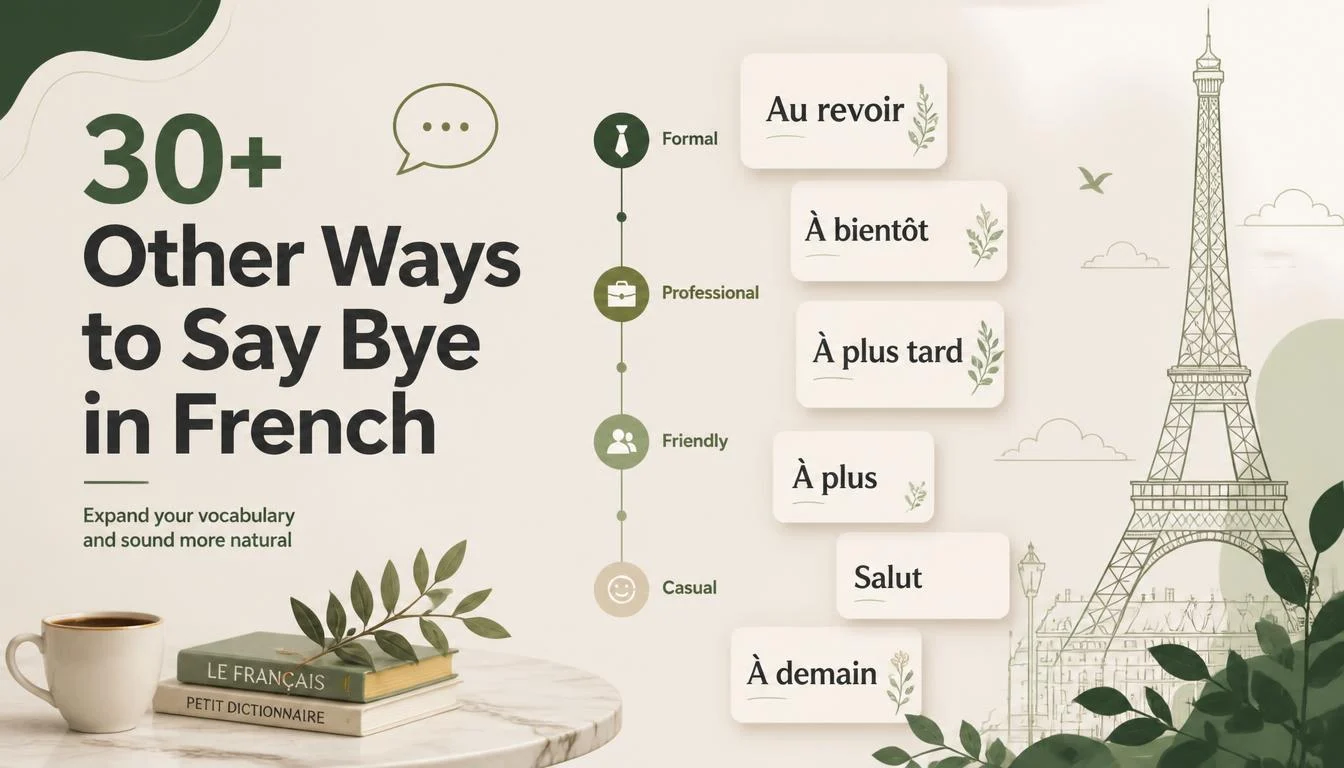
Quick Answer
The most common way to say bye in French is “Au revoir,” which works in most everyday situations.
For casual conversations, you can use “Salut,” “À bientôt,” or “À plus.”
For formal situations, “Au revoir” and “Bonne journée” are polite and natural choices.
Looking for different ways to say bye in French? French has many expressions for saying goodbye, and the right phrase depends on the situation, relationship, and level of formality. From everyday conversations to polite professional settings, choosing the right expression can make your French sound more natural.
In this guide, you’ll discover 30+ ways to say bye in French with simple meanings and practical examples. Whether you’re talking to a friend, meeting someone new, or ending a formal conversation, you’ll find useful French goodbye expressions for different situations.
Why Do People Search For Other Ways to Say Bye in French
People search for “other ways to say bye in French” for several distinct reasons. Some are language learners preparing for travel or conversation practice. Others are professionals who need to write French emails or participate in bilingual meetings. Many are simply curious about French culture and want to understand why French speakers use so many different farewells.
The intent behind this search is almost always practical. Users want actionable alternatives they can use immediately, not academic linguistics. They want to know which phrases are formal, which are casual, which work in writing, and which sound strange if used incorrectly. There is also a strong spoken versus written distinction. Some French farewells, like à plus, are almost exclusively spoken and would look odd in a formal email. Others, like je vous prie d’agréer mes salutations distinguées, are written only and would sound absurd in casual conversation.
Formal versus informal communication intent also plays a major role. In French, the choice between tu and vous affects every farewell. If you are on tu terms with someone, you have access to a wider range of casual farewells. If you are on vous terms, your options narrow considerably. This guide addresses that distinction throughout, helping you match your farewell to your relationship and register.
When searching for alternatives to “bye in French,” users also encounter semantic variations like “other ways to say goodbye in French,” “professional French farewells,” and “informal French expressions.” This article naturally incorporates these semantic phrases to ensure comprehensive coverage of the topic while maintaining natural, readable prose.
Tone Ladder System
Understanding the tone ladder is essential for choosing the right farewell. French farewells range from very formal to very informal, and each level has its own appropriate contexts. This system ranks phrases so you can instantly gauge whether a farewell fits your situation.
Very Formal French Farewells
These phrases are used in highly professional, ceremonial, or respectful contexts. They are appropriate for job interviews, official correspondence, meetings with superiors, and interactions with people you have just met in a formal setting. Very formal farewells often use the vous form and may include complete sentences rather than short expressions. Examples include je vous prie d’agréer mes salutations distinguées and je vous souhaite une excellente journée. These sound polished and respectful but would feel absurdly stiff among friends.
Formal French Farewells
Formal farewells sit just below very formal. They are appropriate for workplace communication, emails to colleagues you do not know well, and interactions with acquaintances. Au revoir belongs here when used with vous, as does bonne journée and cordialement. These phrases are polite without being ceremonial. They work in both spoken and written French and are safe choices when you are unsure of the appropriate register.
Neutral French Farewells
Neutral farewells work in almost any situation. They are neither overly stiff nor overly casual. Au revoir is the classic neutral farewell, appropriate for shops, strangers, casual colleagues, and most everyday interactions. Bonne soirée and à bientôt also fit here. If you are uncertain about tone, a neutral farewell is your safest bet. It will never offend and will almost always sound natural.
Casual French Farewells
Casual farewells are for friends, family, and people you know well. They signal comfort and familiarity without being overly intimate. Salut, à plus, and à tout à l’heure belong in this category. These are common in spoken French and appear in informal written messages like texts or social media comments. They would sound out of place in a formal email or a job interview.
Informal French Farewells
Informal farewells are the most relaxed and intimate. They are used with close friends, romantic partners, and family members. Ciao, tchao, and à plus dans le bus are examples. These phrases often carry humor, affection, or a sense of shared insider language. Using them with someone you do not know well would be inappropriate and potentially awkward.
Table: Tone Classification
| Phrase | Tone Level | Formality | Best Situation |
|---|---|---|---|
| Je vous prie d’agréer mes salutations distinguées | Very Formal | Highest | Official letters, job applications |
| Je vous souhaite une excellente journée | Very Formal | High | Formal emails, professional meetings |
| Cordialement | Formal | High | Work emails, colleagues |
| Au revoir | Neutral | Medium | Shops, strangers, everyday use |
| Bonne journée | Neutral | Medium | Ending any interaction politely |
| À bientôt | Neutral | Medium | When you expect to see someone again |
| Salut | Casual | Low | Friends, family, peers |
| À plus | Casual | Low | Friends, text messages |
| À tout à l’heure | Casual | Low | Seeing someone later the same day |
| Ciao | Informal | Lowest | Close friends, playful contexts |
| Tchao | Informal | Lowest | Close friends, casual goodbyes |
| À plus dans le bus | Informal | Lowest | Humorous, close friends only |
This table gives you a quick reference for matching farewells to situations. Notice how the formality level correlates with the relationship and context. The higher the formality, the more restricted the usage. Very formal farewells have narrow applications, while neutral farewells work almost everywhere.
Quick Selection Guide
Sometimes you need an instant answer. This decision block helps you choose the best farewell for common situations without reading the entire article.
Interview: Use je vous prie d’agréer mes salutations distinguées in written follow-up, or au revoir, merci beaucoup when leaving in person. These signal respect and professionalism.
Email: Use cordialement for colleagues, bien cordialement for slightly warmer professional tone, or je vous souhaite une excellente journée for formal correspondence.
Networking: Use au revoir, ravi de vous avoir rencontré or à bientôt to leave the door open for future contact. These are polite, warm, and professional.
Casual conversation: Use salut, à plus, or à tout à l’heure depending on whether you will see the person again soon. These sound natural and friendly.
This guide is not exhaustive, but it covers the most common scenarios. The sections below provide deeper context and additional options for each situation.
Real-Life Conversation Transformations
Seeing how farewells work in actual conversations is more valuable than memorizing lists. These before-and-after transformations show how a basic farewell can be upgraded to match the tone and context of real interactions.
Job Interview Scenario
Before: “Au revoir, merci.”
After: “Je vous remercie pour votre temps. Au revoir et je vous souhaite une excellente journée.”
The before version is not wrong, but it is abrupt. The after version adds gratitude and warmth, which leaves a stronger impression. In a job interview, your farewell is your last chance to demonstrate professionalism and interpersonal skill. Adding a thank-you and a wish for the other person’s day shows that you are considerate and polished.
Networking Event Scenario
Before: “Salut, à plus.”
After: “Ravi de vous avoir rencontré. J’espère que nous aurons l’occasion de nous recroiser. À bientôt!”
The before version is too casual for a professional networking event. The after version is warm but still professional. It expresses genuine interest in future contact without being overly familiar. The phrase ravi de vous avoir rencontré is a standard polite formula in French networking contexts.
Email Scenario
Before: “Au revoir.”
After: “Je vous remercie pour votre réponse rapide. Cordialement, [Your Name].”
Ending an email with just au revoir can feel abrupt or even cold. Adding a thank-you and using cordialement creates a professional, respectful closing. In French business emails, the closing formula is almost as important as the body of the message.
Casual Conversation Scenario
Before: “Au revoir.”
After: “Bon, je file. À plus, à plus!”
The before version sounds stiff among friends. The after version uses je file (I’m off) and à plus to create a relaxed, natural goodbye. This is how French friends actually speak to each other.
These transformations illustrate a key principle: the right farewell depends on the relationship, the context, and the impression you want to leave. A farewell that works in one situation may fail in another.
30+ Other Ways to Say Bye in French
This core section provides more than thirty alternatives to “bye in French.” Each entry includes the phrase, its meaning, an explanation, an example sentence, tone, best use, worst use, and context variability. This structure ensures you understand not just what to say but when and why to say it.
Au Revoir
Meaning: Goodbye, until we see each other again.
Explanation: The standard, all-purpose French farewell. It literally means “until seeing again” and works in nearly every context.
Example: “Au revoir, monsieur. Bonne journée!”
Tone: Neutral.
Best Use: Shops, strangers, colleagues, everyday interactions.
Worst Use: None, though it can feel impersonal with close friends.
Context Variability: Works in both spoken and written French. Safe in almost any situation.
Salut
Meaning: Hi or bye, depending on context.
Explanation: A casual greeting and farewell used among friends and peers. It signals familiarity and informality.
Example: “Salut, à demain!”
Tone: Casual.
Best Use: Friends, family, people your own age.
Worst Use: Formal settings, strangers, superiors.
Context Variability: Spoken French primarily. Appears in informal texts and social media.
À Plus
Meaning: See you later.
Explanation: Short for à plus tard, this is a very common casual farewell among friends and younger people.
Example: “Bon, j’y vais. À plus!”
Tone: Casual.
Best Use: Friends, text messages, informal conversations.
Worst Use: Formal emails, professional meetings.
Context Variability: Mostly spoken. Common in texts and online chat.
À Plus Tard
Meaning: See you later.
Explanation: The full version of à plus. Slightly more complete but still casual.
Example: “À plus tard, je dois partir.”
Tone: Casual.
Best Use: Friends, informal goodbyes when you expect to meet again.
Worst Use: Very formal contexts.
Context Variability: Spoken and informal written French.
À Bientôt
Meaning: See you soon.
Explanation: A polite, warm farewell that suggests you expect to see the person again in the near future.
Example: “À bientôt, j’espère!”
Tone: Neutral.
Best Use: Acquaintances, colleagues, networking.
Worst Use: When you genuinely do not expect to see the person again.
Context Variability: Both spoken and written. Works in professional and casual contexts.
À Tout À L’Heure
Meaning: See you in a bit, later today.
Explanation: Used when you will see the person again the same day.
Example: “À tout à l’heure, je reviens dans une heure.”
Tone: Casual.
Best Use: Family, friends, colleagues you will see later.
Worst Use: When you will not see the person again soon.
Context Variability: Spoken French primarily.
À Tout De Suite
Meaning: See you right away, in a moment.
Explanation: Used when you will see the person again within minutes.
Example: “À tout de suite, je raccroche et j’arrive.”
Tone: Casual.
Best Use: Family, close colleagues, immediate reunions.
Worst Use: Long-term goodbyes.
Context Variability: Spoken only.
Bonne Journée
Meaning: Have a good day.
Explanation: A polite farewell that wishes the other person well. Often used in shops and professional settings.
Example: “Merci, bonne journée!”
Tone: Neutral.
Best Use: Shops, colleagues, acquaintances.
Worst Use: Close friends in casual settings, where it can sound distant.
Context Variability: Spoken and written. Common in emails.
Bonne Soirée
Meaning: Have a good evening.
Explanation: The evening equivalent of bonne journée.
Example: “Bonne soirée, à demain!”
Tone: Neutral.
Best Use: Evening departures, restaurants, social events.
Worst Use: Morning or afternoon contexts.
Context Variability: Spoken and written.
Bonne Nuit
Meaning: Good night.
Explanation: Used only when someone is going to sleep.
Example: “Bonne nuit, fais de beaux rêves.”
Tone: Neutral to intimate.
Best Use: Family, partners, close friends at bedtime.
Worst Use: Leaving a party or event, where it sounds strange.
Context Variability: Spoken and written.
Bon Week-end
Meaning: Have a good weekend.
Explanation: Used on Fridays or before weekends.
Example: “Bon week-end, on se voit lundi!”
Tone: Neutral.
Best Use: Colleagues, acquaintances, professional contexts.
Worst Use: Midweek.
Context Variability: Spoken and written.
Cordialement
Meaning: Cordially, regards.
Explanation: The standard formal email closing in French.
Example: “Cordialement, Marie Dupont.”
Tone: Formal.
Best Use: Professional emails, colleagues, superiors.
Worst Use: Spoken conversation, casual texts.
Context Variability: Written only.
Bien Cordialement
Meaning: Kind regards.
Explanation: Slightly warmer than cordialement, used in professional emails.
Example: “Bien cordialement, Jean Martin.”
Tone: Formal.
Best Use: Professional emails when you want to sound warm but respectful.
Worst Use: Spoken conversation.
Context Variability: Written only.
Je Vous Prie D’Agréer Mes Salutations Distinguées
Meaning: Please accept my distinguished greetings.
Explanation: The most formal French email closing. Used in official correspondence.
Example: “Je vous prie d’agréer, Madame, mes salutations distinguées.”
Tone: Very Formal.
Best Use: Job applications, official letters, formal complaints.
Worst Use: Casual emails, spoken conversation.
Context Variability: Written only.
Je Vous Souhaite Une Excellente Journée
Meaning: I wish you an excellent day.
Explanation: A very polite farewell, often used in professional settings.
Example: “Je vous souhaite une excellente journée. Au revoir.”
Tone: Very Formal.
Best Use: Formal emails, professional meetings.
Worst Use: Casual conversation.
Context Variability: Spoken and written.
Ciao
Meaning: Bye (borrowed from Italian).
Explanation: A playful, informal farewell used among friends.
Example: “Ciao, à demain!”
Tone: Informal.
Best Use: Close friends, playful contexts.
Worst Use: Formal settings.
Context Variability: Spoken and informal written.
Tchao
Meaning: Bye (alternative spelling of ciao).
Explanation: Same as ciao, often used in Southern France.
Example: “Tchao, bisous!”
Tone: Informal.
Best Use: Close friends, family.
Worst Use: Professional contexts.
Context Variability: Spoken and informal written.
Adieu
Meaning: Farewell forever.
Explanation: Used when you will never see the person again or in dramatic contexts.
Example: “Adieu, mon ami.”
Tone: Very Formal or Dramatic.
Best Use: Final goodbyes, literary contexts.
Worst Use: Everyday farewells, where it sounds overly dramatic.
Context Variability: Spoken and written.
À La Prochaine
Meaning: Until next time.
Explanation: A warm farewell suggesting you will meet again.
Example: “À la prochaine, prends soin de toi!”
Tone: Casual to Neutral.
Best Use: Friends, acquaintances.
Worst Use: Formal emails.
Context Variability: Spoken and informal written.
À Un De Ces Quatre
Meaning: See you one of these days.
Explanation: A casual farewell suggesting you will meet again at some unspecified time.
Example: “À un de ces quatre, on se fait un café!”
Tone: Casual.
Best Use: Friends, acquaintances.
Worst Use: Formal contexts.
Context Variability: Spoken primarily.
À Plus Dans Le Bus
Meaning: See you later in the bus (humorous).
Explanation: A playful, rhyming farewell used among close friends.
Example: “Allez, à plus dans le bus!”
Tone: Informal.
Best Use: Close friends, humorous contexts.
Worst Use: Anyone you do not know well.
Context Variability: Spoken only.
Bisous
Meaning: Kisses.
Explanation: A warm farewell used with close friends and family.
Example: “Bisous, à demain!”
Tone: Informal.
Best Use: Close friends, family, romantic partners.
Worst Use: Professional contexts, strangers.
Context Variability: Spoken and written (texts, cards).
Grosses Bises
Meaning: Big kisses.
Explanation: A warmer version of bisous.
Example: “Grosses bises, ma chérie!”
Tone: Informal.
Best Use: Very close friends, family.
Worst Use: Professional contexts.
Context Variability: Spoken and written.
Je File
Meaning: I’m off.
Explanation: A casual way to announce your departure.
Example: “Bon, je file. À plus!”
Tone: Casual.
Best Use: Friends, informal gatherings.
Worst Use: Formal settings.
Context Variability: Spoken primarily.
Je M’En Vais
Meaning: I’m leaving.
Explanation: A neutral way to announce departure.
Example: “Je m’en vais, au revoir tout le monde!”
Tone: Neutral.
Best Use: Any situation where you need to announce departure.
Worst Use: None, though it is more announcement than farewell.
Context Variability: Spoken and written.
Je Dois Y Aller
Meaning: I have to go.
Explanation: A polite way to excuse yourself.
Example: “Je dois y aller, à bientôt!”
Tone: Neutral.
Best Use: Any situation where you need to leave politely.
Worst Use: None.
Context Variability: Spoken and written.
On Se Voit Plus Tard
Meaning: We’ll see each other later.
Explanation: A casual farewell among friends.
Example: “On se voit plus tard, salut!”
Tone: Casual.
Best Use: Friends, informal contexts.
Worst Use: Formal settings.
Context Variability: Spoken primarily.
On Se Revoit
Meaning: We’ll see each other again.
Explanation: A warm farewell suggesting future meetings.
Example: “On se revoit bientôt, j’espère!”
Tone: Casual to Neutral.
Best Use: Friends, acquaintances.
Worst Use: Formal emails.
Context Variability: Spoken and informal written.
Passe Une Bonne Journée
Meaning: Have a good day.
Explanation: A friendly farewell, slightly more personal than bonne journée.
Example: “Passe une bonne journée, à ce soir!”
Tone: Casual to Neutral.
Best Use: Friends, family, colleagues.
Worst Use: Very formal contexts.
Context Variability: Spoken and written.
Passe Une Bonne Soirée
Meaning: Have a good evening.
Explanation: The evening version of passe une bonne journée.
Example: “Passe une bonne soirée, à demain!”
Tone: Casual to Neutral.
Best Use: Friends, family, colleagues.
Worst Use: Very formal contexts.
Context Variability: Spoken and written.
Porte-Toi Bien
Meaning: Take care of yourself.
Explanation: A warm, caring farewell.
Example: “Porte-toi bien, à bientôt!”
Tone: Neutral to Casual.
Best Use: Friends, family, acquaintances.
Worst Use: Very formal contexts.
Context Variability: Spoken and written.
Prends Soin De Toi
Meaning: Take care of yourself.
Explanation: Similar to porte-toi bien, used with tu.
Example: “Prends soin de toi, bisous!”
Tone: Casual.
Best Use: Friends, family.
Worst Use: Formal contexts.
Context Variability: Spoken and written.
Ravi De Vous Avoir Rencontré
Meaning: Delighted to have met you.
Explanation: A polite farewell used after meeting someone new.
Example: “Ravi de vous avoir rencontré. Au revoir!”
Tone: Formal to Neutral.
Best Use: Networking, professional introductions.
Worst Use: People you already know well.
Context Variability: Spoken and written.
Enchanté
Meaning: Delighted (to meet you).
Explanation: Often used at introductions but can serve as a farewell in brief encounters.
Example: “Enchanté, au revoir!”
Tone: Formal to Neutral.
Best Use: Brief professional or social encounters.
Worst Use: Close friends.
Context Variability: Spoken primarily.
Bon Courage
Meaning: Good luck, stay strong.
Explanation: Used when someone faces a challenge.
Example: “Bon courage pour ton examen, à bientôt!”
Tone: Neutral.
Best Use: Friends, colleagues facing challenges.
Worst Use: When no challenge exists.
Context Variability: Spoken and written.
Bonne Continuation
Meaning: Good continuation, enjoy the rest.
Explanation: Used when leaving someone who is continuing an activity.
Example: “Bonne continuation, au revoir!”
Tone: Neutral.
Best Use: Leaving a meeting or event early.
Worst Use: When the person is also leaving.
Context Variability: Spoken and written.
Salutations
Meaning: Greetings.
Explanation: A formal written farewell.
Example: “Salutations distinguées.”
Tone: Formal.
Best Use: Formal emails, official correspondence.
Worst Use: Spoken conversation.
Context Variability: Written only.
Mes Amitiés
Meaning: Best wishes, regards.
Explanation: A warm formal farewell.
Example: “Mes amitiés à votre famille.”
Tone: Formal to Neutral.
Best Use: Acquaintances, semi-formal correspondence.
Worst Use: Very close friends.
Context Variability: Written primarily.
Bien À Vous
Meaning: Yours sincerely, best regards.
Explanation: A professional email closing.
Example: “Bien à vous, Claire.”
Tone: Formal.
Best Use: Professional emails.
Worst Use: Casual texts.
Context Variability: Written only.
Table: Usage Comparison
| Phrase | Spoken Use | Written Use | Context |
|---|---|---|---|
| Au revoir | Very common | Common | All contexts |
| Salut | Very common | Informal texts | Friends, peers |
| À plus | Very common | Texts, chat | Friends |
| Cordialement | Rare | Very common | Professional emails |
| Bonne journée | Very common | Common | Shops, colleagues |
| Bisous | Common | Texts, cards | Close friends, family |
| Adieu | Rare | Literary | Final goodbyes |
| À bientôt | Common | Common | Acquaintances, colleagues |
| Je vous prie d’agréer mes salutations distinguées | Never | Formal letters | Official correspondence |
| Ciao | Common | Informal texts | Close friends |
This comparison table highlights the spoken versus written divide. Some phrases, like cordialement, are almost exclusively written. Others, like salut, are primarily spoken. Understanding this distinction prevents awkward mismatches.
Email and LinkedIn Ready Expressions
French professional communication has its own set of farewell conventions. Using the wrong closing can undermine your credibility, so these expressions are essential for anyone communicating in French professionally.
Email Greetings
Madame, Monsieur, is the standard formal greeting when you do not know the recipient’s name. Bonjour Madame Dupont, works when you know the name. Bonjour, is acceptable in less formal professional contexts.
Professional Introductions
Je me permets de vous contacter au sujet de… (I am taking the liberty of contacting you regarding…) is a polite opening. Suite à notre conversation… (Following our conversation…) works for follow-ups.
LinkedIn Connection Messages
Bonjour, je souhaitais entrer en contact avec vous car… (Hello, I wanted to get in touch because…) is professional and direct. Ravi de découvrir votre profil… (Delighted to discover your profile…) is warmer.
Follow-Up Lines
Je reste à votre disposition pour toute information complémentaire. (I remain at your disposal for any additional information.) Dans l’attente de votre réponse, je vous souhaite une bonne journée. (Awaiting your response, I wish you a good day.)
Email Closings
Cordialement, is the standard. Bien cordialement, is slightly warmer. Je vous prie d’agréer mes salutations distinguées, is the most formal. Bonne journée, works as a friendly closing.
These expressions ensure your French professional communication sounds natural and respectful. They are ready to copy and adapt to your specific needs.
Native Speaker Insight Box
French native speakers use farewells with a level of nuance that can surprise learners. Here are some patterns that reveal how French people actually say goodbye.
Natural Native Usage Patterns: French speakers often combine multiple farewells in sequence. You might hear “Bon, je file. À plus, salut!” or “Au revoir, bonne journée, à bientôt!” This stacking is natural and adds warmth.
Shortened Spoken Versions: À plus becomes à plus or even a+ in texts. À tout à l’heure becomes à tout. Bonne journée becomes bonne journée or just bonne jour. These shortenings are common in rapid speech.
What Sounds Unnatural: Using adieu casually sounds melodramatic. Using ciao in a formal meeting sounds out of place. Using je vous prie d’agréer mes salutations distinguées in spoken conversation sounds absurd.
Preferred Professional Alternatives: In professional settings, French speakers prefer cordialement, bien à vous, and bonne journée. These strike the right balance between respect and warmth.
This insight helps you sound more like a native speaker and less like a textbook.
Common Mistakes and What Not to Say
Even advanced learners make farewell mistakes in French. These are the most common pitfalls.
- Using Adieu for Everyday Goodbyes: Adieu means farewell forever. Using it when you expect to see someone again sounds dramatic or even rude.
- Using Salut with Superiors: Salut is for peers. Using it with your boss or a stranger can sound disrespectful.
- Mixing Tu and Vous: If you are on vous terms, do not use tu farewells like à plus or prends soin de toi. Match your farewell to your pronoun.
- Overusing Bisous: Bisous is for close friends and family. Using it with colleagues or acquaintances can be inappropriate.
- Forgetting the Closing in Emails: French professional emails expect a closing formula. Omitting it can seem abrupt or careless.
- Using Bonne Nuit as a General Goodbye: Bonne nuit is only for bedtime. Using it when leaving a party sounds strange.
- Avoiding these mistakes will make your French farewells sound natural and appropriate.
Expansion Phrases
Beyond direct farewells, French offers many related expressions that enrich your communication.
Greeting Variations: Bonjour, Bonsoir, Salut, Coucou (informal), Enchanté.
Introduction Phrases: Je me présente, Je m’appelle, Voici, Permettez-moi de me présenter.
Polite Communication Alternatives: S’il vous plaît, Je vous en prie, Excusez-moi, Pardonnez-moi.
Conversational English Upgrades: Bonne continuation, Bon courage, Bonne chance, Bonne route.
These phrases expand your French communication toolkit and help you navigate a wider range of situations.
Table: Decision-Making Table
| Situation | Best Phrase | Why It Works |
|---|---|---|
| Job interview | Je vous prie d’agréer mes salutations distinguées | Shows maximum respect and professionalism |
| Email to colleague | Cordialement | Standard professional closing |
| Networking event | Ravi de vous avoir rencontré | Warm, professional, leaves good impression |
| Casual conversation | Salut or à plus | Natural, friendly, appropriate for peers |
| Leaving shop | Bonne journée | Polite, standard, appreciated |
| Bedtime | Bonne nuit | Correct context for this phrase |
| Leaving friends | Bisous or à plus | Warm and casual |
| Formal letter | Je vous prie d’agréer mes salutations distinguées | Required for official correspondence |
| Phone call with friend | À plus, salut | Natural spoken farewell |
| Meeting someone new | Enchanté, au revoir | Polite and appropriate |
This table provides instant guidance for the most common situations.
Quick Fast List
Top 10 best alternatives to bye in French:
- Au revoir – universal, neutral
- Salut – casual, friendly
- À plus – informal, common among friends
- Bonne journée – polite, everyday
- À bientôt – warm, suggests future meeting
- Cordialement – professional email closing
- Bisous – affectionate, close friends
- À tout à l’heure – seeing someone later today
- Ciao – playful, informal
- Porte-toi bien – caring, warm
These ten phrases cover the vast majority of everyday situations.
Mini Quiz
Test your understanding with these scenario based questions.
1. You Are Leaving a Job Interview. Which Farewell Is Most Appropriate?
A) Salut, à plus!
B) Au revoir, je vous remercie pour votre temps.
C) Ciao!
D) À plus dans le bus!
Answer: B. This is professional and grateful.
2. You Are Texting a Close Friend. Which Is Most Natural?
A) Je vous prie d’agréer mes salutations distinguées.
B) Cordialement.
C) À plus!
D) Bonne continuation.
Answer: C. À plus is casual and perfect for texts.
3. You Are Leaving a Shop. What Should You Say?
A) Adieu.
B) Bonne journée!
C) Bisous!
D) Je file.
Answer: B. Bonne journée is standard and polite.
4. You Are Going to Bed. What Do You Say?
A) Au revoir.
B) Bonne nuit.
C) À bientôt.
D) Cordialement.
Answer: B. Bonne nuit is specifically used when someone is going to bed or saying goodnight.
5. You Are Writing a Formal Email to a Superior. Which Closing Works Best?
A) Bisous.
B) Salut.
C) Cordialement.
D) À plus.
Answer: C. Cordialement is a standard professional email closing.
FAQs
Is It Polite to Say “Au Revoir” in French?
Yes, au revoir is polite and works in almost any situation. It is one of the safest and most versatile French farewells.
What Is More Professional Than “Au Revoir”?
Cordialement and je vous prie d’agréer mes salutations distinguées are more formal and professional, especially in written communication.
Can I Use “Salut” in an Email?
Salut is generally too casual for professional emails. It is better suited to close friends and very informal communication.
What Do Native Speakers Say Instead of “Au Revoir”?
Native speakers may use salut, à plus, à bientôt, or bonne journée, depending on the situation, relationship, and level of formality.
What Is the Best Alternative for “Goodbye” in French?
Au revoir is a reliable all purpose farewell. In casual settings, salut or à plus can also work well.
Is “Adieu” the Same as “Au Revoir”?
No. Adieu traditionally suggests a permanent or indefinite farewell, while au revoir expresses the idea of seeing someone again. They are not interchangeable in everyday use.
Can I Say “Ciao” in French?
Yes, ciao is used informally in France, especially among friends. The expression is borrowed from Italian and has become familiar in casual French conversation.
How Do I Say Goodbye in a French Email?
Use cordialement, bien cordialement, or je vous prie d’agréer mes salutations distinguées, depending on the level of formality and the type of email.
Conclusion
Mastering the many ways to say bye in French is about more than vocabulary. It is about understanding tone, context, and relationship. The right farewell can leave a warm impression, while the wrong one can create distance or confusion. By using the tone ladder, comparison tables, and decision guides in this article, you can choose the perfect French goodbye for any situation.
Practice these alternatives in real conversations, emails, and messages. Pay attention to how native speakers combine and shorten farewells. Over time, saying goodbye in French will feel as natural as it does in your first language. Remember that tone awareness is the key to authentic communication, and every farewell is an opportunity to connect.