Quick Answer
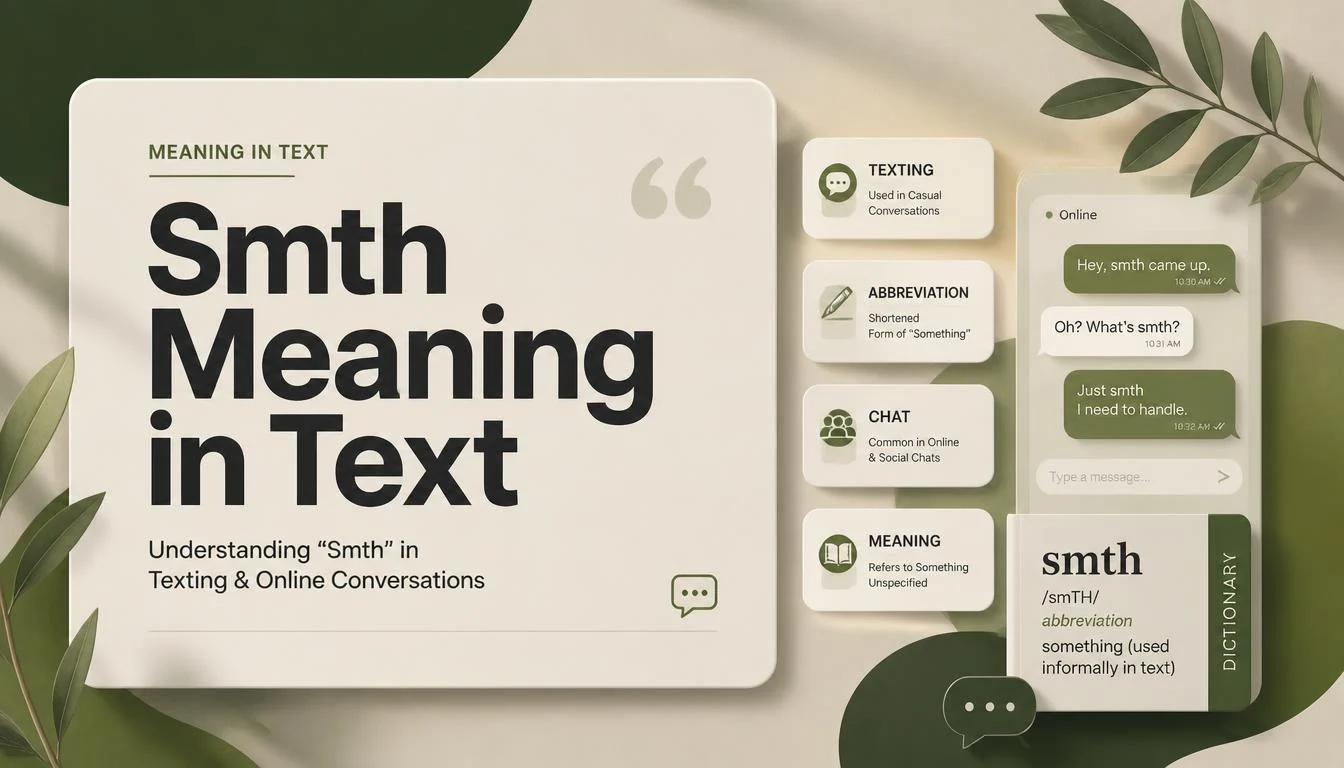
In texting, “smth” is short for “something.” People drop the vowels and the “o” and “ing” to save time, which leaves four letters instead of nine. You’ll see it in texts, captions, and comments, almost always in a casual tone. It’s a close cousin of “smthn,” “sumn,” and “sum,” which all point to the same word.
Wondering about the SMTH meaning in text? SMTH is a casual abbreviation for “something” that people use to make messages shorter and quicker. You may see it in texts, social media posts, comments, and online conversations.
Although SMTH is easy to understand, its tone can vary depending on the context. In this guide, we’ll explain what SMTH means, how people use it, and provide simple examples to help you understand it naturally.
What Smth Stands For
“Smth” is a clipped spelling of “something.” It belongs to a style of abbreviation called disemvoweling, which simply means removing vowels while keeping the consonants that carry the sound. Your brain still reads it correctly because the shape of the word survives. Try reading “smth” next to “sm” and “th” and you’ll see how little is actually missing.
This habit is much older than smartphones. Shorthand has a long history, from telegram abbreviations that saved money per word to the stenography systems clerks used for decades. Text messaging revived the same instinct, since early phones limited a single SMS to 160 characters and every letter counted.
Nowadays, the character limit rarely matters, so the choice is mostly about tone. Writing “smth” instead of “something” tells the reader that you’re relaxed. It’s the written version of waving instead of shaking hands.
Smth, Smthn, Sumn: Spotting the Variants
Slang spreads fast, and every group of friends tends to bend a word its own way. That’s how one word ends up with half a dozen spellings. Most of them are easy to decode once you’ve seen two or three.
| Variant | Reads As | Common Context |
|---|---|---|
| smth | something | Texts, captions, notes to self |
| smthn | something | Casual chats, slightly more stretched |
| sumn | something | Spoken-style spelling, many English dialects |
| sum | something | Very informal, can be confused with the word “sum” |
| sth | something | Often seen among non-native English speakers |
| smthing | something | Mixed form, half shortened |
The spelling “sum” is the trickiest. In a sentence like “wanna grab sum food,” it clearly means “some,” but “sum” can also stand for “something” in phrases like “you want sum?” Context decides it. Meanwhile, “sth” is also common in dictionaries, where it’s written as shorthand next to verbs, as in “to do sth.”
The Vagueness Trick: Why “Smth” Feels Mysterious
Here’s what makes this word interesting. “Something” is already one of the vaguest words in English. Shortening it makes the sentence feel even looser, almost like the writer is shrugging while typing.
Think about “we should do smth this weekend.” The plan is deliberately undefined. It leaves the door open without committing to a place, a time, or a budget. People use this on purpose when they want to float an idea without risking a hard “no.”
Vagueness can also be playful. “I made you smth” builds curiosity in a way “I made you a gift” doesn’t. The unfinished feel invites questions, and a question is exactly what many people want from a message.
Of course, the same vagueness can irritate. “We need to talk about smth” sends some people into a spiral. When the topic is serious, the shortened word can sound ominous because it hides the one detail the reader needs.
Soft-Launching Feelings with “Smth”
A newer habit worth noticing is using “smth” to introduce an emotion without fully naming it. “Feeling smth today” or “this song does smth to me” lets a person admit a feeling exists while keeping its details private. It’s a shield and a confession at the same time.
This works well on social platforms, where people want to share a mood without writing an essay. Captions like “smth about this place” invite followers to fill in the blank. The reader supplies the meaning, which often makes the post feel more personal than a precise description would.
It also appears in early romantic chats. “I think there’s smth between us” is easier to type than “I like you,” and it gives both people an exit. If the other person doesn’t respond warmly, the speaker can pretend it was a light remark. That’s low risk, and honestly, a bit cowardly, but it’s very human.
Smth vs. Similar Shortcuts
Texting is full of abbreviations for indefinite words, and they don’t always behave alike. Knowing the small differences helps you pick the right one.
“Smth” stands for a thing, while “sm1” stands for “someone” and “smwhr” means “somewhere.” Each swaps in digits or drops letters in its own way. “Idk” and “idc” express attitude rather than substance, so they work differently from words that name a thing.
Then there’s “smh,” which looks nearly identical to “smth” at a glance but means “shaking my head.” Mixing those two up can cause real confusion. “I’m smh about what he said” and “I’m thinking smth about what he said” send totally different signals.
A good habit is to scan for context. If the sentence needs a noun, it’s likely “smth.” If it needs a reaction, it’s likely “smh.”
Where It Fits and Where It Doesn’t
Casual spaces are the natural home for this word. Group chats, direct messages, comment sections, and personal notes all welcome it. Nobody blinks at “bring smth to drink.”
Formal spaces are different. Emails to a manager, school assignments, job applications, and customer messages should use the full word. Shortened spellings can make a message look careless, even when the content is solid.
There’s a middle zone as well. Messaging a coworker you know well on a team chat? Probably fine. Writing to a new client for the first time? Spell it out. Reading the room matters more than any rule.
Autocorrect adds another wrinkle. Many phones will change “smth” into “smith” or “sth” without asking, so double-check before sending. A message about “smith to eat” will confuse people for a second, and you’ll look silly.
How to Reply to a Vague “Smth” Text
When someone writes “we should do smth,” your best move is to turn the vagueness into a plan. Offer two or three concrete options, such as dinner, a walk, or a movie. That gives them an easy way to say yes.
If the message is “I need to tell you smth,” respond with warmth and a clear invitation. Something like “sure, I’m free after 6, want to call?” works well. It shows you’re ready to listen without pushing for details they aren’t ready to share by text.
For playful ones like “I got you smth,” match the energy. A quick “ooh, what is it?” keeps the mood light. There’s no need to overthink it.
If a vague message makes you anxious, it’s fine to ask. “Is it good smth or bad smth?” is a common and friendly way to calm your nerves. Most people will answer right away.
The Quiet Role of Smth in Hard Conversations
This is a use that rarely gets discussed. When someone is struggling, they often can’t find words, and “smth” fills the gap. “Smth’s been off lately” is a way of saying “I’m not okay” without having to explain why.
If a friend sends you a line like that, treat it as an opening rather than filler. You don’t need the perfect response. Try “I’m here, want to talk about it?” and let them decide how much to share.
Notice patterns too. A person who keeps saying “smth happened” or “smth’s wrong” but never elaborates may be waiting for you to ask twice. A gentle follow-up can matter more than you’d guess.
If you’re the one writing it, consider adding one more line. Even a small detail, like “smth at work” or “smth with my family,” helps the other person respond in a useful way.
FAQs
Is “smth” the same as “sth”?
They mean the same thing, but they’re used in different circles. “Sth” is common in learner dictionaries and among speakers who learned English as a second language. “Smth” is more common in everyday American and British texting.
Can I use “smth” in a work chat?
It depends on your workplace culture. If your team uses a relaxed tone and emojis, it won’t raise eyebrows. For anything going to clients or senior leaders, write the full word.
Why do some people avoid shortening words like this?
Some find abbreviations harder to read, especially for people using screen readers or translation tools. Others simply prefer full spelling for clarity. Neither choice is wrong, and mixing them up is normal.
Does “smth” work in other languages?
Not directly, since it’s built on English spelling. Many languages have their own shortcuts, though, like “qqch” for “quelque chose” in French. The habit of clipping common words is nearly universal.
Is there a spoken version of “smth”?
Yes, and it’s “sumthin'” or “sumn.” People say it casually in everyday speech, and the written spelling “sumn” is basically a transcription of that sound.
Should I worry that “smth” makes my writing look lazy?
Only in the wrong setting. In casual chats, it signals ease, not laziness. In formal writing, it can look sloppy, so choose the full word there.
Conclusion
“Smth” looks like a tiny shortcut, but it does more than save a few keystrokes. It adds softness, hides detail, invites curiosity, and sometimes lets people say the hard thing without saying all of it. Used well, it keeps chats warm and quick.
When it lands in your inbox, read the tone around it before replying. When you send it, ask whether the vagueness helps or hurts. And if a friend ever types it in a heavy moment, take a second to ask what’s behind it.