Quick Answer
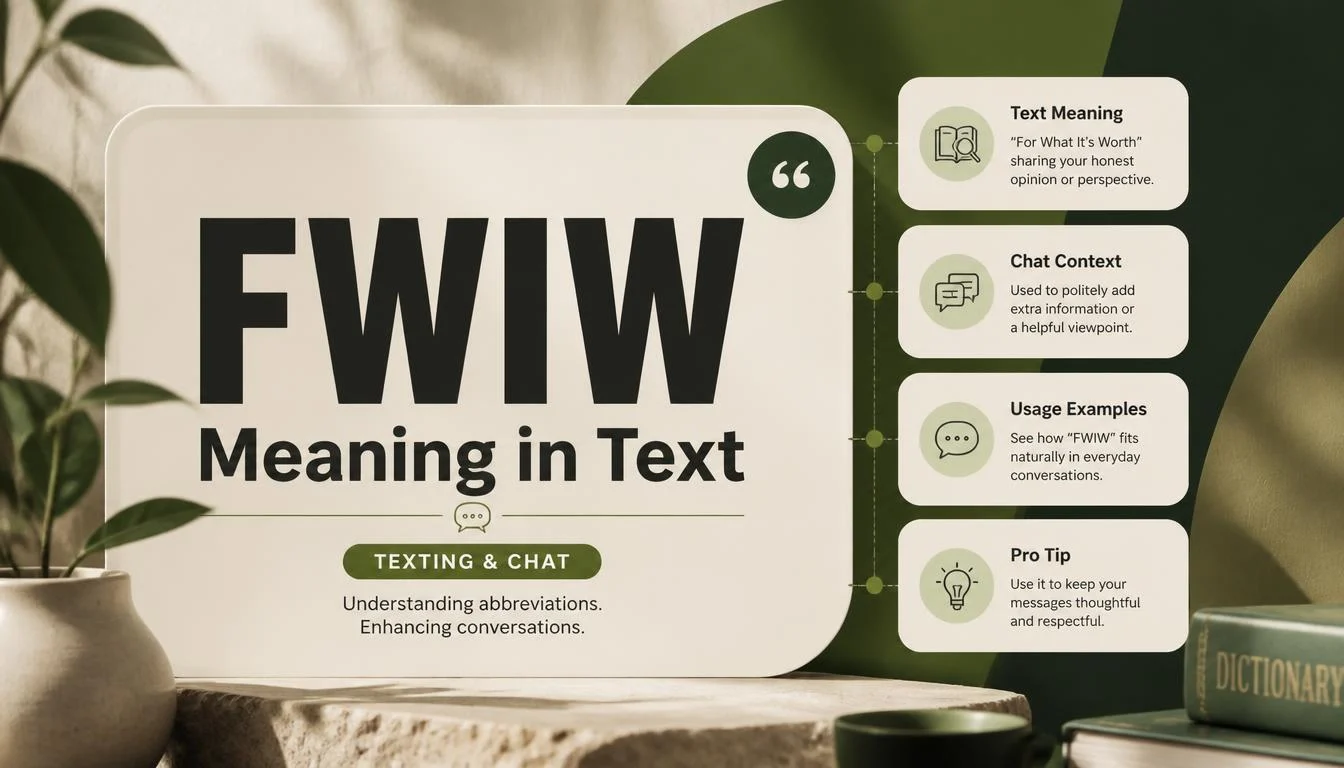
FWIW stands for “for what it’s worth.” People use it before sharing an opinion, suggestion, or piece of information they suspect might not be particularly helpful, welcome, or important. It’s a softener a way to say “take this or leave it.”
FWIW meaning in text is “for what it’s worth.” People use this abbreviation in text messages, online chats, and social media when sharing an opinion, suggestion, or piece of information they think might be helpful. It often adds a personal perspective without making the message sound too forceful.
Understanding FWIW can help you interpret conversations more naturally, especially when someone offers advice or shares their point of view. Whether you’re chatting with friends, messaging coworkers, or reading online discussions, knowing what FWIW means makes informal digital communication easier to follow.
What Does FWIW Actually Mean?
At its core, FWIW is an initialism for “for what it’s worth.” But the phrase does more work than its literal definition suggests.
When someone types “FWIW, I think you should apologize,” they’re not just sharing an opinion. They’re hedging. The phrase signals that the speaker recognizes their input might be unwanted, unhelpful, or simply one perspective among many. It’s a linguistic cushion.
You’ll see it most often at the beginning of a sentence, though it can appear at the end or even mid-thought. The capitalization doesn’t matter much “fwiw” and “FWIW” are used interchangeably, with lowercase becoming more common in casual texting.
The term falls into a broader family of texting abbreviations that manage tone and social expectations. Think of it alongside IMO (“in my opinion”), TBH (“to be honest”), and NGL (“not gonna lie”) . Each one does something slightly different, but they all serve the same basic function: they soften whatever comes next.
The Surprising History Behind the Abbreviation
Here’s where things get interesting. FWIW didn’t start as internet slang.
The phrase “for what it’s worth” dates back much further than AOL chat rooms. An 1844 play by William Henry Oxberry, Newton Foster, or the Merchant Service, includes the line: “Consequently, your opinion goes for what it’s worth nothing” . That’s the sarcastic version of the phrase, and it’s been around for nearly two centuries.
The abbreviation itself, though, is a product of early computer networking. The Oxford English Dictionary traces the first known use of FWIW to 1986, in a Usenet post about UNIX systems . Usenet was essentially the internet’s predecessor a decentralized discussion system used mostly by academics and tech workers.
There’s also a claim that telegraph operators in the mid-19th century used abbreviations like FWIW and IMHO to save time and money on wire transmissions . That’s harder to verify, but it fits the pattern: whenever communication costs money or time, people abbreviate.
For decades, FWIW remained niche something you’d see in email chains, forum posts, and early social media. It wasn’t until September 2022 that Merriam-Webster officially added it to the dictionary . That’s a long journey from a 1986 Usenet thread to mainstream recognition.
FWIW vs. Similar Abbreviations
The texting acronym ecosystem is crowded. Here’s how FWIW compares to its closest cousins:
| Abbreviation | Stands For | Primary Function | Example |
|---|---|---|---|
| FWIW | For what it’s worth | Softens an opinion or unsolicited advice | “FWIW, the cheaper option works fine.” |
| IMO | In my opinion | Marks a statement as subjective | “IMO, the book was better.” |
| TBH | To be honest | Signals candor, sometimes brutal | “TBH, that outfit isn’t working.” |
| NGL | Not gonna lie | Admits something potentially embarrassing | “NGL, I forgot your birthday.” |
| IMHO | In my humble opinion | Older, more formal version of IMO | “IMHO, the sequel fell short.” |
The key distinction is that FWIW carries a hint of self-deprecation. IMO just says “this is my view.” FWIW says “this is my view, and I’m aware you might not care.” That’s a meaningful difference in tone.
NGL and TBH are about honesty they promise the speaker is being upfront. FWIW is about value it acknowledges that what follows might not be valuable at all. That’s a different social move.
How to Use FWIW Without Sounding Passive-Aggressive
Here’s the tricky part. FWIW is a hedging phrase, and hedging phrases can backfire.
Used genuinely, it’s fine: “FWIW, I’ve had good luck with the cheaper brand.” That’s helpful. You’re offering a data point without insisting on it.
Used poorly, it becomes passive-aggressive: “FWIW, you’re doing that wrong.” That reads like a criticism wrapped in fake humility. The “for what it’s worth” doesn’t soften the blow it just makes the speaker seem insincere.
The difference comes down to intent. If you’re genuinely offering an optional perspective, FWIW works. If you’re actually certain you’re right and just want plausible deniability, FWIW makes you sound worse, not better.
A good test: would you be fine if the other person ignored your suggestion entirely? If yes, FWIW is appropriate. If no, just say what you mean directly.
Why FWIW Matters More Than It Seems
Text-based communication strips out tone, facial expression, and body language. That’s a problem, because human conversation relies heavily on those cues to manage social friction.
FWIW is one of many linguistic tools people invented to fill that gap. It’s a written tone marker. It tells the reader: “I’m not trying to dominate this conversation. I’m not certain. I’m not demanding you agree.”
Researchers who study computer-mediated communication have long noted that text-only environments force people to develop explicit ways of signaling politeness and uncertainty . FWIW is a small but effective example. It’s a single four-letter string that does the work of a shrug, a raised eyebrow, and a tentative smile.
That’s why it’s survived for nearly forty years. It’s efficient. And in texting, efficiency is everything.
Common Mistakes and Misunderstandings
Assuming it’s always sarcastic. It’s not. The sarcastic use “your opinion goes for what it’s worth nothing” exists, but it’s not the default. Most people use FWIW sincerely.
Using it to introduce facts. FWIW works best with opinions and suggestions. “FWIW, the meeting is at 3 PM” is odd that’s just information. FYI would be more appropriate there .
Overusing it. Like any hedge, FWIW loses power when it’s everywhere. If every opinion you share comes with “for what it’s worth,” it starts to feel like a verbal tic.
Capitalization anxiety. Stop worrying about it. FWIW, fwiw, Fwiw nobody cares. Lowercase has become standard in casual texting, but the meaning doesn’t change.
FAQ
Is FWIW formal or informal?
Informal. You’d use it in texts, Slack messages, emails to colleagues you know well, and social media comments. You would not use it in a cover letter, a legal document, or a formal report.
Can FWIW be used in spoken conversation?
Rarely. It’s almost exclusively written. Saying “for what it’s worth” out loud works fine, but abbreviating it to “F-W-I-W” in speech would sound strange. The abbreviation exists because typing is slower than talking.
Does FWIW have different meanings in different contexts?
Not really. “For what it’s worth” is the standard meaning across English-speaking internet culture. Unlike IMO, which can also stand for International Maritime Organization, FWIW doesn’t have competing definitions .
What’s the difference between FWIW and FYI?
FYI means “for your information” it introduces information you think is useful . FWIW introduces an opinion or suggestion you’re not sure the other person wants. FYI is more neutral; FWIW is more deferential.
Is FWIW outdated?
No. It was added to Merriam-Webster in 2022, which suggests it’s still going strong . It’s not trendy slang it’s established vocabulary.
Should I capitalize it in professional emails?
Either works, but lowercase is more common in casual professional settings. If you’re unsure, just spell out “for what it’s worth.” It reads as slightly more thoughtful anyway.
Conclusion
FWIW is a small phrase with a long history. It started as a sarcastic jab in a Victorian-era play, became a Usenet shorthand in the 1980s, and finally earned dictionary recognition in 2022. Along the way, it became one of the most useful tone-softeners in digital communication.
Use it when you’re offering something optional. Skip it when you’re actually sure. And if you’re ever confused about whether it sounds passive-aggressive, just ask yourself: do I actually care if they take this advice? If the answer is no, FWIW is fine. If the answer is yes, say what you mean without the hedge.