Quick Answer
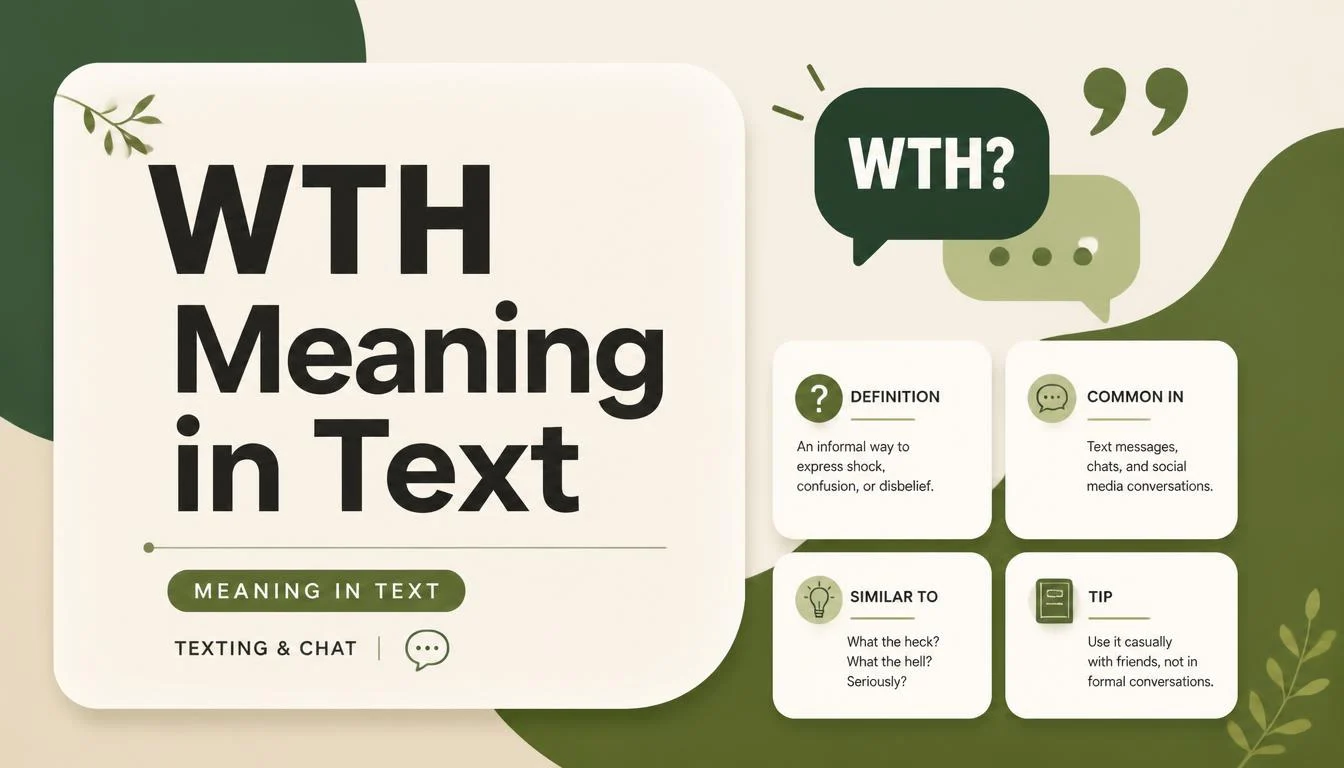
WTH stands for “What the hell” or “What the heck.” It’s a text and chat abbreviation used to express confusion, surprise, or mild frustration. Think of it as the polite cousin of WTF same energy, less profanity. You’ll see it in casual messages, group chats, and social media comments when something doesn’t make sense.
The WTH meaning in text is usually “What the heck” or “What the hell.” People use this popular abbreviation in text messages, online chats, and social media to express surprise, confusion, frustration, or disbelief. Its exact meaning depends on the conversation and the tone of the person using it.
Understanding the WTH meaning in text can help you interpret messages more accurately and respond appropriately. Although some people use it as a mild expression of shock, others use it to show annoyance or ask what is happening. Since WTH can represent either a softer or stronger phrase, the context helps determine its intended meaning.
What WTH Actually Stands For
The acronym breaks down into three words: What The Hell. That’s the original, and it remains the most common expansion. But there’s a softer version too: What the heck.
Both work. The choice depends on how you want to sound.
“What the hell” carries a sharper edge. It signals genuine irritation or disbelief. “What the heck” dials that back it’s the version you’d use in front of your grandmother or a coworker you don’t know well. Same acronym, different temperature.
There’s also a less common set of expansions that swap out the question word entirely. According to Computer Hope, WTH can also mean “when the hell,” “where the hell,” “who the hell,” or “why the hell”. The context of the sentence makes the intended meaning clear. If someone texts “WTH are you doing in my kitchen,” they probably mean “why.” If they text “WTH is my phone,” they mean “where.”
The “what” version dominates because it’s the most flexible. You can drop it into almost any situation of confusion without needing extra context.
The Hell vs. Heck Distinction (And Why It Matters)
This isn’t just a grammatical footnote. The hell/heck choice tells you something about the sender’s tone, their relationship with the recipient, and how much they care about keeping things polite.
| Version | Tone | Typical Context |
|---|---|---|
| WTH (What the hell) | Mildly aggressive, genuine frustration | Close friends, group chats, reacting to something absurd |
| WTH (What the heck) | Softened, playful, family-friendly | Mixed company, work-adjacent messages, when you want to be relatable without swearing |
| WTF | Blunt, profane, often hostile | Extreme frustration, casual swearing among friends, internet culture |
The “heck” substitution is a classic English workaround. It lets you express strong emotion without crossing into profanity. People do this in speech too “what the heck” has been a euphemism for “what the hell” for generations. The acronym just carried that dynamic into text.
Baidu Baike, which tracks Chinese internet culture, notes that WTH is often described as a “twin brother” of WTF, but with a gentler tone. That framing is useful. Both express the same core reaction “this makes no sense” but they sit at different points on the politeness spectrum.
WTH vs. WTF: The Real Difference
Let’s be clear about what separates these two.
WTF stands for “What the fuck.” It’s profane. Using it signals that you’re either very angry, very comfortable with the person you’re texting, or both. In many workplaces and formal settings, WTF is off-limits.
WTH gives you an escape hatch. It carries the same emotional payload confusion, disbelief, frustration without the swear word. You can type “WTH” in a group chat that includes your boss’s boss and not worry about it. Try that with WTF.
The trade-off is intensity. WTH is inherently milder. If you stub your toe on a table leg, you might say “what the hell” out loud. If you discover your car has been towed, you’re more likely to reach for WTF. The acronym matches the moment.
There’s also a generational and regional component. WTH has been in the internet shorthand toolkit since at least the early 2000s, appearing alongside other chat abbreviations like LOL, BRB, and BTW. It’s old enough to feel natural to older millennials and Gen X, but not so old that it reads as cringe to Gen Z. That’s a sweet spot not every acronym manages.
How to Use WTH in a Sentence
WTH is flexible. You can use it as a standalone reaction or embed it in a longer message.
Standalone:
“WTH”
“Wth??”
“WTH is going on”
In a sentence:
“WTH was that email about”
“Wth u talking about” (common in very casual texting where “you” becomes “u”)
“I just saw the price on this thing, wth”
Notice the capitalization. Most people type it in all lowercase (“wth”) in casual messages. Uppercase (“WTH”) reads as slightly more emphatic or angry. The question mark situation is also loose some people add one, some add three, some skip it entirely. “Wth” with no punctuation can actually feel more exasperated than “WTH???” because it suggests you’re too stunned to even bother with punctuation.
The acronym doesn’t need to start a sentence. You can use it mid-thought: “I was walking to work and wth, the whole street was blocked off.” It functions like an interjection a verbal elbow to the ribs.
Why “What the Hell” Became an Acronym in the First Place
The rise of WTH tracks with the broader explosion of internet initialisms in the 1990s and 2000s. As people moved from phone calls and letters to chat rooms, instant messaging, and eventually text messages, they needed ways to type fast and convey emotion efficiently.
The Jargon File, a collection of hacker slang compiled at Stanford in the 1970s, documented early shorthand like BTW, FYI, and THX used in talk mode between terminals. By the late 1980s and early 1990s, services like CompuServe and GEnie had popularized terms like LOL and BRB. WTH fits into that same tradition taking a common spoken phrase and compressing it into three letters.
There’s a practical reason these acronyms stick. “What the hell” takes a while to type on a phone keyboard. WTH takes half a second. When you’re reacting in real time to something confusing, speed matters. The acronym preserves the emotional punch of the full phrase while cutting the effort.
It also serves a social function. Typing out “what the hell” in a message can feel aggressive or overly invested. WTH feels lighter. It’s the difference between shouting and raising an eyebrow.
Common Variations and Related Terms
WTH doesn’t exist in a vacuum. It’s part of a family of question-based acronyms that all follow the same pattern.
WTF What the fuck. The profane sibling. More intense, more confrontational, more likely to start an argument if misdirected.
WTH What the hell/heck. The middle ground. Useful when you want to express frustration without swearing.
WTAF What the actual fuck. An intensified version of WTF. Used when regular WTF doesn’t capture the level of disbelief. More common in extremely online circles.
WTHDTM What the hell does that mean. A longer, more specific variant that occasionally shows up in technical or argumentative conversations.
There are also regional and platform-specific quirks. On some platforms, people type “wth” to mean “with” in a hurried message though this is rare and usually obvious from context. In technical documentation, WTH can also stand for “watt-hour,” a unit of energy. You’re unlikely to confuse the two unless you’re reading a battery spec sheet and a group chat at the same time.
When WTH Works (And When It Doesn’t)
WTH belongs in informal communication. Text messages, group chats, social media replies, Discord servers, Slack channels with a casual culture. It signals that you’re reacting in the moment, not drafting a formal statement.
It does not belong in professional emails, academic papers, or any context where you’d be embarrassed to have your message screenshotted and shared. Even the softened “heck” version reads as casual. If you’re emailing a client about a billing error, “WTH happened to this invoice” is not the move. “Could you clarify what happened here” is the move.
There’s also a question of audience. WTH is broadly understood among English-speaking internet users, but it’s not universal. If you’re texting someone who isn’t fluent in chat abbreviations, they might not know what you mean. The same goes for older relatives who missed the AOL era. In those cases, spelling it out is safer.
One more thing: tone is hard to read in text. WTH can come across as playful or genuinely angry depending on context. If you’re frustrated with someone and type “wth,” they might read it as a joke. If you want to be clearly annoyed, use more words. Acronyms are efficient, but they’re not always precise.
FAQ
Is WTH a Swear Word?
Not exactly. WTH itself is just an abbreviation, but it commonly stands for “what the hell,” which can be considered a mild swear phrase in some situations. It can also mean “what the heck,” which is more polite and family friendly. If you want to avoid offending someone, the “heck” version is the safer choice.
Can I Use WTH in a Work Message?
It depends on your workplace and the person you’re messaging. WTH may be acceptable in a casual team chat where slang and emojis are common. However, it’s better to avoid it in formal emails to managers, clients, or senior colleagues. A simple rule is to avoid WTH whenever “what the hell” would sound inappropriate in a conversation.
What’s the Difference Between WTH and WTF?
WTH usually means “what the hell” or “what the heck,” while WTF stands for “what the fuck.” WTF is more vulgar and can sound more aggressive or confrontational. WTH is generally a milder alternative for expressing surprise, confusion, or frustration without using stronger profanity.
Does WTH Always Mean “What the Hell”?
No. Although “what the hell” is the most common meaning of WTH, its exact interpretation depends on the conversation. It can also stand for “what the heck,” “who the hell,” “where the hell,” or “why the hell.” The surrounding message usually makes the intended meaning clear.
Is WTH Still Used, or Is It Outdated?
WTH is still used in text messages, online chats, and social media conversations. While some older internet abbreviations have become less common, WTH remains useful for expressing surprise, confusion, or frustration in a relatively mild way. Its meaning is widely recognizable, making it a practical choice for informal digital communication.
Conclusion
WTH is one of those small abbreviations that does a lot of quiet work. It gives you a way to react with real emotion without crossing into profanity. The hell-or-heck choice lets you calibrate your tone for whoever’s reading. Use it in casual chats, skip it in formal ones, and you’ll never misfire. Three letters, one clear job: expressing confusion without the cleanup.