Quick Answer
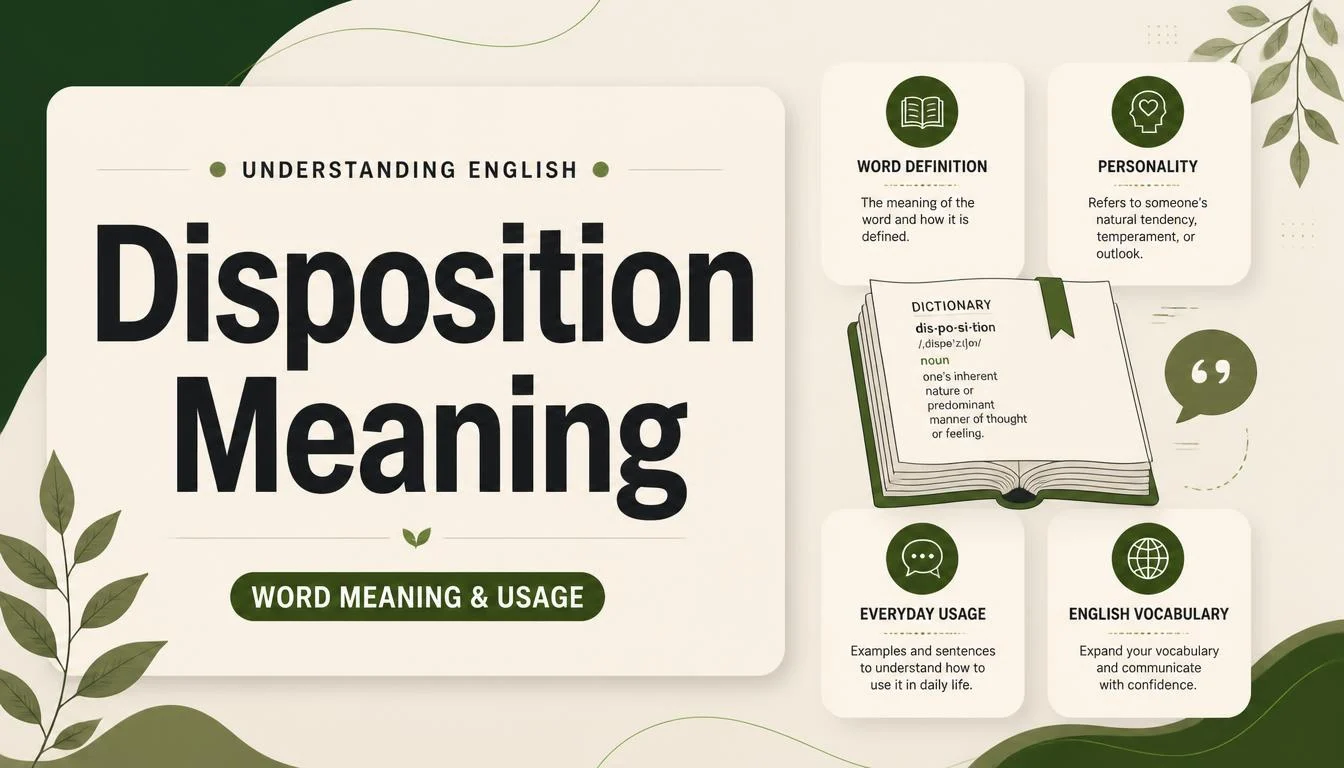
Disposition means a person’s usual mood, temperament, or natural way of behaving. It can also refer to how something is arranged, managed, or handled, depending on the context. For example, someone with a cheerful disposition tends to be friendly, positive, and pleasant around others.
The word disposition can describe your personality, your attitude toward life, or the way you usually respond to different situations. If someone has a calm disposition, they tend to stay relaxed even when things get stressful. The word often appears in conversations about personality, behavior, and relationships.
However, the disposition meaning can change depending on where you encounter it. In law, it may refer to the final outcome of a case, while in business or finance, it can describe the sale or transfer of an asset. Understanding the context helps you identify the exact meaning and use the word correctly.
What Does Disposition Mean in Simple Words?
In simple words, disposition means someone’s natural way of thinking, feeling or behaving. It can describe whether a person tends to be cheerful, patient, friendly, serious or easily irritated.
For example, imagine two coworkers facing the same stressful deadline. One remains calm and encourages the team, while the other becomes frustrated quickly. Their different dispositions help explain why they respond to the same situation differently.
Disposition can also mean a person’s inclination toward something. Someone might have a disposition to help others or a natural disposition toward creative activities.
In other contexts, the word refers to how something is handled, arranged or transferred. A court case can have a disposition, just as a company can decide on the disposition of its assets.
Disposition Definition and Part of Speech
The word disposition is a noun. It has several related meanings, so the surrounding sentence usually tells you which definition applies.
Here are the main meanings of disposition:
- Temperament or character: A person’s usual emotional tendencies and behavioral patterns.
- Inclination or tendency: A natural preference or readiness to do something.
- Arrangement or placement: The way people or things are positioned or organized.
- Handling or transfer: The act of dealing with property, assets or other matters.
- Outcome or resolution: The result or procedural status of a legal case.
The word comes through French from Latin dispositio, which relates to arranging or setting things in order. This background helps explain why disposition can describe both a person’s nature and the arrangement or handling of something.
What Does Disposition Mean When Describing a Person?
When disposition describes a person, it usually refers to their characteristic temperament or general emotional nature. It gives you an idea of how they tend to interact with people and respond to everyday experiences.
A person with a friendly disposition may enjoy meeting new people. Someone with a patient disposition might remain understanding when others make mistakes.
These descriptions don’t mean people always behave the same way. Even a naturally cheerful person can have a difficult day, and a reserved person may become lively around close friends.
Disposition describes a general tendency rather than every action a person takes. It can help explain someone’s behavior without defining their entire personality.
Types of Disposition and Their Meanings
People use different adjectives to describe disposition. These descriptions aren’t official psychological categories. Instead, they provide practical ways to explain someone’s usual temperament and behavior.
Positive Disposition Meaning
A positive disposition describes a tendency to approach people and situations with optimism, friendliness or hope. People with this disposition often look for constructive ways to handle challenges.
For example, a student who treats a disappointing grade as an opportunity to improve may show a positive disposition toward learning. This doesn’t mean the student never feels disappointed. It means they tend to respond constructively.
A positive disposition can make communication easier and help people maintain supportive relationships. However, it doesn’t require someone to ignore real problems or pretend everything is perfect.
Negative Disposition Meaning
A negative disposition describes a tendency toward pessimism, irritability or unfavorable reactions. Someone with this disposition may expect things to go wrong or focus on the drawbacks of a situation.
For example, a coworker who regularly assumes a new project will fail might be described as having a negative disposition toward change.
This description doesn’t automatically mean the person is unkind. Their behavior could reflect stress, past experiences or concerns about a particular situation.
Natural Disposition Meaning
Natural disposition refers to a person’s usual tendencies or inclinations. These tendencies may reflect a combination of temperament, experiences, habits and environmental influences.
For instance, someone may show a natural disposition toward helping others. Another person might naturally enjoy solving puzzles or working independently.
A natural disposition doesn’t determine someone’s future. People can learn new skills, develop different habits and change how they respond to situations.
Cheerful Disposition Meaning
A cheerful disposition describes someone who tends to be happy, upbeat and pleasant. Such a person may smile often, share encouragement and bring positive energy to social situations.
Example: Despite the busy schedule, Maria maintained her cheerful disposition throughout the day.
The sentence suggests that Maria generally remained pleasant even when she had plenty of work to manage.
Friendly or Pleasant Disposition Meaning
A friendly disposition describes someone who tends to be warm, approachable and welcoming. A pleasant disposition similarly suggests that someone is agreeable and comfortable to interact with.
For example, a receptionist with a friendly disposition may greet visitors warmly and make them feel welcome. A teacher with a pleasant disposition may help students feel comfortable asking questions.
Calm or Easygoing Disposition Meaning
A calm disposition describes someone who generally responds to stressful situations without becoming visibly upset. An easygoing disposition suggests flexibility and a relaxed approach to everyday problems.
Example: His calm disposition helped the team work through an unexpected delay.
These descriptions don’t mean the person never experiences stress. They suggest that remaining composed is a common tendency.
Reserved or Irritable Disposition Meaning
A reserved disposition describes someone who tends to be quiet, private or cautious in social situations. Such people may prefer listening to speaking, especially around unfamiliar people.
An irritable disposition, by contrast, describes someone who tends to become annoyed or frustrated easily. Context matters because temporary stress can also affect a person’s behavior.
Neither description tells you everything about someone’s character. A reserved person can be warm and caring, while an irritable person may behave differently when relaxed.
Disposition Examples in Everyday Sentences
The easiest way to understand disposition is to see how people use it in different situations.
| Example sentence | Meaning |
|---|---|
| She has a cheerful disposition. | She generally seems happy and upbeat. |
| His friendly disposition makes new employees feel welcome. | He tends to be approachable and welcoming. |
| The manager has a calm disposition under pressure. | The manager usually remains composed during stressful situations. |
| Her natural disposition is to help anyone who needs support. | She tends to help others without much hesitation. |
| He has a reserved disposition around strangers. | He tends to be quiet around unfamiliar people. |
| The child showed a curious disposition toward science. | The child naturally seemed interested in science. |
| The court recorded the disposition of the case. | The court documented the case’s outcome or procedural resolution. |
| The company reviewed the disposition of its unused equipment. | The company considered how to handle or transfer the equipment. |
How to Use Disposition in a Sentence
Disposition often appears with adjectives that describe a person’s temperament. Common combinations include cheerful disposition, pleasant disposition, friendly disposition and calm disposition.
You can also use the word with prepositions to explain a tendency or the handling of something.
Disposition toward: This construction describes someone’s attitude or tendency regarding a particular subject.
Example: She has a positive disposition toward learning new languages.
Disposition to: This construction can describe a tendency or inclination to act in a certain way.
Example: He has a disposition to help people in difficult situations.
Disposition of: This construction often describes the handling, transfer or arrangement of something.
Example: The report explains the disposition of the company’s remaining assets.
Pay attention to the context. A disposition toward learning concerns a person’s inclination, while the disposition of assets concerns what happens to those assets.
Disposition vs. Personality, Temperament and Attitude
Disposition, personality, temperament and attitude have related meanings. However, they aren’t interchangeable in every sentence.
| Word | Meaning | Example |
|---|---|---|
| Disposition | A person’s usual temperament or tendency | She has a patient disposition. |
| Personality | The broader pattern of someone’s characteristic traits | He has an outgoing personality. |
| Temperament | A person’s characteristic emotional responses and reactivity | The child has a naturally calm temperament. |
| Attitude | A way of thinking or feeling about a specific person, subject or situation | She has a positive attitude toward change. |
| Character | The qualities that help describe someone’s moral nature and personal qualities | His honesty reflects his character. |
| Demeanor | The way someone appears or behaves outwardly | Her professional demeanor reassured the client. |
Disposition vs. Personality
Personality refers to the broader combination of traits, patterns and characteristics that distinguish one person from another. Disposition often focuses on a particular aspect of that person’s nature, especially their usual temperament or inclination.
For example, someone may have an outgoing personality and a patient disposition. The first description suggests a broader social style, while the second highlights how the person tends to respond to situations.
Disposition vs. Temperament
Temperament generally refers to characteristic patterns of emotional response and reactivity. Disposition has a broader range of meanings and can describe temperament as well as someone’s inclination toward an activity or their way of handling something.
For example, a person might have a calm temperament and a strong disposition toward helping others. The first describes their emotional style, while the second describes a tendency to act helpfully.
Disposition vs. Attitude
Attitude usually concerns how someone thinks or feels about a particular subject or situation. Disposition more often describes a general tendency that can appear across different situations.
For example, a person may have a cheerful disposition but a negative attitude toward a specific workplace policy. These descriptions can both be accurate because general temperament and situation-specific opinions aren’t the same thing.
Disposition Synonyms and Antonyms
Choosing the right synonym depends on how the word appears in a sentence. Some related words describe personality, while others refer to preference or arrangement.
Common Synonyms for Disposition
Here are useful synonyms for the personality-related meaning:
- Temperament: A person’s characteristic emotional tendencies.
- Nature: Someone’s general character or natural qualities.
- Personality: The broader pattern of a person’s traits and behaviors.
- Character: A person’s distinguishing qualities, especially their moral qualities.
- Inclination: A tendency or preference toward something.
- Tendency: A pattern of behaving or responding in a particular way.
- Demeanor: Someone’s outward manner or behavior.
- Outlook: A person’s general perspective on life or a situation.
- Predisposition: An existing tendency to think, feel or act in a certain way.
For example, temperament may replace disposition in a sentence about emotional reactions. However, inclination is usually more suitable when discussing someone’s preference for a particular activity.
Antonyms of Disposition
Disposition doesn’t have one universal antonym because its meaning changes with context.
When disposition describes a person’s friendly nature, words such as hostility and unfriendliness can express the opposite quality. When it means inclination, disinclination, reluctance and unwillingness may be more appropriate.
For example, someone with a disposition to volunteer is inclined to help. Someone who shows a disinclination to volunteer is reluctant to do so.
The best opposite depends on the meaning you want to communicate.
Other Meanings of Disposition in Different Contexts
Although everyday English often uses disposition to describe temperament, the word appears in professional settings with different meanings.
Disposition Meaning in Law
In legal contexts, disposition generally refers to the outcome or resolution of a legal matter. The exact meaning depends on the type of proceeding and the stage of the case.
For example, a case may end through dismissal, a guilty plea, a verdict or another legally recognized outcome. A case record may document its disposition to show how the matter was resolved.
The word doesn’t always mean a judge issued a final judgment after a trial. Some cases end through other procedures.
Case Disposition Meaning
Case disposition refers to the recorded outcome or procedural resolution of a particular case. You may see this term in court records, case management systems and legal paperwork.
A criminal case disposition might record a conviction, acquittal, dismissal or another outcome. A civil case disposition might reflect a settlement, dismissal or judgment.
If a record says a case has been disposed of, it generally means the case has reached a recorded resolution at the relevant stage. The precise status depends on the court and the record.
Disposition of Assets or Property
In financial and business contexts, disposition of assets refers to what happens when an organization or individual sells, transfers, distributes or otherwise relinquishes an asset.
For example, a business might review the disposition of old vehicles before replacing its fleet. It could sell the vehicles, transfer them to another department or dispose of them according to applicable rules.
Similarly, disposition of property may involve a sale, transfer or another legally permitted way of handling ownership. The specific transaction determines the exact meaning.
Patient Disposition Meaning
In medical settings, patient disposition refers to the next step in a patient’s care after an assessment or treatment.
For example, an emergency department may document whether a patient will be discharged home, admitted to the hospital or transferred to another facility. The disposition records the planned outcome of that encounter.
This use doesn’t describe the patient’s personality. It identifies where the patient goes or what happens next in the care process.
Disposition as Arrangement or Placement
Disposition can also describe how objects or people are arranged in a particular space or order. This meaning is less common in everyday conversation but appears in formal descriptions.
For example, the disposition of the chairs created a clear path through the room describes their arrangement. In this context, disposition is closer to layout, positioning or organization than to temperament.
What Does Disposition Mean in Psychology?
In psychology, disposition can refer to a relatively enduring tendency to think, feel or behave in certain ways. Researchers may discuss dispositional traits when examining patterns that appear across different situations.
For example, a person who generally remains calm during everyday challenges may show a tendency toward emotional stability. Someone who frequently seeks social interaction may display an outgoing disposition.
However, disposition doesn’t explain behavior on its own. A person’s actions also depend on their environment, experiences, current emotions and the situation they’re facing.
It’s also important to distinguish an everyday description from a clinical assessment. Calling someone pessimistic or reserved doesn’t establish a psychological diagnosis.
Can a Person’s Disposition Change?
Yes. Although some aspects of temperament may remain relatively stable, a person’s disposition can change over time.
Life experiences, relationships, personal habits and changing circumstances can influence how someone responds to other people. For example, someone who once felt uncomfortable speaking in groups may become more confident after practicing public speaking.
Likewise, a person experiencing prolonged stress may seem more irritable than usual. Their behavior could change again when the stressful situation improves.
Disposition isn’t a permanent label. It describes a pattern of tendencies, not an unchangeable rule about how someone must behave.
FAQs
What does disposition mean in simple terms?
Disposition means someone’s usual nature, temperament or tendency to behave in a particular way. It can also refer to the handling or outcome of something, depending on the context.
What is a person’s disposition?
A person’s disposition is their general emotional and behavioral tendency. For example, someone may have a cheerful, patient, friendly, reserved or irritable disposition.
What does it mean to have a good disposition?
Having a good disposition usually means being pleasant, friendly, patient or easy to get along with. The phrase often describes someone who treats others warmly and responds well to everyday situations.
What does a bad disposition mean?
A bad disposition generally describes someone who tends to be irritable, hostile, unpleasant or pessimistic. However, this phrase is subjective and doesn’t necessarily reflect someone’s entire character.
What does a cheerful disposition mean?
A cheerful disposition means someone tends to be happy, upbeat and positive. Such a person often brings warmth and encouragement to everyday interactions.
Is disposition the same as personality?
No. Personality describes a broader combination of traits and characteristics. Disposition usually highlights someone’s temperament or tendency to behave in a particular way.
What is the difference between disposition and attitude?
Disposition usually describes a person’s general tendencies, while attitude often refers to their feelings or opinions about a particular subject. Someone can have a friendly disposition but a negative attitude toward a specific decision.
What does disposition mean in a legal case?
In law, disposition generally refers to the recorded outcome or procedural resolution of a case. Examples include a dismissal, conviction, acquittal or judgment, depending on the proceeding.
What does disposition of assets mean?
Disposition of assets means selling, transferring, distributing or otherwise handling property or other assets. The exact meaning depends on the transaction involved.
Can disposition be positive or negative?
Yes. A positive disposition often suggests optimism, friendliness or patience. A negative disposition may suggest pessimism, irritability or hostility. These terms describe tendencies rather than every aspect of someone’s behavior.
Conclusion
Disposition usually describes a person’s natural temperament, general character or tendency to behave in certain ways. A cheerful disposition suggests a positive nature, while a reserved disposition describes someone who tends to be quieter around others.
The word also has important meanings in legal, financial and medical contexts. When you look at the surrounding sentence, you can identify which meaning fits and use disposition with greater confidence.