Quick Answer:
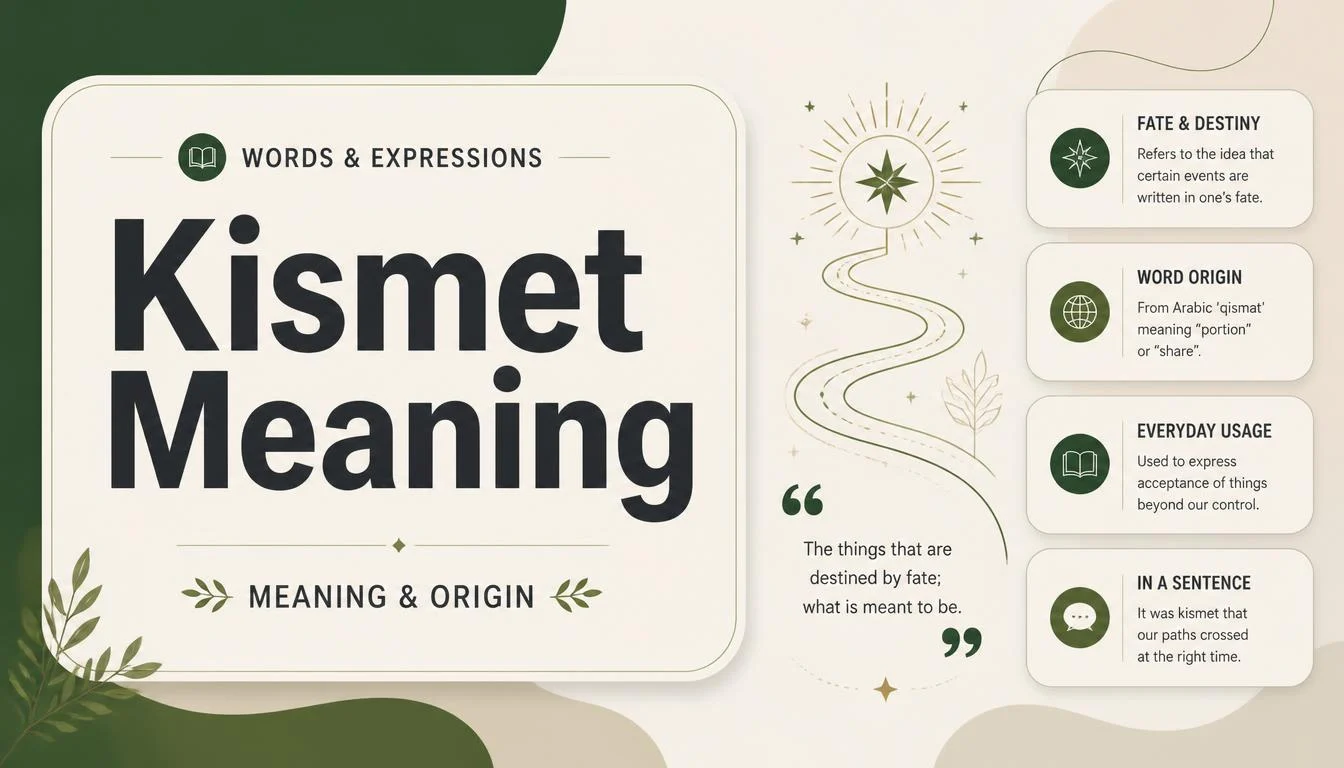
Kismet means fate or destiny, especially when something seems meant to happen. People use it to describe events or relationships that feel destined or beyond their control. For example, meeting your future partner by chance might feel like kismet.
The word kismet describes the idea that certain events in life are meant to happen. It often refers to unexpected meetings, surprising opportunities, or life-changing moments that seem guided by fate. When something feels too perfect to be a coincidence, you might call it kismet.
You may hear kismet in conversations about love, relationships, career opportunities, or surprising twists of fate. The word adds a sense of mystery and meaning to ordinary experiences. For example, if you meet an old friend in a faraway city without planning it, you might say it was kismet.
What Does Kismet Mean?
Kismet means fate or destiny. It refers to an event or outcome that seems predetermined or beyond a person’s control. The word often carries a sense of inevitability, as though life has brought certain circumstances together for a reason.
In everyday English, people use kismet when an event feels unusually meaningful. It can describe a chance encounter, an unexpected opportunity, or a surprising reunion. The word doesn’t necessarily mean that someone believes every detail of life has already been decided.
Kismet Meaning in Simple Words
In simple words, kismet means something that feels meant to happen. Imagine missing a train and meeting someone who later becomes an important part of your life. You might look back at that moment and call it kismet.
The word can also describe difficult situations. Someone might accept an unexpected setback as part of their fate. Whether the event feels fortunate or unfortunate depends on the situation.
Kismet Definition and Part of Speech
According to English dictionary definitions, kismet refers to fate or destiny. It is a noun that people often use when describing events believed to be predetermined.
Here are the basic details:
- Word: Kismet
- Part of speech: Noun
- Meaning: Fate, destiny, or an outcome believed to be predetermined
- Common context: Love, life events, unexpected encounters, and fortune
- Tone: Often reflective, romantic, or literary
For a formal definition, consult the Oxford Learner’s Dictionaries entry for kismet.
How Do You Pronounce Kismet?
The standard American English pronunciation of kismet is KIZ met. The first syllable receives the main stress.
Its pronunciation can be represented as /ˈkɪzˌmɛt/. Some dictionaries may use slightly different phonetic notation.
The word has two syllables and is relatively easy to say once you hear it. If you’re learning English, listen to the pronunciation in the Oxford Learner’s Dictionaries entry.
What Is the Origin of the Word Kismet?
The word kismet has a history that connects several languages and cultures. English borrowed it through Turkish, and its deeper roots are connected to the Arabic word qisma, meaning a division, portion, or allotted share.
The idea behind the word is straightforward. If something has been allotted to you, it can be understood as part of your share in life. Over time, this sense became closely associated with fate and destiny.
Kismet and Its Arabic Roots
The Arabic word qisma is associated with dividing or assigning a portion. The related word qismat appears in languages such as Urdu and Persian. These words share a linguistic history connected to the idea of an allotted share or fate.
The English word kismet came through Turkish kısmet. Its meaning developed around the idea of what fate has assigned to someone. This history explains why kismet is often used when people describe events that seem destined to occur.
When Did Kismet Enter English?
English dictionaries record kismet in the nineteenth century. The word gained recognition as English speakers encountered literature and cultural references that used it to describe fate.
Today, kismet remains part of English vocabulary. It appears in everyday conversation as well as in romantic stories, films, and discussions about destiny.
How Is Kismet Used in Everyday English?
People generally use kismet when an event feels too meaningful or unexpected to be an ordinary coincidence. It can describe something wonderful, something surprising, or an outcome someone has learned to accept.
For example, imagine that you apply for a job you almost decided to ignore. You get the position and discover that it leads to a career you love. You might describe the unexpected opportunity as kismet.
The word can also appear when two people meet in unusual circumstances. If their lives keep crossing in surprising ways, they may wonder whether fate is bringing them together.
Common Expressions With Kismet
Here are a few natural ways to use the word:
- It was kismet: Something seemed destined to happen.
- Pure kismet: An event felt remarkably fortunate or destined.
- A matter of kismet: Something was attributed to fate.
- Perhaps it was kismet: The speaker wonders whether an event was meant to happen.
For example, someone might say, “We both almost canceled our plans, but meeting at that party felt like kismet.” The word adds a sense of significance to an otherwise ordinary meeting.
What Does Kismet Mean in Love and Relationships?
Love is one of the most common contexts in which people use kismet. When two people meet unexpectedly and develop a meaningful connection, they may describe their encounter as fate.
The kismet meaning in love is the belief that two people were meant to cross paths. It can describe an instant attraction, a surprising reunion, or a relationship that begins under unusual circumstances.
However, the word expresses a feeling or belief rather than a guarantee. Calling a relationship kismet doesn’t automatically mean that two people are compatible or destined to stay together.
Kismet and Soulmates
Some people connect kismet with the idea of soulmates. They believe certain people enter their lives for a special reason. A chance meeting may feel significant because it leads to a lasting friendship or romantic relationship.
For example, two people might meet while traveling in different countries and discover that they share similar interests and life goals. They may feel that their meeting was more than a coincidence.
Still, the idea of soulmates is a personal belief. Kismet can describe that feeling without proving that a relationship was predetermined.
Does Kismet Mean Two People Are Meant to Be?
Not necessarily. Kismet can describe a meeting that feels destined, but it doesn’t promise a particular future. Two people can share a meaningful connection and still choose different paths.
The word is most useful when expressing how a relationship feels to the people involved. It captures the wonder of an unexpected meeting without requiring anyone to know what the future holds.
What Is the Spiritual Meaning of Kismet?
The spiritual meaning of kismet relates to beliefs about fate, divine will, and the direction of life. Some people believe that certain events happen according to a greater plan. Others use the word to describe moments that feel meaningful without connecting them to religion.
For someone with spiritual beliefs, kismet may offer comfort during uncertain times. It can help them accept an unexpected change or find meaning in a difficult experience. Another person may use the same word simply because a coincidence seems remarkable.
Kismet should not be treated as identical to every religious teaching about predestination. Beliefs about divine knowledge, human responsibility, and free will vary across traditions. The word can express a broad idea of fate without explaining every aspect of those beliefs.
What Does Kismet Mean in Turkish, Urdu, and Arabic?
Although the word has connections across several languages, its spelling and everyday use differ by culture. Understanding these differences helps explain why kismet can carry a familiar meaning for people from different linguistic backgrounds.
Kismet Meaning in Turkish
In Turkish, kısmet refers to fate, destiny, or what life has allotted to someone. It can appear in conversations about relationships, opportunities, and circumstances that people cannot fully control.
The word may also express acceptance when something doesn’t happen as expected. Someone might use it to suggest that an opportunity wasn’t meant for them at that time.
Kismet Meaning in Urdu
The Urdu word qismat (قسمت) means fate, fortune, or destiny. People commonly use it when discussing life’s opportunities, personal circumstances, and unexpected outcomes.
For example, someone who misses an opportunity might say that it wasn’t in their qismat. This expresses the idea that the outcome was not part of their allotted fate. The meaning is closely related to English kismet, although each word belongs to a different language.
Kismet Meaning in Arabic
The Arabic word qisma (قسمة) is associated with division, a share, or an allotted portion. It is linguistically connected to the history of kismet.
Arabic has other words and expressions for fate and destiny as well. Therefore, qisma should not be treated as a universal substitute for every use of the English word kismet.
Kismet in a Sentence: Examples and Meanings
Seeing the word in context makes its meaning easier to understand. These examples show how kismet can describe relationships, unexpected opportunities, and everyday experiences.
| Example sentence | Meaning |
|---|---|
| Meeting my childhood friend overseas felt like kismet. | The reunion seemed destined to happen. |
| Maybe it was kismet that brought us to the same party. | The meeting felt more meaningful than chance. |
| Finding my dream job through a casual conversation was pure kismet. | An unexpected opportunity felt meant to happen. |
| Their paths crossed again after ten years, and she wondered if it was kismet. | The reunion seemed unusually significant. |
| He accepted the unexpected outcome as kismet. | He viewed the outcome as part of his fate. |
| It felt like kismet when I found the exact book I needed. | The discovery seemed remarkably well timed. |
| They met by chance, but their connection felt like kismet. | Their relationship seemed destined to begin. |
| Perhaps it was kismet that led her to a new city. | She interpreted the move as part of her fate. |
How to Use Kismet Naturally
Use kismet when you want to give an event a sense of fate or significance. It works particularly well when an unexpected occurrence changes someone’s life or brings people together.
For ordinary situations, words such as luck or coincidence may sound more natural. Kismet usually suggests something deeper than a random event, even when the speaker uses it playfully.
What Are the Synonyms of Kismet?
Several English words have meanings close to kismet. However, they carry different shades of meaning, so the best choice depends on the sentence.
| Synonym | Meaning |
|---|---|
| Fate | Events believed to be beyond personal control |
| Destiny | A future or outcome believed to be meant for someone |
| Fortune | Luck or the circumstances affecting a person’s life |
| Predestination | The belief that events have been determined beforehand |
| Providence | Divine guidance or care believed to shape events |
| Luck | Good or bad outcomes influenced by chance |
| Lot | The circumstances or fate assigned to someone |
Fate and destiny are usually the closest synonyms. Providence has a stronger religious association, while luck emphasizes chance rather than a predetermined outcome.
What Is the Opposite of Kismet?
Kismet doesn’t have one perfect antonym. It describes fate or destiny, so its opposite depends on which aspect of the meaning you want to contrast.
- Free will: The ability to make choices independently.
- Chance: An event that happens without an assumed predetermined plan.
- Randomness: An outcome that lacks an identifiable pattern or intention.
- Self determination: The ability to shape your own choices and direction.
These terms contrast with certain interpretations of fate. They aren’t strict opposites in every situation. For example, someone can believe in kismet while also believing that personal choices influence the future.
Kismet vs. Fate, Destiny, Serendipity, and Karma
Kismet is closely related to several familiar concepts. Knowing the differences helps you choose the right word and understand what someone means when they use it.
Kismet vs. Fate
Kismet and fate often mean nearly the same thing. Both can describe an outcome that seems beyond personal control. However, kismet sometimes carries a more literary or culturally specific tone.
For example, “It was fate that we met” and “It was kismet that we met” express similar ideas. The second version may sound more reflective or romantic.
Kismet vs. Destiny
Destiny often emphasizes a future or outcome that someone believes is meant for them. Kismet can describe that same idea, but it also commonly refers to a particular encounter or event.
Someone might describe their career as their destiny. They might call an unexpected meeting kismet.
Kismet vs. Serendipity
Serendipity means discovering something valuable or pleasant by chance. Kismet suggests that an event feels destined to happen.
Imagine finding a useful book while browsing a store. The discovery is serendipitous. If you believe that finding the book happened for a special reason, you might describe it as kismet.
Kismet vs. Karma
Karma has specific meanings within religious and philosophical traditions, including Hinduism and Buddhism. Broadly speaking, it concerns actions and their consequences. Kismet focuses on fate or an outcome believed to be allotted.
The two concepts aren’t interchangeable. Karma shouldn’t be reduced to simple luck, and kismet doesn’t necessarily suggest that someone’s actions caused an event.
Is Kismet a Positive or Negative Word?
Kismet is generally a neutral word. Its emotional meaning depends on the situation and the speaker’s perspective.
A person might describe meeting their partner as positive kismet. Another might use the word when accepting an unexpected disappointment. In both cases, the word refers to fate rather than directly labeling the event as good or bad.
People often use kismet in romantic or hopeful situations because the idea of destiny can feel comforting. However, the word can also express resignation when circumstances don’t go as planned.
What Does Kismet Mean as a Name?
Kismet is also used as a personal name, particularly in Turkish contexts through the form Kısmet. Its meaning is associated with fate, fortune, or destiny.
As a name, it may appeal to people who like the idea of meaningful encounters or a life shaped by unexpected possibilities. Usage and gender associations can vary by culture and community.
The meaning of a name doesn’t determine a person’s personality or future. It simply reflects the word’s linguistic and cultural associations.
FAQs
Does Kismet Mean Everything Happens for a Reason?
Not exactly. Kismet refers to fate or destiny and can express the belief that certain events happen for a reason. However, the word doesn’t prove that every event has a predetermined purpose.
Is Kismet the Same as Being Meant to Be?
The expressions are similar. Both suggest that an event or relationship feels destined to happen. Meant to be is more conversational, while kismet can sound more literary or reflective.
Is Kismet an Arabic Word?
English borrowed kismet through Turkish, and the word has roots in Arabic. Its linguistic history is connected to Arabic qisma, meaning a division, portion, or allotted share.
What Is the Difference Between Kismet and Qismat?
Kismet and qismat share a linguistic history and are both associated with fate or destiny. Kismet is the English word, while qismat is used in languages such as Urdu and Persian.
Can Kismet Describe a Chance Meeting?
Yes. People often use kismet when an unexpected encounter feels meaningful or destined. It is especially common when describing romantic meetings or surprising reunions.
Is Kismet a Religious Word?
Kismet can appear in religious or spiritual discussions about fate and divine will. However, English speakers also use it in everyday conversation without any religious meaning.
What Is a Simple Example of Kismet?
“Running into my old friend on vacation felt like kismet.” The sentence means the unexpected meeting seemed destined to happen.
Conclusion
Kismet means fate or destiny, especially when an event feels as though it was meant to happen. Its history connects English with Turkish and Arabic linguistic roots, while its modern use often appears in conversations about love, life, and unexpected encounters.
Whether you use kismet to describe a surprising reunion or a life changing opportunity, the word captures a familiar human feeling. Sometimes an ordinary coincidence feels like something much more meaningful.