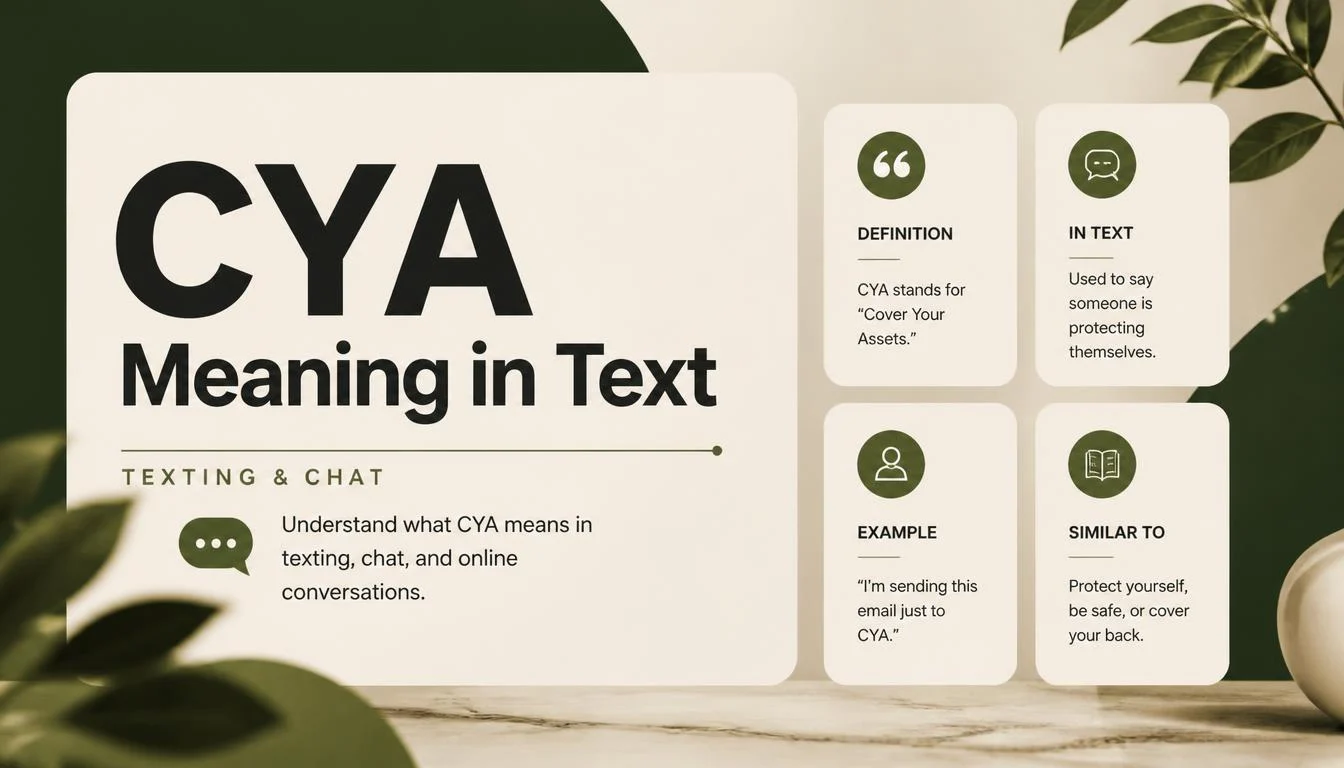
Quick Answer: In a text message or chat, “cya” almost always means “see ya,” a quick, casual goodbye. Outside of texting, the same three letters can stand for “cover your ass,” a workplace habit of building a paper trail to protect yourself. In swimming pool care, CYA is short for cyanuric acid, a chemical that shields chlorine from sunlight. Context tells you which one you’re looking at.
Wondering about the CYA meaning in text? CYA most commonly stands for “see ya,” a casual abbreviation people use when saying goodbye or ending a conversation. It is especially common in texting, online chats, and social media where short expressions are preferred.
However, CYA meaning in text can depend on the context. In some workplace or professional conversations, CYA can mean “cover your ass,” referring to taking precautions or protecting yourself from blame. Knowing the surrounding conversation can help you understand which meaning is intended.
Where the Three Letters Came From
Texting shorthand has always been about saving effort. Early phone keypads made every letter cost you a few button presses, so people chopped words down to their sounds. “See you” became “c u,” then “cya,” and the trend stuck long after touchscreens made typing easy.
The spelling follows pronunciation rather than grammar. “Ya” is how most English speakers actually say “you” at the end of a casual goodbye, so the abbreviation reads like a spoken sigh more than a written word. That’s part of why it feels so relaxed.
It also pairs naturally with other leftovers from the early messaging era, like “ttyl” (talk to you later), “brb” (be right back), and “l8r” (later). Of that group, cya has aged the best. You can still send it in 2026 without sounding like you’re quoting a flip phone.
The Three Lives of CYA
Most people only know one version of this abbreviation, and they’re usually surprised to learn there are others. The three meanings come from completely different worlds, so they rarely collide, but when they do, the confusion is real. Here’s how they compare.
| Meaning | Stands for | Where you’ll see it | Tone |
|---|---|---|---|
| Casual goodbye | “See ya” | Texts, DMs, Discord, WhatsApp | Relaxed, quick, friendly |
| Self-protection | “Cover your ass” | Offices, email threads, meetings | Cynical, defensive, sometimes joking |
| Pool chemical | Cyanuric acid | Pool supply stores, maintenance forums | Technical, neutral |
The first is the one your friends send. The second is the one your coworker mutters after copying six people on an email. The third belongs to anyone who has ever stood at the edge of a green pool wondering what went wrong.
Why Lowercase “cya” Hits Different
Here’s the thing about a three-letter goodbye: it carries more tone than its size suggests. Written in lowercase with no punctuation, “cya” sounds easygoing. It says the conversation was fine and you’re moving on with your day.
Add a period, and everything changes. “Cya.” can read as cold, final, or a little irritated, especially if the previous message was an argument or a disagreement. Plenty of people read a clipped sign-off like that as a door closing rather than a wave.
Capitalization matters too. “CYA” in all caps in a chat feels loud and slightly theatrical, closer to a shout across a parking lot. In a work message, all-caps CYA is far more likely to mean the defensive one, which is a very different energy from a friendly goodbye.
Emoji soften or sharpen the whole thing. “cya 👋” is warm. “cya 🙂” from someone who was just annoyed with you is a different story entirely. Longer messages generally give more warmth, so a bare “cya” after a long, friendly conversation can feel abrupt. Tone in text is mostly about what surrounds the words, and this three-letter sign-off is a clean example.
The Digital Irish Goodbye and Other Exits
An “Irish goodbye” is the habit of leaving a party without telling anyone. The online version is slipping out of a group chat or call without announcing it, and “cya” sits somewhere interesting on that spectrum. It’s the polite middle option: you acknowledge you’re leaving, but you spend almost no effort doing it.
Compare it to the other common exits. “Ttyl” promises a future conversation, which makes it slightly more committal. “Gtg” (got to go) explains the exit with an excuse. “Bye” is neutral and a bit formal for casual texting.
Then there’s ghosting, which is the complete absence of any sign-off. The difference between ghosting and a quick “cya” is that the second one closes the loop. Even a cold “cya” tells the other person the conversation is over, which many people find kinder than silence.
So if you want to leave a chat without drama, “cya” is a reasonable choice. It works best when the conversation was already winding down. Dropping it mid-argument tends to read as a mic drop, and not a flattering one.
Paper-Trail Culture at Work
The other meaning of CYA has nothing to do with farewells. “Cover your ass” is blunt American workplace slang, widely believed to have spread through military and corporate culture in the second half of the twentieth century. It describes any action taken mainly to protect yourself from blame rather than to do the work better.
You’ll often hear it as a modifier. A “CYA email” is a message sent so there’s a written record that you warned someone, asked a question, or followed procedure. A “CYA memo” does the same job on paper. Even the familiar passive-aggressive phrase “per my last email” has CYA energy: it points to the record.
This habit isn’t always cynical. In regulated fields like healthcare, finance, and construction, documentation protects everyone involved, and writing things down is simply good practice. The slang gets its edge when the paper trail replaces actual communication, and people send forty emails to avoid one honest conversation.
A useful test is intent. If the record helps the team understand what was decided, it’s documentation. If its main purpose is to make someone else look careless later, that’s the defensive kind. People use the abbreviation to point at the second one, usually with a raised eyebrow.
One more wrinkle: the workplace version almost never shows up in casual texting. If a coworker sends “cya tmrw” at 5 p.m., they’re saying goodbye, not confessing to anything. Context carries all the weight here.
The Pool Meaning Nobody Searches For
This is the least expected version, and probably the one with the least written about it for everyday readers. In pool care, CYA stands for cyanuric acid, a chemical compound with the formula C3H3N3O3. Pool owners add it as a stabilizer, sometimes called conditioner.
Its job is protecting chlorine from the sun. Without a stabilizer, ultraviolet light breaks down chlorine in outdoor pools surprisingly fast, which means you keep adding more and never quite catch up. A bit of CYA slows that loss and keeps your sanitizer working longer.
More is not better, though. Many pool guides suggest keeping levels in roughly the 30 to 50 parts per million range, though recommendations vary by pool type and by whose advice you follow. Too much cyanuric acid can make chlorine less effective, a problem pool forums often describe as “chlorine lock.” Public aquatics guidance, such as the Model Aquatic Health Code from the Centers for Disease Control and Prevention, also treats stabilizer levels as something to monitor rather than ignore.
If you stumbled onto this article because a pool store employee said “check your CYA,” now you know. They weren’t telling you to protect yourself or say goodbye. They were telling you to test your water.
Cya in Group Chats, Discord, and Gaming Lobbies
Platforms shape how the abbreviation lands. In a WhatsApp or iMessage thread with friends, “cya” is an easy way to end a conversation without ceremony. Nobody expects a long goodbye.
On Discord, it fits the rhythm of voice and text channels, where people hop in and out constantly. Leaving a game lobby with a quick “cya” or “gg, cya” is standard behavior. It acknowledges the group without making a production of it.
Slack and workplace chat tools are trickier. Colleagues might use “cya” with people they know well, but with a manager or a client it can feel a little too breezy. In those cases, “talk soon” or “see you tomorrow” lands more safely, and no one has to wonder which meaning you intended.
Age plays a role as well. Younger users tend to treat classic shorthand as a bit retro, sometimes using it ironically. Older users may use it earnestly, because it’s what they grew up typing. Neither group is wrong, but the same message can feel different depending on who reads it.
When in doubt, match the energy of whoever you’re talking to. If they write long, warm messages, a bare “cya” might feel clipped. If they send single words and emoji, you’re fine.
FAQs
Is “cya” rude?
Not by default. It becomes rude only when the surrounding conversation is tense, or when you add punctuation or tone that makes it feel final. Between friends in a relaxed chat, it’s perfectly normal.
How is “cya” different from “cu” or “c u”?
They all come from “see you,” but “cya” mirrors the spoken “see ya,” which makes it sound friendlier and less abrupt. “C u” is the older, more stripped-down version and is rarer now.
Can I use “cya” in a professional email?
It’s best avoided in formal writing. A clear closing line like “see you Thursday” or “talk soon” removes any doubt, and it keeps the defensive meaning out of the reader’s head.
Do people say “CYA” out loud in the workplace?
Yes, though usually in a joking or knowing way. Someone might say “I’m just doing this for CYA” to explain why they’re documenting something that seems unnecessary.
Is cyanuric acid safe in a pool?
In typical, moderate amounts it’s a standard part of outdoor pool care. The risks come from letting levels climb too high, so testing regularly and following your product label matters more than any single number.
Conclusion
Three letters, three completely different worlds. In your texts, “cya” is a quick wave. In your inbox, CYA is a quiet admission that someone is worried about blame. At the pool store, it’s a chemical that keeps your water clear.
The trick is reading the room. Check who sent it, where it appeared, and what came right before it. Once you do, the intended meaning is usually obvious.
1 thought on “CYA Meaning in Text | Goodbye, Cover-Up or Pool Chemistry In 2026”