Quick Answer:
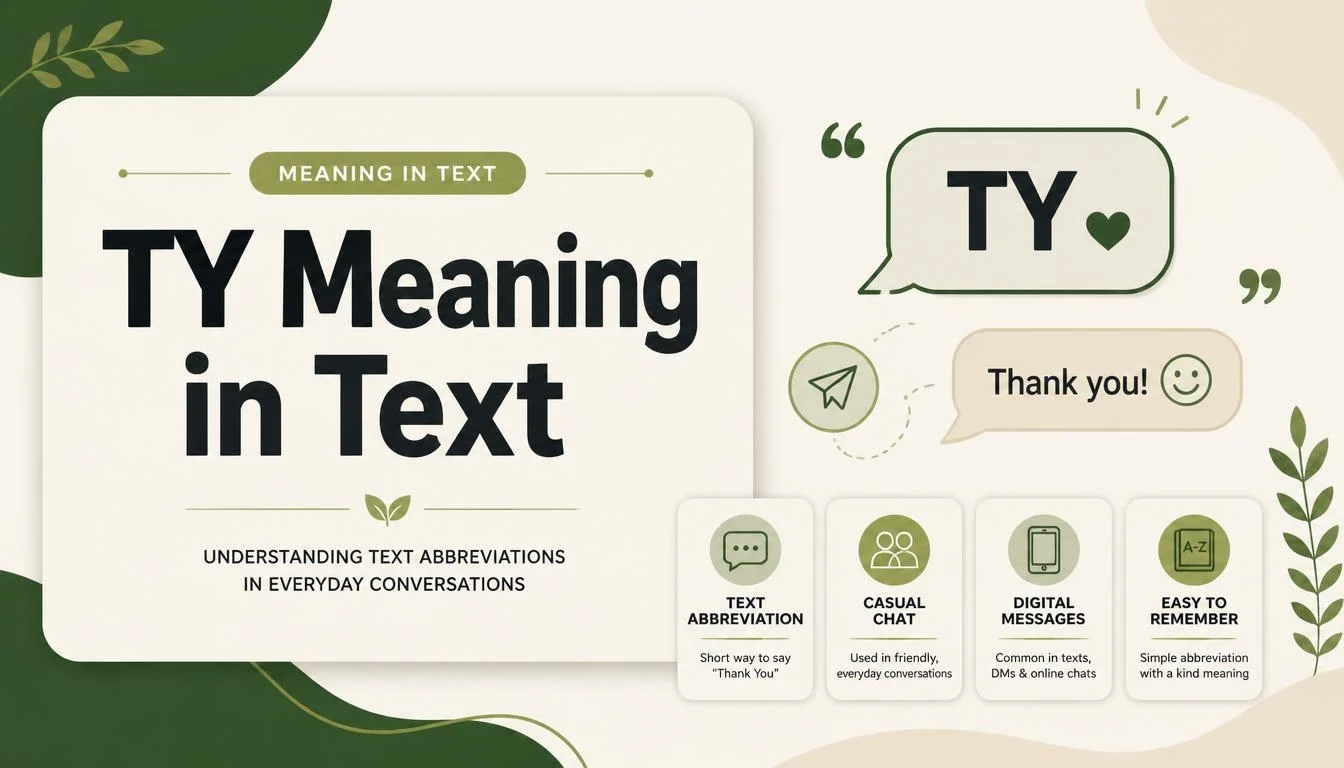
TY means “Thank You” in text messages and online conversations. People use this abbreviation to express gratitude quickly and casually. For example, if someone helps you with something, you can reply, “TY for your help!” to show appreciation.
The abbreviation TY meaning in text is simple: it stands for “Thank You.” People commonly use it in text messages, social media comments, online chats, and gaming conversations when they want to show appreciation without typing the full phrase. It’s a quick and friendly way to acknowledge someone’s help, kindness, or thoughtful gesture.
You might see TY when a friend shares useful information, someone does you a favor, or a person sends you something you’ve been waiting for. Depending on the conversation, it can sound casual, polite, or friendly. For example, replying “TY so much!” is an easy way to thank someone while keeping your message short and natural.
What Does TY Mean in Text?
TY is a common texting abbreviation that stands for “Thank You.” People use it when they want to express gratitude without typing the complete phrase. It’s especially popular in casual conversations where short messages keep the exchange quick and natural.
For example, imagine your friend sends you the notes from a class you missed. Instead of writing a lengthy response, you might reply, “TY for sharing these!” The abbreviation communicates appreciation while keeping the conversation relaxed.
The TY abbreviation meaning doesn’t usually change between messaging platforms. It remains a simple expression of thanks in text messages, direct messages, online gaming chats, and social media comments.
Here are a few everyday examples:
- “TY for your help!”
- “TY for reminding me.”
- “TY! I really appreciate it.”
- “TY for sending the pictures.”
- “TY, that’s so kind of you.”
Although TY is short, it can still communicate genuine appreciation. Adding a few extra words or an emoji can make the message feel warmer.
What Does TY Stand for in Texting?
TY stands for Thank You. It comes from the first letters of both words, making it easy to type and recognize.
People often use shortened expressions because they make digital communication faster. Just like BRB means “Be Right Back” and BTW means “By the Way,” TY saves time while keeping the original message clear.
You might also see TY described as an abbreviation, texting acronym, or chat shorthand. Technically, it’s an initialism because people pronounce the letters individually rather than saying them as one word.
Regardless of the terminology, its everyday meaning stays the same: someone is expressing thanks.
What Does TY Mean in Different Conversations?
The basic definition remains consistent, but the situation can influence how you interpret the message. A TY from a friend might feel casual, while one from a coworker could simply acknowledge your assistance.
TY Meaning From a Girl
When a girl sends you TY, she generally means “Thank You.” She might be appreciating a compliment, acknowledging a favor, or responding to something thoughtful.
For example:
- You: “I saved you a seat.”
- Her: “TY! That’s so sweet.”
Her response shows appreciation for your gesture. However, don’t automatically interpret TY as flirting or romantic interest. The surrounding conversation provides better clues about her intentions.
If she adds a smiley face, asks another question, or continues the conversation, those details can help you understand her overall tone.
TY Meaning From a Guy
When a guy texts TY, he usually wants to acknowledge something you’ve done or shared. It could be a straightforward response to help, advice, a gift, or useful information.
For example:
- You: “Here’s the address for the restaurant.”
- Him: “TY, I’ll check it out.”
In this situation, he’s simply thanking you. The abbreviation doesn’t necessarily indicate a deeper emotion or hidden message.
TY Meaning After a Compliment
If someone sends TY after receiving a compliment, they’re acknowledging your kind words.
For example:
- You: “You looked amazing at the party!”
- Them: “TY! I appreciate that.”
This is a natural way to accept praise without making the exchange awkward. Depending on the relationship, they might add a heart emoji or another friendly expression.
TY Meaning After Someone Helps You
People frequently use TY after receiving assistance. It works particularly well when someone solves a problem, shares useful information, or takes time out of their day to help.
For example:
- “TY for explaining that question.”
- “TY for helping me move.”
- “TY for covering my shift.”
Each message recognizes someone’s effort and communicates appreciation.
TY in a Romantic Conversation
In romantic conversations, TY still means Thank You. Someone might use it after receiving a sweet message, thoughtful compliment, or small gift.
For example:
- You: “I had a great time with you tonight.”
- Them: “TY! I enjoyed it too.”
The additional words provide more emotional context than TY alone. Therefore, consider the complete exchange rather than reading romantic meaning into the abbreviation.
What Does TY Mean on Social Media?
TY appears across many social media platforms. People use it in comments, direct messages, replies, and group discussions to acknowledge something positive.
Its full form remains “Thank You.” However, the situations in which people use it can differ slightly.
TY Meaning on Snapchat
On Snapchat, TY commonly appears in private chats and snap replies. Someone might send it after receiving a compliment, funny picture, or helpful response.
For example:
- “TY for the snap!”
- “TY, you’re the best.”
- “TY for letting me know.”
It’s simply a convenient way to acknowledge another person’s message.
TY Meaning on Instagram
Instagram users often write TY in comments and direct messages. You might see it when someone responds to a compliment, thanks a follower, or acknowledges a recommendation.
For example:
- “TY for the support!”
- “TY! Love your comment.”
- “TY for sharing my post.”
Creators may also use it when responding to positive feedback from their audience.
TY Meaning on WhatsApp
On WhatsApp, TY is common in personal conversations and group chats. People use it when someone shares a document, sends important information, or completes a favor.
For example:
- “TY for sending the location.”
- “TY everyone for your wishes!”
- “TY for the update.”
It’s especially useful when you want to acknowledge a message without starting a longer conversation.
TY Meaning on TikTok
On TikTok, TY often appears in comments and direct messages. Viewers might use it to appreciate a creator’s response or thank someone for sharing useful content.
For example:
- “TY for explaining this!”
- “TY for the recommendation.”
- “TY for making this video.”
It’s a simple expression of gratitude in online communities.
TY in Discord and Online Gaming
Gamers and Discord community members often use short abbreviations to communicate quickly. TY is one of the expressions they use when another player provides assistance or shares something useful.
For example:
- “TY for the backup!”
- “TY for the invite.”
- “TY for helping with that mission.”
The abbreviation fits naturally into fast conversations where shorter messages are convenient.
How to Use TY in a Text Message
Knowing the TY full form in chat is helpful, but understanding when to use it makes your messages sound more natural. You can use it in several everyday situations.
1. When Someone Helps You
If a friend or coworker helps you complete something, TY is a quick way to acknowledge their effort.
Example: “TY for helping me finish the presentation!”
2. When Someone Gives You a Compliment
You can use TY to accept a compliment without writing a lengthy response.
Example: “TY! That means a lot.”
3. When Someone Sends You Information
When someone shares an address, document, link, or update, TY works as a simple acknowledgment.
Example: “TY for sending me the details.”
4. When Someone Gives You a Gift
A short thank-you message can still sound warm and sincere.
Example: “TY for the birthday present! I absolutely love it.”
5. When Someone Offers Emotional Support
TY can also acknowledge kindness during difficult moments.
Example: “TY for listening. I really needed someone to talk to.”
6. When Someone Shares Something Useful
If someone recommends a product, website, or helpful resource, you can thank them with TY.
Example: “TY for sharing that article. It answered my question.”
The key is to match your message to the situation. A simple TY works for everyday exchanges, while a longer thank-you message may feel more thoughtful when someone makes a significant effort.
How to Respond to TY in Text
Wondering what to say when someone sends you TY? The good news is that you don’t need a complicated response. A short and friendly acknowledgment usually works perfectly.
Here are some natural options:
| Response | Best Situation |
|---|---|
| You’re welcome! | Everyday conversations |
| No problem! | Casual chats |
| Anytime! | When you’re happy to help again |
| Of course! | Friendly and supportive exchanges |
| Happy to help! | Personal or professional conversations |
| NP | Quick informal replies |
| YW | Short texting responses |
| Glad I could help! | When someone appreciates your assistance |
| Don’t mention it! | Small favors |
| My pleasure! | Polite or professional exchanges |
Short Replies to TY
If the conversation is casual, these quick responses work well:
- NP
- YW
- Anytime!
- Sure!
- No worries.
- Of course!
Friendly Replies to TY
Want your response to sound a little warmer? Try these:
- “You’re always welcome!”
- “Glad I could help.”
- “Of course, happy to help!”
- “No worries at all!”
- “Anytime you need me!”
Professional Replies to TY
For workplace conversations, choose a polite response that matches the situation:
- “You’re welcome.”
- “Happy to assist.”
- “Glad I could help.”
- “It was my pleasure.”
- “You’re very welcome.”
You don’t need to respond to every TY with another message. Sometimes, the conversation has already reached a natural stopping point.
TY vs. TYSM vs. THX: What’s the Difference?
TY, TYSM, and THX all express gratitude. However, they differ slightly in wording and emphasis.
| Abbreviation | Full Form | Meaning |
|---|---|---|
| TY | Thank You | Simple expression of thanks |
| TYSM | Thank You So Much | More enthusiastic gratitude |
| TYVM | Thank You Very Much | Emphasized appreciation |
| THX | Thanks | Short and casual thanks |
| TNX | Thanks | Informal alternative spelling |
| TQ | Thank You | Alternative shorthand used in some communities |
| TYSVM | Thank You So Very Much | Extra emphasis |
| TIA | Thanks in Advance | Appreciation before receiving help |
TY vs. TYSM
The main difference is the level of emphasis.
TY simply means Thank You. TYSM adds “So Much,” making the appreciation sound stronger.
For example:
- “TY for the notes!” communicates simple gratitude.
- “TYSM for the notes!” sounds more enthusiastic and appreciative.
Use TY for everyday exchanges. Choose TYSM when someone has done something especially helpful or thoughtful.
TY vs. THX
Both abbreviations express thanks, so their meanings are very similar.
TY is short for “Thank You,” while THX represents “Thanks.” Neither is inherently more polite than the other.
Examples:
- “TY for the update.”
- “THX for the update.”
Both messages acknowledge the information and express appreciation.
TY vs. TYVM
TYVM stands for “Thank You Very Much.” It adds emphasis to the original expression.
For example, “TYVM for helping me” communicates stronger appreciation than a simple “TY.” The choice depends on how much emphasis you want to convey.
TY vs. TIA
These two abbreviations serve different purposes.
TY expresses gratitude after someone does something for you. TIA means “Thanks in Advance” and usually appears when you’re requesting assistance.
For example:
- TY: “TY for sending the document.”
- TIA: “Could you send me the document? TIA!”
Is TY Rude or Polite in Texting?
TY is generally considered polite because it expresses gratitude. However, some people might interpret a very short response as distant or uninterested.
The difference often comes down to context, personal communication habits, and your relationship with the other person.
Consider these examples:
| Message | Possible Impression |
|---|---|
| TY | Simple and casual |
| TY! | Friendly and appreciative |
| TY so much! | Warm and enthusiastic |
| TY 😊 | Friendly and cheerful |
| TY ❤️ | Affectionate or warm |
| TY. | Brief or neutral, depending on context |
A period doesn’t automatically make TY rude. Some people naturally use punctuation in every message. Others rarely include it.
If you want your appreciation to sound more personal, add a few words. For example, “TY, I really appreciate your help!” feels warmer than a two-letter response.
Is TY Formal or Informal?
TY is primarily an informal texting abbreviation. It works well in everyday conversations with friends, relatives, classmates, and people you know.
However, it isn’t always the best choice for professional communication. The audience and setting should guide your decision.
Can You Use TY in Professional Messages?
Yes, you can use TY in relaxed workplace conversations, especially when communicating through internal messaging platforms.
For example:
Casual workplace chat:
“TY for sending the report!”
Formal email:
“Thank you for sharing the report. I appreciate your help.”
The complete phrase “Thank You” sounds more polished in formal emails, business proposals, client communication, and official correspondence.
When you’re unsure about the appropriate tone, writing the complete phrase is the safer option.
Is TY an Acronym or an Abbreviation?
TY is commonly called a texting abbreviation because it shortens the phrase “Thank You.”
More technically, it’s an initialism. An initialism uses the first letters of multiple words, which people pronounce separately.
For comparison, NASA is an acronym because people pronounce it as a word. TY is pronounced by saying the two individual letters.
In everyday conversations, however, most people simply call TY an abbreviation or texting shorthand. Both descriptions make sense in informal usage.
Other Common Texting Abbreviations Related to TY
If you regularly chat online, you’ll probably encounter several other abbreviations that express thanks or acknowledge someone’s message.
Here are some useful ones to recognize:
| Abbreviation | Full Form | Meaning |
|---|---|---|
| TYSM | Thank You So Much | Strong appreciation |
| TYVM | Thank You Very Much | Emphasized thanks |
| THX | Thanks | Casual gratitude |
| TIA | Thanks in Advance | Appreciation before help |
| NP | No Problem | No trouble or inconvenience |
| YW | You’re Welcome | Response to thanks |
| TNX | Thanks | Alternative spelling |
| TQ | Thank You | Short thank-you expression |
| BTW | By the Way | Introduces additional information |
| ILY | I Love You | Expresses affection |
These expressions make online conversations shorter and more convenient. However, their meanings depend on the situation, so understanding the surrounding message always helps.
FAQs
1. What does TY mean in text?
TY means “Thank You.” It’s a common texting abbreviation people use to express gratitude, acknowledge assistance, or appreciate someone’s kindness.
2. What does TY stand for in texting?
TY stands for Thank You. It uses the first letter of each word to create a quick expression commonly found in text messages and online conversations.
3. Is TY short for thank you?
Yes. TY is a shortened form of Thank You. People use it when they want to express appreciation without typing the complete phrase.
4. What does TY mean from a girl?
When a girl sends TY, she generally means Thank You. She might be acknowledging a compliment, appreciating your help, or responding to a thoughtful gesture. The surrounding conversation determines whether there’s any additional meaning.
5. What does TY mean from a guy?
A guy usually uses TY to express gratitude or acknowledge something you’ve done. It doesn’t automatically indicate romantic interest or a particular emotional response.
6. How do you respond to TY in a text?
You can reply with “You’re welcome,” “No problem,” “Anytime,” or “Happy to help.” Choose a response that matches your relationship and the conversation’s tone.
7. Is TY rude in texting?
No. TY is generally a polite and friendly expression. However, a very short reply might feel distant in certain situations. Adding a few extra words can make your appreciation sound warmer.
8. What is the difference between TY and TYSM?
TY means Thank You, while TYSM means Thank You So Much. TY expresses basic gratitude, whereas TYSM adds more emphasis and enthusiasm.
9. What does TY mean after a compliment?
TY after a compliment means the person appreciates your kind words. It’s a simple way to acknowledge praise without needing a lengthy response.
10. Can TY be used in professional messages?
Yes, TY can work in casual workplace chats and informal team conversations. For formal emails, client communication, and business correspondence, writing “Thank You” in full is generally more appropriate.
Conclusion
The TY meaning in text is simple: it stands for Thank You. People use it across messaging apps, social media platforms, and online communities to express gratitude quickly. Whether someone sends it after a compliment or a helpful gesture, the basic message remains the same. When you want a quick and friendly way to show appreciation, TY gets the job done.