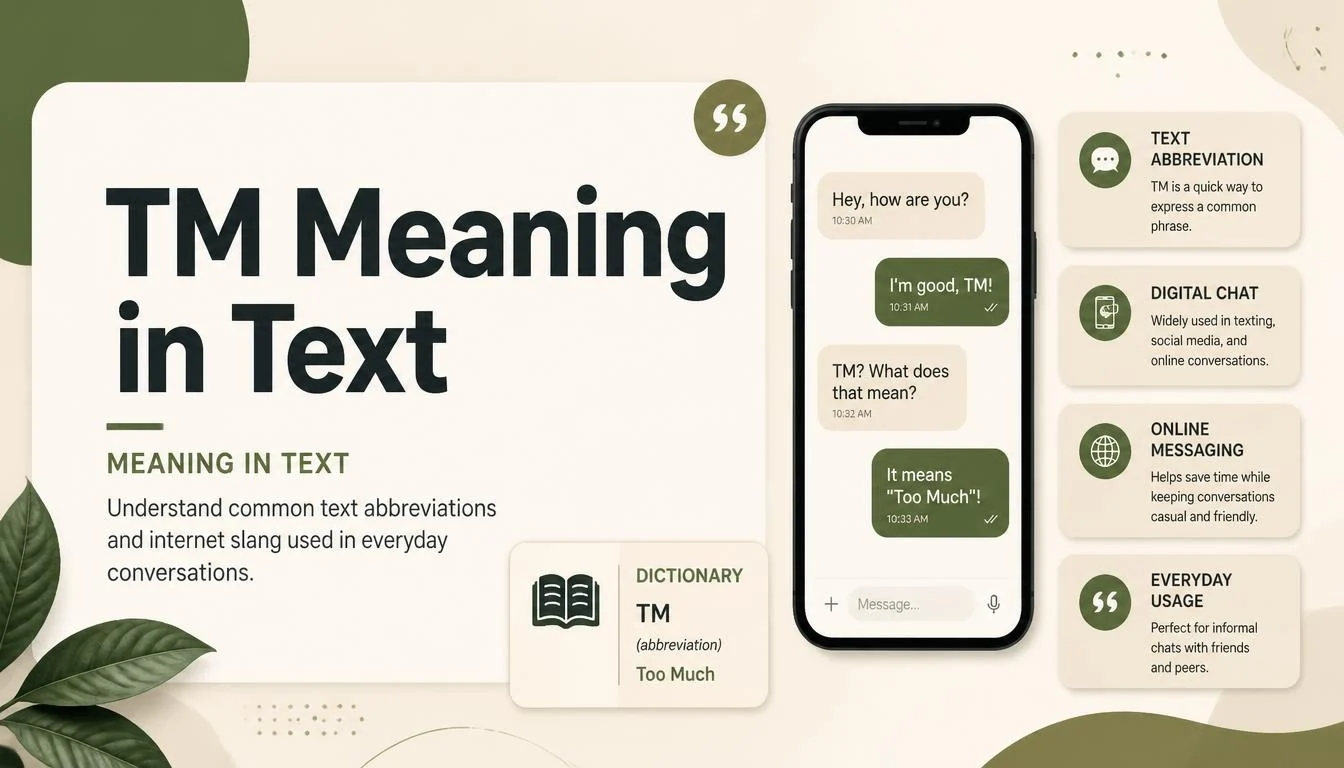
Quick Answer:
TM in text most commonly means “Text Message” or “Trust Me,” depending on the conversation. It can also stand for “Too Much” in casual texting and online chats. The exact meaning depends on the context and how someone uses it in a message.
Have you received a message containing TM and wondered what the sender was trying to say? This short abbreviation can have different meanings in texting, depending on the conversation. Someone might use it to mean “Trust Me,” “Too Much,” or even “Text Message” when chatting with friends.
You may also come across TM on social media, in comments, or in private messages. Since abbreviations often have multiple interpretations, understanding the surrounding conversation can help you figure out the intended meaning. In this guide, we’ll explore the common meanings of TM in text, along with examples of how people use it.
What Does TM Mean in Text?
TM doesn’t have one universally accepted meaning in everyday texting. Its interpretation depends on the sentence, conversation topic, and personal habits of the sender.
Some people may use TM as shorthand for tomorrow, text me, or trust me. However, these aren’t standardized meanings that everyone recognizes. The trademark meaning is much more established, especially when TM appears beside a company, product, or brand name.
Here are some possible interpretations:
| TM Meaning | Explanation | Example |
|---|---|---|
| Tomorrow | Refers to the following day | “See you tm!” |
| Text Me | Asks someone to send a message | “TM when you arrive.” |
| Trust Me | Expresses confidence or reassurance | “TM, you’ll enjoy it.” |
| Too Much | May represent an informal personal shortcut | Depends on context |
| Text Message | Refers to a written message | “I received your text message.” |
| Team Member | Refers to someone in a group or workplace | “Ask another team member.” |
| Trademark | Identifies a claimed brand mark | “BrandName™” |
It’s important to remember that not every possible expansion represents established texting slang. When someone sends TM, look at the complete message before deciding what it means.
Different Possible Meanings of TM in Texting
A closer look at each interpretation makes the abbreviation easier to understand.
1. TM Meaning Tomorrow
Some people use lowercase tm as an informal shortcut for tomorrow. It may appear when friends discuss upcoming plans, appointments, school activities, or work schedules.
For example, someone might write, “I’ll see you tm.” The intended message is that they’ll meet you the following day.
Examples:
- “Are we still meeting tm?”
- “I’ll call you tm morning.”
- “Can’t wait to see you tm!”
- “Let’s finish the project tm.”
TMRW is another recognizable abbreviation for tomorrow. It’s often clearer because it closely resembles the original word.
2. TM Meaning Text Me
Another possible interpretation is text me. Someone might use these letters when asking another person to send a message later.
For example, “TM when you get home” could mean that the sender wants you to contact them after arriving.
Examples:
- “TM when you’re free.”
- “TM after your class.”
- “Let me know when you arrive. TM!”
- “TM if you need any help.”
However, TM isn’t a universally recognized replacement for text me. If the sentence doesn’t make the request clear, it’s better to ask what the sender means.
3. TM Meaning Trust Me
TM may also represent trust me in an informal conversation. Someone might use this interpretation when offering reassurance or encouraging another person to believe what they’re saying.
For example, imagine you’re unsure about trying a new restaurant. Your friend replies, “TM, the food is amazing!”
They’re expressing confidence in their recommendation.
Examples:
- “TM, you’ll love this movie.”
- “TM, everything will work out.”
- “TM, that place is worth visiting.”
People generally write trust me in full when they want to avoid confusion. Don’t assume this meaning without checking the surrounding conversation.
4. TM Meaning Too Much
Some people may use TM as a personal abbreviation for too much. However, this isn’t a widely standardized texting shortcut.
For instance, someone might shorten the expression while chatting with friends who already understand their texting habits.
A more recognizable way to communicate the same reaction is to write “too much” or use an established expression such as “TMI” when referring to too much information.
5. TM Meaning Text Message
In conversations about phones, messaging, or communication, TM may refer to a text message. However, SMS and text message are clearer terms when discussing the technology itself.
For example:
“Did you get my text message?”
Here, the conversation concerns an actual written message rather than informal slang.
6. TM Meaning Team Member
In workplace conversations, TM may serve as an abbreviation for team member. Its meaning depends on the organization’s terminology.
For example:
“Ask another TM to help with the assignment.”
In this situation, the sender may be referring to another person on the team. Workplace abbreviations often differ between companies, so context remains important.
TM Meaning in Chat and Text Messages
The position of TM in a message can provide useful clues. However, placement alone doesn’t establish its meaning.
TM at the Beginning of a Message
When TM appears at the beginning, check whether the sender is making a request or emphasizing a statement.
For example:
- “TM when you reach home.”
- “TM, you’ll understand soon.”
The first sentence could suggest a request to text someone. The second may suggest trust me, although writing the complete expression would be clearer.
TM at the End of a Message
When TM appears at the end, it may relate to timing or personal texting shorthand.
For example:
- “I’ll see you tm.”
- “Call me tm.”
- “We can discuss it tm.”
In these examples, tomorrow is a reasonable interpretation because the sentences discuss future plans.
TM as a Standalone Message
A message containing only “TM” can be difficult to understand. Without the previous conversation, you might not know whether the sender means tomorrow, text me, or something else.
Instead of guessing, simply ask, “What do you mean by TM?”
A quick clarification can prevent an unnecessary misunderstanding.
TM Meaning on Social Media Platforms
TM appears in different forms across social media. However, Instagram, Snapchat, TikTok, and WhatsApp don’t assign the abbreviation separate official meanings.
People use informal shorthand according to their own communication styles. The trademark symbol also appears frequently in usernames, captions, and brand references.
TM Meaning on Instagram
On Instagram, TM may appear in direct messages, comments, and captions. Someone might use informal shorthand while discussing plans or asking a friend to send another message.
You may also notice the ™ symbol after a username or phrase.
For example:
“Coffee Lover™”
This could be a playful way of presenting a personal identity or claiming a humorous title. It doesn’t necessarily indicate an officially registered trademark.
TM Meaning on Snapchat
Snapchat conversations often involve short messages and quick replies. Someone might use TM as personal shorthand when discussing future plans or asking another person to get in touch.
For example:
“See you tm!”
In this context, tomorrow is a reasonable interpretation.
However, don’t assume every Snapchat message containing TM has the same meaning. Previous messages can provide important clues.
TM Meaning on TikTok
On TikTok, TM may appear in comments, captions, and creator usernames.
One interesting use involves the trademark symbol after an ordinary word or phrase. People sometimes add ™ humorously to suggest that a particular expression, habit, or personality trait belongs to them.
For example:
“Professional overthinker™”
This is usually playful internet humor rather than a formal legal statement.
TM Meaning on WhatsApp
WhatsApp users often rely on shortened expressions when chatting with friends, family, and coworkers.
TM may appear in conversations about upcoming plans or personal requests. For example, someone might write, “Call me tm when you’re free.”
Here, tomorrow is a reasonable interpretation.
In a workplace group, however, TM could refer to a team member. The topic of the conversation helps distinguish these possibilities.
TM Meaning on Facebook and Messenger
Facebook comments and Messenger conversations use many of the same informal expressions found elsewhere online.
You might encounter TM in a private message, group discussion, or business page. If it appears beside a company or product name, the trademark interpretation becomes more likely.
What Does TM Mean From a Girl or a Guy?
Does TM have a different meaning depending on who sends it? Not necessarily.
The abbreviation itself doesn’t change based on someone’s gender. The conversation and relationship between the people involved matter much more.
TM Meaning From a Girl
If a girl sends you TM, consider what you were discussing before receiving the message.
For example:
- “See you tm!” could refer to tomorrow.
- “TM when you get home” could be a request to send a message.
- “TM, you’ll love it!” could suggest trust me.
Don’t automatically interpret TM as a romantic signal. It doesn’t have an established flirty meaning on its own.
TM Meaning From a Guy
The same interpretations apply when a guy sends TM.
For example, if he writes, “I’ll call you tm,” he’s likely referring to tomorrow. If he says, “TM, everything is fine,” he might be using personal shorthand for trust me.
The surrounding conversation provides more useful information than the sender’s gender.
Does TM Have a Flirty Meaning?
TM isn’t inherently romantic or flirtatious. Its meaning depends on the words around it and the relationship between the people communicating.
Emojis, playful comments, and previous messages can influence the tone. Still, two letters alone aren’t enough to establish someone’s feelings.
What Does the TM Symbol (™) Mean?
Outside casual texting, TM has a well-established meaning. It stands for trademark and commonly appears as the ™ symbol.
A trademark identifies a particular business, product, or service. It helps customers recognize the source of something and distinguish it from competing offerings.
According to the United States Patent and Trademark Office (USPTO), trademarks can include words, phrases, symbols, designs, or combinations of these elements.
What Is a Trademark?
A trademark is a recognizable identifier associated with particular goods or services.
For example, a business might use a distinctive name, logo, or slogan to help customers identify its products. That identifier can function as a trademark.
Trademarks play an important role in brand identity. They also help businesses distinguish their offerings in the marketplace.
Why Do Brands Use the ™ Symbol?
Businesses use ™ to notify the public that they’re claiming a particular name, phrase, or design as a trademark.
You’ll often see it beside:
- Company names
- Product names
- Brand slogans
- Logos
- Marketing phrases
- Distinctive business identifiers
For example:
- BrightHome™
- FreshGlow™
- SmartLiving™
The symbol communicates a trademark claim. However, it doesn’t automatically prove that the mark has received official registration.
Can You Use ™ Without Registering a Trademark?
Yes. In the United States, you can generally use ™ to identify a claimed trademark without first obtaining federal registration.
The USPTO explains that businesses can use TM for goods even if they haven’t filed a trademark application. However, using the symbol doesn’t guarantee legal protection or establish federal registration.
Trademark rights depend on applicable law and the circumstances surrounding the mark’s use. For specific legal questions, consult a qualified trademark professional.
Difference Between TM, ™, ®, SM, and ©
These symbols may look similar in branding materials, but they serve different purposes.
| Symbol | Full Form | What It Represents |
|---|---|---|
| TM or ™ | Trademark | A claim to a trademark |
| ® | Registered Trademark | A registered trademark |
| SM or ℠ | Service Mark | A claim to a service mark |
| © | Copyright | Copyright protection for creative work |
TM vs. ®
The main difference concerns registration status.
TM identifies a trademark claim. It doesn’t mean the mark has received federal registration.
The ® symbol indicates that a trademark has been registered. In the United States, businesses should only use it for the goods or services covered by their federal registration.
For example, a business might display its unregistered brand name with ™. After receiving the relevant federal registration, it may use ® for that registered mark.
TM vs. SM
TM and SM both communicate claims to intellectual property rights.
The distinction relates to what the mark identifies:
- TM generally applies to goods or products.
- SM applies to services.
For example, a clothing brand might use ™ beside its product name. A consulting company might use ℠ beside its service brand.
TM vs. ©
These symbols protect different kinds of intellectual property.
TM identifies a trademark claim associated with a brand identifier. Copyright protects eligible original creative works such as books, photographs, music, and artwork.
For example, a company may use ™ beside its product name while displaying © on its original website content.
How to Understand TM From Context
When someone sends you an unfamiliar abbreviation, the surrounding conversation often provides the answer.
Here are five practical ways to interpret TM.
1. Read the Complete Sentence
Don’t focus on the two letters alone. Look at the words before and after them.
For example, “I’ll see you tm” suggests a future meeting. Meanwhile, “TM when you arrive” could suggest a request to send a message.
2. Consider the Conversation Topic
Think about what you and the sender were discussing.
If the conversation involves weekend plans, tomorrow might make sense. If you’re discussing a company logo, trademark is a stronger possibility.
3. Check the Symbol
Notice whether the sender wrote TM or used the actual ™ symbol.
The trademark symbol commonly appears beside a brand name, product, or slogan. Its placement provides a useful clue.
4. Consider the Sender’s Texting Habits
Some people create their own shortcuts and use them regularly with friends.
If someone frequently shortens words, TM might have a personal meaning within your conversations. Previous messages can help you recognize that pattern.
5. Ask for Clarification
There’s nothing wrong with asking someone what they mean.
A simple question is often better than interpreting a message incorrectly. Try asking, “Do you mean tomorrow or something else?”
TM Meaning in Real Text Conversations: Examples
Realistic conversations make it easier to understand how context changes the interpretation.
Example 1: Talking About Tomorrow
Person A: “Are we meeting at the mall?”
Person B: “Yes, see you tm!”
Meaning: The second person is saying they’ll see the other person tomorrow.
Example 2: Asking Someone to Send a Message
Person A: “I’ll reach home around 7.”
Person B: “TM when you get there.”
Meaning: The second person may be asking for a message after the other person arrives.
Example 3: Offering Reassurance
Person A: “I’m nervous about my presentation.”
Person B: “TM, you’ll do great!”
Meaning: The second person may be using TM as shorthand for trust me.
Example 4: Discussing a Brand
Person A: “Why is there a tiny symbol after this product name?”
Person B: “That’s the trademark symbol.”
Meaning: TM identifies a claimed trademark.
Example 5: Discussing Work
Person A: “Who can help with the next assignment?”
Person B: “Ask another TM.”
Meaning: In this workplace context, TM may refer to a team member.
Example 6: Making Future Plans
Person A: “Can we discuss the project later?”
Person B: “Sure, let’s talk tm.”
Meaning: The sender is referring to tomorrow.
Example 7: An Unclear Message
Person A: “TM.”
Person B: “What do you mean by TM?”
Meaning: The second person asks for clarification because the abbreviation doesn’t provide enough context.
How to Respond When Someone Texts TM
Your response should match the meaning the sender intended.
Here are some natural replies:
| If TM Means | Possible Response |
|---|---|
| Tomorrow | “Sounds good! What time?” |
| Text Me | “Sure, I’ll message you.” |
| Trust Me | “Okay, I’ll take your word for it.” |
| Too Much | “I know, that’s a lot!” |
| Team Member | “Sure, I’ll ask someone from the team.” |
| Unclear | “What does TM mean here?” |
You don’t need to overthink every abbreviation. If the meaning seems obvious from the conversation, respond naturally. Otherwise, ask a quick question.
Is TM the Same as TMRW?
TM and TMRW can both refer to tomorrow in informal messages. However, they’re not equally clear.
TMRW is a recognizable shortened form of tomorrow. TM is shorter but can have several possible interpretations.
Compare these examples:
- “I’ll see you tm.”
- “I’ll see you tmrw.”
Both messages may communicate the same idea. However, TMRW makes the intended meaning easier to recognize.
If you’re messaging someone who doesn’t regularly use texting shortcuts, writing tomorrow in full is the clearest option.
Is TM Slang, an Abbreviation, or an Acronym?
TM is better described as an abbreviation when someone uses it as a shortened form in a message.
An abbreviation is a shortened version of a word or phrase. Texting abbreviations help people communicate quickly without typing every word.
Slang is different. It refers to informal expressions that develop within particular communities or social groups.
An acronym is generally formed from the initial letters of a phrase and pronounced as a word. An initialism uses individual letter names instead.
The trademark symbol is a separate matter. It represents a trademark designation rather than an ordinary texting acronym.
Common Mistakes When Interpreting TM
Even a short abbreviation can cause confusion when people assume its meaning too quickly.
Watch out for these common mistakes:
- Assuming TM always means trademark: In casual messages, the sender might be using personal shorthand.
- Assuming TM always means tomorrow: This interpretation makes sense in some sentences but not every conversation.
- Confusing TM with TMRW: Both can refer to tomorrow, but TMRW is more recognizable.
- Treating TM and ™ as identical in every situation: Plain letters and the trademark symbol can serve different purposes.
- Assuming it has a romantic meaning: TM doesn’t automatically indicate attraction or flirting.
- Ignoring the conversation topic: A workplace discussion and a conversation about weekend plans can produce different interpretations.
The easiest way to avoid these mistakes is to consider the complete message rather than relying on the abbreviation alone.
When Should You Use TM in a Message?
Using shortened expressions can make casual conversations quicker. However, clarity should always come first.
Appropriate Situations
You might use informal texting shortcuts when:
- Messaging close friends.
- Talking in familiar group chats.
- Making casual plans.
- Communicating with people who understand your texting style.
- Continuing an informal conversation.
When to Avoid TM
Avoid unclear abbreviations in situations where misunderstandings could create problems.
For example, professional emails, business proposals, formal requests, and messages to unfamiliar people usually deserve complete words.
Instead of writing “TM,” explain exactly what you mean. A few extra characters can save everyone time.
FAQs
1. What does TM mean in text?
TM has several possible interpretations in informal messages. Depending on the conversation, it may mean tomorrow, text me, or trust me. It also commonly stands for trademark outside casual texting.
2. What does TM stand for in texting?
There isn’t one universally accepted texting expansion for TM. Some people use it as personal shorthand for tomorrow, text me, or trust me. The sentence determines which interpretation makes sense.
3. Does TM mean tomorrow?
It can. Some people use lowercase tm as a shortcut for tomorrow when discussing plans or upcoming events. TMRW is another recognizable abbreviation for the same word.
4. Does TM mean text me or trust me?
It may represent either expression in personal texting shorthand. “TM when you arrive” could suggest text me, while “TM, you’ll enjoy it” could suggest trust me. Neither interpretation is universal.
5. What does TM mean on Snapchat?
On Snapchat, TM may appear in informal messages about plans or communication. Its meaning depends on the surrounding conversation rather than a special Snapchat definition.
6. What does TM mean on Instagram?
TM can appear in Instagram DMs, comments, and captions. The ™ symbol may also appear beside usernames, brand names, and playful phrases to indicate a trademark claim.
7. What does TM mean from a girl or a guy?
The abbreviation doesn’t have a different standard meaning based on gender. Both girls and guys may use it as personal shorthand or in conversations involving trademarks.
8. What does ™ mean after a brand name?
The ™ symbol indicates that someone claims a particular name, logo, or phrase as a trademark. It doesn’t automatically mean the mark has received official registration.
9. Is TM the same as TMRW?
No. TM has multiple possible interpretations, while TMRW is a recognizable abbreviation for tomorrow. Both may communicate the same meaning in a suitable sentence.
10. How do you respond when someone texts TM?
First, consider the surrounding conversation. If the meaning is clear, respond naturally. If you’re unsure, ask, “What do you mean by TM?”
Conclusion
The TM meaning in text depends on the conversation. It may represent personal shorthand for tomorrow, text me, or trust me, although these interpretations aren’t universally established. Outside casual messaging, TM is widely recognized as an abbreviation for trademark. Pay attention to the surrounding words and you’ll have a much easier time understanding what someone means.