Quick Answer
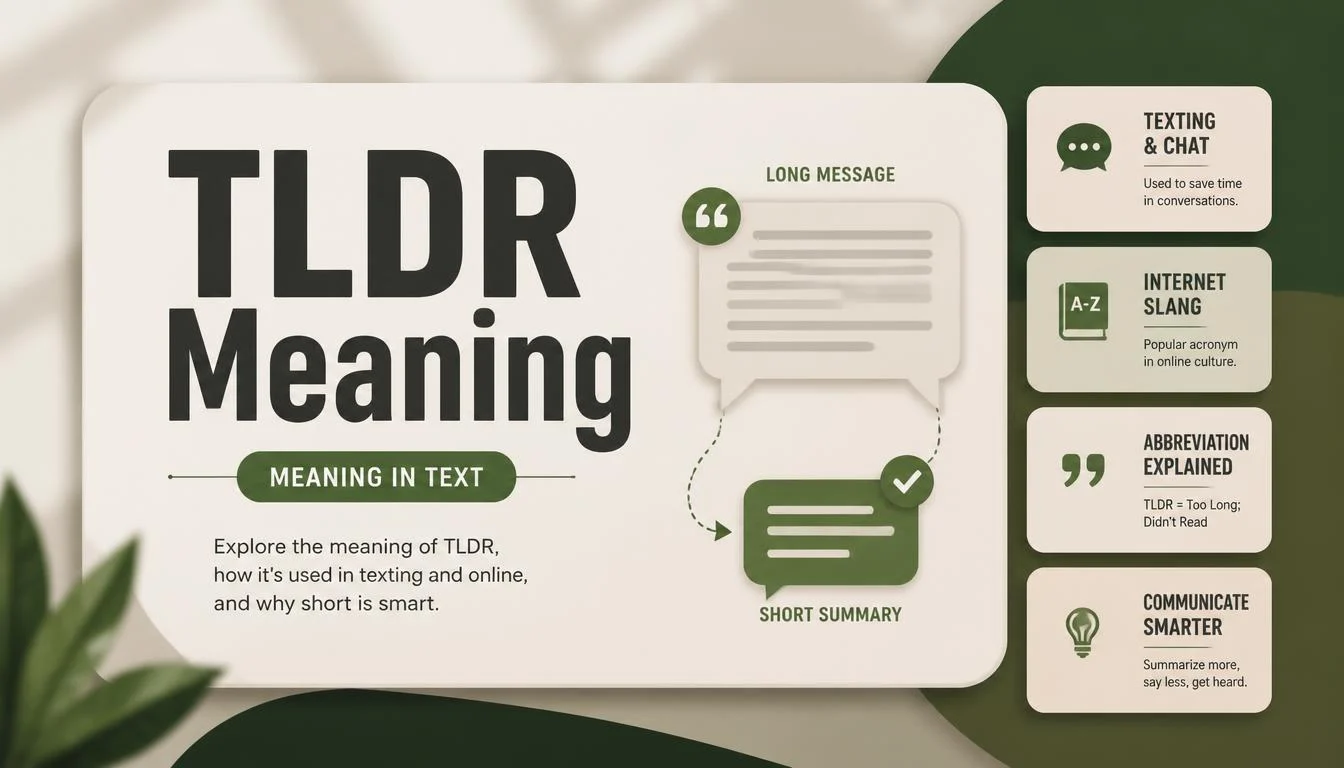
TLDR stands for “Too Long; Didn’t Read.” It is commonly used online to introduce a short summary of lengthy text or to say that something is too long to read. Example: TLDR: The meeting has been moved to Friday.
The TLDR meaning is “Too Long; Didn’t Read.” People use this popular internet abbreviation in texts, online discussions, and social media when they want a quick summary of lengthy content. It helps readers understand the main point without going through every detail.
You may see TLDR at the beginning or end of a message, article, or online post. Depending on the context, it can introduce a short summary or suggest that something is too long to read. Understanding how TLDR works can help you recognize its meaning and use it naturally in everyday digital conversations.
What Does TLDR Mean?
TLDR is an internet abbreviation for “too long; didn’t read.” It is used when someone wants to refer to a long piece of writing without reading all of it or when a writer wants to provide a brief version of a longer explanation.
You may see it in text messages, online discussions, social media posts, product reviews, news commentary, and forum threads. Its basic purpose is to save time by highlighting the most important information.
For example, imagine a friend sends you five paragraphs explaining why they want to change their travel plans. They might finish with:
TLDR: Let’s leave on Saturday instead of Friday because the tickets are cheaper.
That final sentence gives you the main point without requiring you to read the entire explanation again.
The abbreviation has two common uses. A reader may use it to admit that a message was too long to finish, while a writer may place it before a short summary to help readers understand the essential information quickly. Context determines which meaning is intended.
Where Did TLDR Come From?
TLDR grew out of early internet communication, when people exchanged messages through discussion boards, mailing lists, chat rooms, and online forums. These spaces often contained long posts, technical explanations, and detailed debates. Readers needed a quick way to signal that a message was too lengthy to read in full.
The phrase “too long; didn’t read” expressed that idea directly. Its shortened form became part of internet shorthand, alongside expressions such as LOL (“laughing out loud”) and BRB (“be right back”).
The abbreviation is also commonly written as TL;DR, with a semicolon separating the shortened words. Both forms communicate the same basic idea, and neither requires a different interpretation in ordinary online conversations.
As online writing expanded, the expression developed a second use. Writers began adding a short summary to lengthy posts so readers could understand the central point without going through every detail. That practice is especially familiar in online communities such as Reddit and Stack Exchange.
Today, TLDR is not limited to casual chat. It can appear in professional discussions, long-form posts, explanatory articles, and technical documentation. Its meaning remains simple, but the tone depends on who uses it and how they present the summary.
How People Use TLDR in Text Messages
In texting, TLDR usually helps someone get to the point. It may appear before a short explanation, at the end of a long message, or as a reply to a detailed story.
1. To Summarize a Long Message
A sender may write several sentences about a problem and then provide a short version for anyone who wants the main takeaway.
Example:
- Alex: “I called the hotel, checked three booking websites, and compared the cancellation policies. The first option is cheaper, but the second one lets us cancel without a fee.”
- Sam: “Okay, what’s the TLDR?”
- Alex: “The second hotel costs more but gives us flexibility.”
Here, the abbreviation is a practical request for the central point. Sam is not necessarily criticizing Alex’s long message.
2. To Admit That a Message Was Too Long
Someone may use the term to explain that they did not read an entire post or article.
Example:
- Mia: “Did you read the whole thread?”
- Noah: “No, TLDR. What happened?”
In this case, Noah is saying that the thread was too long for him to read. He is asking Mia to explain the main events.
This use can sound blunt if the writer spent considerable time preparing the original message. A softer reply would be, “I haven’t had time to read the whole thing. Can you give me a quick summary?”
3. To Introduce a Short Version
Writers often put TLDR at the beginning of a summary rather than using it to complain about the length of something.
Example:
“TLDR: The meeting has moved to Thursday, and everyone should submit their reports by Wednesday afternoon.”
The abbreviation tells readers that the essential information follows. This format is useful when a message includes background details, explanations, or several separate instructions.
4. To Respond Humorously
Friends may use TLDR as a joke when someone sends an unusually long story.
Example:
- Jamie: “First, I missed the bus. Then it started raining, my phone battery died, and I had to walk home.”
- Chris: “TLDR: Monday won.”
The reply compresses the story into a humorous conclusion. The joke works because both people understand that Chris is summarizing the situation rather than asking for a literal report.
TLDR Examples Across Different Online Situations
The abbreviation appears in different settings, and its function changes slightly depending on the type of content.
| Situation | Example | What it communicates |
|---|---|---|
| Text message | “TLDR: I’ll be there at 6.” | A short version of a longer explanation |
| Reddit post | “TLDR: The update fixed the problem.” | The main takeaway from a discussion |
| Product review | “TLDR: Great quality, but the battery is weak.” | A quick assessment of the product |
| Work chat | “TLDR: We need approval before Friday.” | The key action or deadline |
| Personal story | “TLDR: I got lost but found the place eventually.” | A brief version of a longer story |
| Online debate | “TLDR: We disagree about the cost, not the goal.” | The central point of a complicated argument |
These examples show why the abbreviation is useful. It reduces the effort required to find a message’s main point, especially when the original contains details that are not immediately necessary.
Still, a short version should not remove information that changes the meaning. A product review that says only “Great product” may leave out a major warning about safety, cost, or reliability. A useful summary preserves the facts readers need to make a decision.
TLDR vs. TL;DR, Summary, and Other Abbreviations
Several expressions serve a similar purpose, but they do not all carry the same tone or meaning.
| Term | Meaning | Typical use |
|---|---|---|
| TLDR | Too long; didn’t read | A short summary or a comment about excessive length |
| TL;DR | Too long; didn’t read | The same meaning, with traditional punctuation |
| Summary | A shortened account of the main points | General, academic, and professional writing |
| In brief | In a few words | A concise explanation, often in polished writing |
| ELI5 | Explain like I’m five | Requesting a simple explanation of a difficult topic |
| IMO | In my opinion | Introducing a personal view |
| FWIW | For what it’s worth | Adding a comment or perspective that may be useful |
The main distinction is that TLDR can refer either to a summary or to the act of not reading something because it is too long. The word “summary” normally refers to the shortened account itself.
ELI5 serves a different purpose. It asks someone to explain a complicated idea in simple terms rather than merely shorten the original. A detailed explanation of inflation, for instance, might need an ELI5 version to make the concept easier to understand. A TLDR version would focus on the main conclusion.
Is TLDR the Same as TL;DR?
Yes. TLDR and TL;DR generally mean the same thing. The semicolon in TL;DR separates the abbreviated parts of the phrase, but many internet users omit it for convenience.
You can use either form in casual digital writing. The choice usually comes down to personal preference, platform conventions, or the style of the writer.
Is TLDR Rude or Disrespectful?
Not necessarily. TLDR can be helpful, neutral, funny, or rude, depending on the situation and the way it is phrased.
When a writer adds a summary to their own post, the abbreviation is usually practical. It helps readers find the main point without suggesting that the full explanation is pointless. In a busy group chat, that small shortcut can make a long update much easier to follow.
The tone changes when someone directs it at another person’s writing. A reply such as “TLDR, nobody is reading all that” can sound dismissive because it implies that the sender’s effort was not worth the reader’s time.
Consider the difference between these messages:
- “TLDR: The event starts at 7 p.m.” This is direct and useful.
- “Can you give me the TLDR? I’m short on time.” This is a polite request for a summary.
- “TLDR. Learn to keep it short.” This sounds critical and may offend the writer.
The abbreviation itself is not inherently impolite. The surrounding words, the relationship between the people, and the seriousness of the discussion all affect how it comes across.
If you want to be considerate, explain that you need a shorter version rather than making the original writer feel ignored. A little extra courtesy can prevent a simple shorthand expression from turning into an unnecessary disagreement.
How to Write a Good TLDR
A useful summary does more than shorten a paragraph. It identifies the main conclusion, decision, or action and leaves out details that readers do not need immediately.
Follow these practical guidelines when writing one.
Keep It Short
Aim for one or two sentences for an ordinary text message or online post. A short summary should be noticeably easier to read than the full explanation.
For example, a long update about a delayed delivery might discuss the shipping company, tracking information, and several customer service calls. The summary could simply say, “TLDR: The package is delayed and should arrive on Friday.”
Include the Main Point
Do not focus on an interesting detail if it is not the central message. Ask yourself what a reader should understand after reading only the summary.
For a project update, that might be the current status, the biggest obstacle, or the next deadline. For a product review, it could be the main advantage and the most important drawback.
Preserve Important Context
Shorter is not always better. If removing a detail changes the meaning, keep it.
Suppose a report says that sales increased in one region but declined overall. A misleading summary would say, “Sales increased.” A more accurate version would be, “TLDR: One region grew, but total sales declined.”
Use Clear Language
Avoid filling the summary with unfamiliar abbreviations or technical terms. The purpose is to make information easier to understand, not to create another puzzle for the reader.
For professional messages, you can also use headings such as “Key takeaway,” “Summary,” or “Action required.” These options communicate the purpose without relying on internet shorthand.
When Should You Use TLDR?
The abbreviation works best when readers benefit from a quick overview or when a conversation is informal enough to support internet slang.
Good choice: Long online posts
A brief summary at the top helps readers understand the main argument before deciding whether to read the full post.
Good choice: Casual group chats
A short version of a lengthy update helps friends find the important information quickly.
Good choice: Informal online reviews
A summary can highlight the main benefit, limitation, or recommendation before the full review.
Use caution: Formal emails
In client communication, official reports, or academic writing, “Summary” or “Key takeaway” is often more appropriate.
Use caution: Sensitive conversations
Responding with TLDR to someone sharing a personal problem may make them feel that their concerns are being dismissed.
A useful rule is to consider the reader before choosing the abbreviation. If the person may not know internet slang, spell out your meaning. If the subject requires accuracy or a formal tone, use a conventional heading instead.
FAQs
Can you say TLDR out loud?
Yes. People sometimes pronounce each letter individually, saying “T-L-D-R,” while others simply use the phrase “too long; didn’t read.” In spoken conversation, the full phrase is often clearer to people who are unfamiliar with internet abbreviations.
Is TLDR used on Reddit?
Yes. TLDR is commonly used in Reddit discussions to summarize long posts, detailed explanations, and extended debates. A writer may put a short version at the beginning or end of a post to help readers understand the main point.
Can you put TLDR at the beginning of a post?
Yes. Placing it near the beginning lets readers see the main takeaway immediately. This is particularly useful for long posts where the conclusion might otherwise be buried beneath several paragraphs of background information.
Should TLDR have punctuation after it?
There is no single rule for casual online writing. You can write “TLDR: The meeting is postponed” or “TL;DR: The meeting is postponed.” The colon clearly introduces the summary, while the semicolon in TL;DR belongs to the traditional form of the abbreviation.
What is the plural of TLDR?
TLDR is not usually pluralized because it functions as an abbreviation rather than a countable object. If you need to discuss several short summaries, write “TLDR summaries” or simply “summaries” for clearer wording.
Conclusion
TLDR is a familiar piece of internet shorthand that helps people shorten long explanations or acknowledge that they have not read something in full. Its tone can range from helpful to dismissive, so context and wording matter. Used thoughtfully, it makes lengthy posts easier to understand without sacrificing the information readers need.