Quick Answer
“Thank you for having me” is a polite expression of gratitude used when leaving a social or professional event where someone has invited you as their guest. It acknowledges the host’s hospitality and welcoming attitude.Best alternatives:
“I appreciate your hospitality,” “Thank you for hosting me,” “I appreciate the opportunity to be here,” “It was a pleasure being your guest,” “I’m grateful for the invitation.”
Finding the right words to express gratitude after being invited somewhere can make your message feel more genuine and memorable. While “Thank you for having me” is a classic and polite phrase, using different expressions can help you match the tone of the occasion, whether it’s a formal event, a business gathering, or a casual get-together with friends. In this guide, you’ll discover 30+ other ways to say “Thank You for Having Me” so you can show appreciation with confidence and variety in any situation.
Why People Search for Alternatives to This Phrase
When someone searches for alternatives to the phrase “thank you for having me,” they typically need to express gratitude in a specific context but want to avoid sounding repetitive or overly generic. The search often stems from different communication needs that vary based on the situation and relationship between the speaker and the host.
Professional settings represent one of the primary drivers for this search. Job seekers preparing for interviews want to make a lasting positive impression rather than using overused phrases that interviewers hear constantly. Professionals attending networking events understand that their parting words can be just as memorable as their introduction, making thoughtful alternatives valuable. Business meeting participants recognize that polished language signals competence and attention to detail.
Social situations present another common scenario where people seek better expressions. Individuals attending dinner parties want to show genuine appreciation to their hosts without sounding rehearsed or insincere. Family gatherings often call for warm, personalized thank-yous that reflect close relationships. Overnight stays at someone’s home require expressions that acknowledge the extra effort hosts make when accommodating guests.
Spoken versus written usage significantly influences which alternative works best in any given situation. In face-to-face conversation, shorter, warmer phrases often feel more natural and sincere. A simple “thanks for having me” with genuine eye contact carries more weight than elaborate formal language. In written communication, however, people typically expect more thoughtful, detailed expressions. An email or LinkedIn message allows space for elaboration and personalization that spoken language doesn’t always permit.
Formal versus informal communication intent helps users match their language to the situation appropriately. A boardroom presentation demands different phrasing than a friend’s casual dinner party. Addressing a senior executive requires more respectful language than thanking a colleague you’ve known for years. Understanding this spectrum helps users choose phrases that feel natural and appropriate rather than awkward or mismatched.
The search for alternatives also reflects a desire for variety and sincerity. When someone says “thank you for having me” repeatedly, it can start to feel like a scripted response rather than genuine appreciation. Having a collection of alternatives allows speakers to choose phrases that precisely match their feelings and the specific circumstances of their visit.
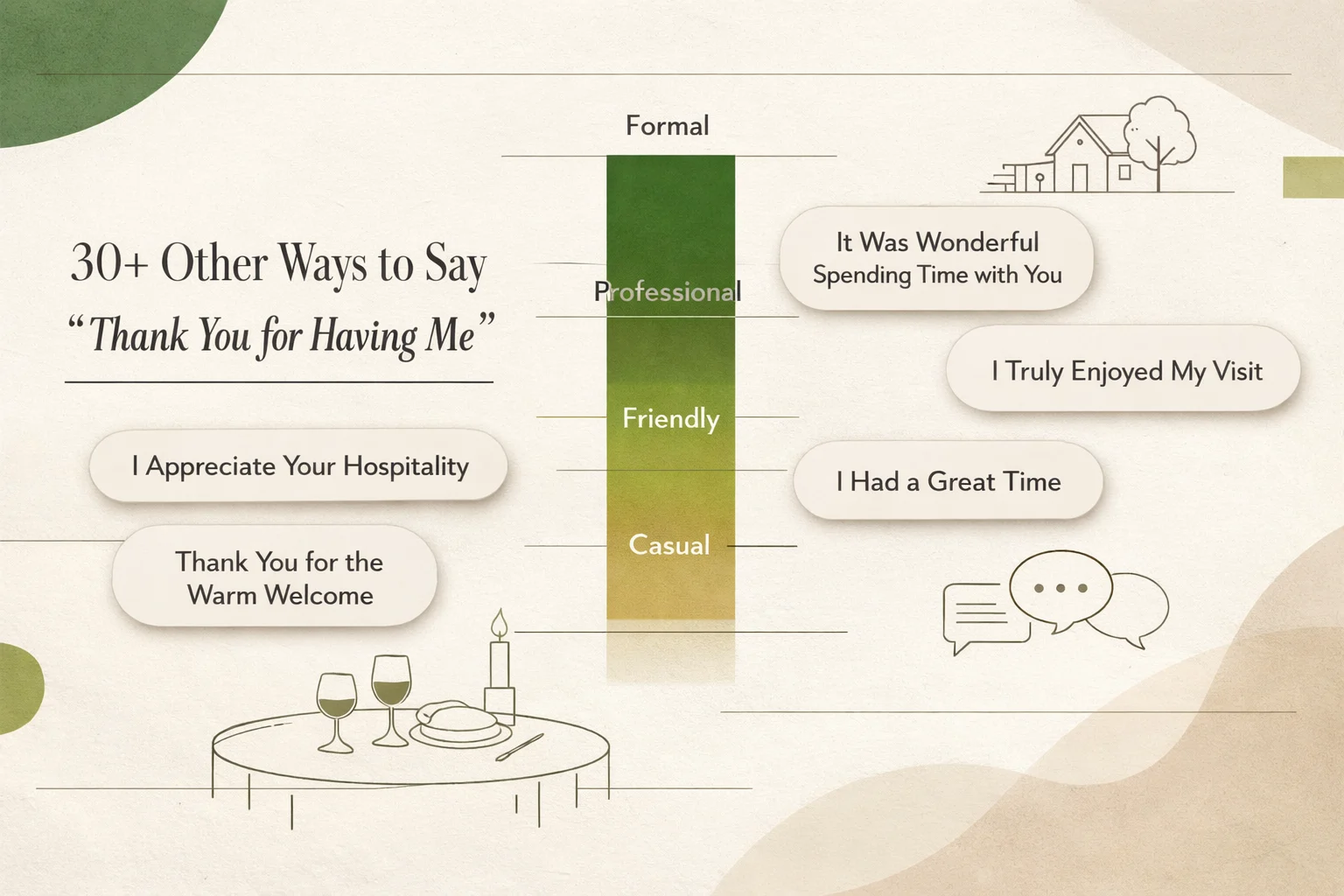
The Tone Ladder System
Very Formal
These phrases convey deep respect and are appropriate for addressing senior executives, dignitaries, or in highly ceremonial settings. They emphasize honor and privilege. Use these when speaking to someone significantly above you in status or in situations with strict protocol.
Formal
These work well in business settings, client meetings, or when thanking superiors. They maintain professionalism while showing genuine appreciation. This category balances respect with warmth, making it suitable for most professional interactions.
Neutral
These phrases strike a balance between warmth and professionalism. They work across most situations without sounding too stiff or too casual. This is the safest category for uncertain situations where you don’t want to risk being either too formal or too familiar.
Casual
These are comfortable phrases used with colleagues you know well, acquaintances, or in relaxed social settings. They maintain politeness while reflecting a comfortable relationship.
Informal
Reserved for close friends and family, these phrases reflect warmth and familiarity. They assume a pre-existing close relationship where formality would actually feel out of place.
Tone Classification Table
| Phrase | Tone Level | Formality | Best Situation |
|---|---|---|---|
| I am deeply grateful for your kind hospitality | Very Formal | 5/5 | Formal dinners, diplomatic events |
| Thank you for the privilege of being your guest | Very Formal | 5/5 | Official functions, award ceremonies |
| I appreciate the opportunity to be here | Formal | 4/5 | Job interviews, business meetings |
| Thank you for hosting me | Formal | 4/5 | Professional events, conferences |
| It was a pleasure being your guest | Formal | 4/5 | Business dinners, formal gatherings |
| I’m grateful for the invitation | Formal | 4/5 | Weddings, formal events |
| Thank you for having me as your guest | Formal | 4/5 | Events where you’re a recognized guest |
| Thanks for including me | Neutral | 3/5 | Team projects, group activities |
| Thank you for your hospitality | Neutral | 3/5 | Social gatherings, informal parties |
| I appreciate your warm welcome | Neutral | 3/5 | Joining new groups or teams |
| Thanks for being a great host | Neutral | 3/5 | House parties, social events |
| I had a wonderful time | Neutral | 3/5 | Any social occasion |
| Thanks for having me over | Casual | 2/5 | Friends’ homes, casual visits |
| Cheers for hosting | Casual | 2/5 | Informal gatherings with friends |
| I’m glad you invited me | Casual | 2/5 | Friendly get-togethers |
| Great to catch up | Informal | 1/5 | Close friends, family visits |
| Thanks for letting me crash | Informal | 1/5 | Staying overnight with close friends |
Quick Selection Guide
Job Interview → “I appreciate the opportunity to be here today”
Professional Email → “Thank you for hosting me” or “I appreciate your hospitality”
Networking Event → “Thank you for the opportunity to connect with everyone”
Dinner Party at Someone’s Home → “Thank you for having me over” or “I had a wonderful time”
Casual Conversation with Friends → “Thanks for having me” or “Cheers for hosting”
Wedding or Formal Event → “I’m grateful for the invitation” or “It was a pleasure being your guest”
After Giving a Speech or Presentation → “Thank you for listening and for the opportunity to share”
Overnight Stay at Someone’s Home → “Thank you for your incredible hospitality”
Team Meeting or Group Activity → “Thanks for including me in this”
Video Call or Virtual Event → “Thank you for the opportunity to join this session”
Meeting Someone for the First Time → “Thank you for taking the time to meet with me”
Professional Conference → “I appreciate the opportunity to attend this conference”
Real-Life Conversation Transformations
Job Interview Scenario
Before: “Thanks for having me.”
This response feels generic and doesn’t leave a memorable impression. The interviewer hears variations of this phrase multiple times daily, making it forgettable at best and insincere at worst.
After: “Thank you for the opportunity to be here today. I’m excited to learn more about how I can contribute to your team’s success.”
This improved version shows enthusiasm for the role, acknowledges the interviewer’s time, and subtly reinforces the candidate’s value proposition. It transforms a simple thank-you into a forward-looking statement that positions the candidate as someone who’s already thinking about contributing.
Alternative for specific situations: “I appreciate you taking time out of your busy schedule to meet with me. Your team’s work in sustainable development is something I’ve followed closely, and I’m genuinely excited about this opportunity.”
Networking Event Scenario
Before: “Thanks for having me.”
This doesn’t leverage the networking opportunity at all. It treats a professional connection the same way one might thank a friend for a casual dinner.
After: “I appreciate the opportunity to connect with professionals in our field. The conversations today have been incredibly valuable.”
This version demonstrates that the speaker values the networking aspect and found the event worthwhile. It subtly positions the speaker as someone who’s engaged and thoughtful about professional relationships.
Alternative for specific situations: “Thank you for bringing together such an impressive group of industry leaders. I’ve already made several connections I look forward to exploring further.
Email Scenario
Before: “Thanks for having me at the meeting.”
This brief message lacks impact and doesn’t demonstrate engagement with the meeting’s content. It reads as a polite but shallow acknowledgment.
After: “Thank you for including me in yesterday’s strategy session. I found the discussion about our Q4 goals particularly insightful and look forward to contributing to the initiatives we outlined.”
The improved version shows engagement, references specific content from the meeting, and demonstrates future commitment. It tells the recipient that the sender was truly present and participating, not just physically occupying space.
Alternative for specific situations: “I greatly appreciated the invitation to join this week’s planning committee. Your team’s approach to stakeholder engagement gave me several new ideas for our own departmental initiatives.”
Casual Conversation Scenario
Before: “Thanks for having me.”
This could apply to literally any situation, making it feel hollow and unpersonalized.
After: “Thanks so much for having me over! Your new place is beautiful, and I loved catching up with everyone.”
Personalizing the thank you makes it feel more genuine and shows you paid attention to details about your experience. It transforms a standard phrase into evidence that you were truly present and engaged during your visit.
Alternative for specific situations: “I had such a wonderful time tonight. The food was incredible, and I especially enjoyed hearing about your recent travels. We should absolutely do this again soon.”
30+ Other Ways to Say “Thank You for Having Me”
1. I appreciate your hospitality
Meaning: Acknowledges the host’s welcoming and generous nature.
Explanation: This phrase focuses specifically on the host’s efforts to make you feel welcome, not just the act of inviting you. It works well because it recognizes the work that goes into being a good host.
Example sentence: “I appreciate your hospitality and the time you took to make sure everyone felt comfortable.”
Tone: Formal
Best use: Business dinners, formal events, overnight stays
Worst use: Text messages to friends where formality would feel strange
Context variability: Works in most professional settings and social situations where you want to sound polished. May feel stiff in very casual situations with close friends.
2. Thank you for hosting me
Meaning: Directly thanks the host for the act of hosting.
Explanation: Clear and straightforward, this phrase leaves no ambiguity about what you’re thanking someone for. It acknowledges the specific role the person played in the situation.
Example sentence: “Thank you for hosting me at the conference. Your team did an exceptional job organizing everything.”
Tone: Formal
Best use: Professional events, conferences, formal gatherings
Worst use: Situations where the person wasn’t technically “hosting” an event
Context variability: Versatile enough for both business and social contexts, though it works best when there’s a clear host-guest dynamic.
3. I appreciate the opportunity to be here
Meaning: Values the chance to participate or attend.
Explanation: This phrase suggests you consider the event valuable and feel privileged to attend. It works particularly well when you gained something meaningful from the experience.
Example sentence: “I appreciate the opportunity to be here and learn from such experienced professionals.”
Tone: Formal
Best use: Job interviews, industry events, workshops
Worst use: Casual social gatherings where “opportunity” sounds too serious
Context variability: Best in professional development contexts where attendance is selective or valuable.
4. It was a pleasure being your guest
Meaning: Expresses enjoyment of being hosted.
Explanation: Elevates the relationship between guest and host, implying a certain formality and respect. This phrase has a classic, elegant quality.
Example sentence: “It was a pleasure being your guest at the awards ceremony. The entire evening was memorable.”
Tone: Formal
Best use: Formal dinners, weddings, charity events
Worst use: Casual coffee meetups where formality would be out of place
Context variability: Primarily formal event contexts where there’s a clear guest-host relationship.
5. I’m grateful for the invitation
Meaning: Thanks someone specifically for inviting you.
Explanation: Acknowledges the host’s thoughtfulness in including you. It suggests you recognize that you could have been overlooked and appreciate not being.
Example sentence: “I’m grateful for the invitation to speak at your annual conference.”
Tone: Formal
Best use: Weddings, formal events, speaking engagements
Worst use: Situations where you weren’t formally invited
Context variability: Works best when there was a formal invitation process involved.
6. Thanks for including me
Meaning: Appreciates being part of a group or event.
Explanation: This phrase works well when you might not have been an obvious choice for inclusion. It shows humility and gratitude for being thought of.
Example sentence: “Thanks for including me in the team meeting. I gained valuable insights from the discussion.”
Tone: Neutral to Formal
Best use: Team projects, group activities, group meetings
Worst use: One-on-one situations where “including” doesn’t make sense
Context variability: Works well in professional settings and also translates to social situations.
7. Thank you for your hospitality
Meaning: Acknowledges the host’s welcoming efforts.
Explanation: Similar to “I appreciate your hospitality,” but slightly more direct. It puts the emphasis on the host’s actions.
Example sentence: “Thank you for your hospitality over the weekend. Everything was perfect.”
Tone: Formal to Neutral
Best use: Overnight stays, weekend visits, dinner parties
Worst use: Brief professional meetings where there wasn’t much “hospitality” involved
Context variability: Works across most social settings where someone has hosted you.
8. I appreciate your warm welcome
Meaning: Thanks someone for making you feel immediately comfortable.
Explanation: This works particularly well when you’re joining a new group or visiting for the first time. It acknowledges the effort to make you feel included.
Example sentence: “I appreciate your warm welcome to the committee. Everyone has been so helpful.”
Tone: Neutral to Formal
Best use: Joining new teams, first-time visits, orientation situations
Worst use: Situations where you’re a regular visitor
Context variability: Best when there’s a “new arrival” or “first-time” element.
9. Thanks for being a great host
Meaning: Gives direct praise to the host.
Explanation: This phrase uses an adjective to describe the host, making it more personal and complimentary.
Example sentence: “Thanks for being a great host tonight. The food and conversation were wonderful.”
Tone: Neutral to Casual
Best use: Dinner parties, house gatherings
Worst use: Professional events where formality is expected
Context variability: Works best in social settings where there’s a clear host.
10. I had a wonderful time
Meaning: Expresses enjoyment of the event itself.
Explanation: While this doesn’t directly thank anyone, it implies gratitude by focusing on the positive experience created by the host.
Example sentence: “I had a wonderful time at your party. Everything was so well organized.”
Tone: Neutral
Best use: Any social occasion where you genuinely enjoyed yourself
Worst use: When you didn’t actually have a good time
Context variability: Works across all social contexts and many professional ones.
11. Thanks for having me over
Meaning: Directly thanks the host for a home visit.
Explanation: This is slightly more casual than “thanks for having me” and specifically references the act of coming to someone’s home.
Example sentence: “Thanks for having me over tonight. Your new patio is stunning.”
Tone: Casual
Best use: Friends’ homes, family visits
Worst use: Public venues or professional settings
Context variability: Specifically for home visit situations.
12. Cheers for hosting
Meaning: Gives a casual, friendly thank you.
Explanation: “Cheers” is a common British and Australian expression of thanks that’s become more widely used. It’s warm but casual.
Example sentence: “Cheers for hosting such a fantastic evening. The drinks were perfect.”
Tone: Casual
Best use: Informal gatherings with friends or colleagues you know well
Worst use: Any situation requiring formality
Context variability: Works in friendly social settings but not in professional ones.
13. I’m glad you invited me
Meaning: Expresses happiness about being included.
Explanation: This focuses on the speaker’s positive emotional response to the invitation, making it feel warm and personal.
Example sentence: “I’m glad you invited me to this event. I’ve made some great contacts tonight.”
Tone: Casual to Neutral
Best use: Friendly get-togethers, networking events
Worst use: Very formal situations
Context variability: Works well in social and semi-professional settings.
14. Great to catch up
Meaning: Appreciates the reunion or check-in opportunity.
Explanation: This phrase works when you’re thanking someone for a meeting that involved catching up with their life or work.
Example sentence: “Great to catch up today. I loved hearing about your recent projects.”
Tone: Casual to Informal
Best use: Close friends, regular professional contacts
Worst use: Formal first-time meetings
Context variability: Best when there’s a prior relationship.
15. Thanks for letting me crash
Meaning: Informally thanks someone for letting you stay.
Explanation: “Crash” implies a slightly last-minute or unplanned stay, and using this phrase shows you appreciate the flexibility.
Example sentence: “Thanks for letting me crash after the concert. I really appreciate you having me.”
Tone: Informal
Best use: Staying overnight with close friends
Worst use: Situations where you were formally invited
Context variability: Only for very casual, close relationship contexts.
16. Thank you for making me feel so welcome
Meaning: Appreciates the inclusion and comfort provided.
Explanation: This phrase acknowledges both the event and the host’s personal effort to make you comfortable.
Example sentence: “Thank you for making me feel so welcome at your family gathering. I had a beautiful time.”
Tone: Neutral to Formal
Best use: Meeting extended family, joining new groups
Worst use: When you weren’t made to feel welcome
Context variability: Great for first-time or “new person” situations.
17. I’m so grateful you had me
Meaning: Expresses deep appreciation in a warm way.
Explanation: “So grateful” adds emotional intensity to the standard thank-you, showing you’re truly moved by the experience.
Example sentence: “I’m so grateful you had me for dinner tonight. Your cooking is absolutely amazing.”
Tone: Warm
Best use: Genuine expressions of appreciation
Worst use: Situations requiring professional detachment
Context variability: Works well when you want to express sincere feeling.
18. Thanks for the invite
Meaning: Casual, shortened version of “thanks for the invitation.”
Explanation: “Invite” as a noun is casual American English. This works for social situations with friends or close colleagues.
Example sentence: “Thanks for the invite to the barbecue. The kids had a fantastic time.”
Tone: Casual
Best use: Friends, family, close work colleagues
Worst use: Formal written communication
Context variability: Social situations with established relationships.
19. I appreciate being included
Meaning: Values the inclusion in a group or activity.
Explanation: This puts the emphasis on the “being included” rather than the host, which works well in group situations.
Example sentence: “I appreciate being included in this year’s charitable initiative.”
Tone: Formal to Neutral
Best use: Work projects, volunteer activities, committee work
Worst use: One-on-one hosting situations
Context variability: Best for group inclusion scenarios.
20. Thank you for your wonderful hospitality
Meaning: Compliments the quality of the hosting.
Explanation: Adding the adjective “wonderful” elevates the standard hospitality thanks and makes it more personal.
Example sentence: “Thank you for your wonderful hospitality during my visit. You made the whole experience unforgettable.”
Tone: Formal
Best use: Overnight stays, extended visits
Worst use: Brief meetings
Context variability: For situations involving significant hosting effort.
21. You’re an amazing host
Meaning: Directly compliments the host’s skills.
Explanation: This moves beyond thanking to paying a direct compliment, which can feel more personal and memorable.
Example sentence: “You’re an amazing host. Every detail was perfect tonight.
Tone: Casual
Best use: Friends’ parties, family gatherings
Worst use: Professional environments
Context variability: Social situations with people you know reasonably well.
22. I feel so fortunate to have been invited
Meaning: Expresses that you feel lucky to be included.
Explanation: “Fortunate” implies you recognize the invitation was a privilege and you don’t take it for granted.
Example sentence: “I feel so fortunate to have been invited to this exclusive networking dinner.”
Tone: Formal
Best use: Exclusive events, selective gatherings
Worst use: When you’re trying not to sound overly grateful
Context variability: Best when the invitation was somewhat exclusive or prestigious.
23. Thanks so much for having me
Meaning: Warm version of the standard phrase.
Explanation: Adding “so much” increases the warmth and enthusiasm of the basic phrase.
Example sentence: “Thanks so much for having me. I had the most wonderful evening.”
Tone: Warm Casual
Best use: Any casual social situation
Worst use: Situations requiring high formality
Context variability: Works in most social situations, especially with people you like.
24. I truly appreciate you having me
Meaning: Sincere expression of gratitude.
Explanation: “Truly” emphasizes that this is heartfelt and not just a standard pleasantry.
Example sentence: “I truly appreciate you having me to your home this week. It meant so much to get to know your family.”
Tone: Warm
Best use: Personal situations where you want to express genuine feeling
Worst use: Situations where formality is expected
Context variability: Best for personal rather than professional contexts.
25. Thank you for welcoming me
Meaning: Thanks for the welcoming atmosphere.
Explanation: This focuses on the welcoming environment rather than the invitation itself.
Example sentence: “Thank you for welcoming me into your community. Everyone has been so kind.”
Tone: Neutral to Formal
Best use: Joining new groups, moving to new areas
Worst use: Situations where you weren’t really “welcomed”
Context variability: Best for transitional situations.
26. It was such a pleasure to be here
Meaning: Expresses enjoyment of the visit.
Explanation: This phrase focuses on the speaker’s experience of pleasure, implying the host created that experience.
Example sentence: “It was such a pleasure to be here today. The seminar was absolutely fascinating.”
Tone: Formal to Neutral
Best use: Professional events, conferences
Worst use: When you didn’t actually enjoy it
Context variability: Works well in both professional and social settings.
27. I’m so happy you thought of me
Meaning: Appreciates being remembered and included.
Explanation: This is a warm, personal expression that acknowledges the host’s thoughtfulness in remembering you.
Example sentence: “I’m so happy you thought of me for this opportunity. It’s exactly what I’ve been looking for.”
Tone: Warm
Best use: When you feel the invitation was especially thoughtful
Worst use: In highly formal business contexts
Context variability: Best when there’s a personal element to the invitation.
28. Thanks for giving me a seat
Meaning: Appreciates being included in a limited space.
Explanation: “Seat” can be literal or metaphorical, but this phrase suggests you recognize you were given a spot in a limited arrangement.
Example sentence: “Thanks for giving me a seat at the table for this project. I’m excited to contribute.”
Tone: Neutral
Best use: Meetings, projects, events
Worst use: Open events with no limited space
Context variability: Works when there’s some exclusivity to the situation.
29. I’m deeply appreciative of your invitation
Meaning: Strong, formal expression of gratitude.
Explanation: “Deeply appreciative” is more intense than simple appreciation, showing significant gratitude.
Example sentence: “I’m deeply appreciative of your invitation to the awards ceremony. This means a great deal to me.
Tone: Very Formal
Best use: Formal events, expressions of deep gratitude
Worst use: Casual settings where intensity feels overwhelming
Context variability: Best for truly important or meaningful invitations.
30. Couldn’t have asked for a better welcome
Meaning: Expresses the welcome was perfect.
Explanation: This phrase goes beyond simple thanks to describe the quality of the experience.
Example sentence: “I couldn’t have asked for a better welcome to the team. Everyone has been so supportive.”
Tone: Warm to Neutral
Best use: New environments, first-time visits
Worst use: When the welcome wasn’t exceptional
Context variability: Best when you genuinely had an exceptional experience.
31. Thank you for having me as your guest
Meaning: Acknowledges the guest-host relationship.
Explanation: This is similar to “thank you for hosting me” but explicitly positions you as a guest, which can feel more personal.
Example sentence: “Thank you for having me as your guest at the gala. The evening was magnificent.”
Tone: Formal
Best use: Events where you were a named guest
Worst use: Casual situations where “guest” sounds too formal
Context variability: Formal event contexts.
32. I really appreciate the chance to be here
Meaning: Values the opportunity to participate.
Explanation: “Chance” suggests opportunity, similar to “opportunity” but slightly more casual.
Example sentence: “I really appreciate the chance to be here and learn from your expertise.”
Tone: Neutral
Best use: Professional learning opportunities
Worst use: Social gatherings where “chance” sounds odd
Context variability: Best for growth and learning situations.
33. Thank you for opening your home to me
Meaning: Appreciates being welcomed into someone’s private space.
Explanation: This phrase specifically acknowledges that you were allowed into someone’s home, which is a meaningful gesture.
Example sentence: “Thank you for opening your home to me during my visit. I felt so comfortable.”
Tone: Formal
Best use: Overnight stays, home visits
Worst use: Events in public spaces
Context variability: Specifically for home hospitality.
34. I appreciate the welcome I received
Meaning: Acknowledges how you were received.
Explanation: This focuses on the reception rather than the host, which can work well when multiple people made you feel welcome.
Example sentence: “I appreciate the welcome I received from the entire department. Everyone has been so friendly.”
Tone: Neutral
Best use: Joining organizations, visiting workplaces
Worst use: When only one person hosted you
Context variability: Group welcome situations.
35. Thanks for being so generous with your time
Meaning: Appreciates the host’s time investment.
Explanation: This works particularly well when someone has spent significant time with you.
Example sentence: “Thanks for being so generous with your time today. I learned so much from our conversation.”
Tone: Formal
Best use: Mentoring meetings, consultations
Worst use: Large parties where time wasn’t the issue
Context variability: One-on-one or small group situations.
36. It was lovely spending time with you
Meaning: Expresses enjoyment of the company.
Explanation: Similar to “I had a wonderful time” but specifically acknowledges the host’s company.
Example sentence: “It was lovely spending time with you this weekend. Your family is charming.”
Tone: Warm
Best use: Social gatherings
Worst use: Professional contexts where “lovely” feels too warm
Context variability: Best in social situations.
37. I’m honored to have been invited
Meaning: Expresses that you feel the invitation is a privilege.
Explanation: “Honored” is a strong word implying you feel elevated by the invitation.
Example sentence: “I’m honored to have been invited to present at this prestigious conference.”
Tone: Very Formal
Best use: Prestigious events, significant opportunities
Worst use: Casual gatherings where “honored” feels excessive
Context variability: Best for truly meaningful invitations.
38. Thanks for letting me participate
Meaning: Appreciates being allowed to take part.
Explanation: This phrase acknowledges the host allowed you to participate, which might not have been automatic.
Example sentence: “Thanks for letting me participate in the planning session. I found it incredibly valuable.”
Tone: Neutral
Best use: Meetings, workshops, activities
Worst use: Situations where your participation was expected
Context variability: Situations where there was some choice about participation.
39. You made me feel so at home
Meaning: Appreciates the comfortable atmosphere.
Explanation: “At home” means comfortable and relaxed, and this phrase acknowledges the host created that feeling.
Example sentence: “You made me feel so at home during my visit. I forgot I was a guest.”
Tone: Warm
Best use: Overnight stays, home visits
Worst use: Professional settings
Context variability: Best for personal, intimate settings.
40. I truly enjoyed myself tonight
Meaning: Genuine expression of enjoyment.
Explanation: “Truly” adds sincerity to the standard “I enjoyed myself” phrase.
Example sentence: “I truly enjoyed myself tonight. The dinner and conversation were both wonderful.”
Tone: Warm to Neutral
Best use: Social gatherings
Worst use: When you didn’t actually enjoy yourself
Context variability: Works across social contexts.
41. Thank you for a memorable evening
Meaning: Appreciates an evening worth remembering.
Explanation: Calling something “memorable” suggests it was special and meaningful.
Example sentence: “Thank you for a memorable evening. I’ll be thinking about tonight for a long time.”
Tone: Formal to Warm
Best use: Special events, milestone celebrations
Worst use: Routine gatherings
Context variability: Best for truly special occasions.
42. I’m so grateful you had me
Meaning: Warm, heartfelt appreciation.
Explanation: “So grateful” and “had me” creates a warm, slightly informal expression of deep appreciation.
Example sentence: “I’m so grateful you had me at your retreat. I gained so much from the experience.”
Tone: Warm
Best use: Genuine expressions of appreciation
Worst use: Formal business contexts
Context variability: Personal and warm situations.
43. Thanks for opening the doors for me
Meaning: Appreciates being given access or opportunity.
Explanation: “Opening the doors” is a metaphor for providing access or opportunity.
Example sentence: “Thanks for opening the doors for me in this industry. You’ve been incredibly generous.”
Tone: Formal to Warm
Best use: Career opportunities, introductions
Worst use: Social gatherings where “doors” doesn’t fit
Context variability: Best for professional advancement contexts.
44. I appreciate the time you spent hosting me
Meaning: Acknowledges the host’s time investment.
Explanation: This phrase explicitly acknowledges that hosting takes time and effort.
Example sentence: “I appreciate the time you spent hosting me this week. I know how busy you are.”
Tone: Formal
Best use: Extended stays, significant hosting efforts
Worst use: Brief encounters
Context variability: When the host has invested significant time.
45. Thank you for the privilege
Meaning: Expresses gratitude for something considered special.
Explanation: “Privilege” suggests the experience was a special honor.
Example sentence: “Thank you for the privilege of visiting your beautiful home and meeting your family.”
Tone: Very Formal
Best use: Special opportunities, prestigious contexts
Worst use: Everyday social situations
Context variability: Best for truly privileged experiences.
46. Your hospitality means a lot to me
Meaning: Expresses personal significance of the hosting.
Explanation: “Means a lot” is a warm, personal way to express deep appreciation.
Example sentence: “Your hospitality means a lot to me, especially during this difficult time.
Tone: Warm
Best use: Personal situations, times of need
Worst use: Professional contexts
Context variability: Best when there’s personal significance.
47. Thanks for making this happen
Meaning: Appreciates that the event or opportunity was created.
Explanation: “Making this happen” acknowledges the host’s effort in creating the experience.
Example sentence: “Thanks for making this happen. The event was exactly what our industry needed.”
Tone: Warm to Neutral
Best use: Events, gatherings, opportunities
Worst use: Situations where you were a casual visitor
Context variability: When someone created an opportunity.
48. I’m touched by your invitation
Meaning: Expresses that the invitation moved you emotionally.
Explanation: “Touched” implies emotional impact, showing the invitation had significance beyond just a social gesture.
Example sentence: “I’m touched by your invitation to speak at the memorial service. It means so much.
Tone: Very Warm
Best use: Meaningful invitations, emotional contexts
Worst use: Casual gatherings
Context variability: Best for invitations with emotional weight.
49. Thank you for the memorable experience
Meaning: Appreciates an experience worth remembering.
Explanation: Similar to “memorable evening” but broader in scope.
Example sentence: “Thank you for the memorable experience at your workshop. I’ve already applied what I learned.”
Tone: Formal to Neutral
Best use: Educational events, retreats
Worst use: Brief encounters
Context variability: Best when the experience was indeed memorable.
50. I’m lucky to have been included
Meaning: Expresses gratitude for inclusion.
Explanation: “Lucky” suggests you recognize you could have been left out and are happy you weren’t.
Example sentence: “I’m lucky to have been included in this project. The team is incredible.”
Tone: Warm to Neutral
Best use: Selective opportunities
Worst use: Situations where inclusion was automatic
Context variability: Best when there’s some selectivity involved.
Usage Comparison Table
| Phrase | Spoken Use | Written Use | Best Context |
|---|---|---|---|
| I appreciate your hospitality | Yes | Yes | Formal events |
| Thank you for hosting me | Yes | Yes | Professional events |
| I appreciate the opportunity to be here | Yes | Yes | Interviews, meetings |
| It was a pleasure being your guest | Yes | Rare | Formal dinners |
| I’m grateful for the invitation | Yes | Yes | Weddings, formal events |
| Thanks for including me | Yes | Rare | Team meetings |
| Thank you for your hospitality | Yes | Yes | Overnight stays |
| I appreciate your warm welcome | Yes | Rare | New environments |
| Thanks for being a great host | Yes | Rare | House parties |
| I had a wonderful time | Yes | Rare | Social occasions |
| Thanks for having me over | Yes | Rare | Friends’ homes |
| Cheers for hosting | Yes | Rare | Friendly gatherings |
| I’m glad you invited me | Yes | Rare | Friendly events |
| Great to catch up | Yes | Rare | Reunions |
| Thanks for letting me crash | Yes | Rare | Overnight stays |
| You’re an amazing host | Yes | Rare | Friends’ parties |
| I feel so fortunate to have been invited | Yes | Yes | Exclusive events |
| It was such a pleasure to be here | Yes | Rare | Conferences |
| I’m deeply appreciative of your invitation | Rare | Yes | Very formal occasions |
| Couldn’t have asked for a better welcome | Yes | Rare | New environments |
| Thank you for having me as your guest | Yes | Rare | Formal events |
| I really appreciate the chance to be here | Yes | Rare | Learning opportunities |
| Thank you for opening your home to me | Yes | Rare | Overnight stays |
| I appreciate the welcome I received | Yes | Rare | Joining groups |
| Thanks for being so generous with your time | Yes | Yes | Mentoring meetings |
| It was lovely spending time with you | Yes | Rare | Social gatherings |
| I’m honored to have been invited | Rare | Yes | Prestigious events |
| Thanks for letting me participate | Yes | Rare | Workshops |
| You made me feel so at home | Yes | Rare | Home visits |
| I truly enjoyed myself tonight | Yes | Rare | Social occasions |
| Thank you for a memorable evening | Yes | Rare | Special events |
| I’m so grateful you had me | Yes | Rare | Personal situations |
| Thanks for opening the doors for me | Yes | Rare | Career opportunities |
| I appreciate the time you spent hosting me | Yes | Yes | Extended visits |
| Thank you for the privilege | Rare | Rare | Special honors |
| Your hospitality means a lot to me | Yes | Yes | Personal situations |
| Thanks for making this happen | Yes | Yes | Events, opportunities |
| I’m touched by your invitation | Yes | Rare | Emotional contexts |
| Thank you for the memorable experience | Yes | Rare | Educational events |
| I’m lucky to have been included | Yes | Rare | Selective opportunities |
Email and LinkedIn Ready Expressions
Email Greetings
Opening Thank-Yous
- “I appreciate the opportunity to connect with you today regarding…”
- “Thank you for taking the time to meet with me about…”
- “I’m grateful for the invitation to discuss…”
- “Thank you for including me in the discussion about…”
- “Thank you for your warm welcome to the project team…”
- “Thank you for your hospitality during my visit to your office…”
Follow-Up Thank-Yous After Meetings
- “Thank you again for hosting the meeting yesterday. I found the discussion extremely valuable.”
- “I wanted to thank you once more for including me in the strategy session. The insights shared were incredibly helpful.”
- “Thank you for the productive meeting today. I appreciate you making time in your busy schedule.”
Professional Introductions
For First-Time Connections
- “Thank you for the introduction opportunity. I’m looking forward to connecting with…”
- “I appreciate you facilitating this connection. Your network is impressive.”
- “Thank you for putting me in touch with your colleague. The conversation was extremely valuable.”
After Being Introduced
- “It was a pleasure being introduced to your team. Everyone was incredibly welcoming.”
- “Thank you for the warm introduction to the department. I felt immediately comfortable.”
LinkedIn Connection Messages
Standard Connection Request
- “Thank you for the opportunity to connect. I’m impressed by your work in…”
- “I appreciate you accepting my connection request. Your insights on…”
Message After Connection Accepted
- “Thank you for connecting. I look forward to following your work on…”
- “Thanks for accepting my invitation. Your expertise in [industry/field] is inspiring.”
Networking Follow-Up
- “I appreciated meeting you at [event/venue]. Your perspective on… was particularly insightful.”
- “Thank you for the valuable conversation at the networking event. I’d love to stay in touch.”
Follow-Up Lines
After Professional Events
- “I wanted to thank you once again for the generous invitation to the [event]. It was a truly memorable experience.”
- “Thank you for making time to connect at the conference. I particularly enjoyed our discussion about…”
After Business Meetings
- “I appreciate the opportunity to meet with you today. The information you shared about… was extremely helpful.”
- “Thank you for your time and expertise during our meeting. I look forward to exploring the next steps.”
Native Speaker Insight Box
Natural Native Usage Patterns
Native English speakers often shorten expressions in casual conversation, especially in spoken settings. “Thanks for having me” becomes “Thanks for having me” with the stress on “having” and a falling intonation at the end. In very casual British contexts, “cheers” frequently replaces “thank you” entirely. American speakers often use “appreciate it” as a shortened version of “I appreciate it.”
Shortened Spoken Versions
“I appreciate it” becomes “Appreciate it” in casual speech. “Thanks so much” becomes “Thanks so much” with emphasis on “so.” “Good to see you” often serves as a thank-you replacement. “Nice to catch up” works similarly.
What Sounds Unnatural
Overly formal language in casual settings sounds noticeably unnatural. Saying “I am deeply appreciative of your kind invitation” at a friend’s barbecue would raise eyebrows. Similarly, using “cheers” in formal American business contexts feels out of place.
Preferred Professional Alternatives
In professional contexts, native speakers prefer phrases that demonstrate engagement and specificity. “Thank you for the opportunity to contribute to the discussion” sounds more natural than “Thanks for having me.” “I appreciate the chance to collaborate” works better than generic thank-yous.
Common Mistakes and What Not to Say
Unnatural Phrases
“Thanks for accommodating me” This sounds overly formal and can imply you were a burden. Use “Thank you for having me” or “I appreciate your hospitality” instead.
“Thanks for allowing me to be present” This sounds strange and overly subservient. “Thank you for including me” is more natural.
“I am thankful for the invitation that you extended” This is too wordy and formal. “Thank you for the invitation” is sufficient.
Tone Mismatch
Using “cheers” in a job interview This is too casual for professional settings. Use “Thank you for the opportunity” instead.
Using “I’m honored” at a casual dinner This feels excessive for social situations. “I’m glad you invited me” is more appropriate.
Using very formal language with friends This can feel cold and distant. Use casual or informal alternatives instead.
Grammar Mistakes
“Thanks for having my family and I” This is grammatically incorrect. The correct version is “Thanks for having my family and me.”
“I appreciate you having me” While common in casual speech, this is technically incorrect. “I appreciate your having me” is grammatically correct, though many native speakers use the first version informally.
“Thank you for yourself” This is completely wrong. Use “Thank you for having me” instead.
Over-Formal or Awkward Usage
Using overly elaborate language Long, complex phrases like “I wish to express my profound gratitude for your most gracious hospitality” sound unnatural in most contexts.
Using the same phrase repeatedly Saying “thanks for having me” multiple times in the same conversation feels repetitive. Vary your expressions.
Forgetting to personalize A generic thanks without any personal reference can feel insincere. Always try to add something specific about your experience.
Expansion Phrases
Greeting Variations
“Good to see you again”
“It’s always a pleasure to visit”
“Thank you for having me back”
“Great to be here once more”
“Nice to be back”
Introduction Phrases
“I appreciate the opportunity to join”
“Thank you for the welcome”
“Glad to be included”
“Thank you for the introduction”
“Thanks for bringing me in”
Polite Communication Alternatives
“I appreciate the time we spent together”
“Thank you for making this work”
“I’m grateful for your generosity”
Your kindness means a great deal
“Thank you for being so accommodating”
Conversational English Upgrades
Instead of “Thanks for having me,” try:
“Thanks so much for having me” (warmer)
“Thanks for having me over” (specific to home)
“Thanks for having me along” (when joining a group)
“Thanks for having me aboard” (when joining a team or project)
“Thanks for having me in” (when joining a meeting or conversation)
Decision-Making Table
| Situation | Best Phrase | Why It Works |
|---|---|---|
| Job Interview | I appreciate the opportunity to be here | Shows enthusiasm and respect for the opportunity |
| Business Lunch | Thank you for hosting me today | Acknowledges the host role while maintaining professionalism |
| Networking Event | Thank you for the opportunity to connect with everyone | Shows you value networking and made meaningful connections |
| Team Meeting | Thanks for including me in the discussion | Shows appreciation for being part of the group |
| Conference | I appreciate the opportunity to be here and learn | Shows you value the learning experience |
| Dinner Party at a Friend’s Home | Thanks for having me over | Casual and warm, appropriate for friends |
| Formal Dinner | It was a pleasure being your guest | Elegant and respectful for formal occasions |
| Wedding | I’m grateful for the invitation | Shows appreciation for being included in a special day |
| Overnight Stay | Thank you for your wonderful hospitality | Acknowledges the significant effort of hosting overnight |
| Joining a New Team | I appreciate your warm welcome | Shows you noticed and valued the welcome effort |
| Speaking Engagement | Thank you for the opportunity to present today | Acknowledges the platform and audience |
| Client Meeting | I appreciate you taking the time to meet with me | Shows respect for the client’s busy schedule |
| Farewell Gathering | I had a wonderful time with everyone | Warm and personal for goodbye situations |
| Virtual Event | Thank you for the opportunity to join online | Acknowledges the digital format while showing appreciation |
| Mentoring Meeting | Thanks for being so generous with your time | Recognizes the mentor’s investment in you |
| Acceptance of Award | I’m honored to have been recognized | Appropriate for award and recognition contexts |
| After a Workshop | Thank you for the memorable experience | Acknowledges the learning and impact |
| Reunion with Old Friends | Great to catch up with everyone | Warm and personal for reunions |
| Company Party | Thanks for putting this together | Acknowledges the organizer’s effort |
Quick Fast List
Top 10 Best Alternatives for Any Situation:
- “I appreciate your hospitality” – Formal and professional
- “Thank you for hosting me” – Direct and clear
- “I appreciate the opportunity to be here” – Best for interviews
- “It was a pleasure being your guest” – Elegant and formal
- “I’m grateful for the invitation” – Shows deep appreciation
- “Thanks for including me” – Warm and inclusive
- “I appreciate your warm welcome” – Great for new environments
- “Thanks for being a great host” – Personal and direct
- “I had a wonderful time” – Warm and general
- “Thanks for having me over” – Casual and friendly
Mini Quiz
Test your understanding with these five scenario-based questions:
Question 1: Job Interview
You’ve just completed a job interview and want to thank the interviewer before leaving. Which phrase works best?
A) Cheers for having me
B) I appreciate the opportunity to be here
C) Great to catch up
D) Thanks for letting me crash
Question 2: Formal Wedding
You’re leaving a formal wedding and want to thank the hosts. Which phrase is most appropriate?
A) Thanks for the invite
B) I’m grateful for the invitation
C) Nice to catch up
D) Cheers for hosting
Question 3: Friend’s Dinner Party
You’re leaving a casual dinner at a close friend’s house. Which phrase fits best?
A) I appreciate your hospitality
B) It was a pleasure being your guest
C) Thanks for having me over
D) I’m honored to have been invited
Question 4: Professional Email
You’re writing a follow-up email after a business meeting. Which phrase works best?
A) Thanks for letting me crash the meeting
B) Cheers for including me
C) Thank you for including me in the strategy session
D) Great to be here
Question 5: International Conference
You’ve just attended a prestigious industry conference as a first-time attendee. Which thank-you is most natural?
A) Thanks for being a great host
B) I feel fortunate to have been invited
C) Great to catch up
D) Cheers for having me
Answers:
- B – “I appreciate the opportunity to be here” shows professionalism and enthusiasm
- B – “I’m grateful for the invitation” is appropriately formal for a wedding
- C – “Thanks for having me over” is casual and perfect for friends
- C – “Thank you for including me in the strategy session” is specific and professional
- B – “I feel fortunate to have been invited” acknowledges the prestige of the conference
FAQs
Can I use “thank you for having me” in an email?
Yes, you can use it in casual emails, but it’s not the best choice for formal or professional correspondence. Better alternatives for emails include “Thank you for including me in the meeting” or “I appreciate the opportunity to participate.” The best email thank-yous reference specific aspects of the experience.
When should I avoid using “thank you for having me”?
- Avoid it in highly formal contexts like addressing senior executives or in important written communications where specific detail is expected.
- Avoid it when you want to make a strong impression, like after a job interview.
- Avoid it when the situation calls for more specific or personalized language.
What’s the difference between “thanks for having me” and “thanks for having me over”?
“Thanks for having me over” is more specific and implies you visited someone’s home or personal space. “Thanks for having me” is more general and can apply to any situation where someone hosted you. “Over” adds a domestic or casual atmosphere that works best for home visits.
Can I say “thank you for having me” after a video call?
Yes, though it’s slightly unusual since you weren’t physically “had.” Better alternatives for video calls include “Thank you for joining today” or “I appreciate the opportunity to connect online.” These acknowledge the digital format while still expressing gratitude.
Is “cheers for having me” acceptable in professional settings?
“Cheers for having me” is too casual for professional settings, especially in American business contexts. In British and Australian English, “cheers” might be acceptable in casual professional situations, but it’s still best avoided in formal contexts. Use more formal alternatives for work-related situations.
Conclusion
Having a diverse collection of alternatives to “thank you for having me” transforms your communication from generic to memorable. The key to natural English lies in matching your phrase to the situation, your relationship with the host, and the specific context of the visit. Whether you’re leaving a job interview, networking at a conference, or saying goodbye at a friend’s dinner party, the right phrase can leave a lasting positive impression.
Practice using these alternatives in your daily interactions. Pay attention to how native speakers express gratitude in different contexts. Notice the tone they use, the specific words they choose, and how they personalize their thanks. With consistent practice, choosing the perfect thank-you will become second nature. The goal isn’t just to find different words but to communicate genuine appreciation in a way that feels natural, sincere, and appropriate for every situation.
Read More Related Articles:
- 30+ Other Ways to Say Happy 4th of July | Professional, Casual & Patriotic Greetings In 2026
- 35+ Other Ways to Say Happy Birthday in Advance | Creative Wishes for Every Relationship In 2026
- 35+ Other Ways to Say “Thank You for the Information” | For Modern Professionals In 2026

Zoe Chambers works as a content writer at synoseek.com, contributing thoughtful pieces on everyday subjects and ideas. She writes in a simple, grounded way, often drawing from real-world experiences. Her focus is on keeping content natural, clear and easy for readers to connect with.
1 thought on “30+ Other Ways to Say “Thank You for Having Me” | Memorable Thank-You Phrases for Guests In 2026”