Quick Answer:
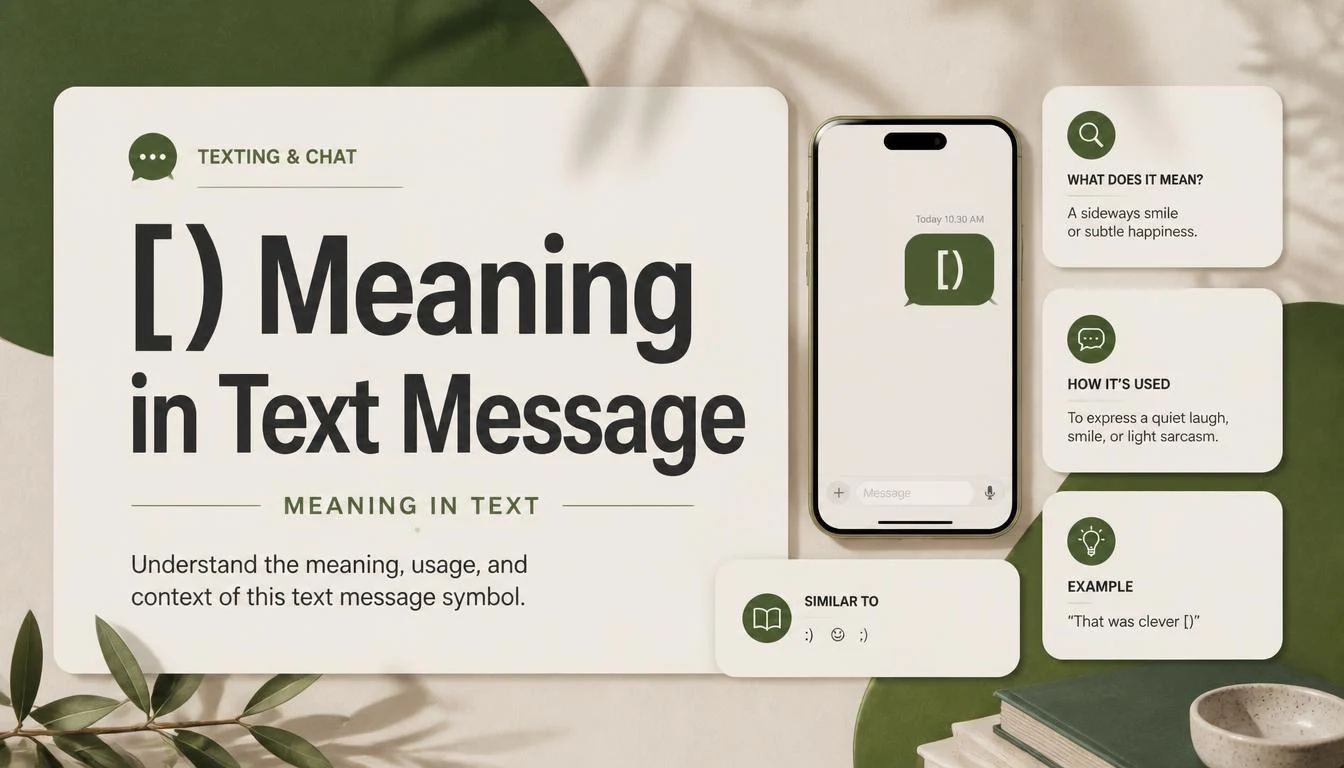
The)symbol in a text message is usually a shortened smile or a friendly closing signal. It can make a message sound warmer, softer, or less serious, especially when used after a sentence. For example, “Thanks for helping me)” can feel friendlier than “Thanks for helping me.” The exact meaning depends on the conversation, the relationship between the people, and how many parentheses are used.
Wondering about the ) meaning in text message? This simple symbol can have different meanings depending on how it appears in a conversation. It may act as a shortened smile, a soft emotional cue, or part of an informal texting style.
Understanding the context is important because a single ) can feel friendly, polite, playful, or even slightly ambiguous. In this guide, we explain what ) means in text messages and how people commonly use it in chats.
What Does ) Mean in a Text Message?
In texting, ) can function as a minimal smile. Instead of typing :), someone may use only the closing parenthesis to show friendliness.
For example:
“Okay, I understand)”
The person probably is not trying to use the parenthesis as mathematical punctuation. It can simply soften the sentence.
Compare these messages:
| Message | Possible impression |
|---|---|
| “Okay.” | Neutral or slightly serious |
| “Okay :)” | Clearly friendly |
| “Okay)” | Friendly, understated, or casual |
| “Okay))” | Warmer or more expressive |
| “Okay)))” | Very cheerful or affectionate in some communities |
There is no universal dictionary rule saying that one closing parenthesis always means a smile. Digital communication depends heavily on community habits.
That is why the same symbol can feel warm to one person and confusing to another.
Why Do People Use Only the Closing Parenthesis?
The practice is connected to the way emoticons developed in early internet communication.
Traditional text emoticons used combinations such as :), ;), and :(. These symbols represented facial expressions without images or graphic emojis.
Over time, some online communities began shortening these expressions. The opening part of the smile could disappear while the closing parenthesis remained.
So:
:) → )
The result is faster to type and visually subtle.
This habit became particularly recognizable in some Russian speaking online communities, where repeated closing parentheses can express different degrees of friendliness or amusement. Similar conventions can appear elsewhere, although the meaning is not identical across every language community.
This history explains why a single ) may carry emotional meaning even though it is technically just a punctuation mark.
) as a Friendly Tone Marker
One of the most common uses is to make a short message feel less cold.
Written communication has a problem that face to face conversation does not. A person cannot hear your voice or see your expression.
Consider:
“Sure.”
That could be completely neutral. It could also sound annoyed.
Now consider:
“Sure)”
The closing parenthesis gives the reader a small clue that the sender is being friendly.
It works somewhat like a smile in conversation. It does not necessarily add new information. Instead, it changes the emotional tone of what was already written.
This is especially useful after short statements that might otherwise sound blunt.
Examples include:
- “No problem)”
- “Thank you)”
- “Sure, I can do that)”
- “See you tomorrow)”
- “Good night)”
In these cases, the symbol generally makes the message feel lighter.
) Can Also Soften an Awkward Message
Another useful function is reducing the harshness of a statement.
Imagine someone writes:
“You forgot the attachment.”
That sentence is clear, but it may sound like criticism.
A softer version could be:
“You forgot the attachment)”
The symbol does not completely remove the criticism. It simply gives the message a friendlier emotional frame.
This is important because text has fewer social signals than spoken conversation. A tiny visual cue can influence how the reader interprets an otherwise ordinary sentence.
However, this technique is not foolproof. If the actual words are strongly negative, adding ) does not automatically make them kind.
For example:
“I really don’t want to talk to you)”
Most readers would still recognize the hostility or rejection.
Context always comes first.
What Does )) Mean in Texting?
Two closing parentheses, )), generally make the same basic idea more expressive.
The sender may be indicating a stronger smile, greater warmth, amusement, or friendliness.
For example:
“That was funny))”
Compared with:
“That was funny)”
The second version can feel slightly more restrained. The double version may feel more animated.
Some people also use ))) or even longer strings:
“Thank you)))”
In communities where this convention is common, additional parentheses can suggest increasing warmth or enthusiasm.
But there is no universal scale. Three parentheses do not officially mean “three times happier” than one.
A reader unfamiliar with this style may simply see extra punctuation.
) vs 🙂 vs 🙂: Are They the Same?
These symbols can communicate similar emotions, but they do not feel exactly the same.
| Symbol | Common interpretation | Typical feeling |
|---|---|---|
) | Shortened smile or friendly cue | Subtle |
:) | Classic text smile | Clearly friendly |
:-) | Traditional smile emoticon | Friendly, slightly old fashioned |
🙂 | Smiling face emoji | More visually expressive |
)) | Stronger version of ) in some communities | Warm or playful |
;) | Wink emoticon | Playful, teasing, or suggestive |
The biggest difference is style.
:) is widely recognizable as a smile. The emoji 🙂 is even more visually obvious. A single ) is more dependent on context and cultural familiarity.
Someone who frequently uses older text based communication may recognize it immediately. Another person might wonder whether the sender accidentally left out the opening parenthesis.
) Can Mean Different Things in Different Communities
Internet language is not universal. A symbol can develop a special meaning inside a particular group.
For example, online communities sometimes create their own conventions for punctuation, abbreviations, emojis, and repeated characters. These conventions can spread through messaging platforms and social networks.
A closing parenthesis may therefore be common in one person’s messages but almost never used by another person.
This is one reason it is risky to assign a single emotional meaning to ).
Consider the message:
“Okay)”
Possible interpretations include:
- “Okay, sounds good.”
- “Okay, I’m being friendly.”
- “Okay, no worries.”
- “Okay,” with a subtle smile.
- Simply a typing habit.
The surrounding conversation helps determine which interpretation makes the most sense.
Can ) Sound Passive Aggressive?
Yes, but the symbol itself is not inherently passive aggressive.
Tone comes from the combination of wording, punctuation, timing, and relationship.
For example:
“Fine)”
could be friendly in one conversation. In another, it might feel sarcastic.
Likewise:
“Whatever)”
can sound dismissive because the word itself carries a negative or careless tone.
Some people interpret a smile marker after a tense statement as artificial or sarcastic. Others may use it sincerely to prevent the message from sounding too harsh.
If you receive ) after an uncomfortable exchange, look at the entire conversation rather than judging the symbol alone.
What Does a Single ) Mean From a Friend?
When a friend sends a single ) after an ordinary sentence, it will often be a casual friendliness marker.
For example:
“I’ll send it tonight)”
could simply mean:
“I’ll send it tonight 🙂”
There may be no hidden message at all.
Friends also develop individual texting habits. Someone might use ) after nearly every message, while another person may use it only when they want to sound especially warm.
The sender’s normal communication style is therefore important.
If they have never used the symbol before, the context deserves more attention.
What Does ) Mean From a Crush or Romantic Interest?
A closing parenthesis can sometimes make a message feel warmer or more playful in romantic conversations.
For example:
“Good night)”
may feel softer than:
“Good night.”
But it should not automatically be interpreted as flirting.
People often use friendly punctuation with friends, coworkers, relatives, and romantic partners. The symbol alone is not enough evidence of romantic interest.
Look for stronger signals in the conversation, such as personal compliments, affectionate language, invitations to spend time together, or repeated attempts to continue the conversation.
A single ) is usually too ambiguous to carry that meaning by itself.
What Does ) Mean at the End of a Sentence?
At the end of a sentence, ) usually acts as an emotional softener when it is being used as a texting convention.
For example:
“I understand what you mean)”
The sender may be communicating understanding while keeping the tone relaxed.
The same sentence without the symbol:
“I understand what you mean.”
is more neutral.
This does not mean the first version is automatically happier. It simply contains an extra social cue.
In informal communication, punctuation can function almost like body language.
Is ) Proper Grammar?
In standard written English, a standalone ) is not a standard way to express a smile.
A parenthesis is normally paired with an opening parenthesis when used for an aside:
“I will call you later (probably after dinner).”
It can also appear in lists:
“Choose (a) the first option or (b) the second option.”
The single ) seen in texting is different. It is an informal digital convention rather than standard English punctuation.
That distinction matters.
You can use it casually in a text message or chat. It would generally be inappropriate in a formal report, academic essay, business document, or professional application.
Where You Might See the ) Symbol
The symbol can appear in many forms of informal online communication.
Common places include:
- Text messages
- Private chats
- Social media messages
- Online forums
- Gaming chats
- Comment sections
- Informal group conversations
- Older internet communities
Its frequency varies greatly between platforms and communities.
You may also encounter related forms such as )), ))), :), :-), and ;).
Although they look similar, they should not be treated as interchangeable in every situation.
Examples of ) in Real Conversations
Here are several examples showing how the symbol can change the feel of a message.
Friendly agreement
Person A: “Want to grab coffee later?”
Person B: “Sure, sounds good)”
Here, the symbol likely adds warmth.
Softening a correction
Person A: “The meeting is at 3.”
Person B: “Actually, it’s at 3:30)”
The sender may be trying to make the correction feel less blunt.
Casual goodbye
Person A: “Talk to you tomorrow.”
Person B: “Yep, see you then)”
The symbol gives the response a relaxed tone.
Possible sarcasm
Person A: “You deleted the whole file.”
Person B: “Oops, my mistake)”
This could be genuine embarrassment. It could also be playful or sarcastic depending on the relationship.
The words and situation decide the meaning.
Related Symbols You Should Know
Understanding nearby texting symbols can make the difference easier to see.
🙂
This is the classic smile emoticon. It has a broadly recognized friendly meaning and is usually easier to understand than a lone ).
😉
This commonly represents a wink. Depending on context, it can suggest teasing, joking, irony, or flirtation.
🙁
This traditionally represents sadness or disappointment.
))
This can indicate a stronger version of the smile convention used by people who shorten :) to ).
😄
This emoji communicates a much clearer cheerful expression. It is less dependent on community specific punctuation habits.
Should You Use ) in Professional Messages?
Usually, avoid it in formal professional communication unless you already know the recipient’s communication style well.
For example, this is safe in a casual workplace chat:
“Thanks for the update)”
But in a formal email, a complete sentence without the symbol is usually more appropriate:
“Thank you for the update.”
Professional writing benefits from clear language because readers may interpret informal symbols differently.
The same applies to applications, academic assignments, official documents, and other formal writing.
FAQs
Is ) an emoji?
No. A standalone ) is a punctuation character. When used in texting as a smile, it functions as an informal text based emotional cue rather than an emoji.
Is ) the same as a smiley face?
Not exactly. Both can communicate friendliness, but ) is a shortened convention that depends more heavily on context. A complete :) is generally easier for a wider audience to recognize.
Why do some people type )) instead of :)?
Some online communities use repeated closing parentheses as a shorthand for smiling or friendliness. The extra parentheses can add emphasis, although the convention differs between communities.
Can ) be used sarcastically?
Yes. Any friendly looking symbol can be used sarcastically when the surrounding words or situation suggest a different intention. For example, “Great job)” could be sincere or sarcastic depending on what happened.
Should I reply with ) if someone sends it to me?
You do not have to. A normal friendly reply is perfectly fine. If the person regularly uses ) as part of their texting style, using a similar convention may simply make the conversation feel more natural.
Does ) always mean the sender is happy?
No. It usually suggests friendliness or a softened tone, but it does not guarantee happiness. Context, wording, and the sender’s normal habits matter more than the symbol by itself.
Conclusion
The ) symbol in a text message is usually a small friendliness marker rather than a literal punctuation choice. It can soften a sentence, signal a smile, or make a short response feel less cold.
Its meaning becomes clearer when you consider the sender’s usual texting style and the conversation around it. In informal chats, it is harmless and expressive, while formal writing is better served by standard punctuation.
When you see a lone ), think of it as a subtle smile first, then check the context before reading anything deeper into it.
2 thoughts on “) Meaning in Text Message | Real Meaning Behind It In 2026”