Quick Answer:
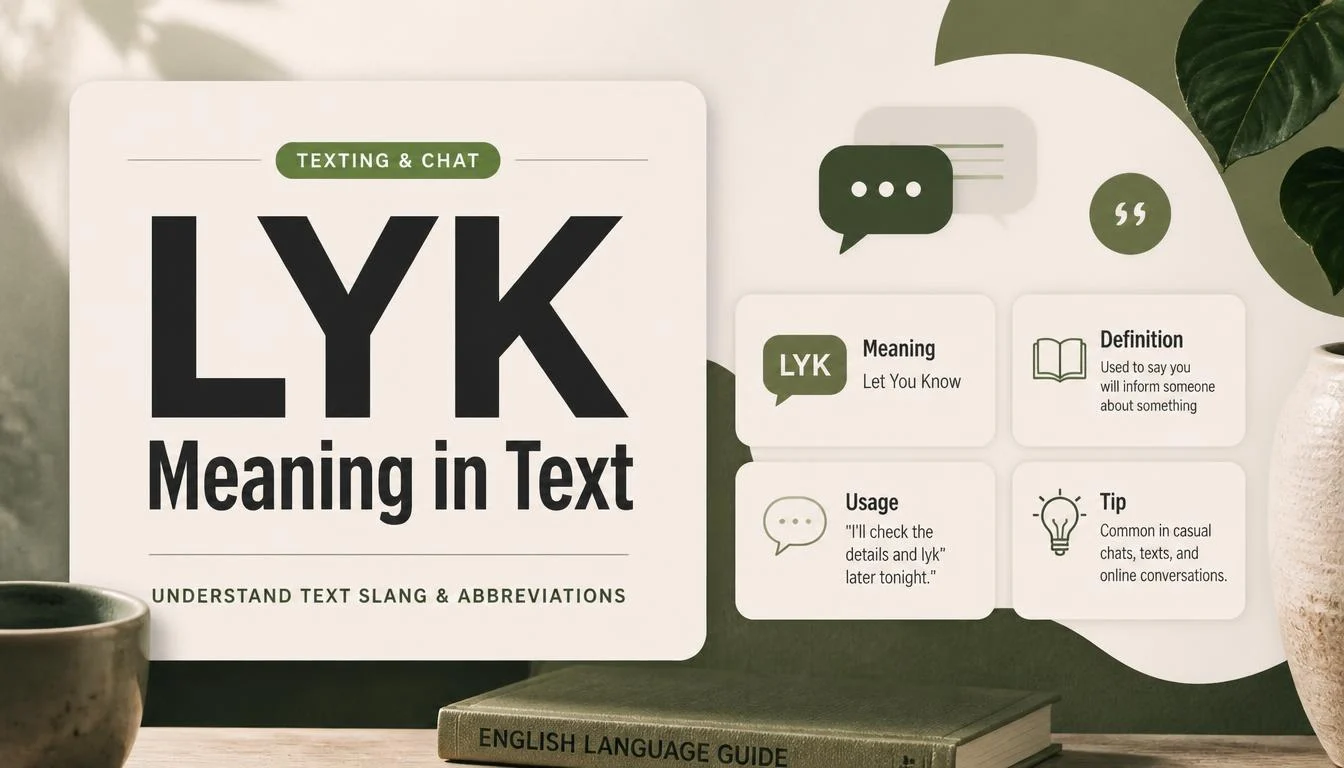
LYK usually means “let you know” in text messages and online chats. People use it when they want to say they will provide information later or update someone once they know more. For example, “I’ll lyk tomorrow” means “I’ll let you know tomorrow.” The abbreviation is informal and works best in casual conversations.
Wondering about the LYK meaning in text? LYK usually means “let you know” and is commonly used in texting, social media, and casual online conversations. It lets someone know that you will provide an update or information later.
Understanding the LYK meaning in text can help you follow fast paced chats and informal messages more easily. Depending on the context, LYK can sound casual, friendly, or straightforward when someone wants to promise an update.
What Does LYK Mean in Text?
LYK most commonly stands for “let you know.” It tells another person that you will give them information when you have it.
For example:
“I need to check with my parents first. I’ll lyk tonight.”
This means:
“I need to check with my parents first. I’ll let you know tonight.”
The abbreviation is especially useful when the speaker does not have an answer yet. Instead of giving an uncertain answer, they indicate that they will provide an update later.
You might also see it written in lowercase as lyk. Texting does not normally require capitalization for abbreviations, so both forms are understandable.
The phrase can appear by itself or as part of a longer message:
- “I’ll lyk.”
- “I’ll lyk when I get home.”
- “Can you lyk what you decide?”
- “I’ll lyk tomorrow.”
- “Let me check and lyk.”
The first three examples use the expression as a way to promise or request information. The last example shows how it can be combined with ordinary words in a casual message.
Why Do People Use LYK?
Texting encourages people to shorten familiar phrases. LYK follows the same basic pattern as many other chat abbreviations. Once a phrase is familiar to both people, typing its shortened form can make communication faster.
There is also a social reason for using it. A message such as “I’ll lyk” feels relaxed and conversational. Writing the complete phrase “I will let you know” can sound more formal than necessary when two friends are chatting.
The abbreviation is therefore less about changing the meaning and more about changing the presentation.
Compare these messages:
| Message | Likely tone |
|---|---|
| “I will let you know.” | Formal or neutral |
| “I’ll let you know.” | Natural and conversational |
| “I’ll lyk.” | Casual and text friendly |
| “lyk when you decide” | Very casual |
None of these automatically changes the underlying message. The main difference is how informal the communication feels.
LYK vs. Let Me Know
One common source of confusion is the difference between LYK and LMK.
LYK generally means “let you know.” LMK means “let me know.” They point in opposite directions.
| Abbreviation | Full phrase | Who provides the information? | Example |
|---|---|---|---|
| LYK | Let you know | The sender promises an update | “I’ll lyk tomorrow.” |
| LMK | Let me know | The recipient is asked for an update | “Lmk when you arrive.” |
Consider this short exchange:
Person A: “Are you coming to the party?”
Person B: “I’m not sure yet. I’ll lyk tonight.”
Here, Person B promises to update Person A.
Now switch the direction:
Person A: “I might be late.”
Person B: “Okay, lmk when you get there.”
Person B is asking Person A to provide the information.
This distinction matters because confusing the two can reverse the meaning of a message.
How LYK Is Used in Conversations
The expression usually appears when information is pending. Someone may need to check a schedule, ask another person, confirm a detail, or make a decision before responding.
When You Need Time to Decide
Suppose a friend asks whether you can meet on Saturday.
You could reply:
“Not sure yet. I’ll lyk tomorrow.”
This tells them that you do not have an answer now, but you expect to have one later.
When You Need to Check Something
Imagine someone asks whether a restaurant has available tables.
You might say:
“I’ll check and lyk.”
The message communicates that you are going to find out before giving an answer.
When Plans Are Uncertain
LYK can also be useful when plans depend on another event.
“If my brother gets home early, I’ll lyk.”
The speaker has not confirmed anything. They are simply saying that they will provide an update when the situation becomes clearer.
When Someone Wants an Update
A person may also use the phrase without the first person pronoun:
“Lyk when you get there.”
In this construction, context matters. The complete phrase would normally be something like “Let me know when you get there.” If someone sends only “lyk,” you should look at the surrounding words before deciding what they mean.
Examples of LYK in Text Messages
Seeing the abbreviation in realistic conversations makes its meaning easier to recognize.
Example 1: Making Plans
Alex: “Are you free for dinner tonight?”
Sam: “I have to finish some work first. I’ll lyk around 6.”
Sam is saying that they will confirm their availability later.
Example 2: Checking With Someone
Mia: “Can we use your car tomorrow?”
Noah: “I need to ask my dad. I’ll lyk.”
Noah does not have permission yet, so he promises to provide an answer later.
Example 3: Waiting for a Schedule
Jordan: “What time does the movie start?”
Taylor: “I’ll check the schedule and lyk.”
Taylor plans to find the information and send it afterward.
Example 4: Uncertain Plans
Chris: “Are you coming to the game?”
Ryan: “Maybe. I’ll lyk after practice.”
Ryan has not made a final decision.
Example 5: Short Casual Reply
Ava: “Let me know if you need a ride.”
Liam: “Will lyk.”
This is an informal response meaning that Liam will provide an update if necessary.
Is LYK Formal or Informal?
LYK is informal. It belongs mainly to texting, online messaging, social media conversations, and other casual forms of digital communication.
It is generally appropriate when you already have a relaxed relationship with the person. Friends, siblings, classmates, and close acquaintances may use it naturally.
Professional communication requires more judgment.
For example, sending this to a close friend is perfectly normal:
“I’ll lyk when I get home.”
Sending the same sentence to a client may appear too casual:
“I’ll lyk after I check the documents.”
A better professional version would be:
“I’ll let you know after I review the documents.”
The full phrase is clearer and more appropriate for formal communication.
Can You Use LYK at Work?
It depends on the workplace and the relationship.
In a relaxed workplace chat between colleagues who regularly use abbreviations, LYK may be understood without any problem. However, it is safer to write the complete phrase in formal emails, reports, applications, customer communication, or messages to someone you do not know well.
For example:
Casual workplace chat:
“I’ll lyk once the meeting time is confirmed.”
Professional email:
“I’ll let you know once the meeting time is confirmed.”
The second version takes only a few extra characters but creates a more polished impression.
The same principle applies to job applications. Texting abbreviations can make an otherwise professional message look careless.
Does LYK Have More Than One Meaning?
In ordinary texting, “let you know” is the meaning most readers will expect when they see LYK in a sentence.
However, abbreviations can occasionally have different meanings in specialized communities. A short combination of letters may represent something completely different in gaming, business, technical discussions, or another subject area.
Context should therefore guide interpretation.
If someone writes:
“I’ll lyk after lunch.”
The intended meaning is very clear because the phrase naturally expands to “I’ll let you know after lunch.”
If the letters appear alone in an unusual context, you may need to look at the surrounding conversation before deciding what they represent.
LYK vs. Other Common Text Abbreviations
LYK belongs to a large family of abbreviations used to shorten everyday expressions.
Here are several related examples:
| Abbreviation | Meaning | Typical use |
|---|---|---|
| LYK | Let you know | Promising an update |
| LMK | Let me know | Asking for information |
| FYI | For your information | Sharing information |
| BTW | By the way | Adding another point |
| IDK | I do not know | Expressing uncertainty |
| TTYL | Talk to you later | Ending a conversation |
| BRB | Be right back | Temporarily leaving a chat |
| ASAP | As soon as possible | Requesting quick action |
These expressions do not all serve the same purpose. LYK is specifically connected with giving someone information later.
For example, IDK communicates that you do not currently have the answer. LYK goes one step further by indicating that you intend to provide information later.
“IDK yet, but I’ll lyk.”
That sentence combines both ideas naturally.
What Does “I’ll LYK” Mean?
“I’ll lyk” means “I’ll let you know.”
It normally suggests that the speaker has not decided something or does not have the requested information yet.
For example:
“I’m not sure if I can come. I’ll lyk tomorrow.”
The important part is the promise of a future update. It does not necessarily mean the speaker has already made a decision.
The timing can also vary. Someone may say “I’ll lyk soon,” “I’ll lyk later,” “I’ll lyk tonight,” or simply “I’ll lyk.”
The surrounding words usually tell you when the update is expected.
What Does “Lyk When You Know” Mean?
“Lyk when you know” can be interpreted as “let me know when you know,” although the abbreviation itself can be ambiguous when it appears without enough context.
A clearer version is:
“Lmk when you know.”
Here, LMK is the standard abbreviation for “let me know.”
This is a useful example of why the exact wording around an abbreviation matters. Texting language is highly dependent on context, and people sometimes use shortened forms loosely.
If a message seems unclear, reading the sentence before and after it will often reveal the intended meaning.
Is LYK Rude?
LYK is not inherently rude.
Its tone usually comes from the rest of the message and the relationship between the people communicating. A simple “I’ll lyk” can sound perfectly friendly between friends.
However, a very short response can sometimes feel distant if the conversation calls for more detail.
Compare:
“I’ll lyk.”
with:
“I’ll check with them and let you know tonight!”
Both communicate an upcoming update. The second feels warmer because it gives more information and sounds more engaged.
Tone is especially important when someone is waiting for an important answer. A short abbreviation may be efficient, but it can sometimes seem dismissive if the situation requires reassurance or explanation.
Should You Capitalize LYK?
Both LYK and lyk are commonly understandable in informal digital communication.
Texting has no universal capitalization rule for abbreviations like this. People may write the letters in uppercase, lowercase, or even mixed case depending on their typing habits.
Examples include:
- “I’ll LYK later.”
- “I’ll lyk later.”
- “I’ll lyk when I know.”
For ordinary texting, capitalization does not normally change the meaning.
In formal writing, however, it is better to avoid the abbreviation altogether and write the complete phrase.
When Should You Avoid LYK?
There are situations where writing the full expression is a better choice.
Avoid it in formal emails, academic assignments, official documents, customer service messages, and important professional communication.
For example, this is not ideal for a formal email:
“I’ll lyk once I have the information.”
A stronger version is:
“I’ll let you know once I have the information.”
The complete phrase is immediately clear to every reader. It also avoids making the recipient interpret texting shorthand.
The same advice applies when communicating with someone who may not be familiar with online abbreviations.
LYK in Social Media and Messaging Apps
You may encounter LYK across many informal communication platforms. People commonly shorten phrases in direct messages, group chats, comments, and private conversations because these spaces favor quick communication.
The abbreviation can appear in a complete sentence:
“I’ll lyk when I get there.”
It can also appear alongside other abbreviations:
“Idk yet, I’ll lyk tmr.”
Here, the message means roughly:
“I do not know yet. I’ll let you know tomorrow.”
The combination of abbreviations makes the message particularly casual. Someone unfamiliar with texting shorthand may need to expand each abbreviation mentally.
That is one reason full words remain preferable when clarity matters more than speed.
Common Mistakes With LYK
One mistake is confusing LYK with LMK. Remember the direction of the information.
LYK: I will tell you.
LMK: You should tell me.
Another mistake is assuming that LYK means the person already knows the answer. Usually, it indicates the opposite. The speaker often needs more information before they can respond.
A third mistake is using it in formal writing simply because it is shorter. Saving a few keystrokes is rarely worth making a professional message look overly casual.
FAQs
Can LYK be used in a sentence without “I’ll”?
Yes. The exact construction depends on the sentence. For example, someone might write “I’ll lyk later” or “I’ll lyk when I find out.” The surrounding words make the intended meaning clear.
Is LYK an acronym or an abbreviation?
It is best described as a texting abbreviation for “let you know.” In casual digital communication, people often use terms such as acronym, abbreviation, and initialism loosely, but LYK is not pronounced as a single word.
Is LYK used by teenagers only?
No. People of different ages use texting abbreviations. Usage depends more on personal communication habits, platform, relationship, and context than on age alone.
Can LYK appear in lowercase?
Yes. “lyk” and “LYK” can communicate the same idea. Lowercase forms are especially common in casual texting because people often type messages without worrying about capitalization.
What should I say instead of LYK in a formal message?
Use the complete phrase “let you know.” For example, replace “I’ll lyk after I check” with “I’ll let you know after I check.” This sounds clearer and more professional.
Conclusion
LYK is a simple texting abbreviation for “let you know.” It is most useful when someone needs to provide information after checking something or making a decision. The expression is casual, so it fits naturally in friendly messages but is usually better replaced with the full phrase in formal communication. Remembering the difference between LYK and LMK will also help you understand who is expected to provide the information.