Quick answer:
FYM is a texting and social media abbreviation that stands for “f*** you mean,” a blunt, informal way of saying “what do you mean?” or “what are you talking about?” It usually signals confusion, disagreement, or mild disbelief at something someone just said. Tone matters a lot here it can come across as playful teasing between friends or as genuinely annoyed pushback, depending on context. It’s almost never used in formal writing or professional messages.
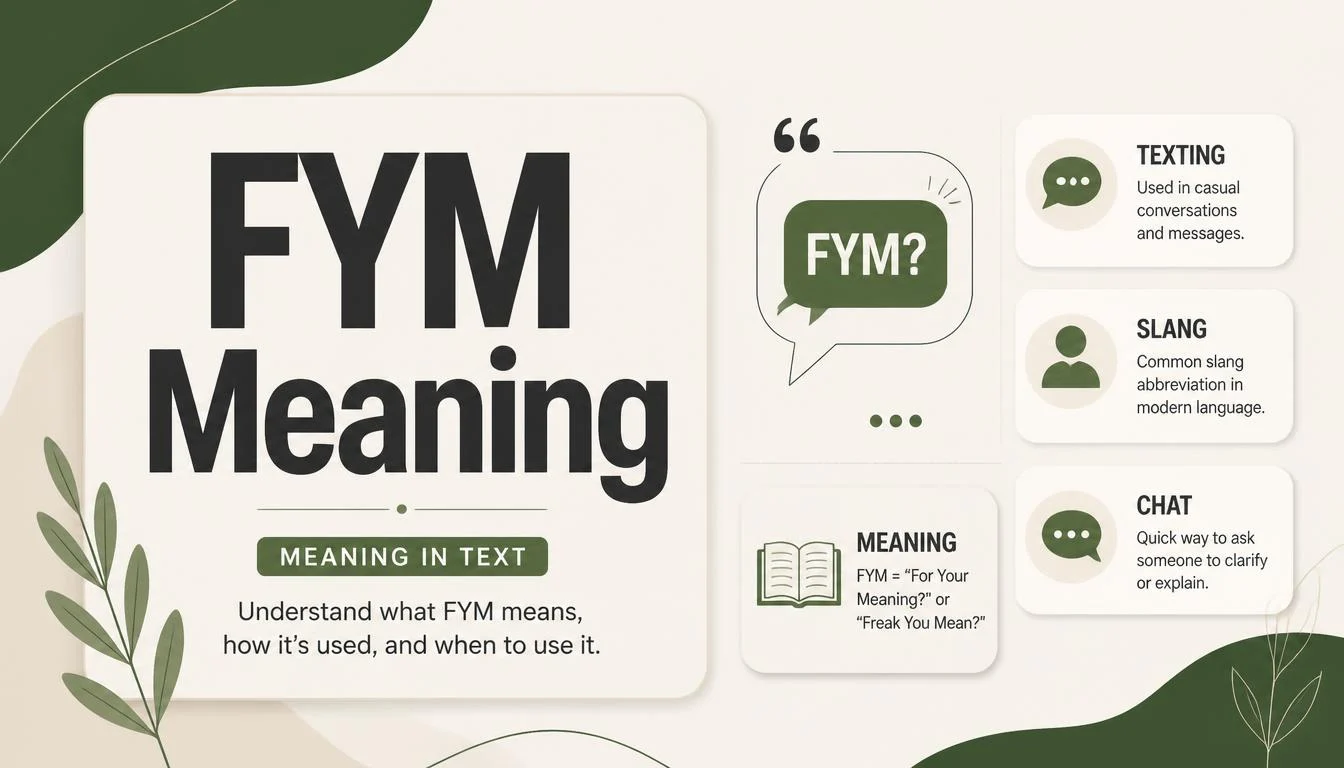
What does FYM Meaning refer to in texting and online conversations? FYM is a casual slang abbreviation commonly used in messages and social media when someone wants to question, challenge, or react strongly to what another person has said.
Understanding the context is important because FYM Meaning can vary slightly depending on the conversation and tone. In this guide, you’ll learn what FYM stands for, how people use it in texts, and examples of FYM in different situations.
Where FYM Comes From
Abbreviations like this one grew out of texting culture in the 2000s and early 2010s, back when character limits and thumb-typing on flip phones pushed people to shorten everything. FYM followed the same pattern as older slang like WTF or OMG: take a phrase people say constantly, strip it down to initials, and let context fill in the rest.
The phrase it’s built on “the f you mean” or “f*** you mean” is a clipped, informal version of “what the f*** do you mean.” Dropping “what” and “do” is common in casual spoken English, especially in African American Vernacular English and various regional dialects, where this kind of contraction has long been part of everyday speech before it ever showed up in texts.
What FYM Actually Signals
This is where a lot of confusion happens, because FYM isn’t just one thing. Depending on who’s saying it and how, it can mean several slightly different things.
- Genuine confusion: “wait fym the show got cancelled” the person legitimately doesn’t understand and wants clarification.
- Disbelief or shock: “fym you’re not coming tonight?!” less about needing information, more about reacting to news.
- Playful pushback: Used between friends to jokingly challenge something ridiculous someone said.
- Actual annoyance: In an argument, it can read as sharp and dismissive, closer to its literal profanity-based root.
Because the tone shifts so much with context, reading the rest of the message, and knowing the relationship between the people texting, matters more than the abbreviation itself.
FYM vs. Similar Slang Terms
People often mix FYM up with other short reaction phrases, but each one carries a slightly different flavor.
| Term | Meaning | Typical Tone |
|---|---|---|
| FYM | “F*** you mean” what do you mean? | Blunt, can be playful or annoyed |
| WYM | “What you mean” | Softer, more neutral version of FYM |
| TF | “The f***” (often paired with other words, like “wtf”) | Emphasizes shock or frustration |
| SMH | “Shaking my head” | Disapproval or disappointment, not confusion |
| IDK | “I don’t know” | Genuine uncertainty, no attitude implied |
WYM is probably the closest relative same basic question, minus the profanity, which makes it land as more neutral and less confrontational. If you’re texting someone you don’t know well, WYM is the safer bet.
Common Variations and Spellings
FYM doesn’t always show up in its clean, four-letter form. People adapt it depending on the platform and how much emphasis they want to add.
- fymm an extended version, often used to stretch out the sound of frustration or disbelief, similar to writing “whyyyy” instead of “why.”
- FYM?? the double question mark version, common when someone is genuinely stunned rather than just asking a casual question.
- lowercase fym by far the most common form in everyday texting; all-caps FYM tends to signal more heat or urgency behind the message.
- fym bro / fym tho paired with filler words that soften the phrase and make it sound more conversational than confrontational.
None of these variations change the core meaning. They just adjust the emotional volume.
FYM Across Different Age Groups and Platforms
Like most internet shorthand, FYM isn’t used identically everywhere. Younger users, particularly teens and people in their early twenties, tend to use it far more casually and frequently than older users, often multiple times in a single conversation thread.
On TikTok and Instagram comment sections, FYM often shows up as a reaction to a bold or funny claim in a video, functioning almost like a punchline response rather than a real question. On Twitter/X, it’s more likely to appear in heated reply threads, where the tone leans closer to actual disagreement. In private texts between close friends, it’s usually the lightest version of itself closer to “wait, what?” than any real hostility.
Older users or those less familiar with texting slang sometimes misread FYM as more aggressive than it’s intended to be, simply because they’re less used to seeing the abbreviated, softened form of the underlying phrase.
Is FYM Considered Rude?
It depends heavily on setting. Among close friends texting casually, FYM is often no more aggressive than saying “wait, what?” out loud. The abbreviation softens the profanity somewhat just by turning it into letters instead of a spelled-out curse word.
That said, because it’s built on a swear word, it’s not something you’d want to use with a boss, a teacher, a customer service rep, or really anyone in a formal or professional context. It reads as casual at best and confrontational at worst, and there’s no version of it that fits a work email or a first conversation with someone new.
When Not to Use FYM
A few situations where this abbreviation is best avoided entirely:
- Messaging a coworker, manager, or client, regardless of how casual your workplace culture feels.
- Texting someone you’ve just met, since tone can easily be misread without established rapport.
- Any written communication that might be forwarded, screenshotted, or seen out of context by someone unfamiliar with the relationship.
- Customer service chats, professional social media comments, or anything tied to your name publicly in a work capacity.
When in doubt, the safer, profanity-free alternative (WYM, or simply “what do you mean?”) gets the same point across without the risk.
How to Use FYM in a Sentence
A few natural examples of how this shows up in real conversations:
- “fym it’s already sold out, I just checked yesterday”
- “wait FYM you didn’t get the text? I sent it this morning”
- “lol fym you thought I was mad, I was just tired”
Notice that it’s almost always lowercase in casual texting, and it’s frequently paired with “wait” or “lol” to soften or clarify the intended tone.
FAQs
Does FYM Always Involve Swearing When Spoken Out Loud?
Not usually. People who type FYM may not say the full curse word when reading it aloud. Many simply understand it as a shortened way to express “what do you mean.” Over time, the abbreviation has developed a broader everyday meaning beyond its literal expansion.
Is FYM the Same Everywhere Online, or Does It Vary by Platform?
The core meaning generally stays consistent across texting, Twitter/X, Instagram comments, and TikTok. However, the tone can change depending on the platform and context. In TikTok comment sections, for example, FYM may be used more for comedic effect than genuine confusion.
Can FYM Be Used Positively?
Yes. FYM can appear in reactions to exciting or surprising news. For example, someone might write, “FYM you got the job?! Let’s go!” In this context, it expresses excited disbelief rather than criticism or anger.
Is There a More Polite Way to Say the Same Thing?
Yes. Expressions such as “What do you mean?”, “WYM,” or simply “Huh?” can communicate the same basic question without the profanity associated with FYM. The best choice depends on the level of formality and the relationship between the speakers.
Did FYM Originate on a Specific App or Platform?
There is no single platform that can be credited with creating FYM. It belongs to a broader tradition of texting shorthand that developed through SMS, early social media, online communities, and group chats rather than being clearly coined on one specific app.
Conclusion
FYM is really just a shorter, blunter way of asking someone to clarify what they meant, dressed up in internet shorthand. The words underneath it are simple, but the delivery changes everything the same three letters can sound like teasing, shock, or genuine irritation depending on who’s typing them. If you’re ever unsure how it’s meant, the safest move is just to look at the rest of the message for the emotional cues.