Quick Answer
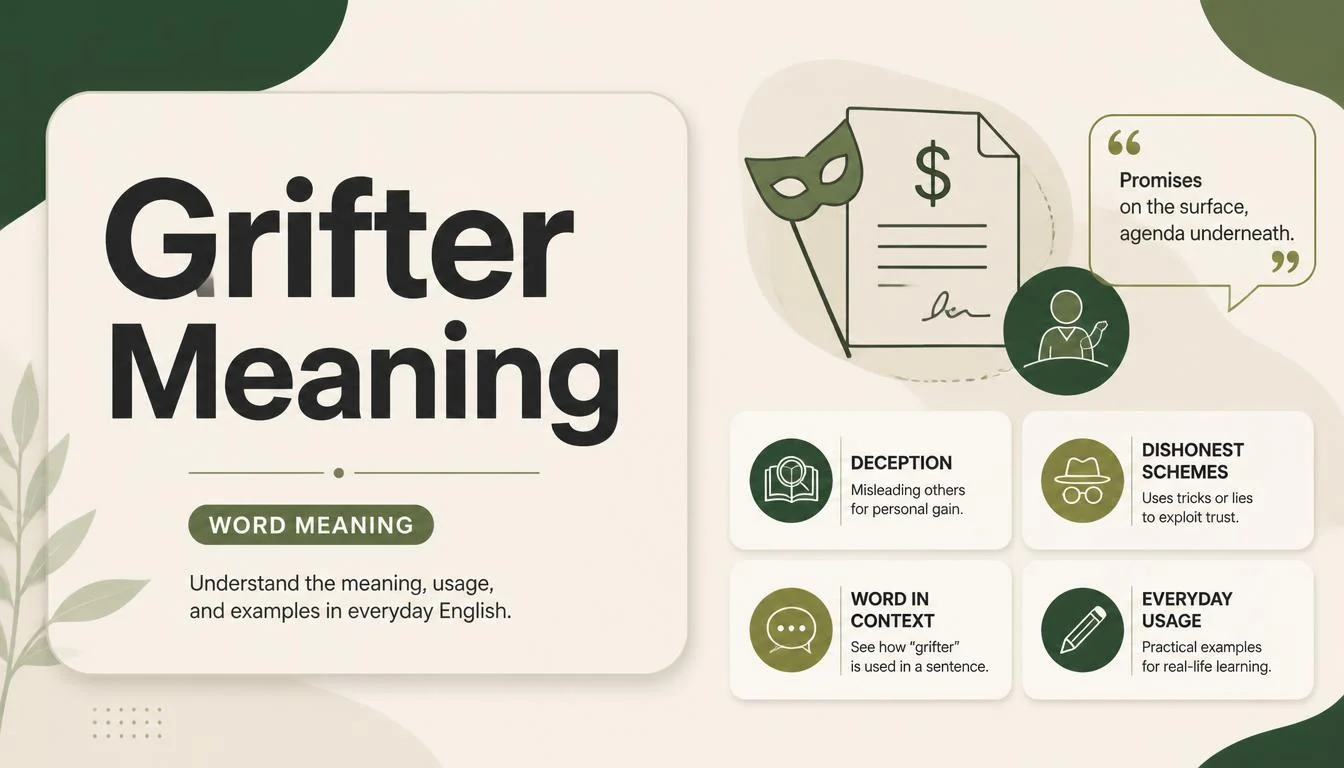
A grifter is someone who tricks or deceives others to get money, favors, or other personal benefits. The term often describes a con artist, scammer, or dishonest person who gains people’s trust to exploit them. For example, someone who pretends to be wealthy to borrow money without intending to repay it could be called a grifter.
The word grifter describes a person who uses dishonesty, manipulation, or clever schemes to take advantage of others. Grifters often gain people’s trust before asking for money, making false promises, or finding ways to benefit at someone else’s expense. The term usually carries a negative meaning because it suggests intentional deception.
You might encounter the word grifter in news stories, social media discussions, movies, or everyday conversations. It can describe anyone from a small-time scammer to someone who builds an elaborate scheme around false claims. Understanding the grifter meaning helps you recognize how the term differs from words like con artist, fraudster, and scammer.
What Does Grifter Mean?
A grifter is a person who uses deception to obtain money or other personal benefits. Grifters often rely on persuasion, misleading claims or carefully crafted stories to gain someone’s trust. Their goal is to get something valuable without being honest about their intentions.
For example, imagine someone who claims to have discovered a secret investment strategy. They promise guaranteed profits and pressure people to pay for access. However, they have no reliable evidence to support their claims and mainly want to collect payments. This behavior fits the meaning of grifter.
The term is closely related to con artist, scammer and swindler. All three describe dishonest behavior, although each word can carry a slightly different emphasis. A grifter may run a traditional money scam or exploit a person’s trust in a less obvious way.
The word doesn’t automatically apply to anyone who makes a mistake or runs an unsuccessful business. Deception and personal exploitation are central to the accusation.
Is Grifter a Slang Word?
Yes. Grifter is an informal word, especially associated with American English. Dictionaries commonly define it as a person who tricks others out of money or gains something through dishonest means.
Although the word has a long history, its modern usage extends beyond traditional scams. People now use it when discussing questionable influencers, dishonest public figures and individuals who exploit their audiences for personal gain.
For example, someone might write, “That online mentor is a grifter who sells promises instead of useful advice.” The speaker is accusing the person of misleading customers for profit.
Grifter is usually an insult rather than a neutral description. However, its meaning depends on context. Sometimes people use it after seeing evidence of deception. In other cases, they use it loosely during arguments or disagreements.
Calling someone a grifter expresses an accusation. It does not prove that the person has committed fraud.
Grifter Pronunciation and Word Forms
Learning the pronunciation and related word forms makes it easier to understand the term in conversation and writing.
How to Pronounce Grifter
The American English pronunciation of grifter is /ˈɡrɪftɚ/. It has two syllables with the stress on the first syllable.
The opening sound rhymes with the beginning of grip. The word ends with the familiar sound heard in writer in many American accents.
What Is the Difference Between Grift, Grifter and Grifting?
These related words describe different parts of the same idea.
Grift: A dishonest scheme or the act of swindling someone.
Grifter: The person who carries out the dishonest activity.
Grifting: The act of running a grift or the ongoing behavior of exploiting others.
Grifted: The past tense of the verb grift.
For example, a dishonest investment scheme could be called a grift. The person behind it would be the grifter. Their ongoing efforts to persuade people to invest could be described as grifting.
What Is the Plural of Grifter?
The plural form is grifters.
Example: “The investigators warned customers about several grifters who were promoting fake investment opportunities.”
Grifter Examples in Everyday Life
The easiest way to understand the grifter meaning is to look at situations where someone uses deception for personal gain. The following hypothetical examples show how the word applies in different settings.
1. A Fake Investment Expert
Imagine a person who advertises an investment program with guaranteed monthly profits. They share fabricated earnings reports and claim that wealthy clients already trust their methods.
After collecting payments, they stop answering messages. Their promises were designed to attract money rather than provide a legitimate service. People could reasonably describe this person as a grifter.
2. A Dishonest Charity Organizer
Someone creates a fundraising campaign and claims that every donation will help families facing an emergency. However, they secretly keep the money for personal expenses.
This person exploits people’s generosity and concern for others. If the deception is intentional, the behavior fits the description of a grifter.
3. A Fake Business Coach
A self proclaimed business expert advertises a course that supposedly guarantees financial freedom. They invent success stories and display credentials they never earned.
Customers pay thousands of dollars but receive little useful guidance. The problem isn’t simply that the course fails to deliver great results. The concern is that the seller deliberately misrepresented the offer to attract buyers.
4. Someone Who Repeatedly Borrows Money
Consider a person who frequently tells friends that they face urgent financial emergencies. They promise to repay every loan but repeatedly invent excuses when repayment becomes due.
If they knowingly fabricate these emergencies to obtain money, their behavior could be described as grifting. However, someone who genuinely struggles financially should not automatically receive that label.
How to Use Grifter in a Sentence
Grifter usually functions as a noun. You can use it when discussing scams, dishonest people or suspected exploitation.
Here are six natural examples:
- “The investor turned out to be a grifter who used fake documents to attract customers.”
- “She warned her friends about an online grifter selling worthless financial advice.”
- “People accused the self proclaimed expert of being a grifter after his claims fell apart.”
- “The charity discovered that a grifter had been collecting donations under its name.”
- “Those grifters promised quick profits but never explained where the money would go.”
- “He called the promoter a grifter because the advertised product never existed.”
Notice that these sentences describe an accusation or a situation involving deception. In real conversations, the word can sound harsh. Use it carefully when you don’t have enough evidence to support the claim.
What Does Grifting Mean on Social Media?
Social media has given grifting new opportunities. People can build an audience through videos, posts and livestreams. Most creators use these platforms legitimately. However, some individuals exploit their followers by making deceptive claims or selling misleading promises.
An online grifter might pretend to have special financial knowledge, promote an investment without disclosing important risks or sell a course using fabricated testimonials. Others may repeatedly create outrage because angry viewers generate attention and engagement that can be monetized.
For example, imagine an influencer who claims to have discovered a guaranteed way to earn thousands of dollars each week. They use rented luxury cars and invented success stories to convince followers that the method works. Their real goal is to sell an expensive program.
People may describe this person as an online grifter if the evidence shows deliberate deception for profit.
However, earning money from content doesn’t make someone a grifter. Sponsorships, advertisements, paid memberships and online courses can all be legitimate. The important distinction is whether the person misleads or exploits their audience.
What Does Political Grifter Mean?
A political grifter is someone accused of exploiting political beliefs, public attention or supporters for personal benefit. The term often appears in debates about fundraising, political commentary and public figures who profit from their supporters’ trust.
For example, a political fundraiser might claim that donations will support a specific campaign. If the organizer knowingly misrepresents the purpose of those donations to enrich themselves, critics may call them a political grifter.
The phrase can also describe someone who uses political outrage to sell merchandise, attract paid subscribers or promote questionable products. In these situations, the accusation centers on alleged dishonesty rather than political beliefs alone.
However, political grifter is a loaded expression. People sometimes use it to attack opponents whose views they dislike. A controversial opinion or a paid political career does not automatically establish dishonest conduct.
To understand whether the label is justified, look for verifiable evidence. Consider the person’s claims, financial arrangements and actions rather than relying on insults from either side.
How to Recognize Common Grifter Tactics
Grifters often depend on trust and persuasion. Their methods can vary, but several warning signs deserve attention.
Unrealistic Promises
Be cautious when someone guarantees extraordinary returns or effortless success. Legitimate opportunities usually involve risks, costs or limitations. A promise that sounds too good to be true deserves closer examination.
Manufactured Urgency
Some dishonest sellers pressure people to act immediately. They might claim that an opportunity will disappear within minutes or that you will lose a special advantage if you ask questions.
Urgency can be legitimate in some situations. However, it becomes suspicious when someone uses pressure to prevent you from checking the facts.
Fake Credentials
A person might invent qualifications, exaggerate professional experience or display misleading testimonials. These tactics create an appearance of expertise without reliable evidence.
Check professional credentials through independent sources whenever possible. Don’t rely only on screenshots or testimonials provided by the seller.
Emotional Manipulation
Grifters may exploit fear, sympathy, loyalty or ambition. They might present themselves as the only person who can solve your problem or claim that questioning them means you don’t care about a cause.
Strong emotions can make people overlook important details. Take time to review the facts before making financial decisions.
Lack of Transparency
Be careful when someone refuses to explain fees, business arrangements or how promised results will be achieved. Vague answers don’t prove dishonesty, but repeated evasiveness should encourage further investigation.
A sensible approach is to verify claims, read the terms and seek independent advice before committing money.
Grifter vs. Scammer vs. Con Artist
Grifter, scammer and con artist have similar meanings, but they aren’t always interchangeable. Each term highlights a slightly different aspect of dishonest behavior.
| Word | Meaning | Main emphasis |
|---|---|---|
| Grifter | Someone who exploits deception for personal gain | Dishonest schemes or ongoing exploitation |
| Scammer | Someone who deceives people through a scam | A fraudulent offer or scheme |
| Con artist | Someone who tricks people by gaining their confidence | Persuasion and manipulation |
| Fraudster | Someone who commits fraud | Deceptive conduct, often in financial or legal contexts |
| Swindler | Someone who cheats others out of money or property | Financial deception |
| Hustler | Someone who works aggressively toward a goal | Can describe honest ambition or dishonest activity |
A grifter might use the same tactics as a scammer or con artist. The difference often lies in how people describe the behavior rather than in a strict boundary between the terms.
For example, a person who runs a fake investment scheme could be called a scammer, a swindler or a grifter. All three labels communicate dishonesty, although the exact nuance can vary.
Hustler is different because it can have a positive meaning. Someone who works hard to build a business may proudly call themselves a hustler. Context determines whether the word suggests ambition or deception.
Grifter Synonyms and Antonyms
Choosing the right related word can help you express the intended meaning more precisely.
Common Synonyms for Grifter
Con artist: Someone who tricks people by gaining their trust.
Scammer: Someone who uses a fraudulent scheme to deceive others.
Swindler: Someone who cheats people, especially to obtain money or property.
Fraudster: Someone who commits fraud.
Charlatan: Someone who falsely claims to have special knowledge or abilities.
Trickster: Someone who deceives others, sometimes through clever schemes or practical jokes.
Deceiver: A broad term for someone who deliberately misleads another person.
Crook: An informal term for a dishonest person or criminal.
These words overlap, but their meanings aren’t identical. A charlatan often pretends to possess expertise, while a swindler usually brings financial deception to mind.
What Is the Opposite of Grifter?
English doesn’t have one exact antonym for grifter. The best opposite depends on the context.
Possible contrasting terms include:
- Honest person
- Trustworthy individual
- Ethical professional
- Truthful person
- Legitimate business owner
- Straight shooter
For example, an honest financial adviser explains risks and fees clearly. A grifter might hide those details to persuade clients to hand over money.
What Is the Origin of the Word Grifter?
The word grifter dates to the early twentieth century. Etymological references trace its use to American slang associated with carnival and circus settings.
The term originally referred to a confidence trickster or someone involved in dishonest gambling and similar schemes. Over time, its meaning expanded to describe people who obtain money through deception more broadly.
The related word grift appeared as a noun around 1906 and as a verb around 1915, according to the Online Etymology Dictionary. The exact derivation is uncertain, although the word is commonly linked to graft in the sense of dishonest gain.
Today, grifter remains especially familiar in American English. Its use has also grown in online discussions, where people apply it to alleged deception involving money, influence or public attention.
FAQs
What does grifter mean in simple terms?
A grifter is someone who tricks people to gain money or another personal benefit. The term usually suggests deliberate dishonesty and exploitation.
Is grifter a slang word?
Yes. Grifter is an informal word commonly used in American English. It has a negative tone and often describes a scammer or con artist.
What does it mean to call someone a grifter?
Calling someone a grifter means accusing them of using deception for personal gain. The accusation may involve money, influence or exploitation of other people’s trust. It doesn’t establish that the person has actually committed fraud.
What is the difference between a grifter and a scammer?
A scammer is someone who deceives people through a fraudulent scheme. Grifter often carries a broader informal meaning that emphasizes exploiting trust for personal benefit. The terms overlap considerably.
What does grifting mean online?
Online grifting refers to alleged dishonest behavior on digital platforms for personal gain. Examples may include fake expertise, misleading promotions or fabricated success stories designed to generate income.
What is the plural of grifter?
The plural is grifters. For example, “The website warned readers about grifters promoting fraudulent investment offers.”
Can a grifter run a legitimate business?
A person can operate a real business while also engaging in dishonest practices. However, running a business or earning a profit doesn’t make someone a grifter. The label concerns deceptive or exploitative conduct.
Is calling someone a grifter an insult?
Yes. The term usually expresses strong disapproval because it suggests dishonesty and exploitation. Since it makes a serious accusation, it’s best to consider the available evidence before using it about a real person.
Conclusion
The grifter meaning centers on deception, manipulation and personal gain. A grifter may use false promises, fake expertise or misplaced trust to obtain money or influence.
The term appears in everyday conversations, online discussions and political commentary. Understanding its meaning helps you recognize the accusation and use the word accurately. Above all, distinguish genuine evidence of dishonesty from personal opinions or unsupported claims.