Quick Answer
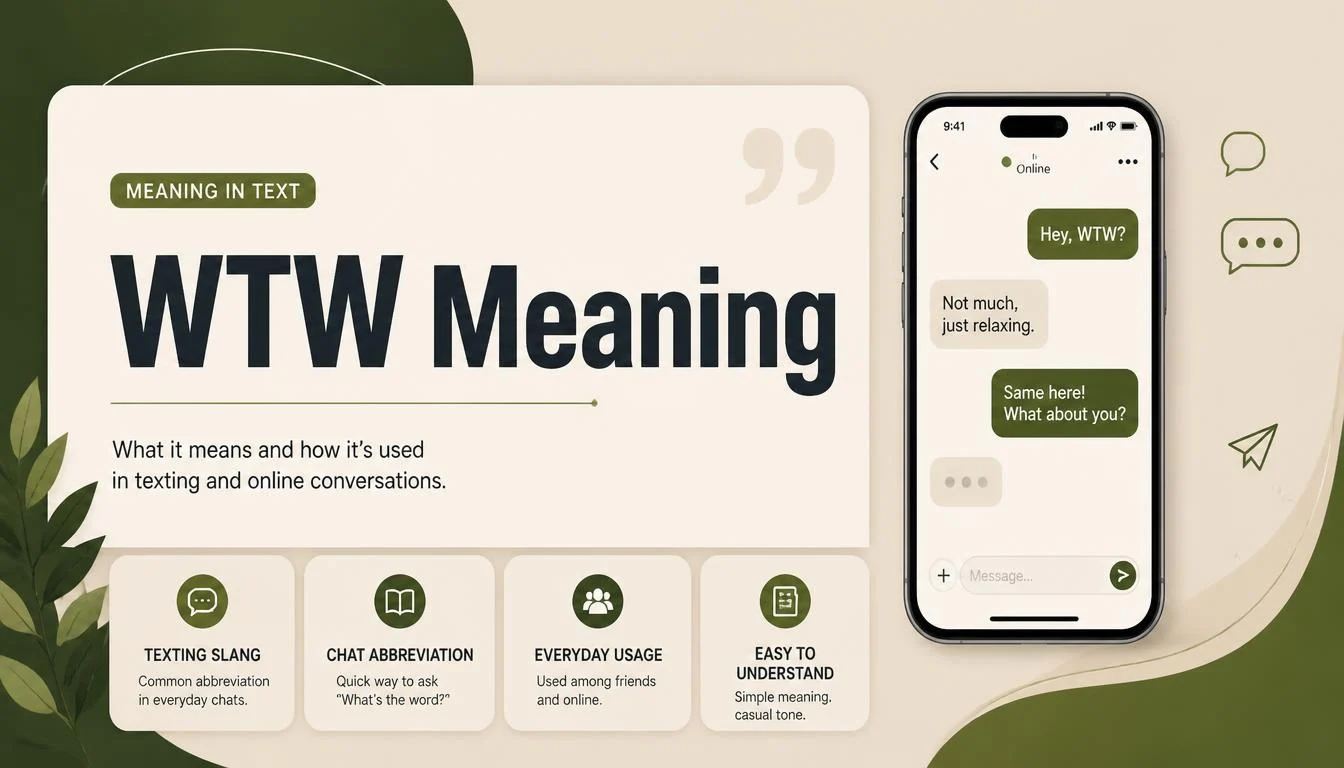
WTW means “What’s the word?” in texting and online chats. People use it to ask what’s happening, check someone’s plans, or start a casual conversation. For example, “Hey, WTW tonight?” means “Hey, what are the plans for tonight?”
If someone texts you “WTW?” you might wonder what they’re asking. This popular abbreviation appears in text messages, Snapchat chats, Instagram DMs, and other social media conversations. It’s a quick, casual way to ask what’s going on or what someone has planned.
The WTW meaning can depend on the conversation, but it usually stands for “What’s the word?” People often use it when they want to make plans, catch up with friends, or find out what’s happening. Understanding this abbreviation can help you keep your online conversations natural and easy to follow.
What Does WTW Mean?
WTW most commonly stands for “What’s the Word?” In everyday texting, it works as an informal question about what’s happening, what someone is doing socially, or whether anything interesting is going on.
Think of it as a quick way to open a conversation. Instead of typing “What’s going on with you?” or “Do you have any plans?” someone can simply send “WTW?”
The exact intention depends on the situation. A friend might want to catch up, while another person might be checking whether you’re available to hang out.
Consider this example:
Alex: Hey, WTW?
Jordan: Not much. Just watching a movie. You?
Here, Alex is starting a casual conversation. Jordan answers and returns the question, giving Alex an opportunity to continue chatting.
WTW doesn’t usually require a detailed response. A short update, a question in return, or a suggestion for an activity can keep the conversation moving.
What Does WTW Stand for in Texting?
In casual messages, WTW generally stands for “What’s the Word?” The abbreviation takes the first letters of the phrase and turns them into a quick, easy-to-type expression.
People often use abbreviations like this because messaging favors speed and convenience. Rather than writing a complete sentence, they rely on familiar shorthand that the other person can understand.
WTW can serve several related purposes:
- Starting a conversation: Checking in with a friend after a while.
- Asking for an update: Finding out what’s happening in someone’s life.
- Making plans: Seeing whether someone wants to go out or do something.
- Checking the vibe: Finding out whether anything interesting is happening.
- Keeping a conversation casual: Opening a chat without sounding overly formal.
For example, “WTW this weekend?” usually asks about possible weekend plans. Meanwhile, “Hey, WTW?” is more open-ended and could simply mean “What’s up?”
Although “What’s the Word?” is the usual interpretation, don’t assume every message uses the abbreviation in exactly the same way. Some people may use WTW as a personal shorthand or intend a different phrase entirely.
WTW Meaning in Text, Chat, and Slang
The WTW meaning in text messages is closely tied to informal online communication. It isn’t usually a technical term or a formal abbreviation. Instead, it helps people ask questions quickly and naturally.
WTW can feel more relaxed than a full sentence. Compare these messages:
- “What are your plans for tonight?”
- “Do you want to do something later?”
- “WTW tonight?”
All three can serve a similar purpose, but the last one is shorter and more casual. It works best when the sender and recipient are comfortable using texting shorthand.
WTW Meaning in a Text Message
When someone sends WTW in a text message, they’re usually asking what’s happening or whether you have something planned.
The wording around the abbreviation can offer useful clues.
Example:
Sam: WTW tonight?
Taylor: I’m free after seven. Want to grab something to eat?
Because Sam mentions tonight, the message most likely concerns plans rather than general news.
Now consider a different exchange:
Sam: Hey, WTW?
Taylor: Nothing much. Just finished work.
Without a specific time or activity, the question is more general. Sam may simply want to catch up.
WTW Meaning in Chat
The WTW meaning in chat is generally the same as its meaning in text messages. People use it in private conversations, group chats, and other informal messaging spaces.
In a group chat, for example, someone might write “WTW this weekend?” to see whether their friends want to meet. In a private chat, the same abbreviation might be a simple greeting.
The important distinction is that WTW opens the conversation rather than providing the answer itself. The sender wants information, a response, or an opportunity to make plans.
WTW Meaning in Slang
WTW counts as internet slang because people use it as an informal expression in digital conversations. It’s also a texting abbreviation, since it shortens a longer phrase into three letters.
The term is especially useful when people already understand common messaging shorthand. However, someone unfamiliar with texting slang might not recognize it immediately.
WTW is generally suitable for conversations with friends, classmates, family members, and other people who communicate casually. In a professional email, formal report, or message to someone who expects complete sentences, writing the full question is usually clearer.
For example:
- Casual: “WTW after class?”
- More explicit: “Are you free to do something after class?”
- Formal: “Would you be available to meet after class?”
The best choice depends on your relationship with the recipient and the tone of the conversation.
Other Meanings of WTW
Although “What’s the Word?” is the most common interpretation in casual texting, WTW doesn’t have one universal meaning in every situation. Other phrases can fit the same letters, especially when people discuss a specific subject.
Context matters more than the abbreviation alone.
| Possible meaning | When it makes sense | Example |
|---|---|---|
| What’s the Word? | Casual check-ins or plans | “WTW this evening?” |
| What the What? | Surprise or confusion | “WTW?! I didn’t expect that.” |
| What to Wear? | Clothing or event discussions | “WTW to the dinner party?” |
| What to Watch? | Movies and television | “WTW on Netflix tonight?” |
These alternatives aren’t equally common in every community. Some are context-specific interpretations rather than standard meanings used by everyone.
WTW Meaning as “What’s the Word?”
This is the main interpretation to remember when you encounter WTW in a casual message.
People use “What’s the Word?” to ask what’s happening, whether there’s any news, or what someone has in mind. The question can also serve as a relaxed way to suggest making plans.
For example:
Chris: WTW for Friday?
Morgan: We could check out that new café.
Chris is asking about possible plans. Morgan responds with a suggestion, so the conversation naturally moves toward arranging an activity.
WTW Meaning as “What the What?”
In some contexts, WTW can stand for “What the What?” This phrase expresses surprise, confusion, or disbelief.
It’s similar in tone to “What?” or “Wait, what?” Someone might use it after hearing unexpected news or seeing something difficult to believe.
For example:
Riley: I accidentally sent the message to the wrong group chat.
Casey: WTW?! How did that happen?
Here, the surrounding conversation points toward surprise rather than a request for plans.
This interpretation is more likely when WTW appears with an exclamation point, follows surprising information, or forms part of a reaction.
WTW Meaning as “What to Wear?”
WTW can also mean “What to Wear?” when the conversation focuses on clothes, events, or personal style.
For example:
Avery: The invitation says the dress code is smart casual.
Jamie: WTW? Maybe a nice shirt and trousers?
The clothing-related context makes the intended meaning clear. Without that context, a reader might interpret the same letters as “What’s the Word?”
WTW Meaning as “What to Watch?”
In conversations about entertainment, WTW may mean “What to Watch?” Someone might use it when looking for a movie, show, or video recommendation.
For example:
Mia: I’m bored and want something funny.
Noah: WTW? I’ve got a few comedy recommendations.
The reference to entertainment signals that the abbreviation concerns viewing choices.
How to Tell Which WTW Meaning Someone Intended
If you’re unsure what WTW means, look at the surrounding messages before deciding.
Use these clues:
- Plans or activities: The sender probably means “What’s the Word?”
- Unexpected news: The sender may mean “What the What?”
- Clothes or an event: “What to Wear?” may fit.
- Movies or television: “What to Watch?” could be intended.
- No clear context: The sender may simply be checking in.
If the meaning still isn’t obvious, asking “What do you mean by WTW?” is perfectly reasonable. There’s no need to guess when a quick clarification will do.
WTW Meaning on Snapchat, Instagram, TikTok, and WhatsApp
WTW doesn’t have a completely different definition on every social media platform. Its basic conversational meaning generally stays the same, although the setting can influence what the sender intends.
A message about tonight’s plans is more likely to be a social invitation than a request for general news. Similarly, an abbreviation appearing after surprising information may be a reaction rather than a greeting.
WTW Meaning on Snapchat
On Snapchat, WTW can appear in private chats or casual exchanges between friends. A person might send it to restart a conversation, check whether someone is available, or find out what’s happening.
Example:
You: WTW tonight?
Friend: Nothing planned yet. What’s up?
The message suggests that the sender wants to discuss possible plans. It doesn’t automatically mean the sender has a specific invitation ready.
Snapchat conversations often rely on short, informal messages. WTW fits that style because it communicates a question without requiring a full sentence.
If someone sends you WTW on Snapchat, consider your recent conversation. If you’ve been discussing a party, the message may concern that event. If you haven’t talked in a while, the sender might simply be checking in.
WTW Meaning on Instagram
On Instagram, WTW may appear in direct messages or informal exchanges with friends and acquaintances.
For example:
Jordan: Hey, WTW?
Taylor: Just scrolling. What’s going on?
Jordan’s message starts a conversation without introducing a specific topic. Taylor’s reply leaves room for Jordan to continue with a question, an update, or an invitation.
WTW may also appear in conversations that begin after someone replies to a story or reacts to a post. In that situation, the preceding interaction can help explain the sender’s intention.
However, receiving WTW in an Instagram direct message doesn’t automatically signal flirting. The sender might be interested in talking, making plans, or simply reconnecting.
WTW Meaning on TikTok
On TikTok, WTW can be used in informal messages and conversations about videos, trends, or social plans.
For example:
Friend: WTW later?
You: Probably free after dinner. Why?
This exchange uses WTW to ask about availability and possible plans.
The platform doesn’t change the abbreviation’s core meaning. Instead, the topic of the conversation helps determine what the sender wants.
If someone sends WTW after sharing a funny video, they may be starting a general conversation. If the message follows a discussion about going out, it probably concerns plans.
WTW Meaning on WhatsApp
On WhatsApp, WTW can appear in private messages, group chats, or conversations with friends and relatives.
For example:
Alex: WTW this weekend?
Morgan: We could go bowling on Saturday.
Here, Alex wants to discuss weekend plans. Morgan responds with a concrete suggestion.
In a group chat, WTW can also help bring people together when no one has decided what to do. The abbreviation keeps the opening message short while allowing everyone to suggest activities.
As with other platforms, it’s best to interpret WTW through the conversation rather than assume WhatsApp gives it a unique meaning.
What Does WTW Mean From a Girl or a Guy?
When someone you’re interested in sends WTW, it’s natural to wonder whether the message has a deeper meaning. However, the abbreviation itself doesn’t tell you whether the sender is flirting, being friendly, or looking for company.
WTW usually communicates a question, not a guaranteed romantic signal. The sender’s tone, your relationship, and the conversation leading up to the message provide better clues.
What Does WTW Mean From a Girl?
If a girl sends you WTW, she may be asking what’s happening, checking whether you’re free, or starting a conversation.
For example:
Her: Hey, WTW tonight?
You: I’m free after seven. Did you have something in mind?
Her message could lead to an invitation, but it doesn’t prove that she has romantic intentions. She might want to hang out as friends or simply see what’s going on.
Look at the broader pattern instead of drawing conclusions from three letters. Does she regularly start conversations? Does she suggest spending time together? Does she show interest in your life?
Even those clues don’t guarantee romantic interest, but they provide more context than WTW alone.
What Does WTW Mean From a Guy?
If a guy texts you WTW, he may be checking in, asking about your availability, or looking for something to do.
For example:
Him: WTW this weekend?
You: I haven’t made any plans yet. What are you thinking?
This exchange opens the door to discussing activities. Whether the invitation is friendly or romantic depends on the relationship and what happens next.
A single abbreviation isn’t enough to determine someone’s feelings. Respond naturally and see whether the conversation develops into a clear invitation or a more personal exchange.
Does WTW Mean Someone Likes You?
Not necessarily. WTW can start a conversation, but people use it for many reasons.
Consider these possibilities:
- A friend wants to know whether you’re free.
- An acquaintance is trying to restart a conversation.
- Someone wants to suggest an activity.
- A person you’re dating wants to make plans.
- Someone is simply asking what’s happening.
If you want to know whether the sender has a particular intention, pay attention to their follow-up messages. You can also ask directly what they have in mind.
There’s no need to overanalyze a casual abbreviation.
How to Respond to WTW in Texting
The easiest way to reply to WTW is to answer the likely question and match the sender’s tone. You don’t need a clever response every time.
If the sender is checking in, share a brief update. If they’re asking about plans, tell them whether you’re available. If you’re unsure what they mean, ask for clarification.
If Someone Is Just Checking In
When WTW means “What’s the Word?” in a general conversation, a simple reply works well.
Examples include:
- “Not much, how about you?”
- “Just relaxing at home. You?”
- “Nothing new here. What’s up?”
- “Just finished work. What about you?”
- “All good over here. What’s happening?”
These responses answer the question and give the sender an opportunity to continue the conversation.
Example conversation:
Friend: Hey, WTW?
You: Not much. Just got home from class. You?
Friend: Same here. Want to grab coffee later?
A casual check-in can easily turn into a plan.
If Someone Is Asking About Plans
If the message includes a time or event, the sender may want to know what you’re doing.
Try one of these replies:
- “I’m free tonight. What’s the plan?”
- “Nothing planned yet. Got any ideas?”
- “I’m busy tonight, but I’m free tomorrow.”
- “Maybe! What did you have in mind?”
- “I’m heading out later. Want to join?”
These answers make your availability clear without forcing you to commit to something.
If You Want to Hang Out
When you’d like to spend time with the sender, respond with interest and offer a suggestion.
For example:
- “I’m down. Where are we going?”
- “Let’s do something this weekend.”
- “Want to get food later?”
- “I’m free after six. Does that work?”
- “We should catch up soon!”
A specific suggestion often makes planning easier than exchanging several vague messages.
If You Don’t Understand WTW
You don’t have to pretend you understand an abbreviation just to keep the conversation going.
Try asking:
- “What do you mean by WTW?”
- “Are you asking about tonight’s plans?”
- “Do you mean what’s happening?”
- “Wait, WTW in this context?”
These responses are direct without being rude. They also prevent misunderstandings when the sender intended a less common interpretation.
How to Reply to WTW Without Sounding Dry
A reply can feel more engaging when it gives the other person something to respond to.
Compare these examples:
Dry reply:
Friend: WTW?
You: Nothing.
More engaging reply:
Friend: WTW?
You: Just finished a new show and need something else to watch. Any recommendations?
The second answer adds a little context and invites the other person to contribute.
You don’t need to turn every text into a long conversation. A small detail or a follow-up question is often enough.
WTW Meaning Examples in Real Conversations
Examples make it easier to understand how WTW works in everyday messaging. The letters remain the same, but the sender’s intention changes with the topic, timing, and tone.
Here are several realistic conversations showing how people might use the abbreviation.
Example: Starting a Conversation
Maya: Hey, WTW?
Chris: Not much. Just got home. You?
Maya: Same. How was your day?
In this exchange, Maya uses WTW to check in. She doesn’t ask about a specific event or activity. Instead, she opens the door to a casual conversation.
Example: Making Weekend Plans
Ethan: WTW this weekend?
Olivia: I’m free Saturday. Want to go somewhere?
Ethan: Yeah, let’s grab dinner.
The reference to the weekend suggests that Ethan wants to discuss plans. Olivia responds with her availability and helps move the conversation forward.
Example: Asking About Tonight
Noah: Yo, WTW tonight?
Liam: Nothing planned yet. What’s up?
Noah: A few of us are going bowling. Want to come?
Here, WTW serves as an informal way to find out whether someone is available. It doesn’t necessarily contain an invitation by itself, but it can lead to one.
Example: Reacting to Unexpected News
Ava: He showed up to the party wearing a full dinosaur costume.
Zoe: WTW?! 😂
In this context, Zoe is reacting to something unexpected. The punctuation, emoji, and preceding message make a surprised interpretation more likely.
Example: Choosing Something to Watch
Ben: I’ve finished every episode of my favorite show.
Lucas: WTW? I can recommend a few good series.
Because the conversation concerns television, WTW may refer to what to watch. This interpretation makes sense in context, although it isn’t the default meaning in an ordinary greeting.
Example: Asking About an Outfit
Emma: The invitation says formal attire.
Sophie: WTW? I’m thinking of wearing a black dress.
The clothing discussion suggests that Sophie means “What to Wear?” The context makes the intended question much clearer than the abbreviation alone.
The main lesson: Don’t interpret WTW in isolation when the surrounding messages provide useful clues. A few words can completely change the intended meaning.
WTW vs. WYD, WYA, WSP, and WTM
WTW belongs to a larger group of texting abbreviations that help people communicate quickly. Some of these expressions sound similar, but each one serves a slightly different purpose.
Understanding the differences helps you choose the right abbreviation and interpret other people’s messages more accurately.
| Abbreviation | Full form | What it usually asks |
|---|---|---|
| WTW | What’s the Word? | What’s happening or what are the plans? |
| WYD | What You Doing? | What are you doing right now? |
| WYA | Where You At? | Where are you? |
| WSP | What’s Up? | What’s happening or how are you? |
| WTM | What’s the Move? or What’s the Matter? | What are the plans, or is something wrong? |
| HRU | How Are You? | How are you feeling or doing? |
| WBU | What About You? | What’s your answer or situation? |
| HMU | Hit Me Up | Contact me or get in touch. |
| SUP | What’s Up? | A casual greeting or check-in. |
| NGL | Not Gonna Lie | Introducing an honest opinion. |
The intended meaning of an abbreviation can vary by context. For example, WTM can mean “What’s the Matter?” when someone appears upset, while “What’s the Move?” usually concerns plans.
What Is the Difference Between WTW and WYD?
The difference between WTW and WYD is mainly the focus of the question.
WTW often asks what’s happening, what’s new, or what someone has planned. WYD more directly asks what someone is doing at that moment.
Compare these examples:
Message A: WTW tonight?
This usually asks about plans for the evening.
Message B: WYD right now?
This directly asks what the recipient is doing at the moment.
The distinction isn’t absolute. Someone might use WTW to ask what you’re doing, particularly when they want to make plans. However, WYD more clearly focuses on your current activity.
What Is the Difference Between WTW and WSP?
WSP generally stands for “What’s Up?” Both WSP and WTW can start a conversation or check in with someone.
For example:
- “WSP?” usually means “What’s up?”
- “WTW tonight?” usually asks what’s happening or what the plans are.
- “WSP with you lately?” asks for an update.
- “WTW this weekend?” invites a discussion about possible activities.
The two abbreviations overlap, so the difference often comes down to how the sender phrases the message.
What Is the Difference Between WTW and WTM?
WTW commonly means “What’s the Word?” while WTM may mean “What’s the Move?” or “What’s the Matter?”
If someone writes “WTM tonight?” they’re probably asking about plans. If they write “WTM? You seem quiet,” they may be asking whether something is wrong.
WTW is generally a broader check-in. WTM can be more specific about either an upcoming activity or a person’s situation.
Is WTW Slang or an Abbreviation?
WTW is both a texting abbreviation and an example of internet slang. More precisely, people commonly use it as an initialism, a type of abbreviation formed from the first letters of a phrase.
Here’s the difference between the terms:
- Abbreviation: A shortened form of a word or phrase.
- Initialism: An abbreviation pronounced by saying its individual letters.
- Acronym: An abbreviation pronounced as a word.
- Slang: Informal language associated with casual speech, social groups, or particular communities.
WTW is usually pronounced by saying the three letters individually when people refer to the abbreviation itself. In writing, however, readers generally understand it without needing to pronounce it.
The phrase “What’s the Word?” is older than modern messaging apps. Digital communication simply makes the shortened form convenient to use.
Is WTW Gen Z Slang?
WTW appears in contemporary informal messaging and may be associated with younger users who regularly use texting shorthand. However, it isn’t exclusive to Gen Z.
People of different ages use abbreviations depending on their communication habits, social circles, and familiarity with internet slang. A person doesn’t need to belong to a particular generation to understand or use WTW.
It’s more accurate to describe WTW as casual internet and texting slang than as a term that belongs to one age group.
Can You Use WTW in Formal Writing?
WTW usually works best in informal communication. In a professional email, academic paper, or formal request, a complete question is generally clearer.
For example:
- Casual message: “WTW with the project?”
- Professional message: “Do you have an update on the project?”
- Casual message: “WTW after work?”
- Professional message: “Are you available to meet after work?”
The abbreviation isn’t inherently wrong. It simply depends on whether the reader will understand it and whether the tone suits the situation.
How to Use WTW Naturally in a Text
Once you understand the WTW meaning, using it is straightforward. The key is to make sure the message fits the conversation.
Use WTW to Start a Casual Chat
If you want to check in with a friend, you can send:
“Hey, WTW?”
This works when you don’t have a specific topic in mind. The other person can respond with an update, ask about your day, or suggest something to do.
If you haven’t spoken in a while, adding a little context can make the message feel more personal.
For example:
“Hey! It’s been a minute. WTW?”
This still sounds casual while giving the recipient a reason to continue the conversation.
Use WTW When Discussing Plans
WTW can also help you find out whether someone has plans.
Examples include:
- “WTW tonight?”
- “WTW for Friday?”
- “WTW after class?”
- “WTW this weekend?”
These messages are short, but they invite the other person to share ideas or discuss their availability.
If you want to make a specific invitation, however, a more direct question may work better.
Instead of “WTW tonight?” you could write, “Want to get dinner tonight?”
The second message makes your intention clear and gives the other person something specific to answer.
Match the Sender’s Tone
If someone texts casually, a short and friendly response usually fits. You don’t have to copy every abbreviation they use, though.
For example:
Friend: Yo, WTW?
You: Not much! Just relaxing at home.
You can use complete words and still match the relaxed tone.
The goal isn’t to fill your messages with slang. It’s to communicate clearly while keeping the conversation comfortable.
Avoid Using WTW When the Meaning Is Unclear
If the recipient doesn’t know the abbreviation, your message might confuse them.
For example, sending “WTW?” to a new colleague or someone who rarely uses texting slang may not get the response you expect.
A simple “What’s going on?” or “Do you have any plans?” is often more effective.
Good communication isn’t about using the shortest possible message. It’s about making yourself understood.
Common Mistakes to Avoid When Using WTW
WTW is easy to understand once you’re familiar with it, but several common mistakes can lead to confusion.
Assuming WTW Always Means the Same Thing
“What’s the Word?” is the main meaning in casual texting, but the letters can represent other phrases in specific contexts.
If you’re discussing a movie, “What to Watch?” may fit. If someone shares surprising news, “What the What?” might make more sense.
Always consider the surrounding conversation.
Assuming WTW Means Someone Is Flirting
A person who texts “WTW tonight?” might want to hang out, but the message doesn’t automatically indicate romantic interest.
They could be inviting a friend to join a group activity or simply asking what’s happening.
If you’re interested in the person, respond naturally and see where the conversation goes. Avoid treating an ordinary abbreviation as proof of someone’s feelings.
Using WTW in Every Conversation
Slang can make a message feel relaxed, but too much shorthand can make conversations harder to follow.
You don’t need to replace every question with an abbreviation. Use WTW when it feels natural and choose a complete phrase when clarity matters more.
Giving a One-Word Reply When You Want to Keep Talking
A reply such as “Nothing” answers the question but doesn’t offer much room for conversation.
If you’d like to keep chatting, add a small detail or ask a question.
For example:
Friend: WTW?
You: Just finished dinner. How’s your evening going?
This creates a natural opening for the other person to respond.
Forgetting That Tone Matters
A message can feel friendly, impatient, playful, or surprised depending on its wording and punctuation.
“WTW?” may sound like a casual check-in. “WTW?!” after unexpected news can communicate disbelief.
However, punctuation alone doesn’t prove what someone feels. If the tone is genuinely unclear, asking a follow-up question is usually the safest approach.
FAQs
What does WTW mean in texting?
WTW most commonly means “What’s the Word?” in texting. It’s a casual way to ask what’s happening, what’s new, or what plans someone has. For example, “WTW tonight?” usually asks about plans for the evening.
What does WTW stand for?
WTW usually stands for “What’s the Word?” in casual digital communication. The phrase functions as a conversational greeting or question. In certain contexts, the same letters may represent another phrase, so the surrounding messages can help clarify the meaning.
What does WTW mean on Snapchat?
On Snapchat, WTW generally means “What’s the Word?” People use it in casual chats to check in, ask what’s happening, or discuss plans. The platform doesn’t automatically give the abbreviation a different meaning.
What does WTW mean on Instagram?
On Instagram, WTW is commonly used in direct messages and informal conversations to ask what’s going on or what someone has planned. It can start a conversation, but it doesn’t automatically indicate romantic interest.
What does WTW mean on TikTok?
On TikTok, WTW can appear in informal messages and conversations about social activities. Its common texting meaning remains “What’s the Word?” The context determines whether the sender is checking in, discussing plans, or using another interpretation.
What does WTW mean from a girl or a guy?
WTW generally has the same meaning regardless of the sender’s gender. A girl or a guy might use it to start a conversation, ask about plans, or check whether you’re available. The abbreviation alone doesn’t reveal romantic intentions.
How do you respond to WTW?
A natural response depends on what the sender wants to know. If they’re checking in, you can say, “Not much, how about you?” If they’re asking about plans, try, “I’m free tonight. What’s the plan?” If the meaning isn’t clear, ask what they mean.
Is WTW the same as WYD?
No, although the two abbreviations can overlap. WTW usually asks what’s happening or what the plans are, while WYD stands for “What You Doing?” and focuses more directly on someone’s current activity. Context can make their meanings similar in some conversations.
Can WTW mean something other than “What’s the Word?”
Yes. Depending on the conversation, WTW may mean “What the What?” as an expression of surprise. It can also be used for phrases such as “What to Wear?” or “What to Watch?” when the topic makes that interpretation clear.
Is WTW appropriate for professional messages?
WTW is generally best suited to casual conversations. In a professional email or formal message, use a complete question such as “What’s the update?” or “Do you have any plans for the meeting?” These alternatives are clearer and more appropriate for most workplace situations.
Conclusion:
The most common WTW meaning is “What’s the Word?” It’s a casual texting abbreviation people use to ask what’s happening, check in with someone, or find out what plans are being made.
You’ll often see it in text messages, Snapchat chats, Instagram DMs, TikTok conversations, and WhatsApp group chats. Although the platform may change, the basic conversational meaning usually stays the same.
WTW can also represent other phrases in specific situations. “What the What?” may express surprise, while “What to Wear?” or “What to Watch?” can fit conversations about clothing or entertainment.
When someone sends you WTW, look at the context and respond naturally. A simple “Not much, you?” works for a casual check-in, while “What’s the plan tonight?” can help clarify an invitation.
Once you recognize the abbreviation, you’ll find it much easier to understand and use in everyday online conversations.