Quick Answer
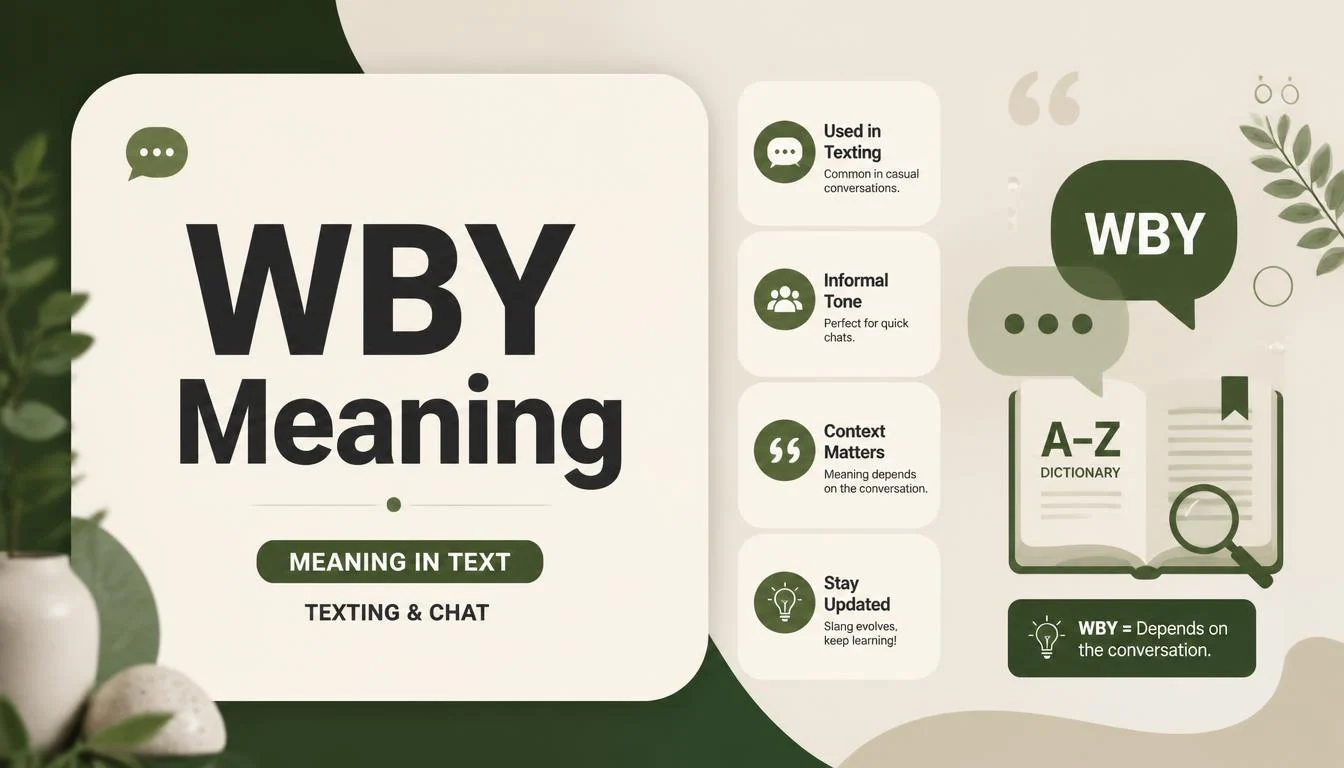
WBY stands for “what about you?” It’s a shorthand way of turning a conversation back toward the other person after you’ve answered a question or shared an update. You’ll see it most in texts, DMs, and group chats, almost never in formal writing. Think of it as the lazier, faster sibling of “how about you?”
If you have seen WBY in a text message or social media chat, you may wonder what it means. This short abbreviation is commonly used in casual online conversations when someone wants to ask about your thoughts, feelings, plans, or situation.
Understanding WBY meaning can make texting conversations easier to follow. In this guide, we will explain what WBY stands for, how people use it, and provide simple examples to help you understand it in different contexts.
What Does WBY Actually Mean?
Someone asks how your day was. You type “pretty good, just tired lol, wby” and hit send without a second thought. That’s the whole function of this abbreviation in one sentence. It takes the question “what about you?” and strips it down to its three loudest letters, skipping “about” entirely and keeping just the “b” as a stand-in.
This isn’t some obscure gaming term or a coinage born on a single app. It’s part of a much older habit in written English: dropping words that a reader can easily fill in on their own. “What about you” becomes WAY too long to type fifteen times a day, so people trimmed it. The same logic gave us “idk” for “I don’t know” and “lol” for “laugh out loud.”
One thing worth separating out early: WBY is not really a “definition” in the dictionary sense. You won’t find it in Merriam-Webster the way you’d find “irony” or “cynical.” It lives in the same space as emoji and reaction GIFs understood by nearly everyone who texts regularly, but treated as slang rather than vocabulary. That distinction matters if you’re writing for an audience that might not text much, since spelling it out is always the safer choice.
WBY vs. WBU vs. HBU: What’s the Real Difference?
If you’ve spent any time in group chats, you’ve probably seen WBY’s close cousins floating around too: WBU and HBU. People often assume these are three unrelated abbreviations, but they’re really doing the exact same job with slightly different letters.
| Abbreviation | Full Phrase | Common Platforms | Vibe |
|---|---|---|---|
| WBY | What about you? | Texting, Instagram DMs, WhatsApp | Slightly more old-school, still common with adults |
| WBU | What about you? (alt. spelling) | Snapchat, TikTok comments, Discord | The most common version among teens right now |
| HBU | How about you? | Texting, group chats | Feels a touch more polite or gentle |
| WYD | What (are) you doing? | Instagram DMs, texting | A different question entirely not a reciprocal tag |
The core takeaway from this table: WBY, WBU, and HBU are functionally interchangeable, just spelled differently, while WYD is asking something new rather than bouncing a question back. If you mix them up in casual chat, nobody will notice or care. If you’re studying English as a second language or teaching digital literacy, though, that distinction is worth pointing out explicitly.
Where You’ll Actually See WBY Used
This abbreviation shows up almost exclusively in low-stakes, informal spaces. A few places you’ll run into it constantly:
- Text messages between friends or family, especially after a “how are you” or “how was your day” exchange
- Instagram and Snapchat DMs, where character limits and speed matter
- Group chats on WhatsApp or Discord, where a quick reply keeps the thread moving
- Comment sections on TikTok, where someone answers a question and tosses it back to the original poster
You won’t see it in a work email to your manager, a college application essay, or a formal letter. That’s not really a rule anyone wrote down; it’s just how the abbreviation evolved. It signals closeness and casualness, so using it with someone you don’t know well can occasionally come across as a little too familiar, too fast.
The Unspoken Etiquette Behind a Three-Letter Question
Here’s the part most explainers skip: WBY isn’t just a word swap, it’s a small social contract. When someone answers your question and adds “wby,” they’re doing two things at once. They’re closing out their own update, and they’re explicitly handing the conversational floor back to you.
Ignoring that handoff is a minor but real faux pas in texting culture. If a friend writes “I’m doing okay, kind of stressed about finals, wby” and you respond with just “cool” or change the subject entirely, it can read as dismissive, even if you didn’t mean it that way. The person asked a direct, if abbreviated, question. Skipping it breaks a rhythm that most people have absorbed without ever thinking about it consciously.
This is also why WBY tends to disappear in conversations that are already flowing naturally. Once two people are deep into a real back-and-forth, nobody needs a formal handoff word anymore, the questions just keep coming organically. WBY shows up most at the start of a chat or right after a lull, functioning almost like a small nudge to keep things going.
Is WBY a Gen Z Thing, a Millennial Thing, or Just Everyone’s?
There’s a persistent idea online that texting abbreviations belong to one generation and instantly age out the moment the next one arrives. WBY doesn’t really fit that pattern. Millennials picked it up in the early days of SMS, when every character counted toward a text message limit. Gen Z kept using it, though many lean toward WBU as the slightly more current variant. Even older users who came to texting later in life tend to adopt WBY quickly, since it’s intuitive once explained.
If anything, WBY is one of the more generation-agnostic pieces of texting shorthand still in circulation. Compare that to something like “on fleek” or “YOLO,” phrases that burned bright and then faded almost entirely. WBY has stuck around because it solves a real, boring, everyday problem: how do you ask “and you?” without typing four extra words every single time.
WBY in Different Contexts: Casual, Dating, and Professional
Not every chat is the same, and WBY doesn’t behave identically across all of them.
In casual friend-to-friend texting, it’s about as neutral as language gets. Nobody reads meaning into it beyond the literal question being asked. In dating app conversations, it carries a bit more weight, since early messages often set the tone for how much effort each person is putting in. A one-word “wby” after a long, thoughtful answer from the other person can feel a little flat, even if that wasn’t the intention behind it.
In anything resembling a professional context, WBY generally doesn’t belong at all. A coworker asking “how was your weekend, wby” in a casual Slack DM might be fine depending on your workplace culture, but the same phrasing in an email thread with a client would look out of place. The safer move in ambiguous professional settings is spelling it out: “How about you?”
Common Mistakes People Make With WBY
A few small missteps come up again and again around this abbreviation:
- Using it with someone in a formal or first-impression context, where it can read as overly casual
- Sending it as a standalone message with no context, which can confuse someone who missed the earlier question
- Assuming it always means “what about you” specifically, when context occasionally shifts it closer to a general “how’s it going?”
- Overusing it in every single message, which starts to feel repetitive rather than genuinely curious
None of these are serious errors. Texting slang is forgiving by nature. But being aware of them helps if you’re writing for an audience that includes non-native English speakers or people newer to digital conversation norms, since the informal rules aren’t written down anywhere obvious.
FAQs
Is WBY the Same as Asking “How Are You?”
Not exactly. WBY assumes that a question has already been asked and answered. It redirects that same question back to the other person. “How are you?” is the original question while WBY works as the reciprocal follow up.
Can WBY Be Used to Start a Conversation?
Rarely. Since WBY usually depends on a question already being part of the conversation, using it as an opener can confuse the other person. It may work if both people already share context from an earlier conversation.
Does WBY Work Over Voice or Only in Text?
WBY is almost exclusively a written language habit. People do not typically say “WBY” out loud. However, some younger texters have started saying abbreviations such as “LOL” or “WBU” aloud as a joke.
Is It Rude Not to Respond to WBY?
It can sometimes come across that way, especially when the conversation was already flowing. WBY is a small social cue, so ignoring it is not a major breach of etiquette. Still, the person who asked may feel that the conversation ended abruptly.
Why Do Some People Write WBU Instead of WBY?
Both abbreviations are commonly used to ask about the other person. WBU is formed from “what about you?” while WBY is another shortened form used with the same intended meaning. Neither is inherently more correct. The choice usually depends on personal habit, platform, and texting style.
Conclusion
WBY is a small piece of digital shorthand that does a surprisingly specific job: it keeps conversations balanced by handing the question back to whoever’s on the other end. It’s not formal, it’s not going in a dictionary anytime soon, and it doesn’t need to be. Once you know what it’s doing, you’ll probably notice it everywhere, in texts, DMs, and comment threads you scroll past every day.