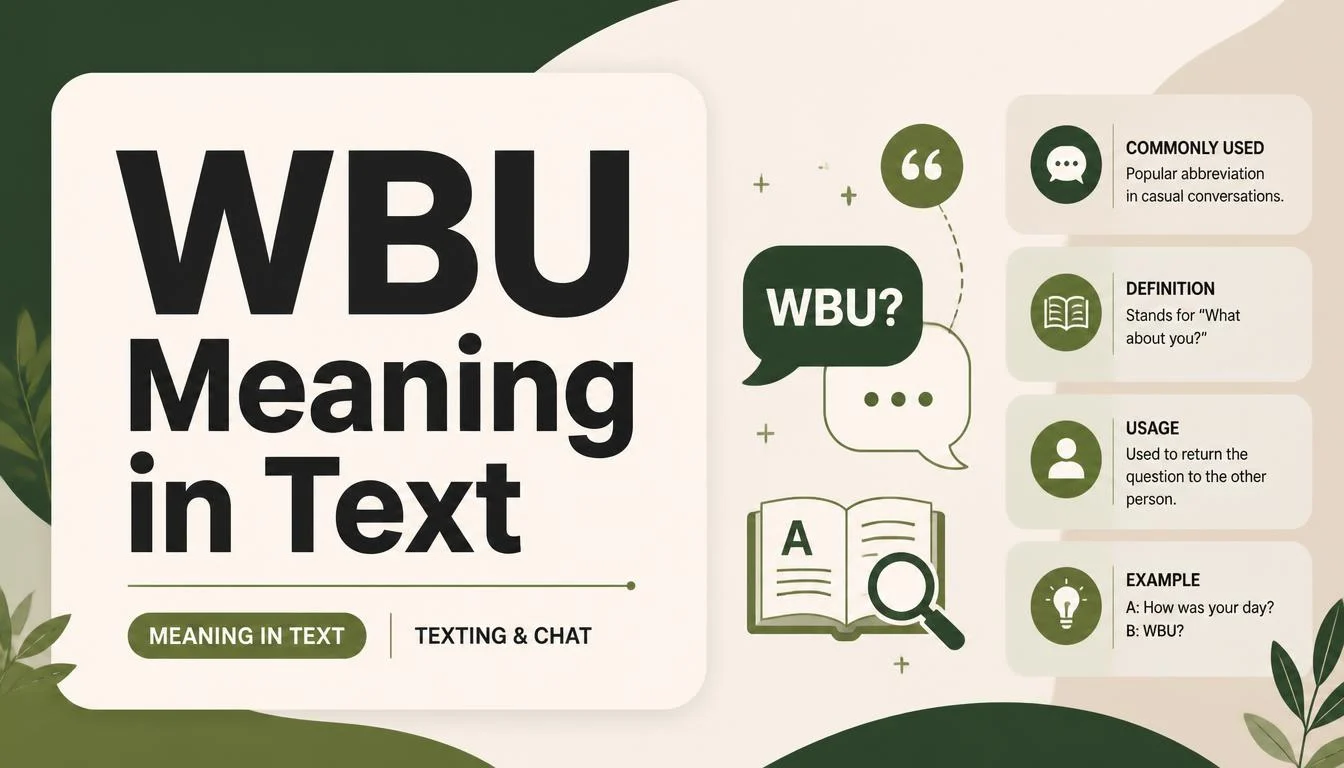
Quick Answer:
WBU means “What about you?” in text messages, social media chats, and other informal online conversations. People use it when they want to ask the other person the same question that was just discussed. For example, “I’m doing great, wbu?” simply means “I’m doing great, what about you?” It is casual, short, and common in everyday digital communication.
Wondering about WBU Meaning in Text? WBU is a common texting abbreviation that usually means “What about you?” People use it in casual conversations to ask the other person the same question or invite them to share their thoughts.
You may see WBU in text messages, social media chats, and messaging apps. It is short, friendly, and informal, making it especially common when people want to keep a conversation quick and natural.
What Does WBU Mean in Text?
WBU is a texting abbreviation for “What about you?” It is usually used when someone wants to return a question to another person.
For example, imagine someone asks, “How are you?” You might reply, “I’m good, wbu?” The abbreviation avoids repeating the entire question. In this case, it means, “I’m good. What about you?”
The same pattern works in many conversations. Someone might say, “I’m watching a movie, wbu?” This asks what the other person is doing. Another person could write, “I love pizza, wbu?” Here, the question is about the other person’s food preference.
The meaning is simple, but the exact question depends on the conversation before it.
That context is important. WBU does not always introduce a completely new topic. Most of the time, it turns the same question back toward the other person.
Why Do People Use WBU?
Texting encourages people to communicate quickly. Short forms such as WBU make that easier.
Typing “what about you?” takes only a few extra characters compared with WBU, but abbreviations can still make casual conversations feel faster. This is especially common in instant messaging, where people often respond in short bursts rather than complete sentences.
WBU also works well when the intended meaning is already obvious.
Consider this exchange:
“I’m from Lahore. WBU?”
The second person is clearly asking where the first person is from. There is no need to repeat the full question.
The abbreviation can also keep a conversation moving:
“I’m free this weekend. WBU?”
The speaker is saying that they are available and asking whether the other person is available too.
So, WBU is less about creating a special tone and more about saving words while keeping the conversation natural.
WBU Can Refer to Different Questions
One interesting thing about WBU is that the abbreviation does not have one fixed question attached to it.
Its meaning changes according to what came immediately before it.
| Previous statement | WBU means | Example reply |
|---|---|---|
| “I’m feeling better today.” | What about you? | “I’m good too.” |
| “I live in Karachi.” | Where do you live? | “I live in Islamabad.” |
| “I love coffee.” | Do you like coffee? | “Yes, especially iced coffee.” |
| “I’m watching a new series.” | What are you watching or doing? | “I’m watching a movie.” |
| “I’m free on Saturday.” | Are you free on Saturday? | “Yes, I am.” |
| “My favorite color is blue.” | What is your favorite color? | “Mine is green.” |
This makes WBU a context dependent abbreviation.
The words “what about you?” are technically the same every time, but the question being returned can vary.
That is why you usually cannot understand the exact meaning of WBU by looking at those three letters alone. You need to read the preceding message.
WBU Examples in Text Messages
The easiest way to understand this abbreviation is to see it in natural conversations.
Example 1: Asking About Someone’s Day
Person A: “My day was pretty good. WBU?”
Meaning: “My day was pretty good. What about you?”
The speaker is returning the same question.
Example 2: Talking About Location
Person A: “I’m from Pakistan. WBU?”
Here, WBU can mean, “What about you? Where are you from?”
The exact words are not repeated because the topic is already clear.
Example 3: Talking About Food
Person A: “I had biryani for lunch. WBU?”
This can mean, “What did you have for lunch?”
The person is not asking the other person to explain themselves generally. They are returning the specific topic.
Example 4: Discussing Hobbies
Person A: “I usually play football after work. WBU?”
Here, the likely meaning is, “What do you usually do after work?”
Example 5: Making Conversation
Person A: “I’m just relaxing at home, wbu?”
The lowercase version has exactly the same basic meaning. The difference is only in formatting and texting style.
WBU vs. Other Common Text Abbreviations
WBU is often confused with other short forms because several texting abbreviations can appear together in the same conversation.
| Abbreviation | Full form | Main use |
|---|---|---|
| WBU | What about you? | Returns a question |
| HBU | How about you? | Asks the same question back |
| WYD | What are you doing? | Asks what someone is doing |
| WYLL | What you look like? | Asks about someone’s appearance |
| IDK | I don’t know | Shows uncertainty or lack of knowledge |
| BTW | By the way | Introduces an additional point |
| FYI | For your information | Gives information or context |
| TTYL | Talk to you later | Ends a conversation temporarily |
The closest comparison is HBU, which means “How about you?”
WBU and HBU can overlap, but they are not always interchangeable.
For instance:
“I’m doing well. HBU?”
Here, HBU naturally asks how the other person is doing.
But:
“I’m from Canada. WBU?”
WBU fits better because the topic is location rather than someone’s condition.
In everyday texting, people may use the two casually, and the intended meaning is often clear from context.
WBU vs. “What About You?”
There is no difference in basic meaning between WBU and what about you?
The main difference is communication style.
“WBU?” feels quick and informal. “What about you?” is the complete phrase and can work in casual speech as well as ordinary writing.
Compare these examples:
“I’m going to the gym. WBU?”
and
“I’m going to the gym. What about you?”
Both communicate the same basic idea.
The first feels more like a quick text. The second feels more complete.
That distinction matters when choosing where to use the abbreviation. A short form that works perfectly in a chat may look out of place in a professional email, academic paper, application, or formal letter.
Is WBU Casual or Formal?
WBU is casual and informal.
It is suitable for many personal conversations, especially when chatting with friends, relatives, classmates, or people who already communicate informally with you.
It can also appear in social media comments, direct messages, dating app conversations, gaming chats, and group messages.
However, it is generally not suitable for formal communication.
For example, this message would be fine between friends:
“I’m free tonight. WBU?”
But a workplace email would normally use the full wording or a more direct sentence:
“I’m available this evening. Are you available as well?”
The issue is not that WBU is grammatically incorrect. It is that texting abbreviations belong mainly to informal digital communication.
Can WBU Sound Friendly?
Yes. WBU can help keep a conversation open because it shows that the speaker is interested in the other person’s answer.
Consider this:
“I had a busy day. WBU?”
The speaker gives a small piece of information and then invites the other person to respond.
That makes WBU useful for reciprocal conversation. Instead of talking only about yourself, you return the topic to the other person.
Still, tone depends heavily on the rest of the message.
Compare:
“I’m good, wbu?”
with:
“I’m doing really well today! WBU?”
The second message feels more energetic because of the surrounding wording and punctuation.
An abbreviation alone does not determine whether a message sounds warm, distant, excited, or annoyed.
How WBU Works in Online Conversations
Text conversations often leave out information that would normally come from voice, facial expressions, or body language.
A person can therefore make a short response sound different depending on punctuation, emojis, capitalization, and the surrounding messages.
For example:
“Fine. WBU?”
could feel brief or neutral.
Meanwhile:
“I’m doing great 😊 WBU?”
feels more welcoming.
The abbreviation itself has not changed. The surrounding language has.
Capitalization also varies:
- WBU?
- wbu?
- Wbu?
All three generally mean the same thing.
People often use lowercase abbreviations because casual texting does not always follow standard capitalization rules.
When Should You Use WBU?
Use WBU when the conversation is informal and the meaning is already clear.
It works particularly well after you answer a personal question.
For example:
“I love summer. WBU?”
“I’m studying English right now. WBU?”
“I usually wake up early. WBU?”
“I’m staying home tonight. WBU?”
These examples all have the same structure:
Your answer + WBU?
That structure is one reason the abbreviation is so convenient.
You can also use it after sharing information when you want the other person to contribute something similar.
For example:
“I’ve been to Dubai twice. WBU?”
The recipient can understand that the topic is travel experience.
When Should You Avoid WBU?
There are situations where spelling out the phrase is more appropriate.
Avoid WBU in formal emails, business reports, academic assignments, official letters, and other professional documents unless you are intentionally quoting or discussing texting language.
For example, instead of:
“I completed the report. WBU?”
a professional message might say:
“I have completed the report. Have you finished yours?”
The second version is clearer and fits a formal setting better.
The same principle applies when communicating with someone who may not know common texting abbreviations. If there is a chance that WBU will confuse the reader, simply write “what about you?”
Clarity should come before shortening a message.
Is WBU Used on Social Media?
Yes. WBU can appear on many types of informal online communication.
You may encounter it in private messages, comments, group chats, and casual conversations on social platforms.
It is especially useful when people are exchanging quick personal details.
For example:
“I’m listening to music right now. WBU?”
A reply might be:
“Same here. I’m listening to Taylor Swift.”
The abbreviation allows the conversation to move quickly without repeating a longer question.
Because social media language changes over time, some abbreviations become more popular while others become less common. WBU remains understandable to many people familiar with English texting conventions.
Does WBU Have Any Other Meaning?
In ordinary texting, “what about you?” is the common meaning of WBU.
However, abbreviations can have different meanings in specialized settings. A group might create its own shorthand, while a company, organization, game, or technical community may use the same letters for something unrelated.
That is why context matters whenever you encounter an unfamiliar abbreviation.
If someone writes:
“I’m fine, WBU?”
there is very little ambiguity. The surrounding sentence clearly indicates the conversational meaning.
But if you see WBU in a technical document or specialized discussion, do not automatically assume it means “what about you?” Look at the surrounding content first.
WBU in Different Types of Conversations
The abbreviation can fit many casual topics.
Friendship Conversations
“I’m going out with my cousins tonight. WBU?”
This asks about the other person’s plans.
School Conversations
“I have a math test tomorrow. WBU?”
Depending on the previous conversation, this might ask whether the other person also has a test.
Work Chats
WBU can appear in informal workplace messaging between colleagues who regularly use casual language.
“I’ve finished my part of the project. WBU?”
However, the full phrase is usually safer when the tone needs to remain professional.
Dating Conversations
“I like hiking and trying new restaurants. WBU?”
Here, the speaker is inviting the other person to share their interests.
Family Chats
“I’m home now. WBU?”
The meaning could be “What about you?” or more specifically “Are you home too?” The previous conversation provides the clue.
Common Mistakes With WBU
One common mistake is assuming WBU always asks the exact same question in every situation.
It does not.
If someone says:
“I’m from Australia. WBU?”
they are probably asking where you are from.
If someone says:
“I’m tired today. WBU?”
they are probably asking how you feel.
Another mistake is using WBU in settings where informal abbreviations are inappropriate. The phrase itself is harmless, but communication style matters.
A third mistake is confusing WBU with WYD. WBU generally returns the topic to the other person, while WYD directly asks, “What are you doing?”
FAQs
Is WBU rude in a text?
No. WBU is not inherently rude. Its tone depends on the conversation, punctuation, and surrounding words. A friendly message can use WBU naturally, while a very short reply may sometimes feel less expressive.
Should WBU be capitalized?
There is no single texting rule that requires one format. WBU, wbu, and Wbu can all be found in informal messages. Capitalization usually reflects the writer’s personal texting style.
Can I use WBU in an email?
You can use it in a very casual personal email, but it is generally better to write “what about you?” in professional emails. The complete phrase is clearer and more appropriate for formal communication.
Is WBU the same as HBU?
They are similar, but not identical. WBU means “what about you?” while HBU means “how about you?” The surrounding topic determines which one sounds more natural.
Can WBU start a conversation?
It can, but it is usually more natural after some context has already been established. For example, after discussing weekend plans, “WBU?” clearly asks about the other person’s plans.
Is WBU still understandable if written in lowercase?
Yes. Lowercase “wbu” normally carries the same meaning as uppercase “WBU.” Informal digital communication frequently uses lowercase abbreviations.
Conclusion
WBU is a simple texting abbreviation that means “what about you?” Its main purpose is to return a question to the other person without repeating the full sentence. The exact question depends on the topic already being discussed, which makes context especially important. In casual chats, it is short and natural, while formal communication usually calls for the complete phrase.