Quick Answer
TYSM stands for “thank you so much.” It’s an initialism each letter represents a word used in texting, social media comments, and direct messages to express stronger gratitude than a simple “thanks.” You’ll see it written in all caps or lowercase, and it almost always appears in informal conversation between friends, classmates, or online acquaintances rather than in professional correspondence.
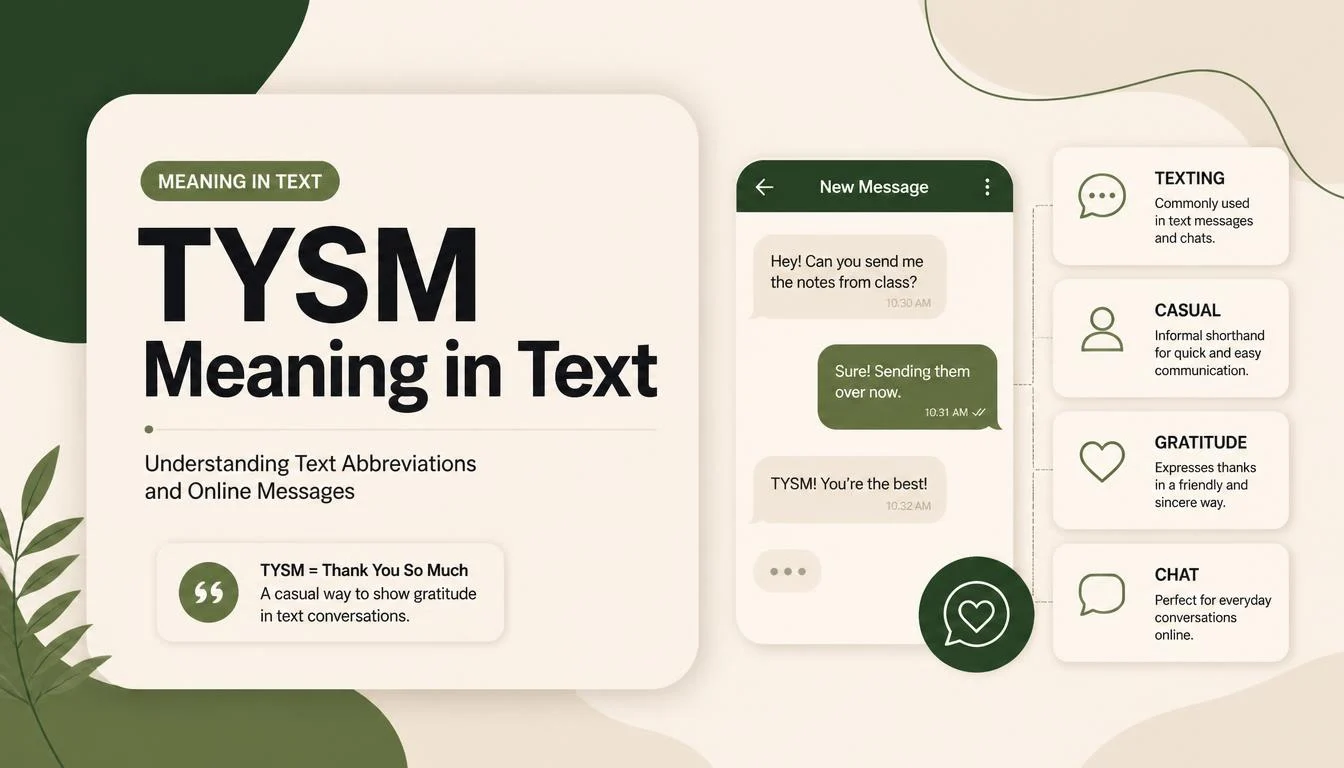
If you have seen TYSM meaning in text and wondered what it stands for, the abbreviation is a simple way to express gratitude. It is commonly used in texting, social media, comments, and online conversations.
TYSM stands for “Thank You So Much” and usually conveys a warm and friendly tone. Understanding the context can help you know whether it sounds casual, enthusiastic, sincere, or playful.
What Does TYSM Actually Stand For?
The answer is straightforward: Thank You So Much. That’s it. No hidden meaning, no double entendre in standard usage.
This four-letter string belongs to a category of language called an initialism an abbreviation formed from the first letters of a phrase, where each letter is pronounced individually. That distinguishes it from an acronym like NASA, which gets pronounced as a single word. You don’t say “tissum” when you read TYSM aloud. You either spell it out mentally or, more often, just absorb the meaning directly the way you would any other word you recognize at a glance.
Dictionary publishers have formally recognized the term. Collins English Dictionary lists TYSM under its “messaging and social media” abbreviations with the definition “thank you so much”. Wiktionary, the collaborative dictionary project, catalogs it as an interjection used in text messages and online posts. The word has crossed the threshold from internet slang to something closer to standard informal English.
What makes TYSM interesting isn’t its definition that part takes five seconds to learn. What’s worth examining is how a four-letter abbreviation became so embedded in digital communication that it spawned its own meme, its own cultural moment, and a small library of misunderstandings.
The Grammar Behind the Acronym
English speakers have been shortening “thank you” for centuries. “Thanks” itself is a clipped form. But TYSM does something slightly different: it preserves the intensifier.
“Thank you” is polite. “Thank you so much” adds emphasis it signals that the gratitude isn’t routine. TYSM carries that same emotional weight in a fraction of the keystrokes. That’s the whole point. On a phone keyboard, typing “thank you so much” takes real effort. TYSM takes four taps.
Linguists who study computer-mediated communication have noted that abbreviations like this often follow a pattern where the most semantically important words survive. In “thank you so much,” the words that carry the meaning are thank, you, and so much. Drop the function words and you get TYSM. The abbreviation isn’t random; it’s a compression of the phrase’s core.
One detail that trips people up: TYSM is not the same as TIA. TIA means “thanks in advance,” used when you’re asking for a favor you haven’t received yet. TYSM thanks someone for something they’ve already done. The timing matters. Sending TYSM before someone helps you makes no sense.
TYSM vs. Other Thank-You Shortcuts
The thank-you abbreviation ecosystem is larger than most people realize. Here’s how the main contenders compare:
| Abbreviation | Full Meaning | Register | When It’s Used |
|---|---|---|---|
| TY | Thank you | Casual, minimal | Quick acknowledgment, low emotional weight |
| TYSM | Thank you so much | Warm, emphatic | Genuine gratitude, something helpful was done |
| TYVM | Thank you very much | Slightly more formal | Politeness with a touch of distance |
| TIA | Thanks in advance | Request-oriented | Asking for a future favor |
| TYT | Take your time | Reassuring | Not a thank-you at all, despite the TY |
| NP | No problem | Response to thanks | What you send back after TYSM |
The distinctions are subtle but real. TY feels almost throwaway it’s what you type when someone holds a door or sends a link. TYSM carries actual warmth. TYVM, by contrast, reads slightly stiffer, almost like something you’d write in a semi-professional email to a colleague you don’t know well. The “very” in TYVM has a formality that “so” in TYSM lacks.
This table matters because using the wrong abbreviation can send the wrong signal. Reply to a heartfelt message with “TY” and the sender might feel brushed off. Reply with TYSM and you’ve matched their emotional register.
When TYSM Works and When It Doesn’t
The single most important rule for TYSM is this: it belongs in informal contexts only.
Texting a friend who sent you notes from a class you missed? TYSM is perfect. Commenting on someone’s art post that genuinely moved you? TYSM works. Replying to a classmate who shared a study guide the night before an exam? Absolutely TYSM territory.
Emailing a professor about a letter of recommendation? Write “Thank you so much” in full. Messaging a hiring manager after an interview? Full words. Sending a thank-you note to a relative who gave you a graduation gift? If you’re under twenty-five and texting them, TYSM is probably fine. If you’re writing a card, spell it out.
The line isn’t about age or technological fluency. It’s about formality and relationship. TYSM signals casual intimacy. Using it in a context that calls for formality can read as lazy or even slightly disrespectful. A journalist for the Deccan Herald once complained about receiving “Tysm” in a WhatsApp birthday message, framing it as evidence that digital communication has eroded basic courtesy. That reaction might be extreme, but it captures a real tension: some people see abbreviations as efficient, others see them as dismissive.
The safe rule: if you’d feel weird saying “so much” out loud in that context, don’t type TYSM either.
The “Aw TYSM” Meme That Took Over TikTok
Here’s where TYSM gets genuinely weird. The abbreviation became the center of a meme that had nothing to do with gratitude and everything to do with phonetic confusion.
In June 2021, a TikTok user named @jax.mp4 posted a comedy video featuring a fake text conversation. In the video, someone receives the message “aw tysm” from a crush and misreads it as “autism” because “aw tysm” spoken aloud sounds roughly like “autism” if you slur the syllables together. The joke hinges on the character’s anxious overinterpretation: he thinks the person he likes just casually diagnosed him.
The video spread fast, and the format kept mutating. Over the following years, versions of the same joke appeared on iFunny, Reddit, and TikTok repeatedly. A December 2022 Reddit post using the joke hit over 43,000 upvotes. By October 2023, TikTok videos making the same “aw tysm / autism” connection were pulling millions of views. One creator’s version crossed 13 million views in under a month.
The meme’s persistence says something about how deeply TYSM has embedded itself in digital vocabulary. For a joke to work, the audience has to immediately recognize the abbreviation without explanation. If people didn’t know what TYSM meant, the punchline would collapse. The meme is evidence that the term has achieved near-universal recognition among younger internet users.
It also created a minor secondary life for the phrase. Some people now type “aw tysm” knowing the meme association, using it as an in-joke. The abbreviation has become a shibboleth a way of signaling that you’re in on the cultural reference.
How TYSM Fits into the Broader History of Texting Shorthand
TYSM didn’t emerge in a vacuum. It belongs to a lineage of abbreviations that stretches back to the earliest days of digital messaging.
Early SMS texting in the 1990s and early 2000s had hard character limits often 160 characters per message. That constraint bred a whole vocabulary of compression: “u” for you, “r” for are, “gr8” for great, “lol” for laughing out loud. The goal was purely functional: say more in fewer characters.
TYSM probably emerged from that environment, though pinning down its exact first use is nearly impossible. What’s clear is that it survived the era of character limits and thrived in the era of unlimited messaging. That’s unusual. Most SMS-era abbreviations either died out (does anyone still type “a/s/l”?) or evolved into something more niche. TYSM stuck around because it serves a purpose that hasn’t gone away: expressing genuine warmth in a medium that often feels cold.
The shift from SMS to apps like WhatsApp, Instagram, and Discord changed the social meaning of abbreviations. When you had to pay per text message, shorthand was economic necessity. Now that messaging is free and unlimited, shorthand is a choice. Typing TYSM instead of “thank you so much” is a deliberate signal of casualness. It says: we’re close enough that I don’t need to perform formality.
That’s a meaningful shift. The same abbreviation that once saved money now communicates intimacy.
FAQs
Is TYSM Rude?
Not inherently. Context makes the difference. Between friends, classmates, or online peers, TYSM usually sounds warm and genuine. In a professional email or a message to someone significantly older whom you do not know well, it may feel too casual. If you are unsure, writing the full phrase is safer.
Is TYSM the Same as TY?
No. TY is a short and simple way to say “thank you.” TYSM means “thank you so much” and adds more emotional emphasis. Sending TY after someone has done you a significant favor may feel a little brief. TYSM better matches a stronger sense of appreciation.
Does TYSM Have an Official Dictionary Entry?
Yes. Collins English Dictionary lists TYSM as a British English abbreviation for “thank you so much” used in messaging and social media. Wiktionary also catalogs it as an interjection. This shows that TYSM is documented informal English rather than simply being an unexplained internet abbreviation.
Why Do People Sometimes Type “Aw TYSM”?
The word “aw” adds warmth and can express genuine appreciation, humility, or pleasant surprise. “Aw TYSM” can therefore sound more touched or emotionally expressive than simply “TYSM.”
The combination also became associated with a 2021 TikTok meme involving the phrase being misheard as “autism.”
Can I Use TYSM in an Email?
You can use TYSM in personal emails to friends or close colleagues. However, it is better to write “thank you so much” in professional correspondence such as job applications, client communication, or academic emails. The full phrase takes only a moment to write and makes your tone clearer.
Conclusion
TYSM is a small thing: four letters that compress a phrase you could type out in full if you wanted to. But the choice not to type it out is the point. Every time someone sends TYSM instead of “thank you so much,” they’re making a tiny statement about the relationship. It says: this is casual, this is warm, this is us.
The abbreviation has earned its place in dictionaries, inspired a meme that refuses to die, and survived the transition from paid SMS to unlimited messaging. It works because it does something specific it carries the so much without making you type it. And in a medium where tone is hard to convey, that little bit of emphasis matters more than you might think.