Quick Answer
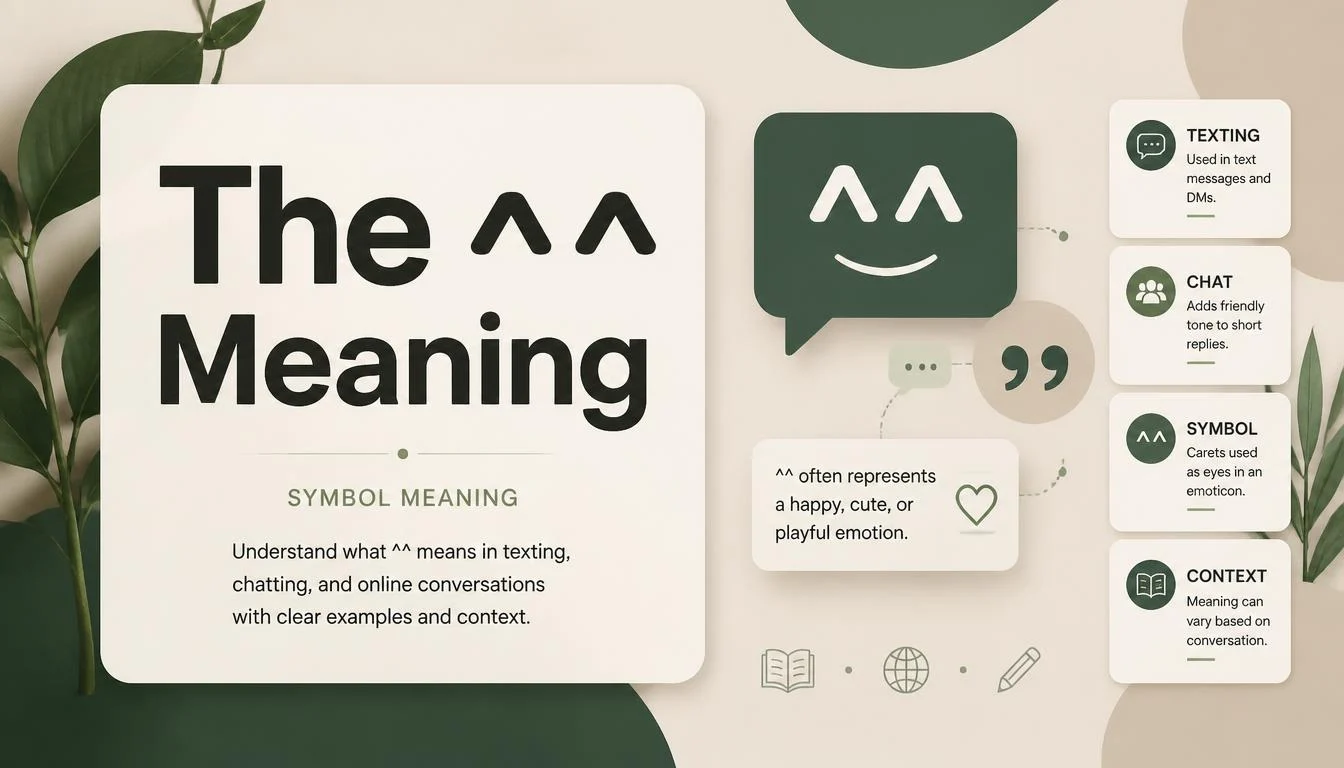
The symbol ^^ is a Japanese-style emoticon, or kaomoji, that represents a smiling face with happy, closed eyes. It signals joy, friendliness, or polite agreement in text conversations. Unlike Western emoticons that are read sideways, ^^ is viewed upright, with the two carets forming the eyes and no mouth needed to convey the expression. It originated in Japanese online culture and has since spread across global chat platforms, particularly among fans of anime, manga, and internet subcultures.
Wondering about the ^^ meaning in a text message or online conversation? This symbol is often used as a friendly emoticon to show happiness, excitement, agreement, or a positive reaction.
The meaning of ^^ can change slightly depending on the context. It is commonly seen in casual chats, gaming communities, social media, and messages where people want to make their tone feel warmer or more cheerful.
The Basics: What Does ^^ Actually Look Like?
At first glance, ^^ looks more like a typo than a facial expression. Two caret symbols sit side by side, pointing upward like the roof of a tiny house. There’s no nose, no mouth, and no outline of a face. That minimalism is the point.
In Japanese text culture, this symbol is understood as a pair of smiling eyes. The upward angle of each caret mimics the curve of eyes when someone is genuinely happy squinting slightly, crinkling at the corners. The absence of a mouth isn’t a flaw; it’s a stylistic choice that makes the expression feel softer and less exaggerated than a wide grin would.
Compare that to the Western smiley 🙂 which requires a colon, a dash, and a parenthesis to form a sideways face. The Japanese approach, which includes ^^ and its many relatives, is designed to be read upright, the way you’d look at someone sitting across from you. It’s a small cultural difference that has a big effect on how the symbol feels in practice.
Where Did ^^ Come From? A Quick Trip to Japan
The ^^ symbol belongs to a family of text-based expressions called kaomoji, which translates roughly to “face characters.” The term covers a wide range of Japanese emoticons that use punctuation marks, letters, and symbols to draw faces: (^^) for a basic smile, (;😉 for crying, (^_^) for blushing, and countless others .
Kaomoji emerged from Japanese online communities, particularly on early message boards and in email culture, where users wanted a way to convey emotion that felt more expressive than plain text but didn’t rely on the sideways Western smiley. The caret symbol, readily available on Japanese keyboards, became a natural choice for eyes. Two carets together created a simple, recognizable happy face that required almost no effort to type.
What makes ^^ interesting is that it’s not just an emoticon it’s a shorthand for a whole set of social intentions. Research on online communication has found that ^^ is frequently used as a gesture of politeness, appearing in messages that express gratitude, pay compliments, or gently steer a conversation in a new direction . It’s the digital equivalent of a warm nod.
Kaomoji vs. Emoji: A Comparison Table
| Feature | Kaomoji (like ^^) | Emoji (like 😊) |
|---|---|---|
| How it’s typed | Keyboard symbols (^, ;, _, etc.) | Pre-made images from a keyboard menu |
| Orientation | Upright, viewed head-on | Upright, designed as a complete image |
| Level of detail | Minimal, often just eyes or a few marks | Highly detailed, includes color and shading |
| Cultural origin | Japanese text culture, early internet boards | Global, standardized by Unicode Consortium |
| Customization | Infinite variations by combining symbols | Limited to what’s been designed and approved |
| Common platforms | Anime forums, Japanese social media, niche chats | Everywhere: iMessage, WhatsApp, Instagram, email |
| Example | ^^, (^^), (><), (^_~) | 😊, 😅, 😂, 🥹 |
The comparison shows why ^^ still has a devoted following even in an age of high-resolution emoji. It’s lightweight, fast to type, and carries a specific cultural flavor that a generic smiley can’t replicate.
The Three Main Meanings of ^^ in Conversation
The ^^ symbol does more than one job, and context determines which meaning is active. Here’s how to tell them apart.
1. Happy eyes / joyful expression. This is the most straightforward use. When someone types ^^ at the end of a message, they’re signaling a smile. It’s a friendly closing, like a little wave goodbye. If a friend says “I got the job!” and you reply “That’s amazing ^^,” you’re matching their excitement with visual warmth.
2. Agreement or acknowledgment. In group chats, ^^ can function as a quick way to say “I agree” or “ditto.” Rather than typing out a full response, someone can drop ^^ to signal that they’re on board with what the previous person said . This use became especially common before messaging apps introduced dedicated reply features. The ^^ was a manual way to link your message to the one above it.
3. Politeness or softening. This is where ^^ shows its Japanese roots most clearly. In Japanese communication, indirectness and social harmony carry a lot of weight. A ^^ can soften a request, make a compliment feel less blunt, or add a layer of friendliness to a message that might otherwise sound curt . Even in English conversations, ^^ can serve a similar purpose making a suggestion feel collaborative rather than demanding.
The tricky part is that these meanings can overlap. A ^^ at the end of “Sounds good” could mean joy, agreement, or politeness all at once. That ambiguity is part of what makes the symbol flexible, but it can also lead to confusion if the context isn’t clear.
Why ^^ Works So Well in Group Chats
Group chats are chaotic. Multiple conversations thread through each other, people respond at different speeds, and it’s easy for messages to get lost. In that environment, ^^ has a practical advantage: it’s a low-effort way to participate without derailing the flow.
Imagine a group planning a dinner. One person suggests a restaurant, and three others immediately reply with ^^. No one has to type “I agree with that suggestion,” and no one has to worry about their message being misread as a competing proposal. The ^^ is a quick, clear signal of alignment.
This function is particularly useful when the group needs to reach a decision. Research on online group communication has noted that simple agreement tokens like ^^ reduce the friction of collective decision-making . They let people register their opinion without adding noise. In a fast-moving chat, that efficiency matters.
There’s also a social dimension. Using ^^ feels friendly without being overbearing. It’s not as loud as an exclamation point or as emotionally intense as a heart emoji. It occupies a middle ground warm, but measured. That makes it a safe choice in mixed company, whether you’re chatting with close friends or a group of acquaintances.
^^ and Its Cousins: Decoding the Variations
The ^^ symbol doesn’t travel alone. It has a family of variations, each with its own shade of meaning. Knowing the differences can save you from misreading a message.
^.^ and ^_^ are the more “complete” versions of the happy face. The dot or underscore serves as a mouth, making the expression feel slightly more deliberate. Some users find ^^ cuter precisely because it lacks a mouth it’s more abstract, more like a pair of happy eyes floating in space . The choice between them often comes down to personal style.
^^; is the nervous or awkward version. The semicolon represents a bead of sweat, a visual trope borrowed from manga and anime. When a character is embarrassed, flustered, or caught in an awkward moment, a big drop of sweat appears near their head. In text, ^^; says “I’m smiling, but I’m also a little uncomfortable” . It’s the emoticon equivalent of a nervous laugh.
^^^^ takes the agreement meaning and dials it up. If ^^ says “I agree,” ^^^^ says “I absolutely agree, no question.” The repetition adds emphasis, much like using multiple exclamation points. It’s a way to show enthusiasm without typing a full sentence .
^*^ is a hybrid. It combines the happy eyes with a mouth that suggests something more than a simple smile. In some contexts, it reads as a slightly mischievous or self-satisfied expression.
Each variation carries its own nuance, and experienced users can switch between them fluidly. The ability to fine-tune emotional tone with a few keyboard symbols is part of what makes kaomoji culture so expressive.
How ^^ Fits Into the Wider World of Digital Communication
The ^^ symbol is a small thing. But it sits at the intersection of several larger trends in how people communicate online.
One is the shift toward visual shorthand. Text alone struggles to convey tone. Sarcasm, warmth, hesitation these are easy to express with a voice or a facial expression, but hard to pin down in a string of words. Emoticons, emoji, and kaomoji all emerged to fill that gap. The ^^ is one solution among many, and its continued use suggests that it fills the gap well.
Another trend is the globalization of niche internet cultures. ^^ started in Japanese online spaces, but it didn’t stay there. Anime and manga fandoms around the world adopted kaomoji as part of their shared vocabulary. Today, you’re as likely to see ^^ in a Discord server full of English-speaking gamers as you are in a Japanese message board. The symbol has become a small piece of cultural export, carrying a bit of Japanese communication style wherever it goes.
There’s also something to be said for the aesthetic appeal of minimalism. In an era of increasingly elaborate emoji animated ones, customizable ones, ones that react to your face the ^^ is almost refreshingly simple. Two symbols. That’s it. No color, no animation, no Unicode approval process. It’s a reminder that sometimes the smallest tools are the most versatile.
Practical Guide: When (and When Not) to Use ^^
If you’re new to ^^, the safest approach is to start small. Add it to the end of a friendly message and see how it lands. Here are a few guidelines.
Use ^^ when:
- You want to signal warmth without being overly emotional.
- You’re agreeing with someone in a group chat and want a quick way to say so.
- You’re writing to someone who uses kaomoji themselves they’ll likely appreciate the shared language.
- You want to soften a request or a piece of feedback. A ^^ at the end of “Can you send that by Friday?” makes it feel less like a demand.
Avoid ^^ when:
- You’re in a formal or professional setting. Most workplaces won’t know what to make of it.
- The conversation is emotionally heavy. A ^^ after someone shares bad news will read as tone-deaf.
- You’re unsure of your audience. If the other person only uses standard emoji, a ^^ might confuse them or come across as cryptic.
The golden rule is context. ^^ is a tool for connection, not a universal solution. Used well, it adds a layer of warmth that plain text can’t match.
FAQs
Is ^^ the Same as 😊?
Not exactly. Both can convey happiness, but ^^ is more minimalist and has a distinct connection to Japanese kaomoji culture. The 😊 emoji is a standardized, full color image with a mouth and rosy cheeks. In contrast, ^^ consists of just two eyes with no mouth, giving it a softer and more understated feel. People familiar with kaomoji often find ^^ more natural than the emoji equivalent.
Can ^^ Be Used Sarcastically?
It can, but using it sarcastically can be risky. Because ^^ usually appears warm and friendly, readers may take it literally unless the context clearly suggests irony. If you want to communicate sarcasm or playful irony, a different expression such as a smirk or winking face may make your intention clearer.
Why Does ^^ Sometimes Have a Semicolon After It?
The semicolon represents a sweat drop, a visual cue commonly associated with manga and anime. It can suggest nervousness, embarrassment, awkwardness, or mild discomfort. Therefore, ^^; can express a friendly smile while also acknowledging that something feels slightly awkward or uncomfortable.
Do People Still Use ^^ in 2026?
Yes, although its use has changed over time. Its older function as a simple sign of agreement may be less common now because messaging platforms offer dedicated reactions and reply features. However, ^^ is still used as a friendly closing or a sign of warmth, especially in communities familiar with kaomoji culture. It remains a niche but recognizable expression.
What’s the Difference Between ^^ and ^_^?
The underscore adds a mouth to the expression. ^_^ creates a more complete facial expression, while ^^ focuses only on the eyes. Some people consider the mouthless version cuter or more abstract, while others prefer the fuller expression. The choice usually depends on personal style and the mood you want to convey.
Conclusion
The ^^ symbol is a tiny thing with a surprisingly rich backstory. It came from Japanese online culture, where keyboard symbols became a creative medium for expressing emotion. It traveled across the internet, picked up new meanings along the way, and found a home in group chats, anime forums, and anywhere people wanted a quick, warm way to connect.
Its power lies in its simplicity. Two carets. No mouth. No color. Just a pair of happy eyes looking back at you from the screen. In a digital world that often feels noisy and overstimulating, there’s something appealing about a symbol that does so much with so little. Whether you’re saying “I agree,” “I’m happy,” or just “I’m here,” ^^ gets the message across softly, politely, and with a smile you can’t quite see but can definitely feel.