Quick Answer
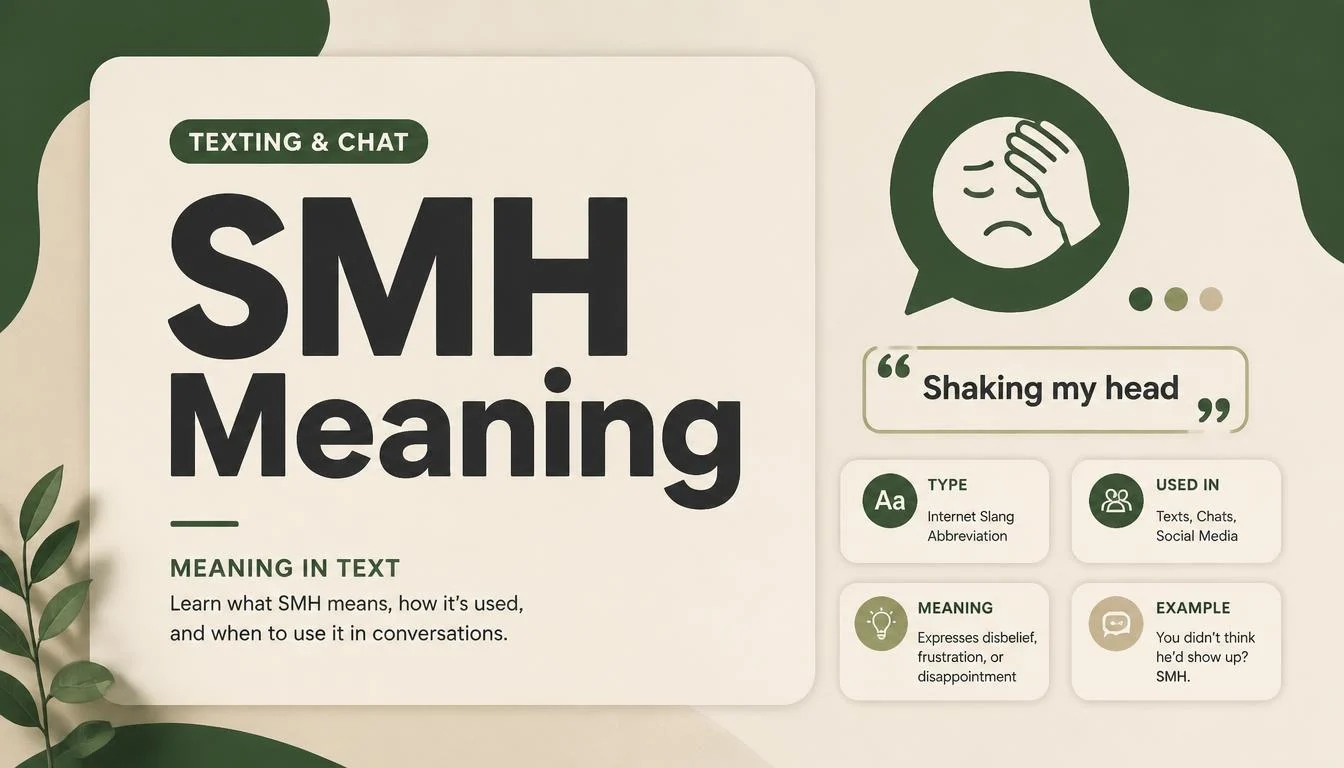
SMH stands for “shaking my head.” It expresses disappointment, disbelief, frustration, or disapproval in text messages and online conversations. Example: “You forgot your keys again? SMH.”
The SMH meaning is “shaking my head.” People use this popular internet abbreviation in text messages, social media comments, and online conversations to express disappointment, disbelief, frustration, or disapproval. It is a quick way to react when something seems silly, surprising, or difficult to believe.
Understanding the SMH meaning in text helps you recognize the emotion behind a message and respond appropriately. Whether you’re chatting with friends, browsing TikTok, or reading comments on Instagram, you’ll often see SMH used to express reactions without writing a full sentence. Its exact meaning depends on the conversation and the tone of the person using it.
What Does SMH Mean?
SMH is short for “shaking my head.” It represents the familiar gesture people make when they find something disappointing, ridiculous, frustrating, or difficult to believe.
Imagine a friend telling you they forgot their phone at home for the third time that week. You might shake your head in disbelief. In a text conversation, typing “SMH” communicates a similar reaction without requiring a full sentence.
The abbreviation is common in informal digital communication, including messaging apps, social media platforms, comment sections, and group chats. It allows people to express a reaction quickly, especially when a situation seems so obvious or frustrating that they do not feel the need to explain it.
However, SMH does not always express anger. A person might use it to react to a harmless mistake, a ridiculous joke, or their own forgetfulness. Context determines whether the message sounds disappointed, playful, sarcastic, or genuinely annoyed.
Is SMH an Acronym or an Initialism?
SMH is an initialism because its letters are pronounced individually rather than as a single word. People generally say the letters “S-M-H” when referring to it aloud.
In everyday writing, the distinction rarely matters. Most people simply recognize it as a texting abbreviation and understand the reaction it represents.
How People Use SMH in Text Messages
The abbreviation works in several situations, but its emotional meaning changes depending on what the sender is reacting to.
1. Expressing Disappointment
Someone may use SMH when another person makes a poor decision or fails to do something they promised.
Example:
- Alex: “I forgot to submit my assignment again.”
- Jamie: “SMH. You had the whole weekend.”
Here, the response suggests frustration or disappointment. Jamie may be surprised that Alex repeated the same mistake, particularly when there was enough time to finish the work.
2. Showing Disbelief
SMH can express a reaction to information that seems absurd or difficult to believe. The sender does not necessarily feel angry. They might simply be amazed that something happened.
Example:
- Mia: “He drove to the store and forgot his wallet.”
- Noah: “SMH 😂”
The laughing emoji makes the response feel more amused than hostile. Noah is reacting to the situation rather than necessarily criticizing the person.
3. Reacting to Something Ridiculous
People sometimes use the abbreviation when a comment, decision, or situation seems unreasonable.
Example:
- Chris: “My brother says he can beat anyone at chess, but he doesn’t know the rules.”
- Taylor: “SMH. That’s confidence.”
The response conveys disbelief with a hint of sarcasm. It suggests that the brother’s confidence is amusing because it does not match his actual knowledge.
4. Teasing Friends
Among friends who understand each other’s humor, SMH can be a playful reaction rather than a serious criticism.
Example:
- Sam: “I spent ten minutes looking for my glasses. They were on my head.”
- Riley: “SMH 😭”
Riley is probably laughing at Sam’s mistake. The abbreviation adds a little dramatic disbelief without necessarily making the exchange uncomfortable.
5. Reacting to Your Own Mistake
SMH is not limited to messages about other people. You can use it to acknowledge your own forgetfulness, poor judgment, or silly mistake.
Example:
- “I made coffee and forgot to add the coffee. SMH.”
- “Just walked into a room and forgot why I came here. SMH.”
- “I sent the message to the wrong group chat. SMH, please tell me nobody noticed.”
In these cases, the sender is making fun of themselves. This self-directed use often feels less confrontational than using the abbreviation to criticize another person.
What Does SMH Mean in Different Contexts?
The same three letters can communicate several emotions. The surrounding conversation often provides a better clue than the abbreviation alone.
| Context | Likely meaning | Example |
|---|---|---|
| A repeated mistake | Frustration or disappointment | “You forgot again? SMH.” |
| An unbelievable story | Disbelief | “He actually said that? SMH.” |
| A silly moment | Amusement | “SMH 😂 you’re impossible.” |
| An irresponsible decision | Disapproval | “You spent your rent money on that? SMH.” |
| Your own mistake | Self-directed embarrassment | “I locked myself out. SMH.” |
| A sarcastic comment | Mild ridicule | “Great planning. SMH.” |
These interpretations are not fixed rules. Someone who uses dry humor may intend a message playfully, while another person might use the same wording to express genuine annoyance.
Pay attention to the relationship, the subject, and the messages immediately before and after SMH. Those clues usually provide enough information to understand the intended reaction.
What Does SMH Mean on Social Media?
SMH is used across different online platforms, but the setting can influence how people interpret it.

People may use SMH in comments, direct messages, and replies to videos or posts. A comment such as “SMH, people really believe this?” can express disbelief or criticism.

TikTok
SMH can appear under videos showing awkward moments, questionable decisions, or funny mistakes. It may signal disapproval, amusement, or a mixture of both.

Snapchat
In private chats and replies to snaps, the abbreviation can be a quick reaction to something a friend says or does. A familiar relationship may make playful teasing easier to recognize.

WhatsApp and group chats
Friends and family can use SMH to react to shared news, recurring habits, or funny situations. In larger groups, however, a short reaction can be easier to misinterpret.
The platform does not give the abbreviation a different official meaning. Its function remains a written version of a head-shaking reaction, even when the subject and tone vary.
SMH vs. Similar Text Abbreviations
SMH belongs to a broader group of informal expressions used to show emotion or respond quickly. Some are close in meaning, but they do not communicate exactly the same thing.
| Abbreviation | Full form | Main difference from SMH |
|---|---|---|
| SMH | Shaking my head | Expresses disbelief, frustration, or disapproval |
| SMFH | Shaking my freaking head, or a stronger profane variant | Adds emphasis and often sounds more frustrated |
| Facepalm | A gesture of covering your face with your hand | Expresses embarrassment, frustration, or disbelief |
| LOL | Laughing out loud | Signals amusement, laughter, or a lighter tone |
| WTF | What the heck, or a profane variant | Expresses shock, confusion, or anger more directly |
| SMDH | Shaking my damn head | Adds emphasis to the head-shaking reaction |
| FR | For real | Expresses agreement, sincerity, or emphasis |
| NGL | Not gonna lie | Introduces an honest opinion or admission |
The important distinction is that SMH describes a reaction of disapproval, disbelief, or frustration, while LOL more directly signals laughter. They can appear together when a situation is both ridiculous and funny.
For example, “SMH 😂” may mean that someone cannot believe what happened but finds it amusing. By contrast, “SMH, that’s unacceptable” is much more likely to express genuine disapproval.
SMFH and SMDH can feel stronger than SMH because of the extra emphasis. They are also more informal, so they may be less suitable for conversations where a respectful tone matters.
Is SMH Rude or Disrespectful?
SMH is not automatically rude, but it can sound dismissive when directed at another person. The difference often comes down to what the sender is criticizing and how the recipient interprets the message.
Consider these two examples:
- “SMH 😂 you really forgot your own birthday plans?”
- “SMH. I can’t believe you made that decision after everything we discussed.”
The first sounds like friendly teasing, especially if the people involved regularly joke with each other. The second feels more serious because it refers to a decision with possible consequences.
A short abbreviation can also make a message seem colder than intended. Without facial expressions or vocal tone, the recipient has to guess whether the sender is joking, irritated, or disappointed.
If you want to avoid sounding harsh, explain your reaction instead of relying on the abbreviation alone. For example, “I understand it was an accident, but I’m frustrated because we discussed this yesterday” communicates your feelings more clearly.
When Should You Use SMH?
SMH is best suited to informal conversations where short, expressive reactions feel natural.
Good situations for using it
- Talking with friends who understand your sense of humor.
- Reacting to a funny or unbelievable story.
- Making a lighthearted comment about your own mistake.
- Replying to a social media post with a clear, informal tone.
- Expressing mild frustration when the situation does not require a detailed response.
When to avoid it
- Formal emails: Use direct, professional language instead.
- Sensitive conversations: The abbreviation may make another person feel mocked or ignored.
- Workplace disagreements: Explain the specific concern rather than sending a reaction that could seem disrespectful.
- Unfamiliar group chats: People may not understand your tone or sense of humor.
- Serious conflicts: A brief expression of disapproval rarely explains what needs to change.
For example, replying “SMH” to a colleague who has made a genuine mistake could sound judgmental. Saying “I think we need to review this before sending it” is more constructive and gives the other person a clear next step.
The abbreviation is useful when the emotion is obvious and the stakes are low. When the situation matters, a complete sentence usually works better.
How to Reply When Someone Sends SMH
You do not need to match the abbreviation with another slang expression. Choose a reply based on whether the sender appears amused, frustrated, or genuinely disappointed.
| Situation | Natural reply |
|---|---|
| A friend is teasing you | “I know, I know 😂” |
| Someone is surprised by your mistake | “Yeah, that was a bad move.” |
| A friend is laughing at something silly | “I can’t believe I did that either.” |
| Someone seems genuinely annoyed | “I understand why you’re frustrated.” |
| You cannot tell what they mean | “Are you joking, or are you actually upset?” |
| Someone uses SMH about a situation you both dislike | “Honestly, I feel the same way.” |
Sometimes, no response is necessary. If SMH is simply a reaction to a funny video or a shared joke, you can respond with an emoji or continue the conversation.
If the message feels insulting, you can ask what the person means rather than immediately assuming hostility. A little clarification can prevent an otherwise minor misunderstanding from becoming an argument.
FAQs
Can SMH be used as a joke?
Yes. People often use it to react humorously to silly mistakes, exaggerated claims, or amusing behavior. Emojis and a playful conversation can make the joking tone easier to recognize.
Is SMH still used by younger people?
Yes, SMH remains recognizable in online communication, including conversations among younger users. However, individual slang preferences vary, and not everyone uses the same abbreviations regularly.
Can I say SMH out loud?
You can pronounce the letters individually as “S-M-H” when discussing the abbreviation. In ordinary conversation, most people would simply say “I’m shaking my head,” “I can’t believe it,” or another phrase that expresses the same reaction.
Does SMH have a different meaning in gaming?
In gaming chats, SMH generally carries the same informal meaning it does elsewhere. Players may use it after a teammate makes a questionable move, misses an easy opportunity, or does something unexpectedly silly. The gaming context affects the reaction, not the standard expansion.
What does SMH mean when someone sends it without any other words?
A standalone “SMH” usually signals disbelief, frustration, disappointment, or amusement about something already discussed. You will need to look at the preceding message or shared situation to identify the exact emotion.
Conclusion
SMH is a quick way to express a reaction that might otherwise involve a shake of the head, an explanation, or a longer comment. Its tone can range from friendly amusement to genuine disappointment, so the context matters more than the letters alone. Use it freely in casual conversations when the meaning is clear, but choose more direct wording when a message could be taken personally.