Quick Answer:
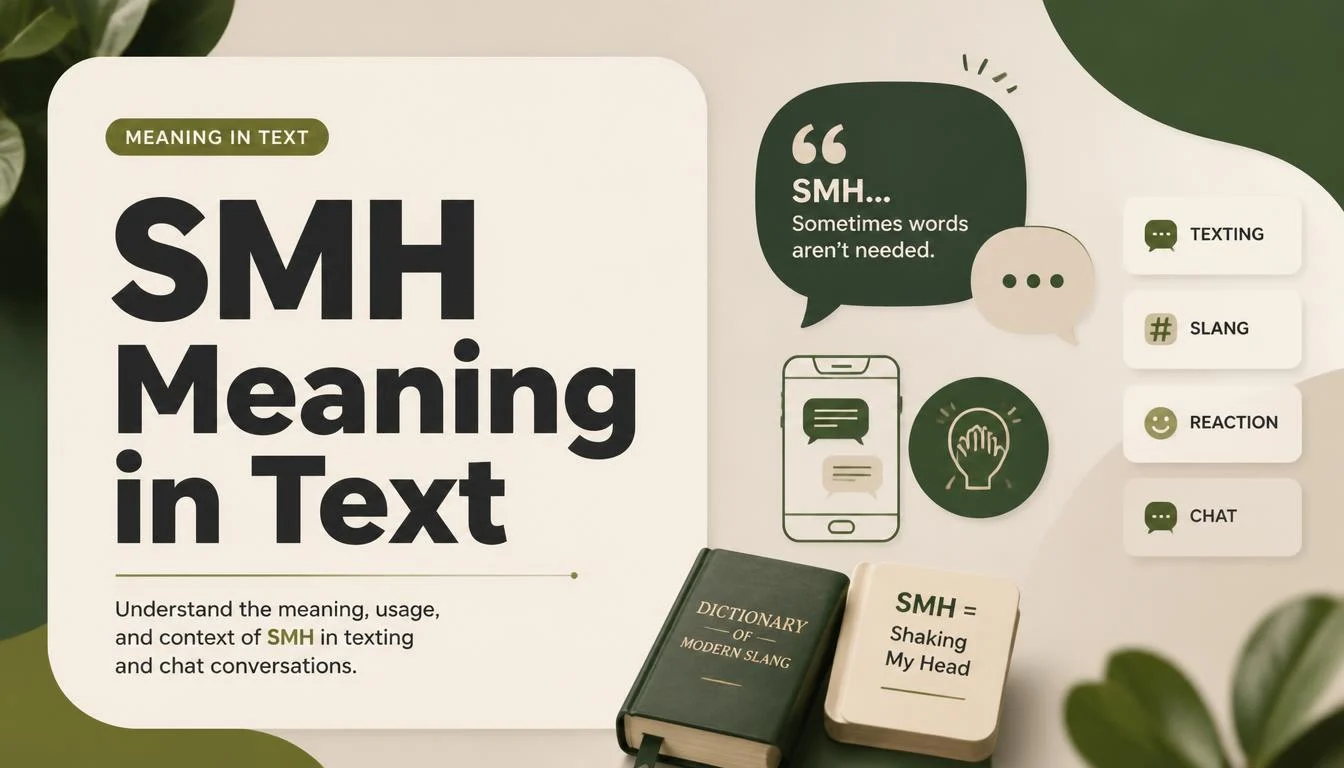
SMH stands for “shaking my head.” It is a text and social media shorthand used to express disappointment, disbelief, frustration, or a kind of resigned exasperation. The gesture it describes a slow head shake communicates what words often cannot: “I cannot believe this just happened.”
If you have seen SMH meaning in text and wondered what this popular abbreviation stands for, you are not alone. SMH means “shaking my head” and is commonly used to show disappointment, disbelief, annoyance, or mild frustration in casual digital conversations.
The SMH meaning in text can change slightly depending on the situation and tone of the message. You may see it in texts, social media comments, group chats, and online conversations when someone reacts to something ridiculous, unexpected, or hard to believe.
What SMH Actually Stands For
The letters are simple enough. S-M-H is an initialism for “shaking my head”. But the meaning lives in the gesture, not the letters.
When you shake your head in real life, you are not usually enraged. You are somewhere between tired and stunned. It is the motion you make when a friend tells you they texted their ex at 2 a.m., or when a company leaves a package at a house that burned down. SMH captures that exact feeling in three characters.
Merriam-Webster notes that the abbreviation has been in use since at least the early 1990s, appearing in Usenet newsgroups before spreading to text messaging and social media. It is not new slang, even if it feels that way. It is old enough to have a genealogy.
What makes SMH interesting is that it functions as a gesture, not a statement. Unlike BRB (“be right back”) or FWIW (“for what it’s worth”), which replace specific phrases, SMH replaces a physical action. You are not saying “I am shaking my head.” You are doing it, in text form.
The Nonverbal Grammar of a Text Message
Text messages lack tone, facial expressions, and body language. This is a well-known problem. SMH is one of the solutions.
It adds a layer of emotional context that plain words miss. Consider the difference between these two messages:
- “My flight got cancelled.”
- “My flight got cancelled smh.”
The first is a statement of fact. The second carries a sigh. The reader knows the sender is not just informing them but also reacting. That is the quiet power of the acronym. It does the work of a facial expression.
Dictionary.com describes SMH as marking “tone in text messages and online,” calling up the left-to-right head shake that signals “no” or frustration. This is why it often appears at the end of a sentence, like a punctuation mark made of attitude. It trails the thought, coloring everything before it.
The abbreviation is also flexible enough to be used as a verb. People write “I’m smh” or “she was smh”. The gesture becomes an action you can conjugate. Language adapts.
SMH vs. SMDH vs. SMFH: A Table of Intensity
One of the more useful things to understand about SMH is that it comes in levels. The base version is mild. The variants are not.
| Acronym | Full Meaning | Emotional Weight | When You Use It |
|---|---|---|---|
| SMH | Shaking my head | Mild to moderate disappointment | Someone says something mildly ridiculous |
| SMDH | Shaking my damn head | Stronger frustration | Someone does something genuinely aggravating |
| SMFH | Shaking my f***ing head | Maximum exasperation | Words have failed you entirely |
The escalation is grammatical, not just emotional. Inserting “damn” or the stronger expletive transforms the gesture from a sigh into a statement of near-despair. Dictionary.com lists all three as common intensifications in digital communication.
This is not unique to SMH. Many internet acronyms have variants that crank the intensity. But SMH’s variants feel more natural because they mirror how people actually speak. You would not say “laughing out very much loud.” But you might say “shaking my damn head” out loud, even if you would never admit it.
The Digital Shrug: How SMH Differs from TBH and NGL
SMH belongs to a family of acronyms that soften, frame, or color what follows. But it does a different job than its cousins.
TBH stands for “to be honest”. It prefaces a statement with a claim of candor. NGL means “not gonna lie”. It does something similar: it signals that the next thing might be uncomfortable, unpopular, or brutally frank. IYKYK, or “if you know, you know,” is a different beast entirely it is an inside reference that deliberately excludes outsiders.
SMH does not preface honesty.
- It reacts to something already said or done.
- It is not a disclaimer.
- It is a response.
This distinction matters in practice. If someone texts “NGL, your outfit is not it,” the NGL softens the blow by pretending to be reluctant honesty. If someone replies “smh,” they are not softening anything. They are expressing a reaction maybe agreement, maybe disappointment, maybe both.
The acronyms can overlap, of course. “NGL, I did not study for the test at all, smh” uses both. The NGL frames the confession. The SMH reacts to the confession. They are doing different jobs in the same sentence.
Why Context Is Everything with SMH
Here is where SMH gets tricky. The same three letters can mean very different things depending on who is sending them and why.
Merriam-Webster describes the tone as “bemused incredulity, or of frustration or disapproval”. That is a wide range. Bemused incredulity is not the same as frustration. Frustration is not the same as disapproval.
If a friend sends you a meme of a dog wearing sunglasses and types “smh,” they probably mean “this is ridiculous and I love it.” If a coworker sends you a message about a project going sideways and types “smh,” they probably mean something closer to genuine irritation.
The context does the interpretive work. Who sent it, what they are reacting to, and the relationship between sender and receiver all shape the meaning. This is not a flaw in the acronym. It is how all language works. SMH just makes the ambiguity more visible because it is so short.
USA Today notes that SMH can be used “when you are disappointed, do not approve of something or you cannot believe a statement”. That last one cannot believe is where the range lives. Disbelief can be funny. Disapproval is usually not.
The Cultural Roots of SMH
The exact origin of SMH is murky, but the trail leads somewhere specific.
Dictionary.com states that the slang “may have been an innovation of black internet users, as early and notable uses are prevalent among such speech communities”. It was first entered on Urban Dictionary in 2004 and spread on Twitter by 2007. By the 2010s, publications like Vice and Bustle were writing articles explaining it to confused readers.
This pattern is familiar. Many of the most durable pieces of internet slang from “on fleek” to “periodt” to “fr” originated in Black digital spaces before spreading outward. SMH is part of that lineage.
By 2018, SMH had become common enough that publications used it in headlines without explanation. BET ran an article titled “SMH: Jay-Z Left the Grammys Empty-Handed and the Internet is Rioting”. The acronym had arrived.
This history matters because it explains why SMH feels natural in some contexts and awkward in others. It is not neutral vocabulary. It carries a cultural fingerprint.
SMH in Real Conversations
The best way to understand SMH is to see it in the wild. Here are a few examples, drawn from real usage patterns:
Reacting to mild absurdity:
“Cocktails are $35? smh”.
The sender is not furious. They are registering the absurdity of the price in three letters.
Reacting to a friend’s romantic decisions:
“Rebecca and Josh got back together? smh”.
The subtext is clear: this is a predictable mess, and the sender has opinions.
Expressing public disappointment:
A celebrity posts something questionable. The replies fill with “smh.” The gesture becomes collective.
Self-directed frustration:
“I stayed up until 2 a.m. watching videos of people restoring old tools. smh.”
Here the acronym turns inward. The sender is shaking their head at themselves.
In each case, SMH does something specific. It adds a layer of emotional commentary without requiring the sender to spell out what they feel. That is efficiency. That is also why it survived.
FAQs
Is SMH rude?
Not necessarily. SMH can sound rude when it is directed at someone in a dismissive or critical way. However, people also use it playfully to express disbelief, amusement, or lighthearted frustration. The tone and relationship between the people involved usually determine how it comes across.
Can SMH be used in professional settings?
Generally, SMH is best avoided in professional communication. It is casual internet shorthand and may sound too informal in a work email or business message. Unless your workplace has a very relaxed communication style, it is better to write out what you mean.
What is the difference between SMH and SMDH?
SMH means “shaking my head,” while SMDH means “shaking my damn head.” The added word makes SMDH stronger and usually expresses greater frustration, disbelief, or annoyance. Both are informal expressions commonly used in texts and social media.
Does SMH always mean disapproval?
No. SMH can express more than simple disapproval. Depending on the context, it may show disbelief, disappointment, amusement, or affectionate frustration. For example, “smh my little brother built a cardboard castle for the cat” can express amused disbelief rather than genuine criticism.
Is SMH still used, or is it outdated?
SMH is still widely recognized and used in texting, social media, and online conversations. While it may not feel like brand new slang, it has remained popular because it is short and effectively communicates disbelief or frustration. Its meaning is familiar to many internet users.
What does SMH mean in person, if someone says it aloud?
People sometimes say “SMH” aloud in conversation, usually in a playful or humorous way. It is similar to saying other texting abbreviations such as “LOL” or “OMG” out loud. When spoken, its meaning generally remains “shaking my head,” although the exact tone depends on the situation.
Conclusion
SMH is a small thing. Three letters. But it does a lot of work.
- It carries frustration, amusement, disbelief, and a specific kind of resigned exhaustion that English does not always have a clean word for.
- It also has history.
- It came from somewhere, from specific communities and specific digital spaces, and it spread because it filled a gap.
Text messages needed a way to convey the head shake, the sigh, the “I cannot with this right now.” SMH became that.
The next time you see it in a message, pay attention to what it is doing. It is not just an acronym. It is a gesture. And like all gestures, it means whatever the moment makes it mean.