Quick Answer
“Author states” simply means the writer of a text is presenting a claim, opinion, or fact. Repeating it across an essay or research paper quickly feels flat and repetitive.
Strong alternatives include the author argues, the author asserts, the author explains, the author suggests, and the author emphasizes.
When writing an essay, research paper, or academic assignment, repeating “Author States” can make your writing sound predictable. Using varied alternatives can help you introduce an author’s ideas more smoothly while keeping your writing clear and academic.
Whether you are explaining an argument, presenting an opinion, or referring to evidence from a source, choosing the right phrase matters. This guide covers 30+ other ways to say “Author States” with useful alternatives for different academic and professional contexts.
Why Writers Search For Other Ways to Say “Author States”
Students, researchers, and content writers run into the same wall almost every time they summarize a source: the phrase “author states” gets used so often that it starts to sound mechanical. Anyone writing a literature review, a research paper, an essay, or even a book report eventually needs a wider vocabulary for describing what a writer is doing in their text.
This search usually comes from three places. First, teachers and professors often mark down papers that reuse the same reporting verb over and over, because it signals a limited vocabulary rather than careful reading. Second, academic style guides like APA and MLA actually encourage varied, precise reporting verbs because different verbs carry different meanings — “argues” is not the same as “notes,” and “claims” is not the same as “demonstrates.” Third, writers want their work to sound natural rather than robotic, especially now that so much writing is checked for AI-generated patterns.
There is also a real difference between spoken and written usage here. In spoken academic discussion, such as a seminar or a presentation, people tend to use simpler, more conversational reporting phrases like “the author says” or “the author points out.” In written academic work, especially formal essays and journal articles, the expectation shifts toward sharper, more analytical verbs such as “posits,” “contends,” or “maintains.” Knowing when to use a formal phrase versus a natural spoken one is part of what separates strong academic writing from writing that merely sounds academic.
Throughout this guide, you will find alternatives to author states, other ways to say author states, and a full set of professional English phrases and informal expressions in English that fit different academic and conversational situations, along with practical tips on how to use each one correctly.
Tone Ladder For Author States Alternatives
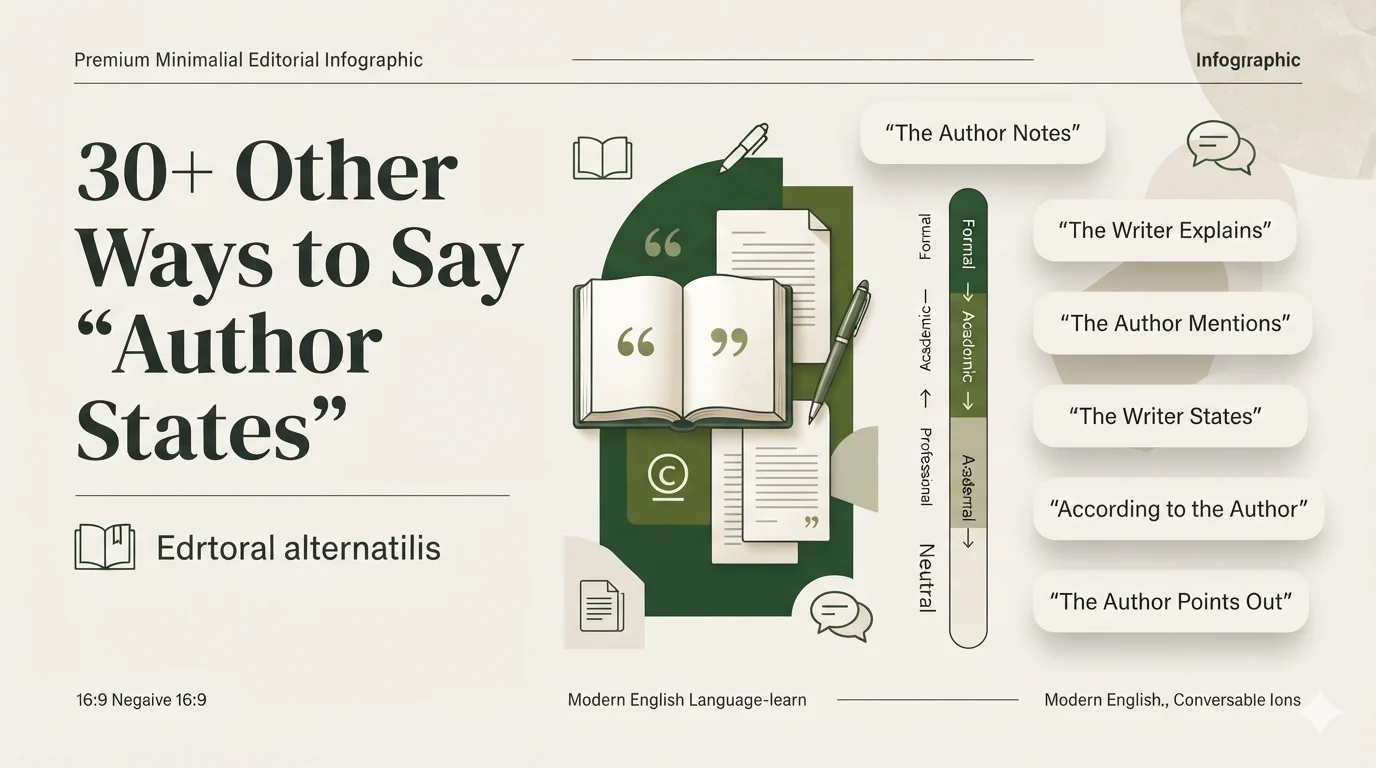
Not every reporting verb carries the same weight. Some are neutral and safe for almost any context, while others carry a stronger, more interpretive tone that should be used carefully. Thinking about these phrases on a ladder, from very formal to informal, makes it much easier to pick the right one.
At the very formal end sit verbs like posits, contends, and asserts. These work well in graduate-level writing, journal articles, and formal literature reviews, where the tone needs to sound authoritative and precise. One step down, formal but slightly more common verbs like argues, maintains, and emphasizes fit comfortably into undergraduate essays and most academic writing.
In the middle of the ladder are neutral verbs such as explains, describes, and notes. These are safe defaults that work in nearly any academic or professional context without sounding forced. Moving toward casual language, phrases like points out, brings up, and talks about are common in class discussions, presentations, and informal writing such as blog posts or reading responses. At the most informal end are conversational phrases like the author says or the writer basically means, which are fine for spoken discussion but should generally be avoided in graded written work.
Spoken English tends to favor the neutral-to-casual range because it needs to be processed instantly by a listener. Written academic English can support the more formal end of the ladder because a reader has time to sit with denser, more precise vocabulary.
Tone Classification Table
| Phrase | Tone Level | Formality | Best Situation |
|---|---|---|---|
| The author posits | Very Formal | High | Journal articles, graduate papers |
| The author contends | Very Formal | High | Formal argumentative essays |
| The author asserts | Formal | High | Research papers, literature reviews |
| The author argues | Formal | Medium-High | Undergraduate essays |
| The author maintains | Formal | Medium-High | Discussion sections |
| The author explains | Neutral | Medium | General academic writing |
| The author describes | Neutral | Medium | Summaries, book reports |
| The author notes | Neutral | Medium | Citing supporting evidence |
| The author points out | Casual | Medium-Low | Class discussions, presentations |
| The author brings up | Casual | Low | Informal writing, blog posts |
| The author basically says | Informal | Very Low | Spoken conversation only |
Quick Selection Guide
Choosing the right phrase becomes much easier once you know the setting you are writing or speaking in.
For a formal research paper or thesis, reach for verbs like posits, contends, or asserts, since these signal careful, evidence-based analysis. For a university essay, arguesand maintains strike a good balance between precision and readability. For a class presentation or seminar discussion, points out and explains sound natural without feeling stiff. For a casual reading response, summary, or blog post, brings up and talks about keep the tone approachable while still crediting the source clearly.
Real World Transformations
Seeing these phrases in context makes the difference far more obvious than a definition alone.
Essay Writing Scenario
Before: The author states that climate change is a serious problem and the author states that governments need to act quickly.
After: The author argues that climate change is a serious problem, and she further contends that governments need to act quickly before the damage becomes irreversible.
Literature Review Scenario
Before: The author states several reasons for the decline in bee populations. The author states that pesticide use is one major factor.
After: The author outlines several reasons for the decline in bee populations, emphasizing that pesticide use remains one of the most significant contributing factors.
Research Paper Discussion Section
Before: The author states that the results support the hypothesis. The author states that further research is needed.
After: The author demonstrates that the results support the hypothesis, while acknowledging that further research is needed to confirm these findings across larger sample sizes.
Class Presentation Scenario
Before: So basically the author states that social media affects mental health.
After: So basically, the author points out that social media has a noticeable effect on mental health, especially among teenagers.
30+ Other Ways to Say “Author States”
Below is a complete list of reporting verbs and phrases you can use instead of “author states.” Each option is organized so you can quickly identify the tone, meaning, and situation that best fits your writing.
The Author Argues
“The author argues” means the writer presents a position and supports it with reasoning or evidence.
Example: The author argues that early education funding directly improves long-term literacy rates.
This phrase has a formal, persuasive tone and works best in essays, editorials, and argumentative writing. Avoid it when the source is simply describing facts rather than defending a position.
The Author Asserts
“The author asserts” means the writer confidently presents a claim, often without extensive justification in that specific sentence.
Example: The author asserts that remote work has permanently changed office culture.
This is a formal expression that works well in research summaries. However, it can sound overly strong if the original source is tentative or uncertain.
The Author Contends
“The author contends” means the writer makes a debatable claim as part of a larger argument.
Example: The author contends that traditional grading systems discourage creativity.
It fits formal academic writing but can feel out of place in casual summaries or spoken discussion.
The Author Posits
“The author posits” means the writer proposes an idea or theory, often a more abstract or theoretical one.
Example: The author posits that language shapes the way people perceive time.
This is a very formal academic phrase best suited to journal articles and theoretical discussions. It can feel unnatural in everyday writing.
The Author Maintains
“The author maintains” means the writer continues to hold a position, often despite possible counterarguments.
Example: The author maintains that the policy will reduce costs over time, even amid criticism.
It works well in formal essays but is rarely used in casual speech.
The Author Explains
“The author explains” means the writer clarifies how or why something works.
Example: The author explains the process behind vaccine development in accessible terms.
This is a flexible, neutral phrase that fits almost any academic context. However, it is less useful when describing an opinion rather than a factual explanation.
The Author Describes
“The author describes” means the writer provides details about a topic, event, or process without necessarily arguing a point.
Example: The author describes the daily routine of nineteenth century factory workers.
It is neutral and safe, making it ideal for summaries and book reports. However, it may be too plain for analytical writing that needs a sharper edge.
The Author Notes
“The author notes” means the writer mentions something as worth paying attention to, often as supporting evidence.
Example: The author notes that only a small percentage of participants completed the full study.
This neutral phrase works well when citing specific data or observations. It also fits comfortably in research papers.
The Author Suggests
“The author suggests” means the writer proposes an idea without presenting it as an absolute fact.
Example: The author suggests that further testing could improve accuracy.
It has a softer and more tentative tone. It is useful when the source itself expresses some uncertainty. However, it should not be used for claims the author states with full confidence.
The Author Claims
“The author claims” means the writer presents something as true, sometimes with a hint that the claim may be disputable.
Example: The author claims that the new method outperforms older techniques.
This phrase is neutral to slightly skeptical. It works well in critical analysis but can unintentionally sound doubtful if used carelessly.
The Author Emphasizes
“The author emphasizes” means the writer stresses the importance of a particular point.
Example: The author emphasizes the need for early intervention in childhood literacy programs.
This formal phrase is excellent for highlighting key arguments. However, it should be reserved for genuinely central points rather than minor details.
The Author Highlights
“The author highlights” means the writer draws special attention to a specific detail or finding.
Example: The author highlights three case studies that support the main argument.
It works well in literature reviews and reports. It also pairs naturally with lists or structured evidence.
The Author Points Out
“The author points out” means the writer identifies something notable, often in a more conversational way.
Example: The author points out that most studies ignore rural populations entirely.
This casual to neutral phrase fits presentations and discussions well. However, it can feel too informal for the most formal academic writing.
The Author Observes
“The author observes” means the writer notices and reports a pattern or trend.
Example: The author observes a steady increase in remote job postings since 2020.
This phrase is neutral and slightly formal. It is useful in data driven or analytical writing.
The Author Reveals
“The author reveals” means the writer uncovers or exposes information that was not previously obvious.
Example: The author reveals hidden biases in standardized testing methods.
It carries a slightly dramatic tone, so it works best when the source genuinely uncovers something surprising rather than making a routine observation.
The Author Illustrates
“The author illustrates” means the writer uses examples to make an idea clearer.
Example: The author illustrates the theory with three real world business case studies.
This phrase is ideal when a source relies heavily on examples. It fits both formal and semi formal writing.
The Author Demonstrates
“The author demonstrates” means the writer proves a point through evidence or data.
Example: The author demonstrates that the intervention reduced dropout rates significantly.
This formal phrase is strong for research papers, especially in results and discussion sections. It should only be used when actual evidence is presented.
The Author Acknowledges
“The author acknowledges” means the writer admits a limitation, counterpoint, or opposing view.
Example: The author acknowledges that the sample size limits the generalizability of the findings.
This phrase is valuable in critical writing because it shows nuance and balance rather than one sided argument.
The Author Critiques
“The author critiques” means the writer evaluates something and points out its weaknesses.
Example: The author critiques the government’s approach to housing policy.
It fits formal analytical writing and literature reviews. Use it specifically when the source offers judgment rather than simply describing something.
The Author Challenges
“The author challenges” means the writer questions or opposes an existing idea or assumption.
Example: The author challenges the common belief that multitasking improves productivity.
This is a formal and assertive phrase suited to argumentative and critical essays.
The Author Outlines
“The author outlines” means the writer presents a structured summary of key points.
Example: The author outlines four strategies for reducing workplace stress.
It works well when summarizing a source with a clear structure, such as a report or a how to guide.
The Author Summarizes
“The author summarizes” means the writer condenses a larger topic into its main points.
Example: The author summarizes decades of research on childhood development in a single chapter.
This neutral phrase is useful in literature reviews that reference broad bodies of work.
The Author Implies
“The author implies” means the writer suggests something indirectly rather than stating it outright.
Example: The author implies that corporate incentives may have influenced the study’s conclusions.
This phrase requires careful use because it involves interpretation rather than a direct statement from the source.
The Author Proposes
“The author proposes” means the writer offers a new idea, method, or solution.
Example: The author proposes a revised framework for measuring economic inequality.
It fits formal academic writing, especially when discussing original contributions or new models.
The Author Concludes
“The author concludes” means the writer arrives at a final judgment after presenting evidence.
Example: The author concludes that remote learning is most effective when paired with regular feedback.
This phrase works best near the end of a summary, mirroring the structure of the original source.
The Author Warns
“The author warns” means the writer cautions readers about a risk or negative outcome.
Example: The author warns that unchecked automation could widen income inequality.
This phrase carries a sense of urgency and fits opinion pieces, policy discussions, and persuasive writing.
The Author Recommends
“The author recommends” means the writer suggests a course of action.
Example: The author recommends stricter regulations on data privacy.
It is formal and action oriented, making it ideal for policy papers, reports, and practical guides.
The Author Questions
“The author questions” means the writer raises doubt about an idea, method, or assumption.
Example: The author questions whether standardized testing accurately measures student ability.
This neutral to formal phrase works well when a source is skeptical rather than fully opposed.
The Author Examines
“The author examines” means the writer investigates a topic in detail.
Example: The author examines the long term effects of childhood bilingualism.
It fits research heavy writing and signals a thorough and careful approach to the subject.
The Author Elaborates
“The author elaborates” means the writer expands on an idea with more detail.
Example: The author elaborates on the initial claim by providing three supporting case studies.
This phrase is useful when a source builds gradually on a single point.
Usage Comparison Table
| Phrase | Spoken Use | Written Use | Context |
|---|---|---|---|
| Points out | Very Common | Common | Discussions, presentations |
| Argues | Occasional | Very Common | Essays, editorials |
| Posits | Rare | Common | Journal articles |
| Explains | Very Common | Very Common | Nearly any context |
| Suggests | Common | Common | Tentative claims |
| Demonstrates | Rare | Common | Research findings |
| Claims | Common | Common | Critical analysis |
| Notes | Occasional | Very Common | Citing evidence |
Email and LinkedIn Ready Expressions
When referencing a source or author in a professional email or LinkedIn message, several natural openers can work well. The best choice depends on the context and the level of formality you want to maintain.
Introducing a Source in an Email
For an email introducing a source, you can use phrases such as “In the attached article, the author explains…” or “I wanted to share a piece where the author makes a compelling case for…”
Referencing Research on LinkedIn
For a LinkedIn post summarizing research, phrases like “The author breaks down…” or “This piece highlights how the author approaches…” sound natural and can invite further engagement.
Referencing a Shared Reading
For a follow up message about something you and the recipient have both read, “As the author points out in the second section…” keeps the tone conversational while still sounding informed.
Native Speaker Insight
Native English speakers rarely repeat the same reporting verb several times in a row. Even in casual conversation, they tend to vary their wording naturally.
Reporting Verbs in Spoken English
In spoken English, contractions and shorter phrases are common. People are more likely to say “the writer’s basically saying” or “he points out that” than use words such as “posits” or “contends,” which can sound noticeably formal in everyday speech.
Reporting Verbs in Academic Writing
In academic writing, native speakers often vary reporting verbs to avoid repetition and express precise meanings. For example, “demonstrates” may be more suitable than “shows” when discussing data. “Acknowledges” can be more precise than “says” when a writer admits a limitation.
Matching the Verb to the Context
A phrase can be grammatically correct but still sound unnatural when its tone does not match the situation. For example, “the author posits” may sound too formal in a casual class discussion. On the other hand, “the author says” may feel too basic for a formal thesis.
Common Mistakes and What Not to Say
Using reporting verbs effectively requires more than choosing a grammatically correct expression. The verb should also match the source, context, and level of formality.
Repeating the Same Reporting Verb
One common mistake is using the same reporting verb throughout an entire paper. Repeating one verb too often can make the writing feel limited and repetitive.
Mismatching the Tone
Another mistake is using an informal expression in a formal setting. For example, “the author is basically saying” may sound too casual in a formal research paper.
Implying Too Much Certainty or Doubt
Be careful when choosing verbs that suggest a particular level of certainty. Writing “the author claims” when the source presents a well supported fact can unintentionally make the statement sound doubtful.
Inconsistent Verb Tense
Grammar mistakes can also occur when writers switch tenses unnecessarily. Academic writing often uses the present tense when discussing texts. For example, “the author argues” is generally preferred when describing what a text says, while “the author argued” may be appropriate when referring to a specific historical moment.
Overusing Highly Formal Verbs
Words such as “posits” and “contends” can be useful in formal academic writing, but using them too often can make writing sound stiff or artificial. Choose them when their meaning and level of formality genuinely fit the context.
Expansion Phrases
Beyond direct alternatives to “author states,” several related expressions can help introduce or connect ideas from a source.
Sentence Openers for Introducing Ideas
Phrases such as “according to the author,” “as the author notes,” and “in the author’s view” work naturally as sentence openers.
Phrases for Building on an Idea
Transitional expressions such as “building on this point, the author…” and “expanding further, the author…” can help connect multiple ideas from the same source.
Creating a Natural Flow
Using these expressions strategically can make an essay or report flow more naturally. They also help prevent the writing from becoming a list of disconnected statements.
Decision Making Table
| Situation | Best Phrase | Why It Works |
|---|---|---|
| Formal thesis or journal writing | Posits, contends | Signals academic authority |
| Undergraduate essay | Argues, maintains | Balances formality and clarity |
| Class discussion or presentation | Points out, explains | Sounds natural when spoken |
| Summarizing evidence or data | Demonstrates, notes | Reflects factual precision |
| Discussing a limitation | Acknowledges | Shows critical, balanced thinking |
| Casual reading response or blog | Talks about, brings up | Keeps tone approachable |
Quick Fast List
The fastest and most versatile alternatives to keep on hand are argues, explains, suggests, demonstrates, points out, claims, notes, emphasizes, outlines, and acknowledges. These ten options cover almost every situation, from a formal research paper to a casual class discussion.
Quick Practice Scenarios
Test your understanding with these short scenarios.
When a Source Presents a Theory
If a source presents a theory without strong evidence, the strongest verb choice is posits or suggests. Both words reflect a proposed idea rather than a proven fact.
When a Source Provides Strong Evidence
If a source presents strong statistical evidence for a claim, demonstrates or shows is more accurate than suggests. These verbs indicate that the available evidence provides stronger support for the claim.
When Summarizing a Source in a Class Discussion
If a writer wants to summarize a source in a casual class discussion, points out or explains sounds more natural than the more formal contends or posits.
When a Source Admits a Weakness
If a source admits a weakness in its own argument, acknowledges is the correct choice rather than argues. It reflects recognition of a limitation rather than simply presenting an assertion.
When You Want to Avoid Repetition
If a writer needs to avoid repeating the same verb three times in one paragraph, rotating between explains, notes, and highlights keeps the writing varied without changing the meaning.
FAQs
Is It Polite to Say “The Author Claims” Instead of “The Author States”?
Yes, though claims can carry a slightly skeptical tone. It works best when the source’s point is debatable rather than fully proven.
What Is More Professional Than “The Author States”?
Phrases like the author asserts, the author argues, and the author demonstrates can sound more precise and professional in academic writing.
Can I Use “The Author Points Out” in an Email?
Yes. It is a natural and slightly conversational phrase that works well in professional emails when referring to an article, report, or other source.
What Do Native Speakers Say Instead of “The Author States” in Conversation?
Native speakers often use simpler spoken phrases like the writer says or he’s basically arguing that. More formal verbs such as posits are generally more common in academic or formal writing.
What Is the Best Alternative for “The Author States” in a Research Paper?
Demonstrates, argues, and contends are strong choices for research writing. The best option depends on whether the source is presenting evidence, defending a position, or proposing a debatable claim.
Conclusion
Moving beyond “the author states” is less about memorizing a long list of synonyms and more about matching the verb to what the source is actually doing, whether that is arguing a point, presenting evidence, admitting a limitation, or simply describing a process. Once that distinction becomes second nature, academic writing starts to sound sharper, more varied, and far more natural.
The next time you find yourself reaching for “the author states,” pause for a moment and ask what the source is really doing in that sentence. Choosing the reporting verb that matches that action, whether it is explains, demonstrates, or acknowledges, will make your writing read like it was crafted by someone who understands the material, not just someone summarizing it.
1 thought on “30+ Other Ways to Say “Author States” | Better Source Integration In 2026”