Quick Answer
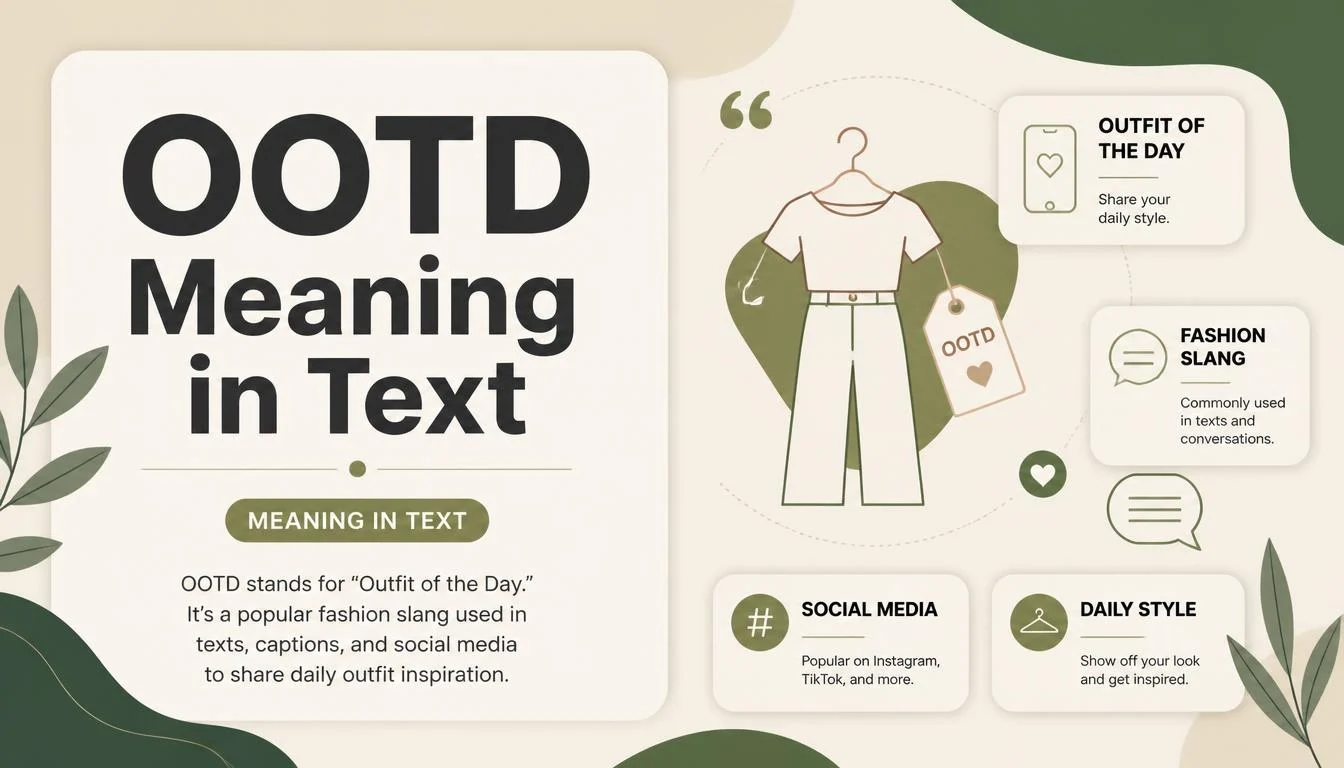
OOTD means Outfit of the Day in text messages and online conversations. It refers to the clothes someone is wearing on a particular day, usually when sharing a picture or video of their look. People use OOTD to show off their personal style, share fashion inspiration, or ask others what they think of an outfit. For example, “Here’s my OOTD!” means “Here’s what I’m wearing today!”
Have you received a message containing “OOTD” or noticed someone using it in a social media caption? If you’re unfamiliar with fashion-related internet slang, the abbreviation might seem confusing at first. However, its meaning is quite simple once you understand the context.
The OOTD meaning in text is “Outfit of the Day.” It’s a popular abbreviation in digital communication that describes someone’s clothing choices for a particular day or occasion. You might encounter it in a conversation with friends, a fashion-related group chat, an Instagram caption, or a TikTok video.
Although OOTD started as a convenient way to label outfit pictures, it has developed into a broader expression associated with personal style, fashion inspiration, and online self-expression. People also use it as a noun when talking about an entire look rather than simply describing individual clothing items.
In this guide, you’ll learn what OOTD stands for, how it works in texting, why people use it, how to interpret its tone, and how it differs from related expressions such as GRWM, OOTN, and fit check.
What Does OOTD Stand For?
OOTD is an abbreviation for Outfit of the Day. Each letter represents the beginning of one word:
- O: Outfit
- O: Of
- T: The
- D: Day
The expression describes the clothes and accessories someone chooses to wear on a particular day. It can refer to an everyday combination of clothing, a carefully planned fashion look, or an outfit selected for a special occasion.
For example:
“Love your OOTD! Where did you get that jacket?”
In this message, the sender compliments someone’s clothing and asks about one of the items they’re wearing.
According to the Cambridge Dictionary and Oxford Learner’s Dictionaries, OOTD is an informal abbreviation used especially when someone shares a photograph or video of their clothing on social media.
However, its meaning isn’t limited to pictures. People also use it in ordinary conversations to discuss what they’re wearing, ask for outfit suggestions, or share fashion ideas.
Does OOTD Have a Different Meaning in Texting?
Generally, no. OOTD retains its established meaning of “Outfit of the Day” in text messages.
The context determines how someone intends to use it.
Consider these examples:
- “Sending you my OOTD later.” This means the person plans to share a picture of their outfit.
- “Your OOTD looks amazing!” This expresses admiration for someone’s clothing.
- “What’s your OOTD for tonight?” This asks what someone plans to wear for an upcoming event.
- “Need some OOTD ideas.” This means the person wants inspiration for daily outfits.
Unlike some texting abbreviations that communicate emotions or reactions, OOTD identifies a particular subject: someone’s clothing and personal style.
It doesn’t automatically express excitement, attraction, sarcasm, or approval. Those meanings depend on the surrounding words, emojis, and relationship between the people communicating.
How OOTD Became a Popular Internet Expression
OOTD developed within online fashion and beauty communities. Before short-form videos became common, fashion enthusiasts used blogs and social networking platforms to document their clothing choices.
The abbreviation offered a simple way to label pictures showing what someone wore on a particular day.
The Early Fashion Blogging Connection
Fashion blogs helped establish the idea of sharing daily outfits online. Bloggers regularly photographed their clothing, described individual pieces, and sometimes explained where readers could purchase similar items.
OOTD became a convenient label for this type of content.
Instead of writing “Here is the outfit I’m wearing today” every time they uploaded a photograph, users could simply write OOTD.
This made the expression shorter and easier to recognize.
How the #OOTD Hashtag Expanded Its Reach
The hashtag #OOTD helped people discover outfit-related content across social media.
According to Dictionary.com, the hashtag appeared on Twitter in 2009 and gained momentum on Instagram around 2011 and 2012.
The hashtag made it easier for fashion enthusiasts to find pictures from other users, discover clothing combinations, and exchange styling inspiration.
As social media fashion content developed, OOTD became more than a label attached to photographs. It also became a recognizable content category.
People started using it in:
- Fashion photography.
- Personal style blogs.
- Instagram captions.
- Pinterest outfit collections.
- YouTube fashion videos.
- TikTok outfit presentations.
- Everyday conversations about clothing.
The expression also entered ordinary English usage as a noun. Someone might describe a look as “a great OOTD” without necessarily referring to a particular hashtag.
This development shows how digital abbreviations can move beyond their original online purpose and become recognizable vocabulary.
How People Use OOTD in Text Messages
Although OOTD is strongly associated with social media, it also works naturally in private messages.
Its meaning changes slightly depending on whether someone is sharing an outfit, requesting advice, discussing an event, or complimenting another person’s appearance.
Here are some common conversational situations.
1. Sharing What You’re Wearing
One of the simplest ways to use OOTD is to tell someone about your current outfit.
You might send a photograph of your clothes with a short caption.
Example:
- Person A: “Ready for the weekend?”
- Person B: “Almost! Here’s my OOTD.”
- Person A: “That combination looks so good!”
Person B uses OOTD to introduce a picture of their clothing.
The abbreviation works as a quick caption because the photograph provides the visual information.
2. Asking Someone About Their Outfit
You can also use OOTD to ask another person what they’re wearing.
Example:
- Person A: “What’s your OOTD for the birthday dinner?”
- Person B: “I’m thinking about wearing a black dress.”
- Person A: “That sounds perfect!”
Here, OOTD refers to the planned outfit rather than something the person has already worn.
This is particularly useful when friends are preparing for parties, celebrations, dinners, or other social occasions.
3. Complimenting Someone’s Fashion Choices
OOTD can appear in a compliment when someone wants to acknowledge another person’s clothing.
Example:
- Person A: “Posted my pictures from yesterday!”
- Person B: “Your OOTD is everything!”
The phrase communicates enthusiasm and admiration.
It can also appear alongside expressions such as “love the look,” “great styling,” and “you look amazing.”
4. Requesting Outfit Inspiration
Sometimes people use OOTD when they need suggestions about what to wear.
Example:
- Person A: “I have a wedding next weekend.”
- Person B: “Have you looked for any OOTD inspiration?”
- Person A: “Not yet. I need some ideas.”
In this conversation, OOTD refers to outfit inspiration that could help someone decide what to wear.
5. Discussing a Fashion Purchase
OOTD can also introduce a discussion about clothing, shopping, or personal styling.
Example:
- Person A: “I finally bought those white sneakers.”
- Person B: “They’ll look amazing with your casual OOTD.”
- Person A: “That’s exactly what I was thinking!”
The abbreviation connects the sneakers with an entire clothing combination.
These examples demonstrate that OOTD can function in several conversational situations without changing its central meaning.
Different Interpretations of OOTD Depending on Context
Although OOTD has one established expansion, people don’t always use it to describe exactly the same thing.
Sometimes it refers to individual clothing items. In other situations, it describes an entire style, a photograph, or a social media post.
Understanding these distinctions helps you interpret the expression more accurately.
The following table explains its most common contextual interpretations.
| Context | What OOTD Refers To | Example |
|---|---|---|
| Daily clothing | Clothes worn that day | “My OOTD is pretty casual.” |
| Fashion photography | A picture showing an outfit | “I need a better OOTD photo.” |
| Personal styling | An assembled clothing combination | “That’s a beautiful OOTD.” |
| Social media | An outfit-related post | “Sharing my OOTD today.” |
| Special occasions | Clothing selected for an event | “My wedding OOTD is ready.” |
| Fashion inspiration | Ideas for clothing combinations | “Looking for winter OOTD ideas.” |
| Outfit discussions | Someone’s clothing choices | “I like your OOTD.” |
OOTD as an Outfit
When someone says “My OOTD looks great,” they’re talking about the actual clothing combination.
This may include:
- Shirts, tops, and sweaters.
- Jeans, trousers, and skirts.
- Dresses and outerwear.
- Shoes and boots.
- Bags and accessories.
- Jewelry and other finishing touches.
The term can describe a simple combination or a carefully coordinated appearance.
OOTD as a Photograph or Video
In some conversations, OOTD refers to the content someone creates to show their clothing.
For example:
“I took three OOTD pictures before leaving.”
Here, the person isn’t discussing three different outfits. They’re talking about photographs documenting what they’re wearing.
OOTD as a Fashion Concept
OOTD can also describe a broader fashion idea.
For instance, someone might ask:
“What’s your favorite OOTD aesthetic?”
They’re asking about the general style or appearance someone prefers.
This interpretation connects the abbreviation with concepts such as personal fashion, clothing coordination, seasonal styling, and visual self-expression.
What Tone Does OOTD Convey in a Conversation?
OOTD is generally neutral and casual. It identifies an outfit without automatically communicating a particular emotion.
However, the surrounding conversation can give it different emotional associations.
Friendly and Casual
Friends often use OOTD when discussing everyday clothing.
Example:
“Send me your OOTD before we meet!”
The message sounds relaxed and friendly. The sender simply wants to see what the other person plans to wear.
Excited and Enthusiastic
When someone shares an outfit they’re particularly proud of, OOTD can appear alongside enthusiastic language.
Example:
“Finally got the perfect OOTD for tonight! 😍”
The heart-eyes emoji and exclamation mark communicate excitement.
Playful and Humorous
OOTD can also appear in jokes about everyday fashion choices.
Example:
“My OOTD is basically pajamas with confidence 😂”
The person humorously describes comfortable clothing as a fashion statement.
Admiring and Complimentary
When someone uses OOTD in a positive comment, it can communicate appreciation for another person’s style.
Example:
“Your OOTD deserves its own photoshoot!”
This is an enthusiastic compliment rather than a literal request for a photoshoot.
Professional or Promotional
Fashion creators, clothing brands, and online retailers sometimes use OOTD in promotional content.
Example:
“Today’s OOTD features our new autumn collection.”
This sounds more promotional because the expression introduces products or a styled clothing combination.
The abbreviation itself remains informal, but its surroundings determine whether the communication feels personal, humorous, enthusiastic, or commercial.
OOTD Examples in Text Messages and Everyday Conversations
The easiest way to understand OOTD is to see how it works in realistic conversations.
Here are additional examples covering different situations.
| Text Message | Meaning and Interpretation |
|---|---|
| “Here’s my OOTD for today!” | The sender is sharing their current outfit. |
| “Your OOTD is so cute.” | The sender likes the person’s clothing. |
| “What’s your OOTD tomorrow?” | The sender asks what someone plans to wear. |
| “Need a new OOTD for college.” | The sender wants outfit ideas for college. |
| “Rate my OOTD!” | The sender wants an opinion about their outfit. |
| “This OOTD took forever to put together.” | The sender spent time coordinating their clothes. |
| “OOTD featuring my favorite sneakers.” | The outfit includes the sender’s favorite sneakers. |
| “My OOTD is giving summer vibes.” | The outfit creates a summery impression. |
More Natural Texting Conversations
Conversation 1: Sharing a Daily Outfit
- Alex: “What are you wearing today?”
- Sam: “Just a casual OOTD. Jeans and a white shirt.”
- Alex: “Simple but stylish!”
Sam uses OOTD to describe an everyday clothing combination.
Conversation 2: Asking for Fashion Advice
- Mia: “I can’t decide what to wear to the party.”
- Lily: “Send me your OOTD options.”
- Mia: “I’ll send you some pictures.”
Here, OOTD refers to the possible outfits Mia is considering.
Conversation 3: Complimenting a Picture
- Emma: “Just uploaded my weekend pictures.”
- Olivia: “That OOTD is gorgeous!”
- Emma: “Thank you! I found the jacket on sale.”
The abbreviation helps Olivia compliment Emma’s clothing without writing a lengthy message.
Conversation 4: Discussing a Special Occasion
- Noah: “Have you picked your OOTD for graduation?”
- James: “Yes, a navy suit with brown shoes.”
- Noah: “That’s going to look sharp.”
The conversation shows that OOTD can describe formal clothing as well as casual fashion.
Conversation 5: Sharing Fashion Inspiration
- Ava: “I need outfit ideas for winter.”
- Sophie: “Pinterest has some great OOTD inspiration.”
- Ava: “I’ll check it out!”
Here, OOTD refers to clothing ideas rather than a specific outfit.
OOTD vs. Similar Fashion Abbreviations
OOTD belongs to a larger group of fashion-related internet abbreviations.
Many of these expressions follow a similar pattern, but each describes a different aspect of clothing, appearance, or getting ready.
Knowing the differences can help you understand fashion-related conversations without confusing one abbreviation with another.
OOTD vs. OOTN
OOTN stands for “Outfit of the Night.”
While OOTD describes clothing worn during the day or on a particular occasion, OOTN specifically refers to an evening or nighttime outfit.
For example:
- OOTD: “Here’s my outfit for today’s shopping trip.”
- OOTN: “Here’s my outfit for tonight’s birthday party.”
The distinction is mainly about the time or occasion.
OOTD vs. GRWM
GRWM means “Get Ready With Me.”
It commonly introduces content in which someone shows their preparation process.
A GRWM video might include:
- Choosing an outfit.
- Applying makeup.
- Styling hair.
- Selecting accessories.
- Getting ready for an event.
OOTD focuses on the finished clothing combination, while GRWM usually shows the process of getting ready.
OOTD vs. Fit Check
A fit check is an informal expression used when someone shows or evaluates an outfit.
The word “fit” is a shortened form of “outfit.”
Although OOTD and fit check can describe similar content, their emphasis is slightly different.
OOTD identifies the outfit being shared. A fit check often presents the outfit for a quick look, evaluation, or reaction.
OOTD vs. WIWT
WIWT means “What I Wore Today.”
It is another way to describe or share someone’s daily clothing choices.
WIWT is phrased as a direct description of what someone wore, while OOTD functions as a shorter label for the outfit itself.
OOTD vs. OOTW
OOTW stands for “Outfits of the Week.”
Instead of highlighting one daily look, this abbreviation usually refers to several outfits worn or selected throughout a week.
A fashion creator might share an OOTW collection featuring different combinations for work, school, weekends, and social occasions.
The following comparison summarizes these differences.
| Abbreviation | Full Form | Main Purpose |
|---|---|---|
| OOTD | Outfit of the Day | Highlights one day’s outfit. |
| OOTN | Outfit of the Night | Highlights an evening outfit. |
| GRWM | Get Ready With Me | Shows the getting-ready process. |
| WIWT | What I Wore Today | Describes clothing worn that day. |
| OOTW | Outfits of the Week | Shares several weekly outfits. |
| MUOTD | Makeup of the Day | Highlights daily makeup. |
| NOTD | Nails of the Day | Shows a nail design or manicure. |
| Fit Check | Outfit Check | Presents an outfit for viewing or evaluation. |
These expressions are related because they describe personal appearance and fashion. However, they aren’t interchangeable in every situation.
For example, using GRWM when you only want to show a finished outfit might not communicate your intended meaning as clearly as OOTD.
Is OOTD an Acronym, Initialism, or Abbreviation?
From a linguistic perspective, OOTD is an abbreviation formed from the initial letters of the phrase “Outfit of the Day.”
It’s commonly classified as an initialism because people generally pronounce its individual letters rather than saying it as one word.
Its pronunciation is:
O-O-T-D
In phonetic terms, the pronunciation can be represented approximately as:
\[ /ˌoʊ.oʊ.tiːˈdiː/ \]
The pronunciation follows the English letter names.
Understanding the Difference Between an Acronym and an Initialism
These terms are related, but they describe slightly different pronunciation patterns.
An acronym is formed from the initial letters of a group of words and is pronounced as a word. Examples include NASA and RADAR.
An initialism is also formed from initial letters, but speakers pronounce the letters individually. Examples include FBI and ATM.
OOTD follows the initialism pattern because people normally say “O-O-T-D.”
In everyday language, however, people frequently use the broader word abbreviation to describe it.
Why Does OOTD Have Four Letters?
Each letter represents one part of the original expression.
The abbreviation keeps the most recognizable words while making the phrase easier to use in short captions and messages.
It also removes unnecessary spaces and punctuation.
Compare:
- Full expression: Outfit of the Day.
- Abbreviated expression: OOTD.
- Hashtag version: #OOTD.
All three communicate the same central idea.
How to Use OOTD Correctly in Sentences
OOTD is flexible because it can function as a noun or as a short label introducing an outfit description.
It commonly appears in informal written communication, particularly captions, messages, comments, and fashion-related discussions.
Using OOTD as a Noun
You can use OOTD to refer to an outfit itself.
Examples:
- “I love your OOTD.”
- “My OOTD is ready for the concert.”
- “That was my favorite OOTD this month.”
- “Your weekend OOTD looks comfortable.”
In these examples, OOTD functions as a noun because it names the clothing combination.
It can also appear with descriptive words such as:
- Casual OOTD.
- Formal OOTD.
- Summer OOTD.
- Winter OOTD.
- Minimalist OOTD.
- Everyday OOTD.
Using OOTD as a Caption
You can place OOTD at the beginning of a caption to introduce a photograph or video.
Examples:
- “OOTD: Keeping it simple today.”
- “Today’s OOTD features my favorite denim jacket.”
- “Casual OOTD for a busy Monday.”
- “A little color in today’s OOTD.”
This format is especially useful when the visual content already shows the clothing.
Using OOTD in Questions
OOTD also works in questions when discussing someone’s clothing choices.
Examples:
- “What’s your OOTD for the event?”
- “Can I see your OOTD?”
- “Have you decided on your OOTD yet?”
- “Which OOTD do you like better?”
These questions are understandable in casual conversations.
Grammar and Usage Table
| Linguistic Feature | How OOTD Works | Example |
|---|---|---|
| Part of speech | Primarily a noun | “My OOTD is ready.” |
| Plural form | OOTDs | “I saved three OOTDs.” |
| Possessive form | OOTD’s | “I love today’s OOTD’s color combination.” |
| Adjective-like modifier | Describes a fashion category | “Summer OOTD ideas.” |
| Question usage | Appears in outfit-related questions | “What’s your OOTD?” |
| Hashtag usage | Groups outfit-related posts | “#OOTD” |
One important grammatical point is that OOTD can take a plural form when someone discusses multiple outfits.
For example, “I shared my OOTDs from the weekend” refers to several outfit combinations.
The possessive form is also possible, although it appears less frequently. In the example above, the phrase “today’s OOTD’s color combination” uses two possessive constructions. A more natural alternative would be “the color combination in today’s OOTD.”
How to Respond When Someone Sends You OOTD
If someone sends you a message containing OOTD, your response depends on what they’re communicating.
They might be showing you their clothing, asking for an opinion, or requesting outfit inspiration.
You don’t need to use another abbreviation in your response. A natural sentence is usually enough.
When Someone Shares Their Outfit
If someone sends a picture of their outfit, you can acknowledge it with a friendly compliment.
Possible responses:
- “Love your outfit!”
- “You look amazing!”
- “That’s such a cute combination.”
- “I love how you styled everything.”
- “Those shoes complete the look.”
These responses show that you’ve noticed their clothing choices.
When Someone Asks for Your Opinion
If someone says “Rate my OOTD,” they’re asking for your thoughts.
You can respond with:
- “Definitely a 10/10!”
- “The colors work really well together.”
- “I love the jacket with those shoes.”
- “The whole look is stylish.”
- “I’d keep the accessories simple.”
If you have a suggestion, make it constructive rather than unnecessarily critical.
When Someone Asks About Your OOTD
If a friend asks what you’re wearing, simply describe your clothing.
For example:
- “Just jeans and a cozy sweater.”
- “I’m wearing a black dress with white sneakers.”
- “Going for a simple and comfortable look today.”
- “A formal outfit because I have a dinner tonight.”
When You Want to Be Playful
A humorous response can make the conversation more entertaining.
Examples:
- “My OOTD is sponsored by comfort.”
- “Whatever was clean in my wardrobe!”
- “Simple outfit, big confidence.”
- “Today’s fashion theme is effortless.”
The best response is one that matches your relationship with the sender and the tone of the conversation.
Is OOTD Only Used on Social Media?
No. Although OOTD became widely recognizable through online fashion communities, people also use it in private digital conversations and everyday speech.
Its original association with fashion content remains important, but its meaning isn’t restricted to a particular platform.
OOTD in Private Text Messages
Friends might exchange outfit photographs before meeting, discuss what they’re wearing to an event, or ask each other for fashion advice.
For example:
“Send me your OOTD before we leave so we don’t accidentally wear the same color!”
This is a natural use of the abbreviation in a private conversation.
OOTD on Instagram
Instagram is closely associated with the hashtag #OOTD.
Users may share mirror selfies, styled photographs, or carousel posts showing their daily clothing choices.
Captions might include:
- “Today’s OOTD.”
- “Weekend OOTD.”
- “Simple and comfortable.”
- “A little outfit inspiration.”
The hashtag also helps organize related content.
OOTD on TikTok
On TikTok, OOTD can introduce short videos showing an outfit from different angles.
A creator might record a transition from casual clothing to a finished look or explain where individual pieces came from.
The expression can appear in video captions, spoken introductions, and on-screen text.
OOTD on Pinterest
Pinterest users may encounter OOTD in fashion inspiration boards.
These collections can feature clothing combinations for different seasons, occasions, aesthetics, or personal preferences.
For example, someone might save OOTD ideas for:
- College outfits.
- Office clothing.
- Summer dresses.
- Winter layering.
- Casual weekend looks.
- Special events.
The abbreviation remains consistent across these settings. The main difference is how people present and discover the clothing.
Common Misunderstandings About OOTD
Because internet abbreviations often have several possible interpretations, people sometimes misunderstand OOTD when they encounter it for the first time.
Here are some common misconceptions worth clearing up.
| Misconception | Correct Explanation |
|---|---|
| OOTD means a person’s entire wardrobe. | It usually describes one outfit or a particular clothing combination. |
| OOTD is only for women. | Anyone can use it to share their clothing choices. |
| OOTD always means a photograph. | It can refer to the actual outfit, a description, or an outfit-related post. |
| OOTD is a compliment. | It identifies an outfit. A compliment depends on the surrounding words. |
| OOTD and GRWM mean the same thing. | OOTD highlights the outfit, while GRWM shows the preparation process. |
| OOTD is only used on Instagram. | It also appears in messages, blogs, videos, and other online spaces. |
| OOTD must describe expensive fashion. | Everyday, inexpensive, thrifted, and casual clothing can all be OOTDs. |
Does OOTD Always Refer to Expensive or Trendy Clothing?
No. An OOTD doesn’t need designer brands, expensive accessories, or fashionable labels.
A person can use the expression to describe a basic combination of jeans, sneakers, and a T-shirt.
The focus is on what someone has chosen to wear rather than how much the clothing costs.
Does OOTD Have a Gender-Specific Meaning?
No. OOTD doesn’t have a separate definition based on gender.
Anyone can share an outfit and call it their OOTD.
The term describes clothing and personal styling, not the identity of the person wearing it.
Is OOTD a Compliment or a Question?
It can appear in either situation, but the abbreviation itself isn’t automatically a compliment or question.
For example:
- “Your OOTD is beautiful!” is a compliment.
- “What’s your OOTD?” is a question.
- “Here’s my OOTD” is a statement.
The sentence structure and surrounding language determine the communication purpose.
When Should You Use OOTD?
OOTD is most appropriate when discussing clothing, personal style, or outfit-related content.
It’s a convenient expression for informal conversations and social media captions.
However, it isn’t suitable for every communication setting.
Appropriate Situations
You can comfortably use OOTD when:
- Sharing a daily outfit with friends.
- Posting a fashion photograph.
- Asking someone what they’re wearing.
- Requesting clothing suggestions.
- Discussing a special occasion’s dress code.
- Commenting on someone’s fashion choices.
- Creating outfit inspiration content.
Situations Where You Should Avoid It
In formal writing, professional reports, academic assignments, or business documents, the full expression is usually clearer.
For example:
| Informal Expression | More Formal Alternative |
|---|---|
| “My OOTD is ready.” | “My outfit for today is ready.” |
| “Check out my OOTD.” | “Take a look at the clothing I’m wearing today.” |
| “Need OOTD ideas.” | “I’m looking for daily outfit suggestions.” |
| “Rate my OOTD.” | “Please share your opinion about this outfit.” |
This doesn’t mean OOTD is incorrect. It simply means that abbreviations should match the audience and communication setting.
If you’re writing to someone unfamiliar with internet fashion expressions, spelling out “outfit of the day” may prevent confusion.
FAQs
1. What does OOTD mean in text from a girl?
OOTD means “Outfit of the Day” regardless of who sends it. If someone sends you an OOTD picture, they’re generally sharing their clothing choices or inviting you to look at their outfit. The message may also encourage a compliment or opinion, depending on the conversation.
2. What does OOTD mean from a guy?
A guy using OOTD is referring to an outfit of the day. He might share his clothing combination, discuss what he’s wearing to an event, or post a picture showing his personal style. The abbreviation doesn’t have a different meaning based on gender.
3. What does OOTD mean on Instagram?
On Instagram, OOTD stands for “Outfit of the Day.” People commonly use #OOTD in captions accompanying outfit photographs, mirror selfies, and fashion-related posts. The hashtag helps users discover clothing inspiration and other people’s styling ideas.
4. What does #OOTD mean?
#OOTD is the hashtag version of “Outfit of the Day.” The hashtag categorizes content showing someone’s daily clothing choices. It’s commonly associated with fashion photographs, outfit videos, personal styling, and clothing inspiration.
5. What is the difference between OOTD and GRWM?
OOTD means “Outfit of the Day,” while GRWM means “Get Ready With Me.” OOTD focuses on the completed outfit. GRWM usually shows the process of getting ready, which may include choosing clothes, applying makeup, styling hair, and preparing accessories.
6. What does OOTN mean in texting?
OOTN means “Outfit of the Night.” It describes clothing someone wears or plans to wear for an evening occasion. Unlike OOTD, which can describe any outfit associated with a particular day, OOTN specifically emphasizes nighttime or evening fashion.
7. Can OOTD refer to more than one outfit?
Yes. The plural form is OOTDs. Someone might use it when sharing several clothing combinations or discussing outfits from different days. For example, “I saved my favorite OOTDs from last month” refers to multiple outfits.
8. Is OOTD considered slang?
OOTD is an informal internet abbreviation rather than slang with a hidden or unusual meaning. It originated in online fashion communities and became a recognizable expression in digital communication. Dictionaries now recognize it as an abbreviation and noun associated with clothing and social media.
9. How do you reply to someone who says OOTD?
Your response depends on the message. If someone shares their outfit, you can say “Love your look!” or “That outfit is beautiful!” If they ask about your OOTD, describe what you’re wearing. If they request an opinion, offer a friendly and honest response.
10. Is OOTD used only for fashionable clothes?
No. OOTD can describe any clothing combination, including casual outfits, workwear, school clothes, sportswear, and formal clothing. The expression doesn’t require expensive brands or a particular fashion aesthetic. It simply identifies someone’s outfit for a specific day or occasion.
Conclusion
The OOTD meaning in text is simple: it stands for “Outfit of the Day.” People use this informal abbreviation to share their daily clothing choices, discuss personal style, request fashion suggestions, and compliment other people’s outfits. Although it became widely recognized through fashion blogging and social media hashtags, it also appears naturally in private messages and everyday conversations. Remember that OOTD describes an outfit, while related expressions such as GRWM and OOTN communicate different fashion-related ideas. Once you understand these distinctions, interpreting and using OOTD becomes easy. Whether you’re sharing a mirror selfie, discussing an upcoming event, or looking for outfit inspiration, OOTD is a convenient way to keep the conversation short and clear.