Quick Answer
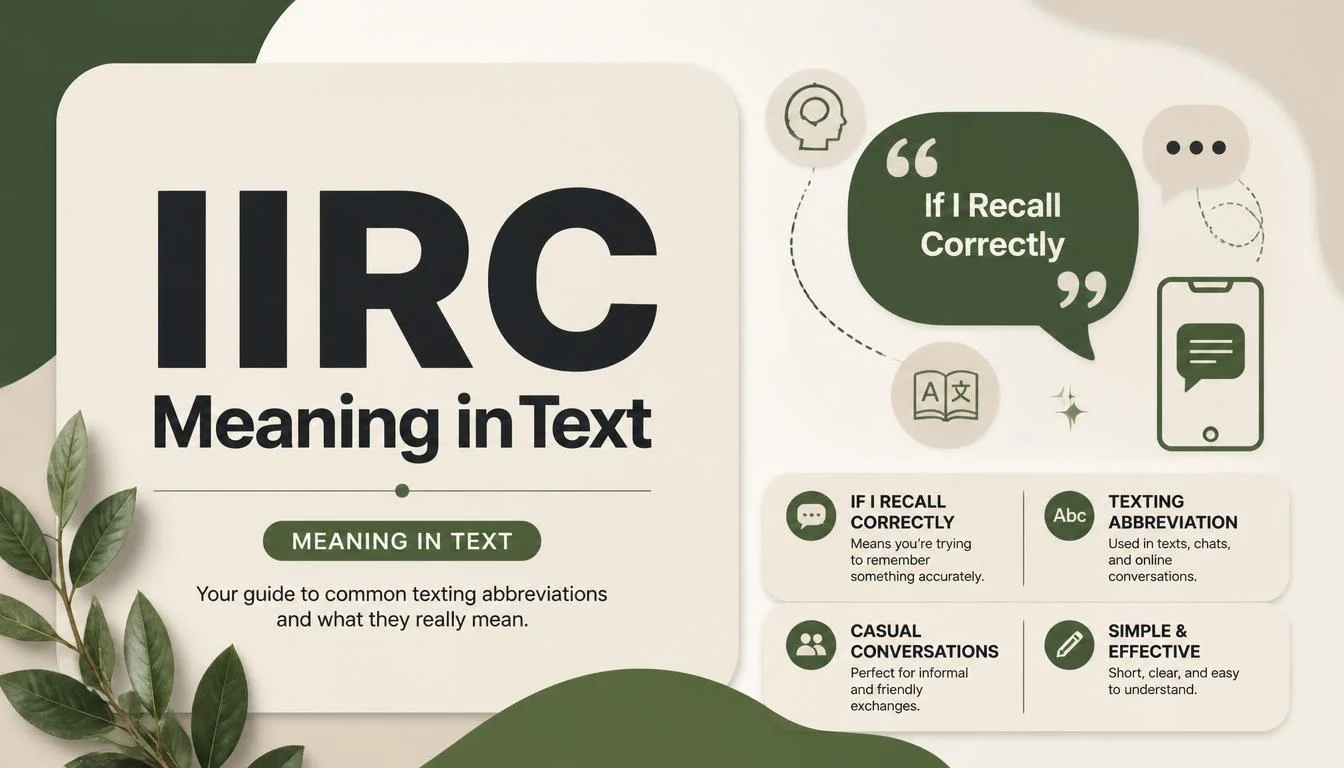
IIRC stands for “If I Recall Correctly” or “If I Remember Correctly.” It is a texting and online chat abbreviation that signals you are offering information from memory rather than from a verified source . People use it to soften statements, acknowledge they might be wrong, or add a touch of humility to an otherwise assertive claim.
IIRC meaning in text is “If I Recall Correctly.” People use this abbreviation in text messages, online chats, and social media when sharing information they remember but are not completely sure about. It helps express uncertainty without making a message sound overly formal.
Understanding the IIRC meaning in text can help you interpret conversations more naturally and respond with confidence. Whether you’re chatting with friends, participating in online discussions, or messaging on platforms like Discord and Reddit, this abbreviation is a useful way to share your recollection while leaving room for possible mistakes.
What Does IIRC Stand For?
The letters break down cleanly. I stands for “If.” The second I stands for “I.” The R stands for “Recall” or “Remember.” The C stands for “Correctly” .
That gives you two accepted expansions:
- If I Recall Correctly
- If I Remember Correctly
Both are correct. Both mean the same thing in practice. Some people also use “If I Recollect Correctly,” though that version is less common .
The abbreviation appears in two forms. You will see it capitalized as IIRC in forums, Reddit threads, and formal-ish online discussions. You will also see it lowercase as iirc in casual text messages and Discord chats . The meaning does not change. The capitalization mostly depends on the platform and the person’s typing habits.
One thing worth clarifying immediately: IIRC is not the same as IDK (“I Don’t Know”). IDK signals ignorance or refusal to engage. IIRC signals partial confidence. You think you know something. You are sharing it. But you are not swearing to it .
The Grammar Behind the Abbreviation
Here is something most people never stop to consider. The phrase “If I recall correctly” is a conditional clause. It sets up a hypothetical: if my memory is accurate, then what follows is true.
This grammatical structure is doing important work. When you type “IIRC, the meeting is at 3 PM,” you are technically saying: In the event that my recollection is correct, the meeting is at 3 PM. You have not actually confirmed the meeting time. You have confirmed only your current mental state regarding the meeting time.
That distinction matters. It is the difference between “The meeting is at 3 PM” and “I think the meeting is at 3 PM.” The first statement invites blame if wrong. The second invites correction without hostility.
The comma placement is also worth noting. IIRC is almost always followed by a comma when it appears at the start of a sentence. “IIRC, the deadline was Friday.” When it appears mid-sentence, commas bracket it: “The deadline, IIRC, was Friday.” This mirrors how you would punctuate the full phrase in formal writing .
How IIRC Functions as a “Hedge” in Conversation
Linguists have a term for phrases like “I think,” “probably,” “sort of,” and “if I recall correctly.” They call them hedges. A hedge is a linguistic device that reduces the force of a statement. It makes a claim less absolute, less confrontational, less certain .
IIRC is a textbook hedge. And it performs several social functions at once.
First, it protects the speaker. If you are wrong, you have already admitted the possibility. You said “if I recall correctly,” not “I am certain.” The other person cannot fairly accuse you of lying or being careless. You flagged your own uncertainty upfront.
Second, it protects the relationship. Digital communication strips away tone of voice, facial expression, and body language. A flat correction can read as aggressive. Adding IIRC softens the edges. It says: I am not attacking you. I am offering what I remember.
Third, it invites collaborative correction. When you hedge, you implicitly ask the other person to verify. You are not closing the door on being wrong. You are leaving it open. This turns a potential argument into a shared fact-checking exercise.
The hedge is not weakness. It is conversational intelligence.
IIRC vs. Similar Text Abbreviations
The text abbreviation ecosystem is crowded. Several initialisms look similar to IIRC but mean very different things. Confusing them can send your message in the wrong direction entirely.
| Abbreviation | Meaning | Tone | When to Use |
|---|---|---|---|
| IIRC | If I Recall Correctly | Tentative, polite | Sharing memory-based info |
| IDK | I Don’t Know | Dismissive or honest | Genuine ignorance |
| IMO | In My Opinion | Subjective, assertive | Stating a viewpoint |
| IMHO | In My Humble Opinion | Subjective, modest | Stating a viewpoint softly |
| AFAIK | As Far As I Know | Tentative, informative | Sharing limited knowledge |
| TBH | To Be Honest | Candid, slightly blunt | Revealing an honest take |
| FWIW | For What It’s Worth | Low-confidence offering | Sharing optional info |
The key distinction between IIRC and its cousins is memory. AFAIK (“As Far As I Know”) refers to the limits of your knowledge. IIRC refers specifically to the reliability of your recollection . You might know a fact well but still say “IIRC” if you are recalling it from memory rather than reading it off a screen.
TBH and FWIW are also hedges, but they hedge different things. TBH hedges honesty (implying you might otherwise lie). FWIW hedges value (implying the information might not matter). IIRC hedges accuracy (implying your memory might fail). Each one serves a distinct purpose.
The Unexpected Origins of IIRC
IIRC did not emerge from a marketing department or a tech company. It grew organically from early internet communities that needed speed above all else.
The abbreviation traces back to Usenet and Internet Relay Chat (IRC) in the 1990s . Usenet was a decentralized discussion system where people posted text-based messages to topic-specific newsgroups. IRC was one of the first real-time chat protocols. Both systems rewarded brevity. Typing out “if I recall correctly” in a fast-moving chat was inefficient. IIRC solved that problem.
The Jargon File, a famous glossary of hacker slang maintained since the 1970s, listed IIRC as a “common abbreviation” by the late 1990s . Its presence there confirms that the term had already achieved widespread use among technically literate internet users before the general public arrived online.
What is interesting is how the abbreviation outlived the platforms that birthed it. Usenet is mostly dead. Traditional IRC is a niche hobby. But IIRC migrated seamlessly into email, forums, Reddit, Slack, Discord, and SMS. The phrase it abbreviates has been part of English for centuries. The abbreviation simply gave it a digital-native form .
When IIRC Backfires: The Passive-Aggressive Risk
Here is something the dictionary definitions will not tell you. IIRC has a dark side.
On platforms like Reddit and Twitter, where arguments are a spectator sport, IIRC can function as a rhetorical weapon. Consider this exchange:
Person A: “The moon landing was faked.”
Person B: “IIRC, NASA has released thousands of pages of documentation on the Apollo missions.”
On the surface, Person B is being humble. They are just recalling something. But the effect is different. The hedge makes the correction more cutting, not less. It implies: I am not even going to bother looking this up because it is so obvious to anyone with basic knowledge.
This sarcastic use of IIRC is common enough that experienced internet users recognize it instantly . The same words that signal genuine uncertainty in one context signal barely concealed contempt in another.
Context is everything. When you use IIRC with someone who shares your knowledge base, it reads as polite. When you use it with someone who is clearly wrong and defensive, it can read as a patronizing jab.
Practical Examples: Using IIRC in Real Conversations
Seeing IIRC in action is the fastest way to internalize how it works. Here are several real-world examples across different contexts.
Texting a friend about plans:
“IIRC, you said you were free on Saturday. Still true?”
Correcting someone gently in a group chat:
“IIRC, the restaurant closes at 9, not 10. Might want to double-check.”
Offering information on a forum:
“IIRC, that model of laptop has soldered RAM, so you can’t upgrade it later.”
Adding a caveat to a detailed explanation:
“The process involves three steps, IIRC, but I might be missing one.”
Softening a disagreement:
“IIRC, the study actually found the opposite result, but I’d have to look it up.”
In every case, IIRC does the same job.
- It marks the information as memory-based.
- It invites correction.
- It keeps the tone conversational rather than authoritative.
FAQs
Is IIRC Rude?
Generally, no. IIRC is a polite way to share information while acknowledging that your memory might not be completely accurate. However, in an argument, it can sound sarcastic or dismissive, especially when used to suggest that someone else is clearly wrong. Its tone depends on the context and the relationship between the people communicating.
What Is the Difference Between IIRC and AFAIK?
Both abbreviations express uncertainty, but they refer to different things. AFAIK means “As Far As I Know” and indicates that your knowledge may be incomplete. IIRC means “If I Recall Correctly” and suggests that you are relying on memory that might not be entirely accurate. Use AFAIK when discussing what you know and IIRC when recalling a specific fact or past event.
Can I Use IIRC in Formal Writing?
No. IIRC is primarily used in informal communication, including text messages, social media posts, online forums, and casual emails. In academic papers, business reports, and formal correspondence, write “if I recall correctly” or use a suitable qualifier to express uncertainty more professionally.
Does IIRC Always Mean “If I Recall Correctly”?
In texting and online conversations, IIRC almost always means “If I Recall Correctly.” However, the abbreviation can have other meanings in specialized contexts. For example, it may refer to the International Integrated Reporting Council or the Interactive Illinois Report Card. The intended meaning depends on the subject and context of the conversation.
What Is the Difference Between “Recall” and “Remember” in the Expansion?
There is very little difference between “recall” and “remember” in this context. Both words describe bringing information back into your mind. “Recall” sounds slightly more formal, while “remember” is more conversational. Although IIRC stands for “If I Recall Correctly,” people generally understand it as expressing the same idea as “If I Remember Correctly.”
Is IIRC Still Popular in 2026?
Yes, IIRC remains a recognizable abbreviation in online communication. People use it in text messages, Reddit discussions, Discord chats, Slack conversations, and other digital spaces. Its continued usefulness comes from its ability to communicate uncertainty without requiring a lengthy explanation. It lets people share remembered information while acknowledging that their memory may not be completely reliable.
Conclusion
IIRC is a small abbreviation with a surprisingly sophisticated job.
- It lets you share what you think you know without claiming certainty.
- It softens corrections. It protects relationships.
- It invites collaboration.
- It has survived three decades of internet evolution because it does something that humans genuinely need: it makes imperfect memory socially acceptable.
Next time you see “IIRC” in a text or a thread, you will know exactly what it means. More importantly, you will understand why it exists. And if you use it yourself, you will be participating in a linguistic tradition that stretches from 1990s IRC chatrooms to the group chats on your phone today.