Quick Answer
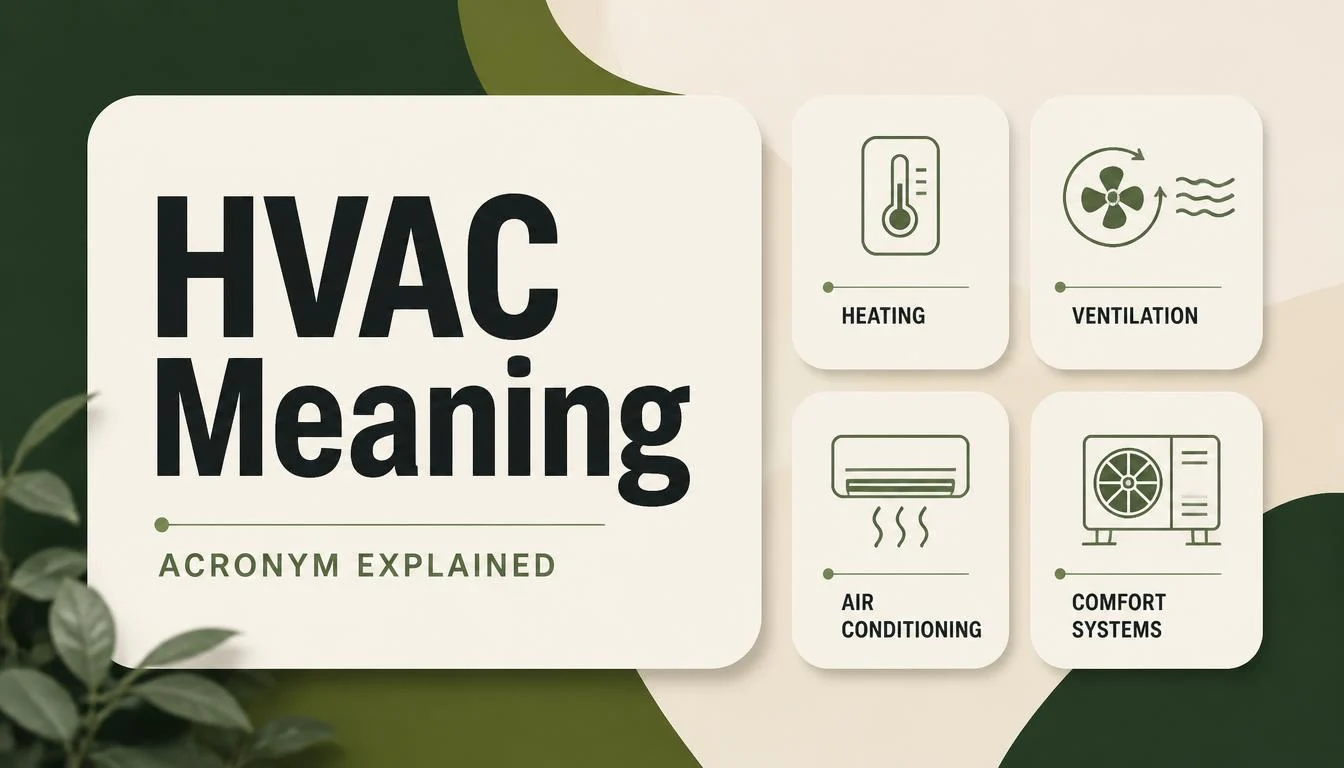
HVAC stands for Heating, Ventilation, and Air Conditioning. It refers to systems that control indoor temperature, airflow, and air quality. You’ll find HVAC systems in homes, offices, hospitals, and commercial buildings to keep indoor spaces comfortable.
The term HVAC meaning refers to the technology used to heat, cool, and ventilate indoor spaces. These systems help maintain a comfortable temperature throughout the year while supporting healthy indoor air quality.
You may come across HVAC when researching home heating, air conditioners, or building maintenance. Understanding what HVAC stands for can help you learn how these systems work and why they play an important role in everyday life.
HVAC Meaning and Full Form Explained
The full form of HVAC is Heating, Ventilation, and Air Conditioning. Each part describes a different function that helps create a comfortable indoor environment.
Although people often use HVAC as a general term for heating and cooling equipment, ventilation is equally important. A properly designed system considers more than the temperature on a thermostat.
Here’s what each letter represents.
Heating: Keeping Indoor Spaces Warm
Heating equipment raises the indoor temperature when the weather turns cold. Depending on the system, it may burn fuel, use electricity, or transfer heat from outdoor air or the ground.
Common heating equipment includes:
- Furnaces: Heat air and distribute it through ducts or another suitable air distribution arrangement.
- Boilers: Heat water or produce steam for use in radiators, radiant floors, or other heating equipment.
- Heat pumps: Transfer heat from one place to another and can provide both heating and cooling.
- Electric resistance heaters: Convert electricity into heat for a room or building.
For example, a home with a gas furnace uses fuel combustion to generate heat. A heat pump works differently by transferring available heat rather than relying solely on direct heat generation.
The right heating system depends on local weather, energy availability, building insulation, installation costs, and operating expenses.
Ventilation: Moving Air and Managing Indoor Conditions
Ventilation involves bringing outdoor air into a building, removing indoor air, or doing both. It helps control indoor pollutants, odors, moisture, and other contaminants when the system is properly designed and maintained.
There are two common forms of ventilation.
- Natural ventilation: Uses openings such as windows and vents to move air through a building.
- Mechanical ventilation: Uses fans and ventilation equipment to move air in a controlled way.
Bathrooms often use exhaust fans to remove moisture. Kitchens may use exhaust hoods to remove cooking fumes. Larger buildings may use dedicated ventilation equipment to supply outdoor air to occupied rooms.
Ventilation is not the same as simply moving the same indoor air around. A ceiling fan can improve air movement and comfort, but it does not automatically replace stale indoor air with fresh outdoor air.
Air Conditioning: Cooling Indoor Spaces
Air conditioning removes heat from indoor air and transfers it elsewhere, usually outdoors. Many systems also remove moisture from the air as part of the cooling process.
A typical air conditioning system uses several components:
- An evaporator coil that absorbs heat from indoor air.
- A compressor that raises the refrigerant’s pressure.
- A condenser coil that releases heat outdoors.
- An expansion device that reduces refrigerant pressure before it returns to the evaporator.
The refrigerant circulates through this system and transfers heat from one location to another.
For example, when you switch on your home’s AC during a hot afternoon, the system removes heat from indoor air and releases it outside. The room gradually becomes cooler as the system continues operating.
In simple terms, heating adds warmth, ventilation manages air exchange, and air conditioning removes heat. Together, these functions help maintain comfortable indoor conditions.
What Is an HVAC System?
An HVAC system is a collection of equipment designed to control heating, cooling, ventilation, and related indoor environmental conditions.
Some systems serve a single room. Others condition an entire house, office building, hospital, warehouse, or industrial facility.
The equipment may operate independently or work together through shared controls. For example, a home might use a furnace and central air conditioner with one thermostat. Another home might use a ductless heat pump that provides both heating and cooling without traditional ductwork.
An HVAC system can include:
- Heating equipment
- Air conditioning or heat pump equipment
- Thermostats and control systems
- Air handlers and blowers
- Air filters
- Supply and return ducts, where applicable
- Ventilation fans and outdoor-air equipment
- Humidity-control equipment, when installed
Not every system needs every component. A building with radiant floor heating may not use a central air handler for heating. A ductless mini-split may condition rooms without a network of supply ducts.
What Is the Purpose of an HVAC System?
The main purpose of HVAC is to create and maintain suitable indoor conditions for people, equipment, and building activities.
Its functions may include:
- Maintaining a comfortable indoor temperature.
- Removing excess heat during warm weather.
- Providing heat during cold weather.
- Supplying outdoor air and exhausting indoor air.
- Filtering certain airborne particles.
- Managing indoor humidity when the equipment supports it.
- Supporting suitable indoor conditions in workplaces and specialized facilities.
These functions matter for more than comfort. Hospitals may need carefully controlled ventilation, while manufacturing facilities can require precise temperature and humidity conditions for their processes.
A residential system usually has simpler requirements, but proper sizing, airflow, ventilation, and maintenance still make a meaningful difference.
What Are the Main Components of an HVAC System?
An HVAC system relies on several components that perform different jobs. Some generate or transfer heat, while others move air, filter particles, or regulate operation.
Understanding these parts helps you recognize common equipment and follow conversations with technicians more confidently.
Thermostat
The thermostat acts as the system’s temperature control. It measures the temperature in its sensing location and compares that reading with your chosen setting.
If the room becomes warmer than the cooling setpoint, the thermostat can signal the cooling system to start. During heating operation, it can call for heat when the temperature falls below the heating setpoint.
Many modern thermostats also offer programmable schedules, remote controls, energy-use information, and learning features.
However, a thermostat doesn’t create heat or cold by itself. It tells compatible equipment when to operate.
Furnace
A furnace heats air and distributes it through a building. Gas and oil furnaces burn fuel, while electric furnaces use resistance heating elements.
In a typical forced-air system, the blower moves air across a heat exchanger or heating elements. The warmed air then travels through ducts to different rooms.
A furnace generally provides heating rather than air conditioning. Homes that use a furnace and central AC often have separate heating and cooling equipment connected to a shared air distribution system.
Air Conditioner
An air conditioner removes heat from indoor air and transfers it outdoors. A central air conditioner usually has an outdoor unit and an indoor evaporator coil.
The outdoor unit commonly contains the compressor and condenser coil. The indoor coil absorbs heat from the air moving through the system.
A split-system air conditioner works with an indoor air handler or furnace blower to distribute cooled air. Window units and portable ACs use different arrangements but follow the same basic principle of transferring heat out of the room.
Heat Pump
A heat pump transfers heat rather than producing all its heat through fuel combustion or electrical resistance.
In cooling mode, it operates much like an air conditioner by moving heat from indoors to outdoors. In heating mode, a reversing valve changes the refrigerant flow so the system can collect heat from outdoor air and deliver it indoors.
Heat pumps can provide efficient heating and cooling in many climates. Their performance depends on outdoor temperatures, equipment design, installation quality, and the building’s heating requirements.
Some systems use auxiliary heat during particularly cold conditions or when demand exceeds the heat pump’s available capacity.
Evaporator Coil
The evaporator coil absorbs heat from indoor air during the cooling cycle.
As warm air passes over the coil, the refrigerant inside absorbs heat and changes state. If the coil surface is colder than the air’s dew point, moisture can condense on it and drain away.
This process helps cool the air and can reduce indoor humidity.
A dirty coil or restricted airflow can reduce performance. Regular inspections and appropriate maintenance help keep the coil working properly.
Condenser Coil and Compressor
The condenser coil releases heat outdoors during the cooling cycle. The compressor circulates refrigerant through the system and raises its pressure, allowing the refrigerant to release heat at a higher temperature.
These components work together with the evaporator coil and expansion device to complete the refrigeration cycle.
The outdoor unit needs adequate airflow to release heat. Blocking it with stored items, debris, or dense vegetation can interfere with performance.
Air Handler and Blower Motor
The air handler houses components that move and sometimes condition air. Depending on the design, it may contain a blower, filters, a cooling coil, and heating elements.
The blower motor pushes or pulls air through the system. That airflow carries heat to or from the occupied spaces.
If the filter becomes clogged or the ducts restrict airflow, the blower may struggle to move the required amount of air. The result can include reduced comfort, lower efficiency, or equipment problems.
Ductwork, Vents, and Registers
Ductwork carries conditioned air between HVAC equipment and rooms in a ducted system.
Supply ducts deliver air to occupied spaces. Return ducts carry air back to the equipment for further conditioning. Registers and grilles cover duct openings and help manage air delivery or return.
Leaky or poorly designed ducts can waste energy and create uneven temperatures. Proper sizing, sealing, insulation, and balancing help the system distribute air more effectively.
Ductless systems, however, deliver conditioned air directly from indoor units and don’t require traditional room-to-room duct networks.
Air Filter
An HVAC air filter captures certain airborne particles as air passes through it. Depending on the filter and system, these particles may include dust, lint, pollen, and other material.
Filters need regular inspection and replacement according to their type, usage, and manufacturer instructions. A heavily clogged filter can restrict airflow and interfere with system performance.
A filter also isn’t a complete solution for every indoor air quality problem. Gases, odors, and very small particles may require other controls or filtration technologies.
Ventilation Equipment
Ventilation equipment supplies outdoor air, exhausts indoor air, or balances both functions.
Examples include exhaust fans, dedicated outdoor-air systems, energy recovery ventilators, and heat recovery ventilators.
Some systems recover part of the heat or energy from outgoing air to reduce the load on heating and cooling equipment. The amount recovered depends on the design and operating conditions.
Ventilation needs vary by building use, occupancy, climate, and applicable codes.
How Does an HVAC System Work?
An HVAC system works by coordinating temperature controls, heating or cooling equipment, air movement, and ventilation. The exact process depends on the type of system installed.
A central forced-air system offers a useful example because it can illustrate several common HVAC functions.
How HVAC Cooling Works
During cooling operation, the system removes indoor heat and releases it outdoors.
Here’s the basic sequence:
- The thermostat detects a cooling demand. When the room rises above the selected temperature, it signals the equipment.
- The indoor blower moves air. Warm indoor air passes through the filter and across the evaporator coil.
- The refrigerant absorbs heat. The coil transfers heat from the indoor air to the refrigerant.
- The compressor circulates the refrigerant. It raises the refrigerant’s pressure and helps move it through the cooling cycle.
- The condenser releases heat outdoors. The outdoor coil transfers indoor heat to the surrounding air.
- The cooled air returns to the rooms. The blower distributes conditioned air through the supply ducts.
- The system responds to changing conditions. Controls adjust operation as the indoor temperature approaches the setpoint.
The air conditioner doesn’t manufacture cold in the same way a heater generates warmth. Instead, it moves heat from one place to another.
That’s why an outdoor condenser releases warm air while the system cools the inside of your home.
How HVAC Heating Works
Heating operation depends on the equipment.
In a furnace, the heating process typically begins when the thermostat calls for warmth. The furnace activates its heating sequence, warms air, and uses a blower to distribute that air through the building.
A heat pump follows a different process. It collects heat from outdoor air or another source and transfers it indoors. Even when the outdoor air feels cold, it may still contain heat energy that a suitable heat pump can extract.
A boiler heats water or produces steam and circulates it through radiators, radiant floors, or other heat emitters. Because these systems distribute heat through water or steam, they don’t necessarily need the same ductwork used by forced-air systems.
The shared goal is to deliver enough heat to meet the building’s needs.
How HVAC Ventilation Works
Ventilation controls the movement of outdoor and indoor air.
A mechanical ventilation system may bring outdoor air into the building through a dedicated intake. Exhaust fans can remove air from kitchens, bathrooms, and other areas where moisture or contaminants build up.
Some systems use heat or energy recovery equipment to transfer part of the energy between outgoing and incoming air streams.
Ventilation must account for local weather, outdoor pollution, building occupancy, and system design. Simply opening windows may help in some situations, but it isn’t always suitable or sufficient.
How HVAC Controls Humidity
Humidity affects how comfortable a room feels. High indoor humidity can make warm conditions feel more uncomfortable and can contribute to condensation or moisture problems.
During cooling, an evaporator coil can remove moisture when water vapor condenses on its surface. A dedicated dehumidifier may provide additional control when ordinary air conditioning isn’t enough.
In dry climates, a humidifier may add moisture when indoor humidity falls too low.
The correct approach depends on the building and local conditions. HVAC equipment shouldn’t be expected to solve every moisture problem caused by plumbing leaks, water intrusion, or poor building design.
What Does HVAC Mean in a House?
In a residential setting, HVAC refers to the heating, cooling, and ventilation equipment serving a home.
The system may be simple or relatively complex. A small house might use a ductless mini-split, while a larger home could have a furnace, central air conditioner, multiple thermostats, and extensive ductwork.
Common residential HVAC setups include:
| System type | How it works | Typical use |
| Furnace with central AC | A furnace provides heat, while a separate AC system provides cooling | Homes with ductwork |
| Heat pump | One system provides heating and cooling by transferring heat | Homes suited to heat-pump operation |
| Ductless mini-split | Indoor units condition individual rooms or zones without traditional ducts | Additions, apartments, and homes without ducts |
| Boiler and radiators | Hot water or steam delivers heat through radiators or other emitters | Homes designed for hydronic heating |
| Packaged HVAC unit | Major heating and cooling components share an outdoor cabinet | Certain homes and buildings |
What Does HVAC Mean on a House Listing?
When a real estate listing mentions HVAC, it generally indicates that the property has a heating, cooling, or combined climate-control system.
However, the term alone doesn’t tell you everything about the equipment.
Before buying a home, check:
- Whether the property has central AC, a heat pump, or another cooling arrangement.
- What provides heating and whether the system serves the entire house.
- The age and apparent condition of the equipment.
- Whether the system uses ducts or ductless indoor units.
- The condition of filters, visible ducts, and outdoor equipment.
- Available maintenance records and any known repair history.
- Whether the equipment appears appropriately sized for the property.
A home listing that says “central HVAC” doesn’t guarantee that every room receives equal airflow or that the equipment operates efficiently. An inspection can reveal problems that the listing description doesn’t mention.
What Does HVAC Mean in Construction and Engineering?
In construction, HVAC refers to the mechanical systems that manage heating, ventilation, and air conditioning inside a building.
HVAC planning often starts before construction begins. Engineers and designers evaluate the building’s size, layout, insulation, occupancy, climate, and intended use to determine the heating and cooling requirements.
They also consider ventilation, equipment locations, air distribution, noise, controls, and access for future maintenance.
HVAC Meaning in Building Design
HVAC design involves several important tasks.
- Load calculations: Estimate how much heating and cooling the building needs.
- Equipment selection: Choose equipment that suits the calculated loads and operating conditions.
- Air distribution design: Plan ducts, grilles, diffusers, and other components.
- Ventilation planning: Determine how outdoor air enters and indoor air leaves the building.
- Controls: Establish how thermostats, sensors, and automation systems manage equipment.
- Energy performance: Consider equipment efficiency, insulation, air leakage, and operating schedules.
- Maintenance access: Leave enough space for inspections, repairs, and component replacement.
Correct sizing matters. Oversized equipment may cycle on and off too frequently, while undersized equipment may struggle to meet demand during extreme weather.
HVAC Meaning in Engineering
HVAC engineering applies principles of thermodynamics, fluid mechanics, heat transfer, and control systems to building climate control.
An HVAC engineer may calculate heating and cooling loads, evaluate system options, design air distribution, coordinate with other engineering disciplines, and review energy performance.
Technicians and installers then carry out work according to the design, equipment requirements, and applicable regulations. In practice, responsibilities vary by project and professional qualifications.
HVAC in Commercial and Industrial Buildings
Commercial buildings often have larger or more specialized requirements than houses.
Offices may use rooftop packaged units or central plant systems. Hospitals may require carefully designed ventilation and pressure relationships. Industrial facilities can need temperature control for equipment, production processes, or stored materials.
Large buildings may also use building automation systems to coordinate HVAC equipment, monitor conditions, and adjust operating schedules.
The right arrangement depends on the building’s purpose rather than simply its square footage.
What Is the Difference Between HVAC and AC?
HVAC and AC are closely related terms, but they don’t mean exactly the same thing.
AC stands for air conditioning, while HVAC stands for heating, ventilation, and air conditioning. Air conditioning is one part of the broader HVAC category.
An air conditioner typically removes heat from indoor air. An HVAC system can combine cooling with heating, ventilation, filtration, and other functions.
| Feature | HVAC | AC |
| Full form | Heating, ventilation, and air conditioning | Air conditioning |
| Main purpose | Manages indoor heating, cooling, and related air conditions | Primarily cools indoor spaces |
| Heating | May include a furnace, boiler, or heat pump | A cooling-only unit doesn’t provide heating |
| Ventilation | May include equipment for outdoor-air exchange | Doesn’t automatically provide mechanical ventilation |
| Air filtration | May include filters and additional air-cleaning equipment | May filter air depending on the unit |
| Common examples | Complete home climate-control system | Window AC, portable AC, or central air conditioner |
Is HVAC the Same as Central Air?
No. Central air generally refers to a cooling system that distributes conditioned air throughout a building, often through ducts.
HVAC covers a wider range of functions and equipment. A home can have central AC as part of its HVAC setup, but the terms aren’t interchangeable in every situation.
For example, a house with a furnace, central AC, and a separate mechanical ventilation system has a broader HVAC arrangement than a cooling-only window unit.
Can an HVAC System Work Without AC?
Yes. A building can have HVAC equipment without a conventional air conditioner.
For instance, a house might use a furnace for heating and mechanical ventilation for air exchange. It would have heating and ventilation equipment but no installed cooling system.
Likewise, some buildings use radiant heating and separate ventilation equipment rather than a central air conditioning system.
The exact meaning of HVAC depends on the equipment included in the building’s setup.
Why Is HVAC Important in Homes and Buildings?
HVAC affects how a building feels, how air moves through it, and how effectively it maintains suitable indoor conditions. Its importance goes beyond keeping rooms warm in winter or cool in summer.
Indoor Temperature and Thermal Comfort
Temperature control helps occupants remain comfortable as outdoor conditions change. A properly selected and installed system can maintain suitable temperatures without excessive cycling or uneven heating and cooling.
However, comfort also depends on humidity, air movement, clothing, activity, and the building envelope. A room can feel uncomfortable even when the thermostat displays the expected temperature.
Indoor Air Quality
Indoor air can contain dust, smoke, pollen, cleaning-product emissions, cooking pollutants, and other contaminants. HVAC filters can capture some airborne particles, while suitable ventilation can dilute and remove certain indoor pollutants.
Still, heating and cooling equipment doesn’t automatically guarantee good indoor air quality. The EPA identifies source control, ventilation, and filtration as important complementary strategies for improving indoor air.
US EPA
+1
For example, replacing a clogged filter may help airflow and particle removal, but it won’t fix a persistent moisture leak or eliminate every chemical pollutant.
Humidity Management
Excessive indoor moisture can contribute to condensation and mold growth. Very dry conditions can also cause discomfort.
Air conditioning often removes some moisture during cooling. Dedicated dehumidifiers and humidifiers can provide additional control when needed.
The appropriate humidity level depends on the climate, building, and indoor conditions. If moisture problems persist, investigate their source rather than relying on HVAC equipment alone.
Energy Efficiency and Operating Costs
HVAC equipment can account for a substantial portion of a building’s energy use, particularly where heating and cooling demand is high.
Efficiency depends on several factors:
- Equipment design and efficiency ratings.
- Correct sizing for the building.
- Quality of installation.
- Insulation and air sealing.
- Duct condition and airflow.
- Thermostat settings and operating schedules.
- Filter condition and routine maintenance.
An efficient unit can still waste energy if the ducts leak, the system is poorly sized, or the building loses heat through gaps and inadequate insulation.
Specialized Building Requirements
Some facilities need more precise environmental control than an ordinary home.
- Hospitals: May require carefully designed ventilation, filtration, and pressure relationships.
- Schools: Need appropriate indoor conditions for occupied classrooms and shared spaces.
- Offices: Benefit from systems designed for changing occupancy and operating schedules.
- Warehouses: May require temperature or humidity control for stored goods.
- Industrial facilities: Can need specialized ventilation and environmental control for processes and equipment.
HVAC design should match the building’s actual use rather than follow a one-size-fits-all approach.
What Are HVAC Services?
HVAC services cover the installation, inspection, upkeep, repair, and replacement of heating, ventilation, and air conditioning equipment.
The services a contractor offers depend on their qualifications, equipment, and the type of system involved.
HVAC Installation
Installation includes selecting suitable equipment, preparing the site, connecting the required components, and checking system operation.
A good installation starts with the building’s heating and cooling needs. Simply choosing the largest available unit isn’t a reliable way to improve comfort.
Depending on the project, installation may involve ductwork, electrical connections, refrigerant piping, drainage, ventilation equipment, and system controls.
HVAC Maintenance
Maintenance helps keep equipment clean, safe, and operating as intended.
Common tasks include inspecting filters, checking airflow, examining electrical connections, clearing appropriate drainage components, and evaluating system performance.
The exact service depends on whether the building uses a furnace, heat pump, boiler, central AC, or another arrangement.
HVAC Repair
HVAC repair addresses faults that prevent equipment from operating correctly.
Common problems include:
- Weak or uneven airflow.
- A system that won’t start.
- Unusual noises or vibrations.
- Water leaking near indoor equipment.
- Heating or cooling that doesn’t meet demand.
- Unexpected increases in energy consumption.
- Thermostat or control problems.
Some issues have simple causes, but others require professional diagnosis. Electrical faults, refrigerant handling, gas combustion, and major mechanical repairs should be left to appropriately qualified technicians.
HVAC Replacement
Replacement becomes an option when equipment is aging, repeatedly failing, poorly matched to the building, or expensive to operate.
Before replacing a system, consider its condition, repair history, expected remaining service life, energy use, and compatibility with the building.
A qualified professional can compare suitable options and determine whether replacing the entire system makes sense or whether a targeted repair is sufficient.
What Does an HVAC Technician Do?
An HVAC technician installs, inspects, maintains, and repairs heating and cooling equipment. Depending on their training and specialization, technicians may also work with ventilation systems, controls, air distribution, and indoor environmental concerns.
Typical responsibilities include:
- Installing furnaces, heat pumps, air conditioners, and related equipment.
- Checking thermostats, sensors, and electrical controls.
- Inspecting filters, coils, blowers, and airflow.
- Diagnosing unusual noises or poor system performance.
- Testing equipment after repairs.
- Identifying ventilation and drainage problems.
- Explaining maintenance requirements to customers.
HVAC Technician vs. HVAC Engineer
These roles overlap, but their typical responsibilities differ.
| HVAC technician | HVAC engineer |
| Focuses on installation, maintenance, troubleshooting, and repair | Focuses on system design, analysis, planning, and technical performance |
| Works directly with equipment and building systems | Often develops calculations, specifications, and design documents |
| Diagnoses faults and tests equipment | Evaluates loads, airflow, efficiency, and design requirements |
| Qualifications depend on the trade and local regulations | Education and professional licensing requirements vary by jurisdiction |
A technician may work on a system designed by an engineer, while engineers may rely on installation and service feedback to improve future designs. Some professionals perform duties across both areas.
Basic HVAC Terminology You Should Know
HVAC professionals use abbreviations to describe equipment, airflow, and performance. Learning a few common terms makes equipment specifications and service reports easier to understand.
| Term | Meaning | Why it matters |
| AC | Air conditioning | Describes equipment that cools indoor spaces |
| AHU | Air handling unit | Moves and may condition air in a building |
| BTU | British thermal unit | Measures heat energy |
| CFM | Cubic feet per minute | Measures airflow volume |
| IAQ | Indoor air quality | Describes the condition of indoor air |
| SEER2 | Seasonal Energy Efficiency Ratio 2 | Measures seasonal cooling efficiency under standardized test conditions |
| AFUE | Annual Fuel Utilization Efficiency | Measures seasonal fuel-use efficiency for applicable furnaces and boilers |
| ERV | Energy recovery ventilator | Transfers heat and, depending on the unit, moisture between outgoing and incoming air |
| HRV | Heat recovery ventilator | Transfers heat between outgoing and incoming air |
| VRF | Variable refrigerant flow | Describes a system that varies refrigerant delivery to multiple indoor units |
| VAV | Variable air volume | Describes a system that varies the airflow delivered to a zone |
| BMS | Building management system | Monitors or controls building services, potentially including HVAC |
What Do HVAC Capacity and Efficiency Ratings Mean?
Two specifications often appear when comparing HVAC equipment: capacity and efficiency.
Capacity describes how much heating or cooling equipment can provide. BTUs per hour and tons of cooling are common capacity measures.
In air conditioning, one ton of cooling capacity equals 12,000 BTUs per hour. The term comes from the historical cooling effect associated with melting a ton of ice over 24 hours. It doesn’t refer to the physical weight of the AC unit.
Efficiency ratings describe how effectively equipment uses energy under defined testing conditions. For example, SEER2 relates to seasonal cooling performance, while AFUE applies to the seasonal fuel efficiency of certain heating appliances.
A higher rating can indicate better efficiency within the same rating category, but it doesn’t guarantee lower bills in every home. Actual energy use depends on climate, installation, operating conditions, and the building’s heating and cooling needs.
How Often Should an HVAC System Be Maintained?
Regular HVAC maintenance helps identify problems before they become major breakdowns. The right schedule depends on the equipment, how often it runs, the surrounding environment, and the manufacturer’s instructions.
A home in a hot climate may use its air conditioner for long periods, while a building in a mild climate may operate its cooling equipment less frequently.
Essential HVAC Maintenance Tasks
| Task | What to do |
| Inspect air filters | Check regularly and clean or replace them according to the manufacturer’s instructions |
| Check outdoor equipment | Keep the area around the unit clear of debris and allow adequate airflow |
| Inspect vents | Make sure supply and return openings aren’t blocked |
| Review thermostat settings | Check schedules, temperature settings, and control operation |
| Inspect drainage | Look for signs of blockage or water leakage around applicable equipment |
| Arrange professional service | Follow the equipment manufacturer’s recommended inspection schedule |
| Monitor performance | Pay attention to unusual sounds, weak airflow, and inconsistent temperatures |
Signs Your HVAC System Needs Attention
Don’t wait for a complete breakdown if the equipment starts behaving differently.
Watch for these warning signs:
- Rooms take longer than usual to reach the desired temperature.
- Airflow feels weak at several supply vents.
- The system starts and stops unusually often.
- Indoor equipment leaks water.
- The system makes new rattling, grinding, or buzzing sounds.
- Energy use rises without an obvious explanation.
- Indoor humidity remains uncomfortable despite normal operation.
Some symptoms result from minor issues, such as a clogged filter. Others may indicate a faulty motor, refrigerant problem, drainage issue, or control failure.
If you smell gas, suspect carbon monoxide, or notice signs of an electrical hazard, treat the situation as a potential safety emergency rather than an ordinary maintenance problem. Follow the relevant emergency procedures and contact qualified professionals.
FAQs
What does HVAC stand for in simple terms?
HVAC stands for heating, ventilation, and air conditioning. It refers to the equipment that helps manage indoor temperature, air movement, and ventilation in homes and buildings. Depending on the system, it may also support filtration and humidity control.
What is the full form of HVAC?
The full form of HVAC is Heating, Ventilation, and Air Conditioning. Heating provides warmth, ventilation manages indoor and outdoor air exchange, and air conditioning removes heat from indoor spaces.
Is HVAC the same as air conditioning?
No. Air conditioning is one part of HVAC. HVAC includes heating and ventilation in addition to air conditioning, although the exact functions depend on the equipment installed.
What does HVAC mean in a house?
In a house, HVAC refers to the heating, cooling, and ventilation systems serving the living space. These may include a furnace, central AC, heat pump, thermostat, filters, ductwork, or ductless indoor units.
What does HVAC mean in construction?
In construction, HVAC refers to the mechanical systems designed to provide heating, ventilation, and air conditioning in a building. Contractors and engineers coordinate equipment selection, airflow, ductwork, controls, ventilation, and energy performance during planning and installation.
What are the four main functions of HVAC?
HVAC is commonly associated with four practical functions: heating, cooling, ventilation, and air filtration. Strictly speaking, the acronym names three elements, and filtration is an additional function that many systems support. Humidity control may also be included when the equipment provides it.
Does every HVAC system use ductwork?
No. Traditional central forced-air systems use ducts to distribute conditioned air, but ductless mini-splits deliver heating or cooling directly through indoor units. Boiler-based systems may distribute heat through radiators or radiant floors instead of air ducts.
Can an HVAC system improve indoor air quality?
Yes, an appropriately designed and maintained HVAC setup can help improve indoor air quality through ventilation and filtration. However, results depend on the equipment, filter performance, airflow, and pollutant sources. Persistent moisture, smoke, or chemical emissions may require additional measures beyond ordinary heating and cooling.
Conclusion:
The HVAC meaning is simple: heating, ventilation, and air conditioning. These systems help maintain comfortable indoor temperatures, manage air exchange, and support suitable conditions in homes and commercial buildings.
However, HVAC doesn’t refer to one specific machine. It describes a range of equipment and functions, from furnaces and air conditioners to heat pumps, ventilation fans, and control systems.
Understanding the difference between HVAC and AC, recognizing common components, and following appropriate maintenance guidance can help you make informed decisions about your home or building. Whether you’re reading a property listing or arranging a repair, knowing the basics makes the terminology much easier to understand.